
Pulp Fiction, 1878 · page 41 of 44
Beadle's Dime Library No. 51: Red Rob, The Boy Road-Agent — page 41: what you’re looking at
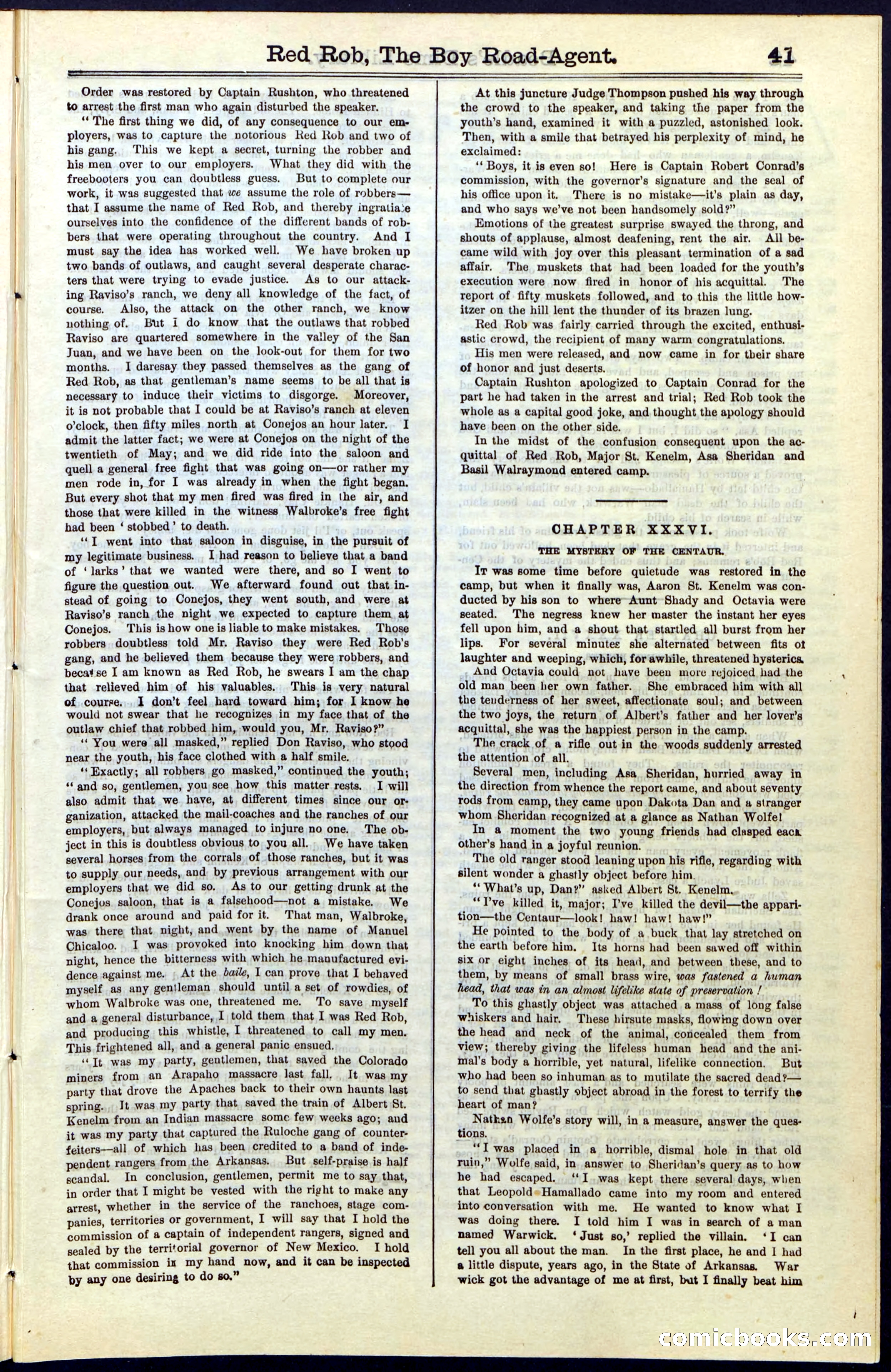
A restored page from Pulp Fiction, 1878. Page through the whole issue in the reader above.
📄 Transcribed text from this page (OCR, searchable)
Machine-transcribed from the original scan — historical spelling and the odd misread are preserved.
re ee — Red Rob, The Boy Road-Agent. Alt ———EEIECICICLSEESESEeEeEeEeEeEeEeEoCoeeeeeeeeeeeeeeeeeeeeeeeeeeeeeeeeeeeeeeeeeeeeeeeee§|”..”0~~-2-Q_2_DNE_— Order was restored by Captain Rushton, who threatened to arrest the first man who again disturbed the speaker. ‘The first thing we did, of any consequence to our em- ployers, was to capture the notorious Red Rob and two of his gang. This we kept a secret, turning the robber and his men over to our employers. What they did with the freebooters you can doubtless guess. But to complete our work, it was suggested that we assume the role of robbers— that I assume the name of Red Rob, and thereby ingratia‘e ourselves into the confidence of the different bands of rob- bers that were operating throughout the country. And I must say the idea has worked well. We have broken up two bands of outlaws, and caught several desperate charac- ters that were trying to evade justice. As to our attack- ing Raviso’s ranch, we deny all knowledge of the fact, of course. Also, the attack on the other ranch, we know nothing of. But i do know that the outlaws that robbed Raviso are quartered somewhere in the vailey of the San Juan, and we have been on the look-out for them for two months. I daresay they passed themselves as the gang of Red Rob, as that gentleman’s name seems to be all that is necessary to induce their victims to disgorge. Moreover, it is not probable that I could be at Raviso’s ranch at eleven o’clock, then fifty miles north at Conejos an hour later. I admit the latter fact; we were at Conejos on the night of the twentieth of May; and we did ride into the saloon and quell a general free fight that was going on—or rather my men rode in, for I was already in when the fight began. But every shot that my men fired was fired in the air, and those that were killed in the witness Walbroke’s free fight had been ‘ stobbed’ to death. ‘‘T went into that saloon in disguise, in the pursuit of my legitimate business. I had reason to believe that a band of ‘larks’ that we wanted were there, and so I went to figure the question out. We afterward found out that in- stead of going to Conejos, they went south, and were at Raviso’s ranch the night we expected to capture them at Conejos. This is how one is liable to make mistakes. Those robbers doubtless told Mr. Raviso they were Red Rob's gang, and he believed them because they were robbers, and becatse I am known as Red Rob, he swears I am the chap that relieved him of his valuables. This is very natural of course. J] don’t feel hard toward him; for I know he would not swear that he recognizes in my face that of the outlaw chief that robbed him, would you, Mr. Raviso?” ‘‘ You were all masked,” replied Don Raviso, who stood near the youth, his face clothed with a half smile. ‘‘Bxactly; all robbers go masked,” continued the youth; ‘‘and so, gentlemen, you see how this matter rests. I will also admit that we have, at different times since our or- ganization, attacked the mail-coaches and the ranches of our employers, but always managed to injure no one. The ob- ject in this is doubtless obvious to you all. We have taken several horses from the corrals of those ranches, but it was to supply our needs, and by previous arrangement with our employers that we did so, As to our getting drunk at the Conejos. saloon, that is a falsehood—not a mistake. We drank once around and paid for it. That man, Walbroke, was there that night, and went by the name of Manuel Chicaloo. I was provoked into knocking him down that night, hence the bitterness with which he manufactured evi- dence against me. _ At the date, I can prove that I behaved myself as any gentleman should until a set of rowdies, of whom Walbroke was one, threatened me. To save myself and a general disturbance, I told them that I was Red Rob, and producing this whistle, I threatened to call my men. This frightened all, and a general panic ensued. ‘Tt was my party, gentlemen, that saved the Colorado miners from an Arapaho massacre last fall. It was my party that drove the Apaches back to their own haunts last spring. It was my party that saved the train of Albert St. Kenelm from an Indian massacre some few weeks ago; and it was my party that captured the Ruloche gang of counter- feiters—all of which has been credited to a band of inde- pendent rangers from the Arkansas. But self-praise is half scandal. In conclusion, gentlemen, permit me to say that, in order that I might be vested with the right to make any arrest, whether in the service of the ranchoes, stage com- panies, territories or government, I will say that I hold the commission of a captain of independent rangers, signed and sealed by the territorial governor of New Mexico. I hold that commission in my hand now, and it can be inspected by any one desiring to do 80,” At this juncture Judge Thompson pushed his way through the crowd to the speaker, and taking the paper from the youth’s hand, examined it with a puzzled, astonished look. Then, with a smile that betrayed his perplexity of mind, he exclaimed: ‘* Boys, it is even so! Here is Captain Robert Conrad’s commission, with the governor’s signature and the seal of his office upon it. There is no mistake—it’s plain as day, and who says we’ve not been handsomely sold?” Emotions of the greatest surprise swayed the throng, and shouts of applause, almost deafening, rent the air. All be- came wild with joy over this pleasant termination of a sad affair. The muskets that had been loaded for the youth’s execution were now fired in honor of his acquittal. The report of fifty muskets followed, and to this the little how- itzer on the hill lent the thunder of its brazen lung. Red Rob was fairly carried through the excited, enthusi- astic crowd, the recipient of many warm congratulations. His men were released, and now came in for tbeir share of honor and just deserts. Captain Rushton apologized to Captain Conrad for the part he had taken in the arrest and trial; Red Rob took the whole as a capital good joke, and thought the apology should have been on the other side. In the midst of the confusion consequent upon the ac- quittal of Red Rob, Major St. Kenelm, Asa Sheridan and Basil Walraymond entered camp. CHAPTER XXXVI. THE MYSTERY OF THE CENTAUR. Ir was some time before quietude was restored in the camp, but when it finally was, Aaron St. Kenelm was con- ducted by his son to where’ Aunt Shady and Octavia were seated. The negress knew her master the instant her eyes fell upon him, and a shout that startled all burst from her lips. For several minutes she alternated between fits ot laughter and weeping, which, for awhile, threatened hysterics, And Octavia could not have been more rejoiced had the old man been her own father. She embraced him with all the tenderness of her sweet, affectionate soul; and between the two joys, the return of Albert’s father and her lover's acquittal, she was the happiest person in the camp. The crack of a rifle out in the woods suddenly arrested the attention of. all. Several men, including Asa Sheridan, hurried away in the direction from whence the report came, and about seventy rods from camp, they came upon Dakota Dan and a stranger whom Sheridan recognized at a glance as Nathan Wolfe! In & moment the two young friends had clasped eacn other’s hand in a joyful reunion. | The old ranger stood leaning upon his rifle, regarding with silent wonder a ghastly object before him. *‘'What’s up, Dan?” asked Albert St. Kenelm, ““Dve killed it, major; I’ve killed the devil—the appari- tion—the Centaur—look! haw! haw! haw!” He pointed to the body of a buck that lay stretched on the earth before him. Its horns had been sawed off within six or eight inches of its head, and between these, and to them, by means of small brass wire, was fastened a human head, that was in an almost lifelike state of preservation | | To this ghastly object was attached a mass of long false whiskers and hair. These hirsute masks, flowing down over the head and neck of the animal, concealed them from view; thereby giving the lifeless human head and the ani- mal’s body a horrible, yet natural, lifelike connection. But who had been so inhuman as to mutilate the sacred dead?— to send that ghastly object abroad in the forest to terrify the heart of man? : ) Nathsn Wolfe’s story will, in a measure, answer the ques- tions. “I was placed in a horrible, dismal hole in that old ruin,” Wolfe said, in answer to Sheridan’s query as to how he had escaped. ‘‘I was kept there several days, when that Leopold» Hamallado came into my room and entered into conversation with me. He wanted to know what I was doing there. I told him I was in search of a man named Warwick. ‘Just so,’ replied the villain. ‘I can tell you all about the man. In the first place, he and I had a little dispute, years ago, in the State of Arkansas. War wick got the advantage of me at first, but I finally beat him (E€(O) COMMICLOOOLES |