
Pulp Fiction, 1878 · page 33 of 44
Beadle's Dime Library No. 51: Red Rob, The Boy Road-Agent — page 33: what you’re looking at
A restored page from Pulp Fiction, 1878. Page through the whole issue in the reader above.
📄 Transcribed text from this page (OCR, searchable)
Machine-transcribed from the original scan — historical spelling and the odd misread are preserved.
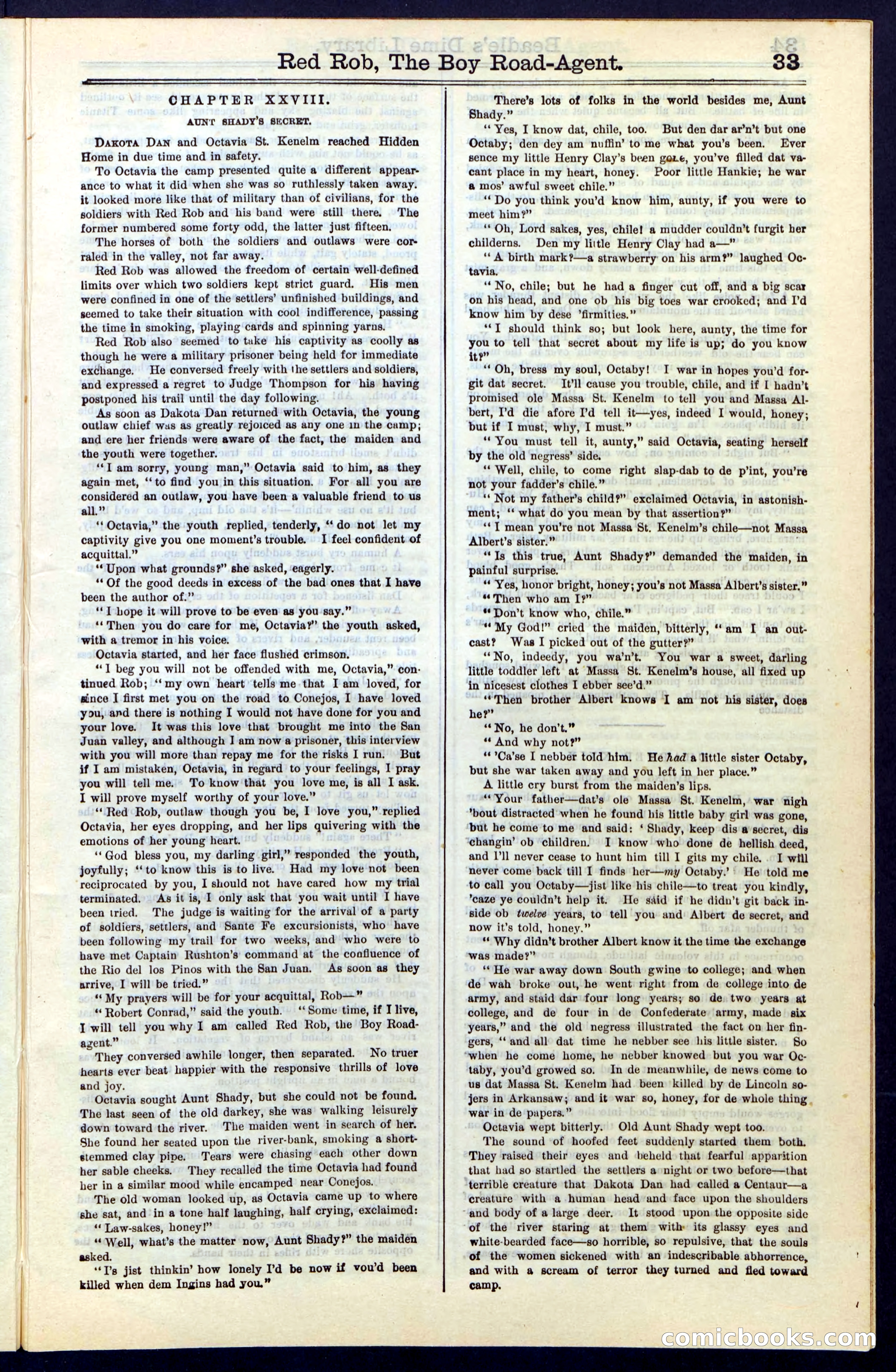
Red Rob, The Boy Road-Agent. 33 CHAPTER XXVIII. AUNT SHADY’S SECRET. DaxoTa Dan and Octavia St. Kenelm reached Hidden Home in due time and in safety. To Octavia the camp presented quite a different appear- ance to what it did when she was so ruthlessly taken away. it looked more like that of military than of civilians, for the soldiers with Red Rob and his band were still there. The former numbered some forty odd, the latter just fifteen. The horses of both the soldiers and outlaws were cor- raled in the valley, not far away. Red Rob was allowed the freedom of certain well-defined limits over which two soldiers kept strict guard. His men were confined in one of the settlers’ unfinished buildings, and seemed to take their situation with cool indifference, passing the time in smoking, playing cards and spinning yarns. Red Rob also seemed to tuke his captivity as coolly as though he were a military prisoner being held for immediate exchange. He conversed freely with the settlers and soldiers, and expressed a regret to Judge Thompson for his having postponed his trail until the day following. As soon as Dakota Dan returned with Octavia, the young outlaw chief wus as greatly rejoiced as any one 1n the camp; and ere her friends were aware of the fact, the maiden and the youth were together. ‘*T am sorry, young man,” Octavia said to him, as they again met, ‘‘to find you in this situation. For all you are considered an outlaw, you have been a valuable friend to us all.” ‘* Octavia,” the youth replied, tenderly, ‘‘do not let my captivity give you one moment’s trouble. I feel confident of acquittal.” ‘Upon what grounds?” she asked, ‘eagerly. ‘*Of the good deeds in excess of the bad ones that I have been the author of.” ‘*I hope it will prove to be even as you say.” ‘‘Then you do care for me, Octavia?” the youth asked, with a tremor in his voice. Octavia started, and her face flushed crimson. “1 beg you will not be offended with me, Octavia,” con- tinued Rob; ‘‘my own heart tells me that I am loved, for since I first met you on the road to Conejos, I have loved you, and there is nothing I would not have done for you and your love. It was this love that brought me into the San Juan valley, and although I am now a prisoner, this interview with you will more than repay me for the risks I run. But if I am mistaken, Octavia, in regard to your feelings, 1 pray you will tell me. To know that you love me, is all I ask. I will prove myself worthy of your love.” ‘‘ Red Rob, outlaw though you be, I love you,” replied Octavia, her eyes dropping, and her lips quivering with the emotions of her young heart. ‘‘God bless you, my darling girl,’ responded the youth, joyfully; ‘‘to know this is to live. Had my love not been reciprocated by you, I should not have cared how my trial terminated. As it is, I only ask that you wait until I have been tried. The judge is waiting for the arrival of a party of soldiers, settlers, and Sante Fe excursionists, who have been following my trail for two weeks, and who were to have met Captain Rushton’s command at the confluence of the Rio del los Pinos with the San Juan. As soon as they urrive, I will be tried.” «My prayers will be for your acquittal, Rob—” “ Robert Conrad,” said the youth. ‘Some time, if I live, I will tell you why I am called Red Rob, the Boy Road- azent.” They conversed awhile longer, then separated. No truer hearts ever beat happier with the responsive thrills of love and joy. Octavia sought Aunt Shady, but she could not be found. The last seen of the old darkey, she was walking leisurely down toward the river. ‘The maiden went in search of her. She found her seated upon the river-bank, smoking a short- stemmed clay pipe. Tears were chasing each other down her sable cheeks. They recalled the time Octavia had found her in a similar mood while encamped near Conejos. The old woman looked up, as Octavia came up to where she sat, and in a tone half laughing, half crying, exclaimed: ‘‘ Law-sakes, honey!” “Well, what’s the matter now, Aunt Shady?” the maiden asked. ‘P's jist thinkin’ how lonely I’d be now if vou’d been killed when dem Ingins had you,” ~and body of a large deer. a. There’s lots of folks in the world besides me, Aunt Shady.” ‘Yes, I know dat, chile, too. But den dar ar’n’t but one Octaby; den dey am nuffin’ to me what you’s been. Ever sence my little Henry Clay’s been gaze, you've filled dat va- cant place in my heart, honey. Poor little Hankie; he war a@ mos’ awful sweet chile.” “*Do you think you’d know him, aunty, if you were to meet him?” ‘** Oh, Lord sakes, yes, chile! a mudder couldn't furgit her childerns. Den my little Henry Clay had a—” ‘*A birth mark?—a strawberry on his arm?” laughed Oc- tavia. ‘* No, chile; but he had a finger cut off, and a big scar on his head, and one ob his big toes war crooked; and I'd know him by dese ’firmities,” ‘*T should think so; but look here, aunty, the time for you to tell that secret about my life is up; do you know it?” ‘Oh, bress my soul, Octaby! I war in hopes you'd for- git dat secret. It’ll cause you trouble, chile, and if I hadn’t promised ole Massa St. Kenelm to tell you and Magsa Al- bert, I'd die afore I’d tell it—yes, indeed I would, honey; but if I must, why, I must.” ‘You must tell it, aunty,” said Octavia, seating herself by the old negress’ side. ‘“‘ Well, chile, to come right slap-dab to de p’int, you’re not your fadder’s chile.” ‘* Not my father’s child?” exclaimed Octavia, in astonish- ment; ‘‘ what do you mean by that assertion?” ‘*T mean you’re not Massa St. Kenelm’s chile—not Massa Albert’s sister.” “Is this true, Aunt Shady?’ demanded the maiden, in painful surprise. ** Yes, honor bright, honey; you’s not Massa Albert’s sister.” “Then who am I?” **Don’t know who, chile.” “My God!” cried the maiden, bitterly, “am I an out- cast? Was I picked out of the gutter?” ‘No, indeedy, you wa’n’t. You war a sweet, darling little toddler left at Massa St. Kenelm’s house, all fixed up in nicesest clothes I ebber see’d.” ‘Then brother Albert knows I am not his sister, does he?” ‘*'No, he don’t.” ‘* And why not?” **°Ca’se I nebber told him. He had a little sister Octaby, but she war taken away and you left in her place.” A little cry burst from the maiden’s lips. “Your father—dat’s ole Massa St. Kenelm, war nigh ‘bout distracted when he found his little baby girl was gone, but he come to me and said: ‘ Shady, keep dis a secret, dis changin’ ob children. I know who done de hellish deed, and 1’ll never cease to hunt him till I gits my chile... I will never come back till I finds her—my Octaby.’’ He told me to call you Octaby—jist like his chile—to treat you kindly, ’caze ye couldn’t help it. He said if he didn’t git back in- side ob twelve years, to tell you and Albert de secret, and now it’s told, honey.” ** Why didn’t brother Albert know it the time the exchange was made?” ‘* He war away down South gwine to college; and when de wah broke out, he went right from de college into de army, and staid dar four long years; so de two years at college, and de four in de Confederate army, made six years,” and the old negress illustrated the fact on her fin- gers, ‘‘and all dat time he nebber see his little sister. So ‘when he come home, he nebber knowed but you war Oc- taby, you’d growed so. In de meanwhile, de news come to us dat Massa St. Kenelm had been killed by de Lincoln so- jers in Arkansaw; and it war so, honey, for de whole thing. war in de papers.” Octavia wept bitterly. Old Aunt Shady wept too. The sound of hoofed feet suddenly started them both, They raised their eyes and beheld that fearful apparition that had so startled the settlers a night or two before—that terrible creature that Dakota Dan had called a Centaur—a creature with a human head and face upon the shoulders It stood upon the opposite side of the river staring at them with its glassy eyes and white-bearded face—so horrible, so repulsive, that the souls of the women sickened with an indescribable abhorrence, and with a scream of terror they turned and fled toward camp. * a7 Gomicbooks (E()