
Pulp Fiction, 1878 · page 25 of 44
Beadle's Dime Library No. 51: Red Rob, The Boy Road-Agent — page 25: what you’re looking at
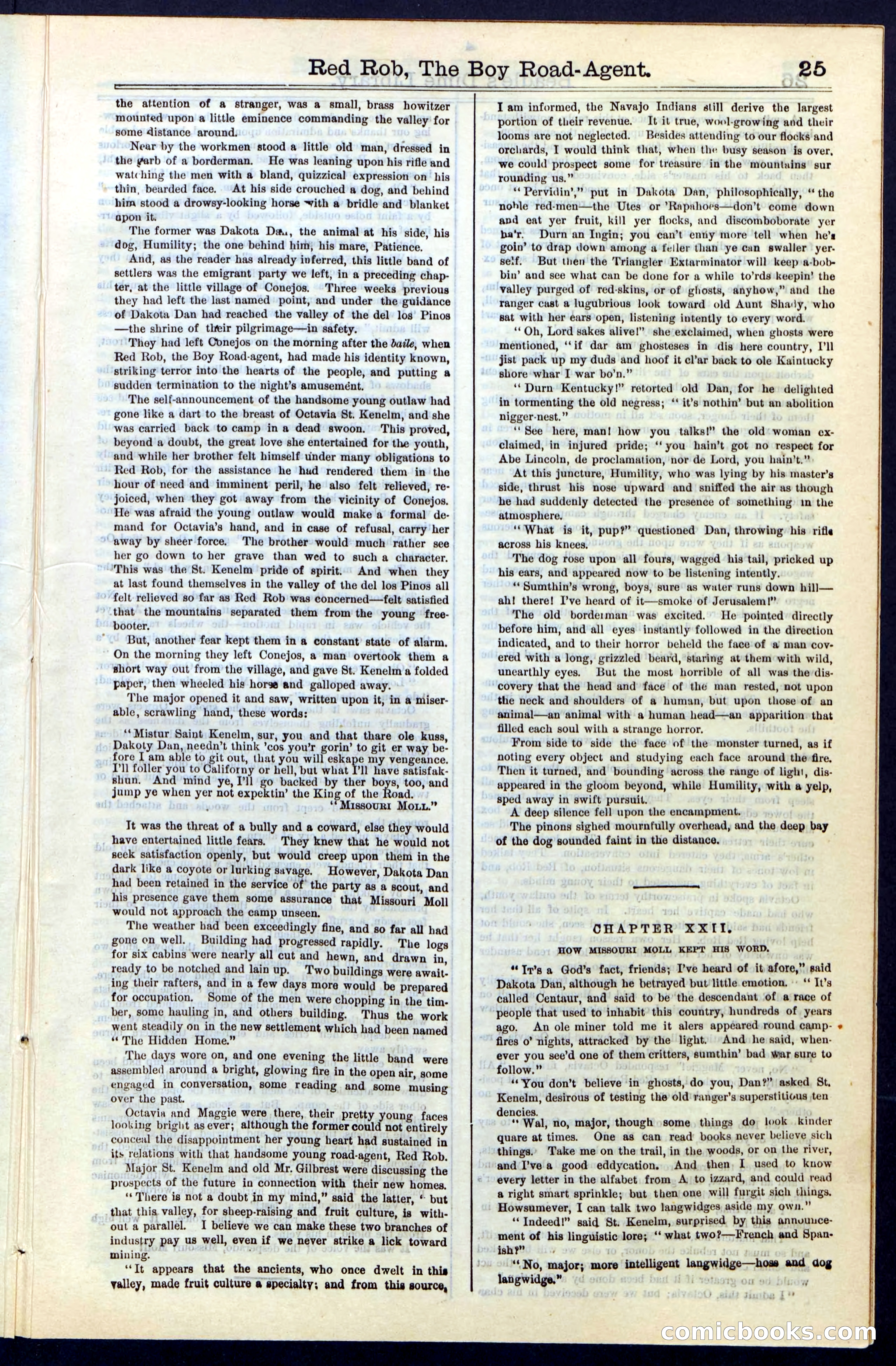
A restored page from Pulp Fiction, 1878. Page through the whole issue in the reader above.
📄 Transcribed text from this page (OCR, searchable)
Machine-transcribed from the original scan — historical spelling and the odd misread are preserved.
Red Rob, The Boy Road-Agent. the attention of a stranger, was a small, brass howitzer mounted upon a little eminence commanding the valley for some distance around, Near by the workmen stood a little old man, dressed in the garb of a borderman. He was leaning upon his rifle and watching the men with a bland, quizzical expression on his thin, bearded face. At his side crouched a dog, and behind him stood a drowsy-looking horse with a bridle and blanket apon it. The former was Dakota Dau, the animal at his side, his dog, Humility; the one behind him; his mare, Patience. And, as the reader has already inferred, this little band of settlers was the emigrant party we left, in a preceding chap- ter, at the little village of Conejos. Three weeks previous they had left the last named point, and under the guidance of Dakota Dan had reached the valley of the del los Pinos —the shrine of their pilgrimage—in safety. They had left Conejos on the morning after the dade, when Red Rob, the Boy Road-agent, had made his identity known, striking terror into the hearts of the people, and putting a sudden termination to the night’s amusemént. The self-announcement of the handsome young outlaw had gone like a dart to the breast of Octavia St. Kenelm, and she was carried back to camp in a dead swoon. This proved, beyond a doubt, the great love she entertained for the youth, and while her brother felt himself under many obligations to Red Rob, for the assistance he hud rendered them in the hour of need and imminent peril, he also felt relieved, re- joiced, when they got away from the vicinity of Conejos. He was afraid the young outlaw would make a formal de- mand for Octavia’s hand, and in case of refusal, carry her away by sheer force. The brother would much rather see her go down to her grave than wed to such a character. This was the St. Kenelm pride of spirit. And when they at last found themselves in the valley of the del los Pinos all felt relieved so far as Red Rob was concerned—felt satisfied that the mountains separated them from the young free- booter. But, another fear kept them in a constant state of alarm. On the morning they left Conejos, a man overtook them a short way out from the village, and gave St. Kenelm a folded paper, then wheeled his horse and galloped away. The major opened it and saw, written upon it, in a miser- able, scrawling hand, these words: ‘‘Mistur Saint Kenelm, sur, you and that thare ole kuss, Dakoty Dan, needn’t think ’cos you'r gorin’ to git er way be- fore I am able to pit out, that you will eskape my vengeance. Pll foller you to Californy or hell, but what I’ll have satisfak- shun. And mind ye, I'll go backed by ther boys, too, and jump ye when yer not expektin’ the King of the Road. ‘*MissourRI Mou.” It was the threat of a bully and a coward, else they would have entertained little fears. They knew that he would not seck satisfaction openly, but would creep upon them in the dark like a coyote or lurking savage. However, Dakota Dan had been retained in the service of the party as a scout, and his presence gave them some assurance that Missouri Moll would not approach the camp unseen. The weather bad been exceedingly fine, and so far all had gone on well.. Building had progressed rapidly. The logs for six cabins were nearly all cut and hewn, and drawn in, ready to be notched and lainup. Two buildings were await- ing their rafters, and in a few days more would be prepared for occupation. Some of the men were chopping in the tim- ber, some hauling in, and others building. Thus the work went steadily on in the new settlement which had been named ‘‘The Hidden Home.” The days wore on, and one evening the little band were assembled around a bright, glowing fire in the open air, some engaged in conversation, some reading and some musing over the past. Octavia and Maggie were there, their pretty oung faces looking bright asever; although the former could not entirely conceal the disappointment her young heart had sustained in its relations with that handsome young road-agent, Red Rob. Major St. Kenelm and old Mr. Gilbrest were discussing the prospects of the future in connection with their new homes. ‘There is not a doubt in my mind,” said the latter, “ but that this valley, for sheep-raising and fruit culture, is with- out a parallel. I believe we can make these two branches of industry pay us well, even if we never strike a lick toward mining. , : ‘‘It appears that the ancients, who once dwelt in this valley, made fruit culture a specialty, and from this source, 25 — en I am informed, the Navajo Indians still derive the largest portion of their revenue. It it true, wool-growing and their looms are not neglected. Besides attending to our flocks and orchards, I would think that, when the busy season is over, we could prospect some for treasure in the mountains sur rounding us.” **Pervidin’,” put in Dakota Dan, philosophically, “ the nohle red-men—the Utes or ’Raprhoes—don’t come down apd eat yer fruit, kill yer flocks, and discomboborate yer ha'r. Durn an Ingin; you can’t entiy more tell when he’s goin’ to drap down among a feller than ye can swaller yer. seif. But then the Triangler Extarminator will keep a-bob- bin’ and see what can be done for a while to’rds keepin’ the valley purged of red-skins, or of ghosts, anyhow,” and the ranger cast a lugubrious look toward old Aunt Shady, who sat with her ears open, listening intently to every word. ‘Oh, Lord sakes alive!” she exclaimed, when ghosts were mentioned, ‘‘if dar am ghosteses in dis here country, ’ll jist pack up my duds and hoof it cl’ar back to ole Kaintucky shore whar I war bo’n.” ‘*Durn Kentucky!” retorted old Dan, for he delighted in tormenting the old negress; “‘ it’s nothin’ but an abolition nigger-nest.”’ ‘‘ See here, man! how you talks!” the old’ woman ex- claimed, in injured pride; ‘‘ you hain’t got no respect for Abe Lincoln, de proclamation, nor de Lord, you hain’t.”) At this juncture, Humility, who was lying by his master’s side, thrust his nose upward and sniffed the air as though he had suddenly detected the presence of something 1n the atmosphere. | ‘What is it, pup?” questioned Dan, throwing: his rifle across his knees, The dog rose upon all fours, wagged his tail, pricked up his ears, and appeared now to be listening intently. ‘*Sumthin’s wrong, boys, sure as water runs down hill— ah! there! I’ve heard of it—smoke of Jerusalem!” The old borderman was excited. He pointed directly before him, and all eyes instantly followed in the direction indicated, and to their horror beheld the face of a man cov- ered with a long, grizzled beard, staring at them with wild, unearthly eyes. But the most horrible of all was the dis- covery that the head and face of the man rested, not upon the neck and shoulders of a human, but upon those of an animal—an animal with a human head—an apparition that filled each soul with a strange horror. From side to side the face of the monster turned, as if noting every object and studying each face around the fire, Then it turned, and bounding across the range of light, dis- appeared in the gloom beyond, while Humility, with a yelp, sped away in swift pursuit. A deep silence fell upon the encampment. | The pinons sighed mournfully overhead, and the deep bay of the dog sounded faint in the distance. CHAPTER XXII. HOW MISSOURI MOLL KEPT HIS WORD. “Ir’s a God’s fact, friends; I’ve heard of it afore,” said Dakota Dan, although he betrayed but little emotion. « ‘ It’s called Centaur, and said to be the descendant of a race of people that used to inhabit this country, hundreds of years ago. An ole miner told me it alers appeared round camp- fires o’ nights, attracked by the light. And he said, when- ever you see’d one of them critters, sumthin’ bad war sure to follow.” ‘“You don’t believe in ghosts, do you; Dan?” asked St, Kenelm, desirous of testing the old ranger’s superstitious ten dencies. ‘0 ‘* Wal, no, major, though some things do look kinder quare at times. One as can read books never believe sich things. Take me on the trail, in the woods, or on the river, and I’ve a good eddycation, And then, I used to know every letter in the alfabet from A, to izzard, and could read a right smart sprinkle; but then one will furgit sich things, Howsumever, I can talk two langwidges aside my own.” ‘‘ Indeed!” said St. Kenelm, surprised by this annuuuce- ment of his linguistic lore; ‘‘ what two?—-French and Span- ‘No, major; more intelligent langwidge—hoas and dog langwidge,” i sotaory om eu blsdwy » - do _- = Gomichboo Sal (0)