
Pulp Fiction, 1878 · page 20 of 44
Beadle's Dime Library No. 51: Red Rob, The Boy Road-Agent — page 20: what you’re looking at
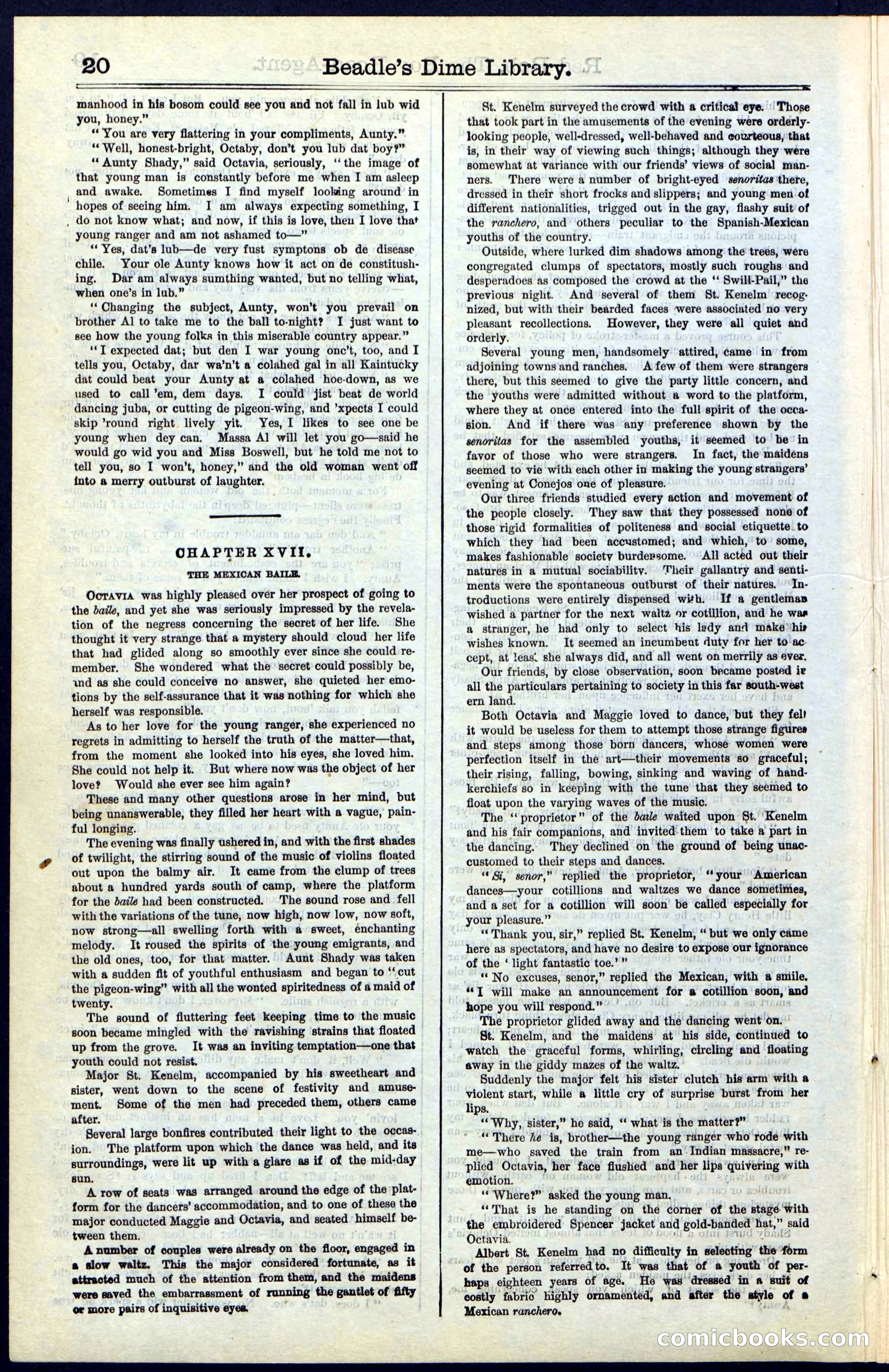
A restored page from Pulp Fiction, 1878. Page through the whole issue in the reader above.
📄 Transcribed text from this page (OCR, searchable)
Machine-transcribed from the original scan — historical spelling and the odd misread are preserved.
20 manhood in his bosom could see you and not fall in lub wid you, honey.” ‘You are very flattering in your compliments, Aunty.” “Well, honest-bright, Octaby, don’t you lub dat boy?” ‘“‘Aunty Shady,” said Octavia, seriously, ‘‘the image of that young man is constantly before me when I am asleep and awake. Sometimes I find myself loolsing around in ' hopes of seeing him. I am always expecting something, I , do not know what; and now, if this is love, then I love that young ranger and am not ashamed to—” ** Yes, dat’s lub—de very fust symptons ob de disease chile. Your ole Aunty knows how it act on de constitush- ing. Dar am always sumthing wanted, but no telling what, when one’s in lub.” ‘*Changing the subject, Aunty, won’t you prevail on brother Al to take me to the ball to-night? I just want to see how the young folks in this miserable country appear.” ‘*T expected dat; but den I war young onc’t, too, and I tells you, Octaby, dar wa’n’t a colahed gal in all Kaintucky dat could beat your Aunty at a colahed hoe-down, as we used to call’em, dem days. I could jist beat de world dancing juba, or cutting de pigeon-wing, and ’xpects I could skip ’round right lively yit. Yes, I likes to see one be young when dey can. Massa Al will let you go—said he would go wid you and Miss Boswell, but he told me not to tell you, so I won’t, honey,” and the old woman went off into a merry outburst of laughter. OHAPTER XVII, THE MEXICAN BAILE. Ocravia was highly pleased over her prospect of going to the daile, and yet she was seriously impressed by the revela- tion of the negress concerning the secret of her life. She thought it very strange that a mystery should cloud her life that had glided along so smoothly ever since she could re- member. She wondered what the secret could possibly be, and as she could conceive no answer, she quieted her emo- tions by the self-assurance that it was nothing for which she herself was responsible. As to her love for the young ranger, she experienced no regrets in admitting to herself the truth of the matter—that, from the moment she looked into his eyes, she loved him. She could not help it. But where now was the object of her love? Would she ever see him again? These and many other questions arose in her mind, but being unanswerable, they filled her heart with a vague, pain- ful longing. The evening was finally ushered in, and with the first shades of twilight, the stirring sound of the music of violins floated out upon the balmy air. It came from the clump of trees about a hundred yards south of camp, where the platform for the baile had been constructed. The sound rose and fell with the variations of the tune, now high, now low, now soft, now strong—all swelling forth with a sweet, enchanting melody. It roused the spirits of the young emigrants, and the old ones, too, for that matter. Aunt Shady was taken with a sudden fit of youthful enthusiasm and began to “‘cut the pigeon-wing” with all the wonted spiritedness of a maid of twenty. The sound of fluttering feet keeping time to the music soon became mingled with the ravishing strains that floated up from the grove. It was an inviting temptation—one that youth could not resist. Major St. Kenelm, accompanied by his sweetheart and sister, went down to the scene of festivity and amuse- ment. Some of the men had preceded them, others came after. Several large bonfires contributed their light to the occas- ion. The platform upon which the dance was held, and its surroundings, were lit up with a glare as if of the mid-day sun. A row of seats was arranged around the edge of the plat- form for the dancers’ accommodation, and to one of these the major conducted Maggie and Octavia, and seated himself be- tween them. A number of couples were already on the floor, engaged in a slow waltz. This the major considered fortunate, as it attracted much of the attention from them, and the maidens were saved the embarrassment of running the gantlet of fifty or more pairs of inquisitive eyes. Beadle’ S s Dime Library. | St. Kenelm surveyed the crowd with a critical eye. | Those that took part in the amusements of the evening were orderly- looking people, well-dressed, well-behaved and courteous, that is, in their way of viewing such things; although they were somewhat at variance with our friends’ views of social man- ners. There were a number of bright-eyed senoritas there, dressed in their short frocks and slippers; and young men of different nationalities, trigged out in the gay, flashy suit of the ranchero, and others peculiar to the Spanish-Mexican youths of the country. Outside, where lurked dim shadows among the trees, were congregated clumps of spectators, mostly such roughs and desperadoes as composed the crowd at the ‘‘ Swill-Pail,” the previous night. And several of them St. Kenelm recog: nized, but with their bearded faces ‘were associated no very pleasant recollections. However, they were all quiet and orderly. . Several young men, handsomely attired, came in from adjoining towns and ranches. A few of them were strangers there, but this seemed to give the party little concern, and the youths were admitted without a word to the platform, where they at once entered into the full spirit of the occa- sion. And if there was any preference shown by the senoritas for the assembled youths, it seemed to be in favor of those who were strangers. In fact, the maidens seemed to vie with each other in making the young strangers’ evening at Conejos one of pleasure. Our three friends studied every action and movement of the people closely. They saw that they possessed none of those rigid formalities of politeness and social etiquette to which they had been accustomed; and which, to some, makes fashionable society burdersome. All acted out their natures in a mutual sociability. Their gallantry and senti- ments were the spontaneous outburst of their natures. In- troductions were entirely dispensed with. If a gentleman wished a partner for the next walta or cotillion, and he waa a stranger, he had only to select his lady and make hir wishes known. It seemed an incumbent duty for her to ac. cept, at leas. she always did, and all went on merrily as ever. Our friends, by close observation, soon became posted ir all the particulars pertaining to society in this far south-west ern land. Both Octavia and Maggie loved to dance, but they fel! it would be useless for them to attempt those strange figures and steps among those born dancers, whosé women were perfection itself in the art—their movements so graceful; their rising, falling, bowing, sinking and waving of hand- kerchiefs so in keeping with the tune that they seemed to float upon the varying waves of the music. The ‘‘ proprietor” of the bale waited upon §t. Kenelm and his fair companions, and invited:them to take a part in the dancing. They declined on the ground of being unac- customed to their steps and dances. ‘« Si, senor,” replied the proprietor, ‘your Dedertoan dances—your cotillions and waltzes we dance sometimes, and a set for a cotillion will soon be called especially for your pleasure.” ‘‘Thank you, sir,” replied St. Kenelm, “ but we only came here as spectators, and have no desire to expose our ignorance of the ‘ light fantastic toe.’” , ‘* No excuses, senor,” replied the Mexican, with a smile. ‘‘T will make an announcement for a cotillion san, and hope you will respond.” The proprietor glided away and the dancing went on. St. Kenelm, and the maidens at his side, continued to watch the graceful forms, whirling, circling and floating away in the giddy mazes of the waltz. Suddenly the major felt his sister clutch his arm with a violent start, while a little cry of surprise burst from her lips. “Why, sister,” ho said, ‘‘ what is the matter?” “There he is, brother—the young ranger who rode with me—who saved the train from an Indian massacre,” re- plied Octavia, her face flushed and her lips quivering with emotion. “Where?” asked the young man, " “‘That is he standing on the corner of the stage With the embroidered Spencer jacket and gold-banded hat, 4 bald Octavia. Albert St. Kenelm had no difficulty in selecting the form of the person referred to. It was that of a youth of per- haps eighteen years of age. He was dressed in a suit of “costly fabric highly ornamented, and after the atyle 6 & Mexican ranchero. Gcom chooks es