
Pulp Fiction, 1878 · page 16 of 44
Beadle's Dime Library No. 51: Red Rob, The Boy Road-Agent — page 16: what you’re looking at
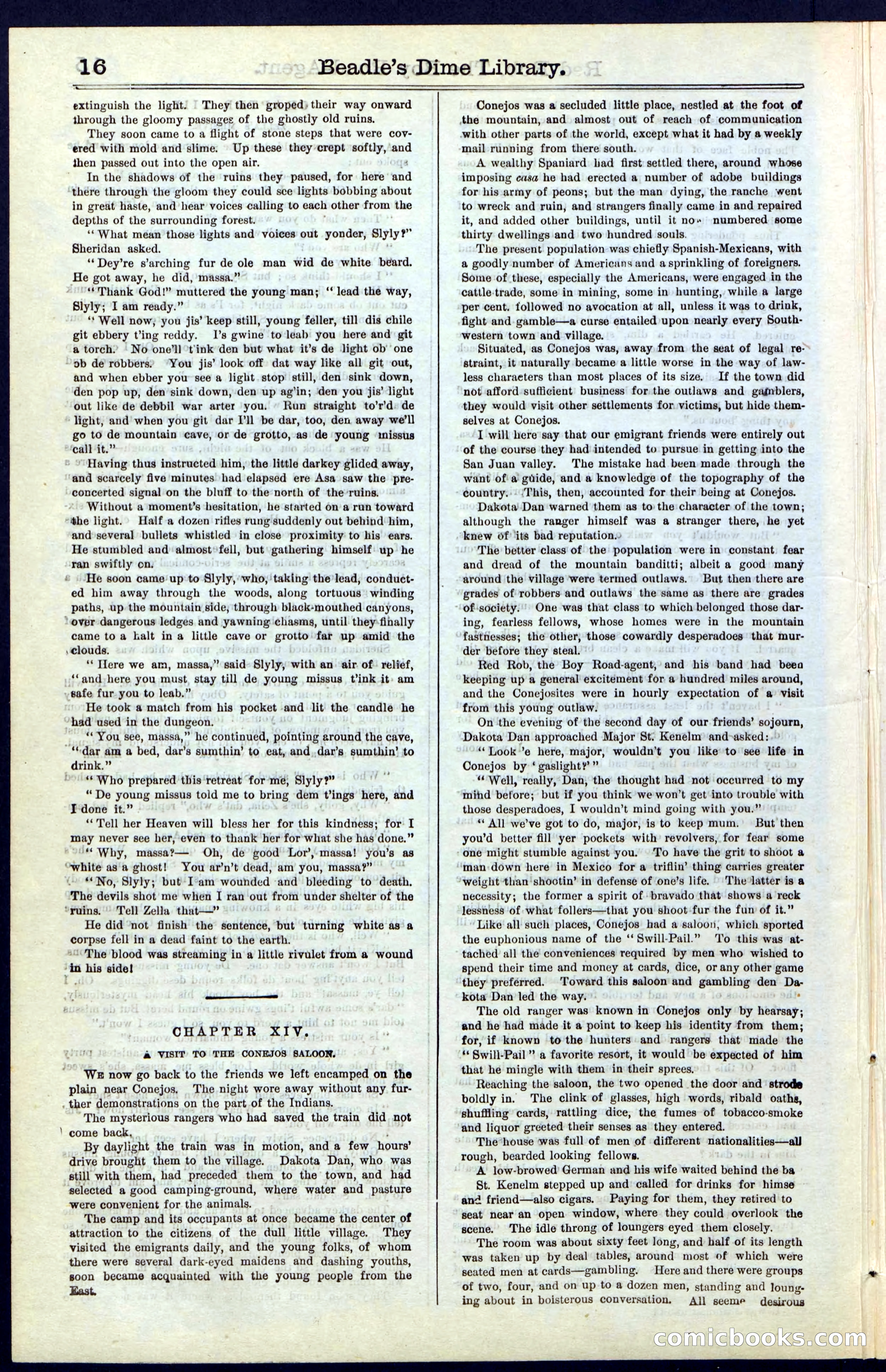
A restored page from Pulp Fiction, 1878. Page through the whole issue in the reader above.
📄 Transcribed text from this page (OCR, searchable)
Machine-transcribed from the original scan — historical spelling and the odd misread are preserved.
16 —- extinguish the light. They then groped, their way onward through the gloomy passages of the ghostly old ruins. They soon came to a flight of stone steps that were cov- ered with mold and slime. Up these they crept softly, and then passed out into the open air. In the shadows of the ruins they paused, for here fad there through the gloom they could sce lights bobbing about in great haste, and hear voices calling to each other from the depths of the surrounding forest. ‘“What mean those lights and voices out yonder, Slyly? Sheridan asked. ‘*Dey’re s’arching fur de ole man wid de white beard. He got away, he did, massa.” ‘Thank God!” muttered the young man; Slyly; I am ready.” ‘* Well now, you jis’ keep still, young feller, till dis chile git ebbery t’ing reddy. I’s gwine to leab you here and git a torch. No one’ll t'ink den but what it’s de light ob’ one ~ ob de robbers: ‘You jis’ look off dat way like all git out, and when ebber you see a light stop still, den sink down, den pop up, den sink down, den up ag’in; den you jis’ light out like de debbil war arter you. Run straight to’r’d de ‘light, and when you git dar I'll be dar, too, den away we'll go to de mountain cave, or de grotto, as de young missus call it.” Having thus instructed him, the little darkey glided away, and scarcely five minutes had elapsed ere Asa saw the pre- concerted signal on the bluff to the north of the ruins. Without a moment’s hesitation, he started on a run toward “the light. Half a dozen rifles rang suddenly out behind him, and several bullets whistled in close proximity to his ears. He stumbled and almost fell, but gathering himself up he ran swiftly on. He soon came up to Slyly, who, taking the lead, oonadét- ed him away through the woods, along tortuous winding paths, up the mountain side; through black-mouthed canyons, ‘over dangerous ledges and yawning chasms, until they-finally came to a halt in a little cave or grotto far up amid the clouds. ‘* Tiere we am, massa,” said Slyly, with an air of. relief, ‘‘and here you must, stay till de young missus t’ink it: am _ safe fur you to leab.” ) He took a match from his pocket and lit the candle he had used in the dungeon. , ““You see, massa,” he continued, pointing around the cave, ~‘¢dar am a bed, dar’s sumthin’ to eat, and..dar’s sumthin’ to drink.” ~ © Who prepared this retreat for me, Slyly?” “De young missus told me to bring dem ‘Vings here, and I done it.” ‘*Tell her Heaven will bless her for this kindness; for I may never see her, even to thank her for what she has done.” ~o** Why, massa?— Oh, de good Lor’, massa! you’s as “white as a ghost! You ar’n’t dead, am you, massa?” **No, Slyly; but Iam wounded and bleeding to death. The devils shot me when I ran out from under shelter of the ‘ruins. Tell Zella that— He did not finish the sentence, but turning white as a corpse fell in a dead faint to the earth. “The blood was streaming in a little rivulet from a wound ‘in his side! ‘lead the way, CHAPTER XIV. 1} a VISIT TO THE CONEJOS SALOON, WE now go back to the friends we left encamped on the plain near Conejos, The night wore away without any fur- . ther demonstrations on the part of the Indians. The mysterious rangers who had saved the train did not ‘ come back, By daylight the train was in motion, and a few hours’ drive brought them to the village. Dakota Dan, who was still with them, had preceded them to the town, and had selected a good camping-ground, where water and pasture were convenient for the animals. The camp and its occupants at once became the center of attraction to the citizens of the dull little village. They visited the emigrants daily, and the young folks, of whom there were several dark-eyed maidens and dashing youths, goon became acquainted with the young people from the Hast. ‘weight than shootin’ in defense of one’s life. Beadle’s Dime Library. Conejos was a secluded little place, nestled at the foot of the mountain, and almost out of reach of communication with other parts of the world, except what it had by a weekly mail running from there south. A wealthy Spaniard bad first settled there, around whose imposing casa he had erected a number of adobe buildings for his army of peons; but the man dying, the ranche went to wreck and ruin, and strangers finally came in and repaired it, and added other buildings, until it no» numbered some thirty dwellings and two hundred souls. The present population was chiefly Spanish-Mexicans, with a goodly number of Americans and asprinkling of foreigners. Some of these, especially the Americans, were engaged in the cattle-trade, some in mining, some in hunting, while a large per cent. followed no avocation at all, unless it was to drink, fight and. gamble—a curse entailed upon nearly every South- western town and village. Situated, as Conejos was, away from the seat of legal re- straint, it naturally became a little worse in the way of law- less charaeters than most places of its size, If the town did not afford sufficient business for the outlaws and gagmblers, they would visit other settlements for victims, but hide them- selves at Conejos. I will here say that our emigrant friends were entirely out of the course they had intended to pursue in getting into the San Juan valley. The mistake had been made through the want of a guide, and a knowledge of the topography of the country. ‘This, then, accounted for their being at Conejos. Dakota’ Dan warned them as to the character of the town; although the ranger himself was a stranger there, he yet knew of its bad reputation. The better class of the population were in constant fear and dread of the mountain banditti; albeit a good many around the village were termed outlaws. But then there are grades of robbers and outlaws the same as there are grades of society. One was that class to which belonged those dar- ing, fearless fellows, whose homes were in the mountain fasthesses; the other, those cowardly desperadoes that mur- der before they steal. Red Rob, the Boy Road-agent, and his band had beea keeping up a general excitement for a hundred miles around, and the Conejosites were in hourly expectation of a visit from this young outlaw. On the evening of the second day of our friends’ sojourn, Dakota Dan approached Major St. Kenelm and-asked: ‘‘Look’e here, major, wouldn’t you like to see life in Conejos by ‘ gaslight?’” “Well, really, Dan, the thought had not occurred to my mind before; but if you think we won’t get into trouble with those desperadoes, I wouldn’t mind going with you.” ** All we’ve got to do, major, is to keep mum. But then you’d better fill yer pockets with revolvers, for fear some one might stumble against you. To have the grit to shoot a ‘man down here in Mexico for a triflin’ thing carries greater The latter is a necessity; the former a spirit of bravado that shows a reck lessness of what follers—that you shoot fur the fun of it.” Like all such places, Conejos had a saloon, which sported the euphonious name of the ‘‘ Swill-Pail.” To this was at- tached all the conveniences required by men who wished to spend their time and money at cards, dice, or any other game they preférred. ‘Toward this saloon and gambling den Da- kota Dan led the way. ‘ The old ranger was known in Conejos only by hearsay; and he had made it a point to keep his identity from them; for, if known tothe hunters and rangers that made the ‘* Swill-Pail ” a favorite resort, it would be expected of him that he mingle with them in their sprees. Reaching the saloon, the two opened the door and strode boldly in. The clink of glasses, high words, ribald oaths, shuffling cards, rattling dice, the fumes of tobacco-smoke and liquor greeted their senses as they entered. The house was full of men of different nationalities—all rough, bearded looking fellows. | A low-browed German and his wife waited behind the ba St. Kenelm stepped up and called for drinks for himse an2 friend—also cigars. Paying for them, they retired to seat near an open window, where they could overlook the scene. The idle throng of loungers eyed them closely. The room was about sixty feet long, and half of its length was taken up by deal tables, around most of which were seated men at cards—gambling. Here and there were groups of two, four, and on up to a dozen men, standing and Joung- ing about in boisterous conversation. All seeme desirous Eomicbooks (E(o)