
Pulp Fiction, 1878 · page 12 of 44
Beadle's Dime Library No. 51: Red Rob, The Boy Road-Agent — page 12: what you’re looking at
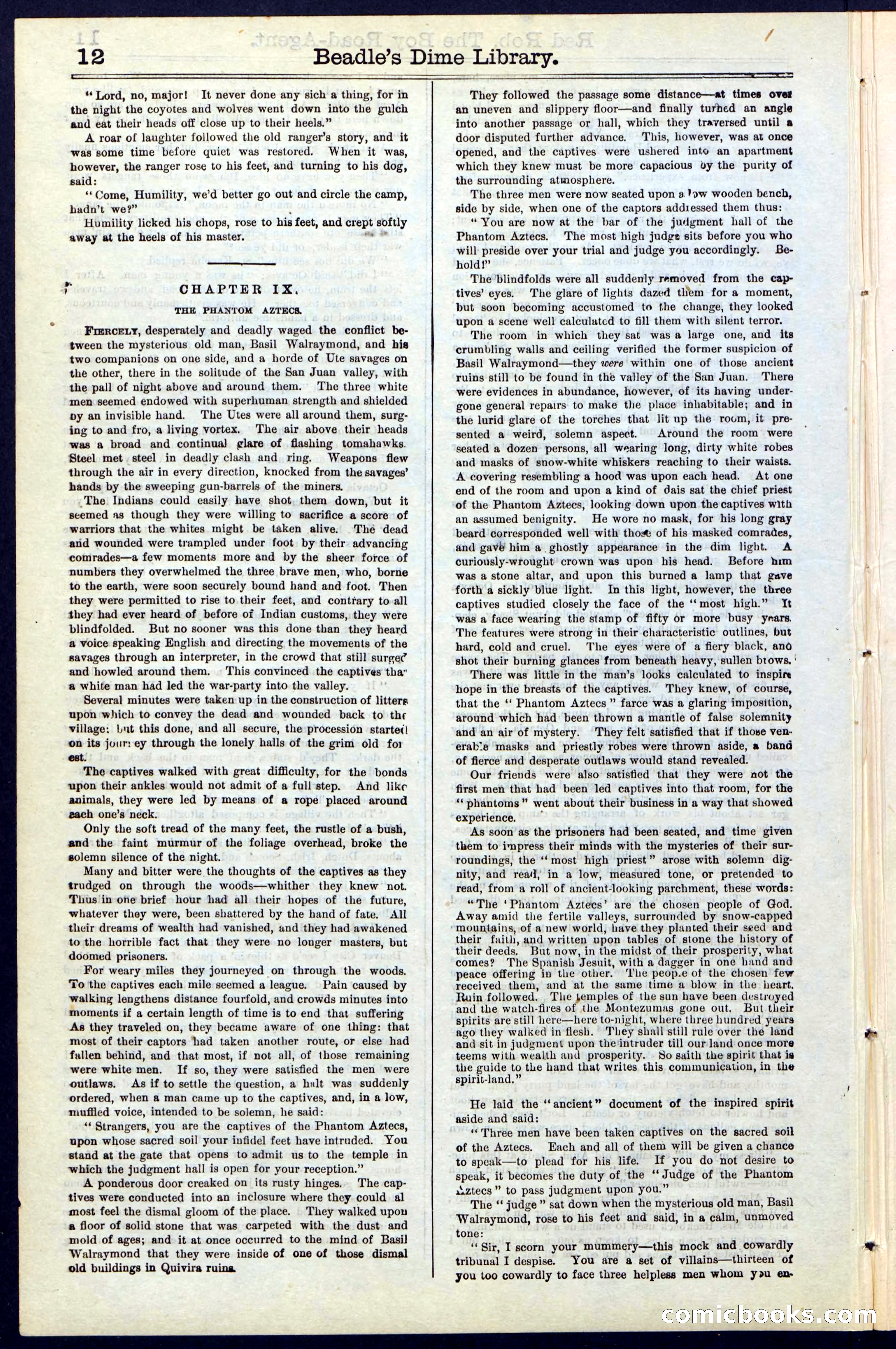
A restored page from Pulp Fiction, 1878. Page through the whole issue in the reader above.
📄 Transcribed text from this page (OCR, searchable)
Machine-transcribed from the original scan — historical spelling and the odd misread are preserved.
12 **Lord, no, major! It never done any sich a thing, for in the night the coyotes and wolves went down into the gulch and eat their heads off close up to their heels.” A roar of laughter followed the old ranger’s story, and it was some time before quiet was restored. When it was, however, the ranger rose to his feet, and turning to his dog, said: ‘‘Come, Humility, we’d better go out and circle the camp, hadn’t we?” - Humility licked his chops, rose to his feet, and crept softly away at the heels of his master. =o . CHAPTER IX. THE PHANTOM AZTECS, Frerce.y, desperately and deadly waged the conflict be- tween the mysterious old man, Basil Walraymond, and his two companions on one side, and a horde of Ute savages on the other, there in the solitude of the San Juan valley, with the pall of night above and around them. The three white men seemed endowed with superhuman strength and shielded py an invisible hand. The Utes were all around them, surg- ing to and fro, a living vortex. The air above their heads was a broad and continua) glare of flashing tomahawks. Steel met steel in deadly clash and ring. Weapons flew through the air in every direction, knocked from the savages’ hands by the sweeping gun-barrels of the miners. The Indians could easily have shot them down, but it seemed as though they were willing to sacrifice a score of warriors that the whites might be taken alive. The dead and wounded were trampled under foot by their advancing comrades—a few moments more and by the sheer force of numbers they overwhelmed the three brave men, who, borne to the earth, were soon securely bound hand and foot. Then they were permitted to rise to their feet, and contrary to all they had ever heard of before of Indian customs, they were blindfolded. But no sooner was this done than they heard a voice speaking English and directing the movements of the savages through an interpreter, in the crowd that still surge¢ and howled around them. This convinced the captives tha” a white man had led the war-party into the valley. Several minutes were taken up in the construction of littera upon which to convey the dead and wounded back to the village: Lut this done, and all secure, the procession starte¢) on its jour: ey through the lonely halls of the grim old fo est. The captives walked with great difficulty, for the bonds upon their ankles would not admit of a full step. And like animals, they were led by means of a rope placed around each one’s neck. Only the soft tread of the many feet, the rustle of a bush, and the faint murmur of the foliage overhead, broke the solemn silence of the night. Many and bitter were the thoughts of the captives as they trudged on through the woods—whither they knew not. Thus in one brief hour had all their hopes of the future, whatever they were, been shattered by the hand of fate. All their dreams of wealth had vanished, and they had awakened to the horrible fact that they were no longer masters, but doomed prisoners. For weary miles they journeyed on through the woods. To the captives each mile seemed a league. Pain caused by walking lengthens distance fourfold, and crowds minutes into moments if a certain length of time is to end that suffering As they traveled on, they became aware of one thing: that most of their captors had taken another route, or else had fullen behind, and that most, if not all, of those remaining were white men. If so, they were satisfied the men were outlaws. As if to settle the question, a halt was suddenly ordered, when a man came up to the captives, and, in a low, muffled voice, intended to be solemn, he said: ‘* Strangers, you are the captives of the Phantom Aztecs, upon whose sacred soil your infidel feet have intruded. You stand at the gate that opens to admit us to the temple in which the judgment hall is open for your reception.” A ponderous door creaked on its rusty hinges. The cap- tives were conducted into an inclosure where they could al most feel the dismal gloom of the place. They walked upon a floor of solid stone that was carpeted with the dust and mold of ages; and it at once occurred to the mind of Basil Walraymond that they were inside of one of those dismal old buildings in Quivira ruing. Beadle’s Dime Library. They followed the passage some distance—at times over an uneven and slippery floor—and finally turhed an angle into another passage or hall, which they traversed until a door disputed further advance. This, however, was at once opened, and the captives were ushered into an apartment which they knew must be more capacious by the purity of the surrounding atmosphere. The three men were now seated upon a.!ow wooden bench, side by side, when one of the captors addiessed them thus: “You are now at the bar of the judgment hall of the Phantom Aztecs. The most high judge sits before you who will preside over your trial and judge you accordingly. Be- hold!” The blindfolds were all suddenly removed from the cap- tives’ eyes. The glare of lights dazed them for a moment, but soon becoming accustomed to the change, they looked upon a scene well calculated to fill them with silent terror. The room in which they sat was a large one, and its crumbling walls and ceiling verified the former suspicion of Basil Walraymond—they were within one of those ancient ruins still to be found in the valley of the San Juan. There were evidences in abundance, however, of its having under- gone general repairs to make the place inhabitable; and in the lurid glare of the torches that lit up the room, it pre- sented a weird, solemn aspect. Around the room were seated a dozen persons, all wearing long, dirty white robes and masks of snow-white whiskers reaching to their waists. A covering resembling a hood was upon each head. At one end of the room and upon a kind of dais sat the chief priest of the Phantom Aztecs, looking down upon the captives with an assumed benignity. He wore no mask, for his long gray beard corresponded well with tho#: of his masked comrades, and gavé him a ghostly appearance in the dim light. A curiously-wrought crown was upon his head. Before him was a stone altar, and upon this burned a lamp that gave forth a sickly blue light. In this light, however, the three captives studied closely the face of the ‘‘most high.” It was a face wearing the stamp of fifty or more busy years. The features were strong in their characteristic outlines, but hard, cold and cruel. The eyes were of a fiery black, ano shot their burning glances from beneath heavy, sullen brows, ' There was little in the man’s looks calculated to inspire hope in the breasts of the captives. They knew, of course, that the ‘‘ Phantom Aztecs ” farce was a glaring imposition, around which had been thrown a mantle of false solemnity and an air of mystery. They felt satisfied that if those ven- erable masks and priestly robes were thrown aside, a band of fierce and desperate outlaws would stand revealed. Our friends were also satistied that they were not the first men that had been led captives into that room, for the ‘‘phantoms” went about their business in a way that showed experience. As soon as the prisoners had been seated, and time given them to impress their minds with the mysteries of their sur- roundings, the ‘‘most high priest” arose with solemn dig- nity, and read, in a low, measured tone, or pretended to read, from a roll of ancient-looking parchment, these words: “The ‘Phantom Aztecs’ are the chosen people of God. Away amid the fertile valleys, surrounded by snow-capped mountains, of a new world, have they planted their seed and their faith, and written upon tables of stone the history of their deeds. But now, in the midst of their prosperity, what comes? The Spanish Jesuit, with a dagger in one hand and peace offering in the other. ‘The peop.e of the chosen few received them, and at the same time a blow in the heart. Ruin followed. Tle temples of the sun have been destroyed and the watch-fires of the Montezumas gone out, But their spirits are sti]l here—here to-night, where three hundred years ago they walked in flesh. They shall still rule over the land and sit in judgment upon the intruder till our land once more teems with wealth and prosperity. So saith the spirit that is the guide to the hand that writes this communication, in the spirit-land,” He laid the ‘‘ancient” document of the inspired spirit aside and said: ‘Three men have been taken captives on the sacred soil of the Aztecs. Each and all of them will be given a chance to speak—to plead for his life. If you do not desire to speak, it becomes the duty of the “Judge of the Phantom si.ztecs” to pass judgment upon you.” The ‘‘ judge” sat down when the mysterious old man, Basil Walraymond, rose to his feet and said, in a calm, unmoved tone: ‘‘ Sir, I scorn your mummery—this mock and cowardly tribunal I despise. You are a set of villains—thirteen of you too cowardly to face three helpless men whom you en- Gomichoo S) G (0)