
Pulp Fiction, 1888 · page 20 of 32
Beadle's New York Dime Library, No. 508 — page 20: what you’re looking at
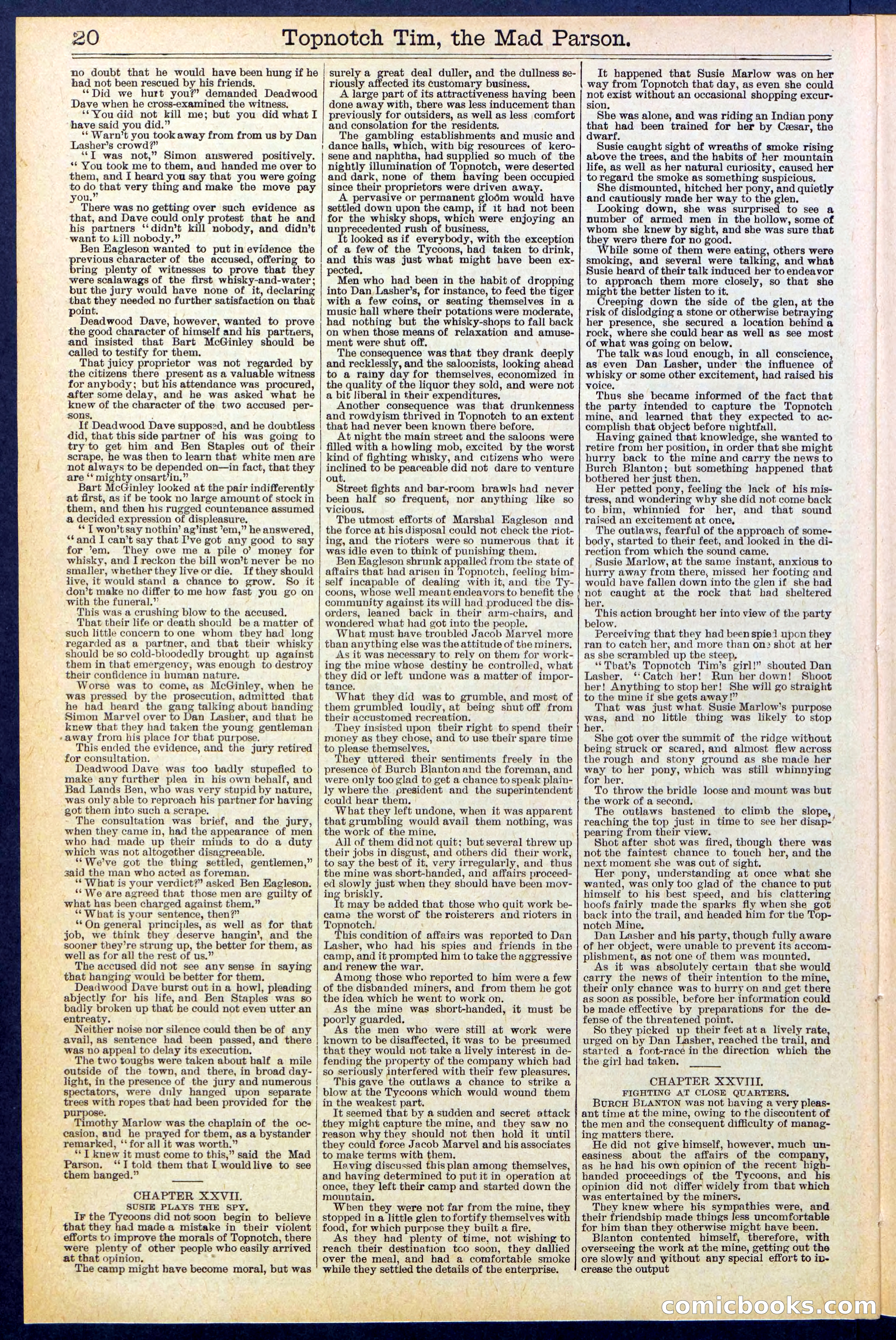
A restored page from Pulp Fiction, 1888. Page through the whole issue in the reader above.
📄 Transcribed text from this page (OCR, searchable)
Machine-transcribed from the original scan — historical spelling and the odd misread are preserved.
% ae “~— F saad on ns cy , ~” . 20 no doubt that he would have been hung if he had not been rescued by his friends, “Did we hurt you?’ demanded Deadwood Dave when he cross-examined the witness, ‘*You did not kill me; but you did what I have said you did.” ** Warn’t you tookaway from from us by Dan Lasher’s crowd?” ‘‘T was not,” Simon auswered positively. ** You took me to them, and handed me over to them, and I heard you say that you were going to do that very thing and make the move pay you. There was no getting over such evidence as that, and Dave could only protest that he and his partners ‘‘didn’t kill nobody, and didn’t want to Lill nobody.” Ben Eagleson wanted to putin evidence the recone character of the accused, offering to ring plenty of witnesses to prove that they were scalawags of the first whisky-and-water; but the jury would have none of it, declaring that they needed no further satisfaction on that point. Deadwood Dave, however, wanted to prove the good character of himself and his partners, and insisted that Bart McGinley should be called to testify for them. That juicy proprietor was not regarded by the citizens there present as a valuable witness for anybody; but his attendance was procured, after some delay, and he was asked what he knew of the character of the two accused per- sons, If Deadwood Dave supposed, and he doubtless did, that this side partner of his was going to try to get him and Ben Staples out of their scrape, he was then to learn that white men are not always to be depended on—in fact, that they are ‘‘ mighty onsart’in,” Bart McGinley looked at the pair indifferently at first, as if be took no large amount of stock in them, and then his rugged countenance assumed a decided expression of displeasure, “*T won’tsay nothin’ ag’inst em,” he answered, ‘and I can’t say that I’ve got any good to say for ’em. They owe me a pile o’ money for whisky, and I reckon the bill won’t never be no smaller, whether they live ordie. Ifthey should live, it would stand a chance to grow. So it don’t make no differ to me how fast you go on with the funeral,”’ This was a crushing blow to the accused, That their life or death should be a matter of such little concern to one whom they had long regarded as a partner, and that their whisky should be so cold-bloodedly brought up against them in that emergency, was enough to destroy their confidence in human nature. Worse was to come, as McGinley, when he was pressed by the prosecution, admitted that he had heard the gang talking about handing Simon Marvel over to Dan Lasher, and that he knew that they had taken the young gentleman away from his place for that purpose. This ended the evidence, and the jury retired for consultation. Deadwood Dave was too badly stupefied to make any further plea in his own behalf, and Bad Lands Ben, who was very stupid by nature, was only able to reproach his partner for having got them into such a scrape. - The consultation was brief, and the jury, when they came in, had the appearance of men who had made up their minds to do a duty which was not altogether disagreeable. ‘We've got the thing settled, gentlemen,” said the man who acted as foreman. ** What is your verdict?” asked Ben Eagleson. ‘We are agreed that those men are guilty of what has been charged against them.” ‘What is your sentence, then?” **On general principles, as well as for that job, we think they deserve hangin’, and the sooner they’re strung up, the better for them, as well as for all the rest of us.” The accused did not see any sense in saying that hanging would be better for them. Deadwood Dave burst out in a howl, pleading abjectly for his life, and Ben Staples was so badly broken up that he could not even utter an entreaty. Neither noise nor silence could then be of any avail, as sentence had been passed, and there was no appeal to delay its execution. The two tougbs were taken about half a mile outside of the town, and there, in broad day- light, in the presence of the jury and numerous spectators, were dnlv hanged upon separate trees with ropes that had been provided for the purpose. Timothy Marlow was the chaplain of the oc- easion, and he prayed for them, as a bystander remarked, ‘‘ for all it was worth.” **T knew it must come to this,” said the Mad Parson. “I told them that I wouldlive to see them hanged.” CHAPTER XXVIII. SUSIE PLAYS THE SPY. Ir the Tycoons did not soon begin to believe that they had made a mistake in their violent efforts to improve the morals of Topnotch, there were plenty of other people who easily arrived at that opinion. 7 —————————————————— eee ——— —— SSS et a eee sp appre tpt hielteecempe eee ipeeatimtieeesiageit itapimmeatstl eating lets ia once Topnotch Tim, the Mad Parson. surely a great deal duller, and the dullness se- riously affected its customary business, A large part of its attractiveness having been done away with, there was less inducement than previously for outsiders, as well as less comfort and consolation for the residents. The gambling establishments and music and dance halls, which, with big resources of kero- sene and naphtha, had supplied so much of the nightly illumination of Topnotch, were deserted and dark, none of them having been occupied since their proprietors were driven away. A pervasive or permanent glo6m would have settled down upon the camp, if it had not been for the whisky shops, which were enjoying an mi Ay rush of business, t looked as if everybody, with the exception of a few of the Tycoons, had taken to drink, and this was just what might have been ex- pected, Men who had been in the habit of dropping into Dan Lasher’s, for instance, to feed the tiger with a few coins, or seating themselves in a music hall where their potations were moderate, had nothing but the whisky-shops to fall back on when those means of relaxation and amuse- ment were shut off. The consequence was that they drank deeply and recklessly, and the saloonists, looking ahead to a rainy day for themselves, economized in the quality of the liquor they sold, and were not a bit liberal in their expenditures, Another consequence was that drunkenness and rowdyism thrived in Topnotch to an extent that had never been known there before. At night the main street and the saloons were filled with a howling mob, excited by the worst kind of fighting whisky, and citizens who were inclined to be peaceable did not dare to venture out, Street fights and bar-room brawls had never been half so frequent, nor anything like so vicious. The utmost efforts of Marshal Eagleson and the force at his disposal could not check the riot- ing, and the rioters were so numerous that it was idle even to think of punishing them. Ben Eagleson shrunk appalled from the state of affairs that had arisen in Topnotch, feeling him- self incapable of dealing with it, and the Ty- coons, whose well meant endeavors to benefit the community against its will had produced the dis- orders, leaned back in their arm-chairs, and wondered what had got into the people. What must have troubled Jacob Marvel more than anything else was the attitude of the miners, As it was necessary to rely on them for work- ing the mine whose destiny be controlled, what they did or left undone was a matter of impor- tance. What ey did was to grumble, and most of them grumbled loudly, at being shut off from their accustomed recreation. They insisted upon their right to spend their money as they chose, and to use their spare time to please themselves. They uttered their sentiments freely in the presence of Burch Blanton and the foreman, and were only too glad to get a chance to speak plain- ly where the president and the superintendent could hear them. What they left undone, when it was apparent that grumbling would avail them nothing, was the work of the mine, All of them did not quit; but several threw up their jobs in disgust, and others did their work, to say the best of it, very irregularly, and thus the mine was short-handed, and affairs proceed- ed slowly just when they should have been moy- ing briskly. Tt may be added that those who quit work be- came the worst of the roisterers and rioters in Topnotch. his condition of affairs was reported to Dan Lasher, who had his spies and friends in the camp, and it prompted him to take the aggressive anil renew the war. Among those who reported to him were a few of the disbanded miners, and from them he got the idea whicb he went to work on. As the mine was short-handed, it must be poorly guarded, | As the men who were still at work were known to be disaffected, it was to be presumed that they would not take a lively interest in de- fending the property of the company which had so seriously interfered with their few pleasures. This gave the outlaws a chance to strike a blow at the Tycoons which would wound them in the weakest part. It seemed that by a sudden and secret attack they might capture the mine, and they saw no reason why they should not then hold it until they could force Jacob Marvel and his associates to make terms with them. Having discussed this plan among themselves, and having determined to put it in operation at once, they left their camp and started down the mountain. Ween they were not far from the mine, they stopped in a little glen to fortify themselves with food, for which purpose they built a fire. As they had plenty of time, not wishing to reach their destination too soon, they dallied over the meal, and had a comfortable smoke The camp might have become moral, but was ' while they settled the details of the enterprise. Dm a a re cS" It happened that Susie Marlow was on her way from Topnotch that day, as even she could not exist without an occasional shopping excur- sion, She was alone, and was riding an Indian pony that had been trained for her by Cesar, the dwarf. Susie caught sight of wreaths of smoke rising above the trees, and the habits of her mountain life, as well as her natural curiosity, caused her to regard the smoke as something suspicious. She dismounted, hitched her pony, and quietly and cautiously made her way to the glen. Looking down, she was surprised to see a number of armed men in the hollow, some of whom she knew by sight, and she was sure that bs wero there for no good. hile some of them were eating, others were smoking, and several were talking, and what Susie heard of their talk induced her to endeavor to approach them more closely, so that she might the better listen to it. reeping down the side of the glen, at the risk of dislodging a stone or otherwise betraying her presence, she secured a location behind a rock, where she could hear as well as see most of what was going on below. The talk was loud enough, in all conscience as even Dan Lasher, under the influence o whisky or some other excitement, had raised his voice, Thus she became informed of the fact that the party intended to we ees the Topnotch mine, and learned that they expected to ac- complish that object before nightfall. Having gained that knowledge, she wanted to retire from her position, in order that she might hurry back to the mine and carry the news to Bureh Blanton; but something happened that bothered ber just then. Her petted pony, feeling the Jack of his mis- tress, and wondering why she did not come back to bim, whinnied for her, and that sound raised an excitement at once, The outlaws, fearful of the approach of some- body, started to their feet, and looked in the di- rection from which the sound came. Susie Marlow, at the same instant, anxious to hurry away from there, missed her footing and would have fallen down into the glen if she had not caught at the rock that had sheltered er. This action brought her into view of the party below. Perceiving that they had been spiei upon they ran to cateh her, and more than on2 shot at her as she scrambled up the steep, ‘*That’s Topnotch Tim’s girl!” shouted Dan Lasher, ‘*Catch her! Run her down! Shoot her! Anything to stop her! She will go straight to the mine if she gets away!” That was just what. Susie Marlow’s purpose was, and no little thing was likely to stop her. She got over the summit of the ridge without being struck or scared, and almost flew across the rough and stony ground as she made her way to her pony, which was still whinnying for her. To throw the bridle loose and mount was but the work of a second. The outlaws hastened to climb the slope, reaching the top just in time to see her disap-’ pearing from their view. Shot after shot was fired, though there was not the faintest chance to touch her, and the next moment she was out of sight. Her pony, understanding at once what she wanted, was only too glad of the chance to put himself to his best speed, and his clattering hoofs fairly madethe sparks fiy when she got back into the trail, and headed him for the Top- notch Mine, Dan Lasher and his party, though fully aware of her object, were unable to prevent its accom- plishment, as not one of them was mounted. As it was absolutely certain that she would carry the news of their intention to the mine, their only chance was to hurry on and get there as soon as possible, before her information could be made effective by preparations for the de- fense of the threatened point. So they picked up their feet ata lively rate, urged on by Dan Lasher, reached the trail, and started a foot-race in the direction which the the girl had taken. CHAPTER XXVIII. FIGHTING AT CLOSE QUARTERS, Burcu BLANTON was not having a very pleas- ant time at the mine, owing to the discontent of the men and the consequent difficulty of manag- ing matters there. He did not give himself, however, much un- easiness about the affairs of the comeeny: as he had his own opinion of the recent high- handed proceedings of the Tycoons, and_ his opinion did not differ widely from that which was entertained by the miners. They knew where his sympathies were, and their friendship made things less uncomfortable for him than they otherwise might have been. Blanton contented himself, therefore, with overseeing the work at the mine, getting out the ore slowly and without any special effort to ip- crease the output Eomicbook —