
Pulp Fiction, 1888 · page 10 of 32
Beadle's New York Dime Library, No. 508 — page 10: what you’re looking at
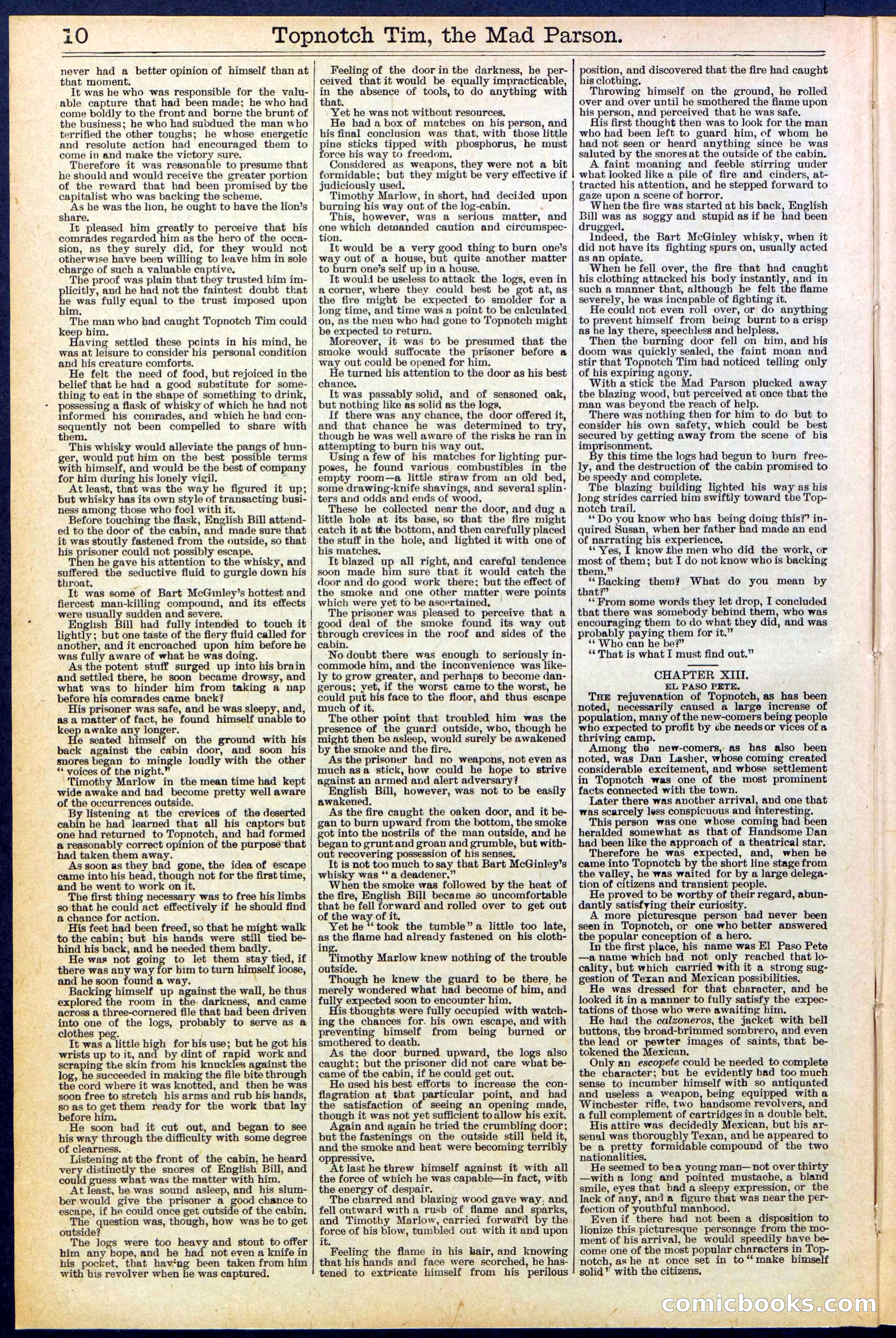
A restored page from Pulp Fiction, 1888. Page through the whole issue in the reader above.
📄 Transcribed text from this page (OCR, searchable)
Machine-transcribed from the original scan — historical spelling and the odd misread are preserved.
es, rae Topnotch Tim, the Mad Parson. never had a better opinion of himself than at that moment. It was he who was responsible for the valu- able capture that had been made; he who had come boldly to the front and borne the brunt of the business; he who had subdued the man who terrified the other toughs; he whose energetic and resolute action had encouraged them to come in and make the victory sure. Therefore it was reasonable to presume that he should and would receive the greater portion of the reward that had been promised by the capitalist who was backing the scheme. As he was the lion, he ought to have the lion’s share. It pleased him greatly to perceive that his comrades regarded him as the hero of the occa- sion, as they surely did, for they would not otherwise have been willing to leave him in sole charge of such a valuable captive. The proof was plain that they trusted him im- pany and he had not the faintest doubt that ne was fully equal to the trust imposed upon im. The man who had caught Topnotch Tim could eee him. aving settled these pcints in his mind, he was at leisure to consider his personal condition and his creature comforts. He felt the need of food, but rejoiced in the belief that he had a good substitute for some- thing to eat in the shape of something to drink, possessing a flask of whisky of which he had not informed his comrades, and which he bad con- seanently not been compelled to share with em This whisky would alleviate the pangs of hun- ger, would put him on the best possible terms with himself, and would be the best of company for him during his lonely vigil. At least, that was the way he figured it up; but whisky has its own style of transacting busi- ness among those who fool with it. Before touching the flask, English Bill attend- ed to the door of the cabin, and made sure that it was stoutly fastened from the outside, so that his prisoner could not possibly escape. Then he gave his attention to the whisky, and ae the seductive fluid to gurgle down his throat. It was some of Bart McGinley’s hottest and Feeling of the doorin the darkness, he per- ceived that it would be equally imoractioabls rs the absence of tools, to do anything with that. Yet he was not without resources, He had a box of matches on his person, and his final conclusion was that, with those little pine sticks tipped with pbosphorus, he must force his way to freedom. Considered as weapons, they were not a bit | formidable; but they might be very effective if judiciously used, Timothy Marlow, in short, had decided upon burning his way out of the log-cabin. This, however, was a serious matter, and one which dewanded caution and circumspec- tion. It would be a very good thing to burn one’s way out of a house, but quite another matter to burn one’s self up in a house. It would be useless to attack the logs, even in a corner, where they could best be got at, as the fire might be expected to smolder for a long time, and time was a point to be calculated on, as the men who had gone to Topnotch might be expected to return. Moreover, it was to be presumed that the smoke would suffocate the prisoner before a way out could be opened for him. He turned his attention to the door as his best chance, It was passably solid, and of seasoned oak, but nothing like as solid as the logs. If there was any chance, the door offered it, and that chance he was determined to try, though he was well aware of the risks he ran in attempting to burn his way out. Using a few of his matches for lighting pur- poses, he found various combustibles in the empty room—a little straw from an old bed, some drawing-knife shavings, and several splin- ters and odds and ends of wood, These he collected near the door, and dug a little hole at its base, so that the fire might catch it at the bottom, and then carefully placed the stuff in the hole, and lighted it with one of his matches. It blazed up all right, and careful tendence soon made him sure that it would catch the door and do good work there: but the effect of the smoke and one other matter were points fiercest man-killing compound, and its effects | which were yet to be ascertained, were usually sudden and severe. English The prisoner was pleased to perceive that a ill had fully intended to touch it | good deal of the smoke found its way out lightly; but one taste of the fiery fluid called for | through crevices in the roof and sides of the another, and it encroached upon him before he was fully aware of what he was doing. As the potent stuff surged up into his brain and settled there, he soon became drowsy, and what was to hinder him from taking a nap before his comrades came back? His prisoner was safe, and he was sleepy, and, as a matter of fact, he found himself unable to keep awake any longer. e seated himself on the ground with his back against the cabin door, and soon his snores began to mingle loudly with the other * voices of the night.” Timothy Marlow in the mean time had kept wide awake and had become pretty well aware of the occurrences outside. By listening at the crevices of the deserted cabin he had learned that all his captors but one had returned to Topnotch, and had formed a reasonably correct opinion of the purpose that had taken them away. As soon as they had gone, the idea of escape came into his head, though not for the first time, and he went to work on it. The first thing necessary was to free his limbs so that he could act effectively if he should find a chance for action. His feet had been freed, so that he might walk to the cabin; but his hands were still tied be- hind his back, and he needed them badly. He was not going to let them stay tied, if there was any way for him to turn himself loose, and he soon found a way. Backing himself up against the wall, he thus explored the room in the darkness, and came across a three-cornered file that had been driven into one of the logs, probably to serve as a clothes peg. | It was a little high for his use; but he got his wrists up to it, and by dint of rapid work and scraping the skin from his knuckles against the log, he succeeded in making the file bite through the cord where it was knotted, and then he was soon free to stretch his arms and rub his hands, so as to get them dy for the work tbat lay before him. He soon had it cut out, and began to see his way through the difficulty with some degree of clearness. , Listening at the front of the cabin, he heard very distinctly the snores of English Bill, and could guess what was the matter with him. At least, he was sound asleep, and his slum- ber would give the prisoner a good chance to escape, if he could once get outside of the cabin, The question was, though, how was he to get outside? The logs were too heavy and stout to offer him any hope, and he had not even a knife in his pocket, that hav‘ng been taken from him with bis revolver when he was captured. ont SS cabin. No doubt there was enough to seriously in- commode him, and the inconvenience was like- ly to grow greater, and perhaps to become dan- gerous; vet, if the worst came to the worst, he could put his face to the floor, ahd thus escape much of it. The other point that troubled him was the presence of the guard outside, who, though he might then be asleep, would surely be awakened by the smoke and the fire. As the prisoner had no weapons, not even as much asa stick, how could he hope to strive against an armed and alert adversary? English Bill, however, was not to be easily awakened. As the fire caught the oaken door, and it be- gan to burn upward from the bottom, the smoke ot into the nostrils of the man outside, and he egan to grunt and groan and grumble, but with- out recovering possession of his senses, It is not too much to say that Bart McGinley’s whisky was ‘‘ a deadener.” When the smoke was followed by the heat of the fire, English Bill became so uncomfortable that he fell forward and rolled over to get out of the way of it. Yet he ‘took the tumble” a little too late, as the flame had already fastened on his cloth- ing. Timothy Marlow knew nothing of the trouble outside. Though he knew the guard to be there, he merely wondered what had become of him, and el expected soon to encounter him. is thoughts were fully occupied with watch- ing the chances for. his own escape, and with preventing himself from being burned or smothered to death. As the door burned upward, the logs also caught; but the prisoner did not care what be- came of the cabin, if he could get out. ! He used his best efforts to increase the con- flagration at that particular point, and had the satisfaction of seeing an ok made, though it was not yet sufficient to allow his exit. Again and again he tried the crumbling door; but the fastenings on the outside still held it, and the smoke and heat were becoming terribly oppressive, t last he threw himself against it with all the force of which he was capable—in fact, witb the energy of despair. The charred and blazing wood gave way. and fell outward with a rusb of flame and sparks, and Timothy Marlow, carried forward by the force of his blow, tumbled out with it and upon it Feeling the flame in his hair, and knowing that his hands and face were scorched, he has- tened to extricate himself from his perilous be ” Rigg, 5 5 ~. Senne ee ee position, and discovered that the fire had caught his clothing. Throwing himself on the ground, he rolled over and over until he smothered the fiame upon his person, and perceived that he was safe. His first thought then was to look for the man who had been left to guard him, ef whom he had not seen or heard anything since he was saluted by the snores at the outside of the cabin. A faint moaning and feeble stirring under what looked like a pile of fire and cinders, at- tracted his attention, and he stepped forward to gaze upon a scene of horror. When the fire was started at his back, English ra = as soggy and stupid as if he had been rugged. Indeed, the Bart McGinley whisky, when it did not have its fighting spurs on, usually acted as an opiate. When he fell over, the fire that had caught his clothing attacked his body instantly, and in such a manner that, although he felt the flame severely, he was incapable of fighting it. He could not even roll over, or do anything to ps ia himself from being burnt to a crisp as he lay there, speechless and helpless. Then the burning door fell on him, and his doom was quickly sealed, the faint moan and stir that Topnotch Tim had noticed telling only of his expiring agony. With a stick the Mad Parson plucked away the blazing wood, but perceived at once that the man was beyond the reach of help. There was nothing then for him to do but to consider his own safety, which could be best secured by getting away from the scene of his imprisonment. y this time the logs had begun to burn free- ly, and the destruction of the cabin promised to be speedy and complete. The blazing building lighted his way as his long strides carried him swiftly toward the Top- notch trail. ‘Do you know who has being doing this?” in- quired Susan, when her father had made an end of narrating his experience, ‘‘- Yes, I know the men who did the work, or most of them; but I do not know who is backing them.” ‘Backing them? What do you mean by that?” ‘‘ rom some words they let drop, I concluded that there was somebody behind them, who was encouraging them to do what they did, and was probably paying them for it.” ** Who can he be?” ‘That is what I must find out.” CHAPTER XIII. EL PASO PETE. THE rejuvenation of Topnotch, as has been noted, necessarily caused a large increase of population, many of the new-comers being people who expected to profit by che needs or vices of a thriving camp. Among the new-comers, as has also been noted, was Dan Lasher, whose coming created considerable excitement, and whose settlement in Topnotch was one of the most prominent facts connected with the town. Later there was another arrival, and one that was scarcely less conspicuous and eg 5 This person was one whose coming had been heralded somewhat as that of Handsome Dan had been like the approach of a theatrical star. Therefore he was expected, and, when he came into Topnotch by the short line stage from the valley, he was waited for by a large delega- tion of citizens and transient people. He proved to be worthy of their regard, abun- dantly satisfying their curiosity. A more picturesque person had never been seen in Topnotch, or one who better answered the popular conception of a hero. In the first place, his name was El Paso Pete —a name which bad not only reached that lo- cality, but which carried with it a strong sug- gestion of Texan and Mexican possibilities. He was dressed for that character, and he looked it in a manner to fully satisfy the expec- tations of those who were awaiting him, He had the calzoneros, the jacket with bell buttons, the broad-brimmed sombrero, and even the lead or pewter images of saints, that be- tokened the Mexican, Only an escopete could be needed to complete the character; but he evidently had too much sense to incumber himself with so antiquated and useless a weapon, being equipped witha Winchester rifle, two handsome revolvers, and a full complement of cartridges in a double belt. His attire was decidedly Mexican, but bis ar- senal was thoroughly Texan, and he appeared to be a pretty formidable compound of the two nationalities, He seemed to bea young man—not over thirty —witha long and pointed mustache, a bland smile, eyes that bad a sleepy expression, or the lack of any, and a figure that was near the per- fection of youthful manhood. Even if there had not been a disposition to Jionize pie ne i 2 personage from the mo- ment of his arrival, he would speedily bave be- come one of the most popular characters in ae notch, as he at once set in to“‘make himse solid” with the citizens. JOOKS (E@)