
Pulp Fiction, 1888 · page 24 of 32
Beadle's New York Dime Library No. 501 — page 24: what you’re looking at
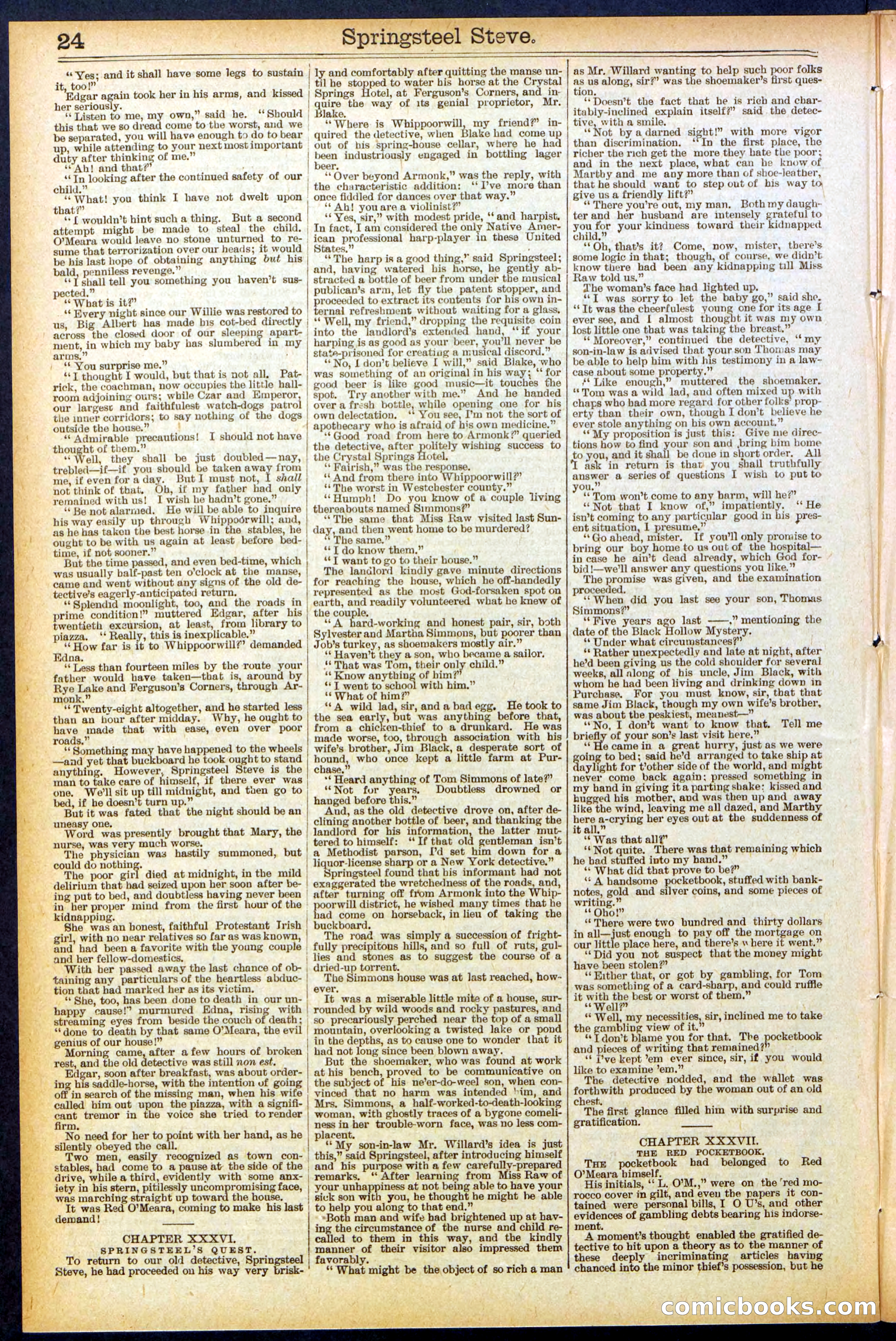
A restored page from Pulp Fiction, 1888. Page through the whole issue in the reader above.
📄 Transcribed text from this page (OCR, searchable)
Machine-transcribed from the original scan — historical spelling and the odd misread are preserved.
—s 9, 9 is - oe — a. x A L* ‘a ‘ ~ could do nothin \, # a Falah ge : * and a. ‘Sf Maa ao 4 a” > -" . | , on ; ing - uneasy one. es vr? © Sy rs ~ A oe > z 3s wr - gu 5 2 : wo ha | * ” ' “Yes; and it shall have some legs to sustain it, too!” ) oat Edgar again took her in his arms, and kissed her seriously. ‘‘ Listen to me, my own,” said he. ‘Should this that we so dread come to the worst, and we be separated, you will have enough to do to bear up, while attending to your next most important duty after thinking of me.” ‘“Ah! and that?” ‘“Tn looking after the conti child.” ‘ “What! you think I have not dwelt upon that?” * f wouldn’t hint such a thing. But a second | attempt might be made to steal the child. | O’Meara would leave no stone unturned to re- | sume that terrorization over our heads; it would | be his last hope of obtaining anything bué his | bald, penniless revenge.” ‘‘T shall tell you something you haven’t sus- ected.” “What is it?” ‘“‘ Byvery night since our Willie was restored to | us, Big Albert has made bis cot-bed directly | across the closed door of our sleeping apart- | ment, in which my baby has slumbered in my arms.” | ‘* You surprise me.” ‘7 thought I would, but that is not all, Pat- | rick, the coachman, now occupies the little hall- | room adjoining ours; while Czar and Emperor, | our largess and faithfulest watch-dogs patrol | the imuer corridors; to say nothing of the dogs | outside the house.” ' ‘‘ Admirable precautions! thought of them.” “Well, they shall be just doubled—nay, | trebled—if—if you should be taken away from | me, ifevenforaday. But I must not, I shall not think of that, Ob, if my father had only remained with us! I wish he hadn’t gone.” “Be not alarmed. He will be able to inquire his way easily up through Whippoorwill; and, | as he has taken the best horse in the stables, he | ought to be with us again at least before bed- | I should not have | time, if not sooner.” But the time passed, and even bed-time, which was usually balf-past ten o’clock at the manse, came and went without any signs of the old de- tective’s eagerly-anticipated return. “Splendid moonlight, too, and the roads in | prime condition!” muttered Edgar, after his twentieth excursion, at least, from library to piazza. ‘ Really, this is inexplicable.” “ How far is it to Whippoorwill?’ demanded Edna. ‘‘ Less than fourteen miles by the route your father would have taken—tbat is, around by Rye Lake and Ferguson’s Corners, through Ar- | onk, “Twenty-eight altogether, and he started less than an bour after midday. Why, he ought to have made that with ease, even over poor roads.” “‘ Something may bave happened to the wheels —and yet that buckboard he took ought to stand anything. However, Springsteel Steve is the man to take care of himself, if there ever was one. Wei'llsit up till midnight, and tuen go to if be doesn’t turn up.” But it was fated that the night should be an brought that Mary, the | Word was presently nurse, was very much worse. The physician was hastily summoned, iad The poor pre died at midnight, in the mild delirium that bad seized upon her soon after be- | ing put to bed, and doubtless having never been | in her proper mind from the first hour of the | kidnapping. | She was an honest, faithful Protestant Trish girl, with no near relatives so far as was known, had been a favorite with the young couple | and her fellow-domestics, With ber passed away the last chance of ob- | taining any particulars of the heartless abduc- | tion that had marked her as its victim. _ “ She, too, has been done to death in our un- | happy cause!” murmured Edna, rising with streaming eyes from beside the couch of death; | _ “done to death by that same O'Meara, the evil By Ie genius of our house!” | Morning came, after afew hours of broken rest, and the old detective was still non est. Edgar, soon after breakfast, was about order- saddle-horse, with the intention of going | off in search of the missing man, when his wife called him out upon the piazza, with a signifi- - eant tremor in the voice she tried to render - ~ ; =% Md a.” firm. No need for her _ silently obeyed the , a with her hand, as he Two men, easily recognized as town con- stables, had come to a pause at the side of the ly and comfortably after quitting the manse un- til he stopped to water his horse at the Crystal | Springs Hotel, at Ferguson’s Corners, and_in- | quire the way of its genial proprietor, Mr. | Blake. ‘“Where is Whippoorwill, my friend?’ in- quired the detective, when Blake had come up out of bis Spring-house cellar, where he had | pea industriously engaged in bottling lager nued safety of our | ‘‘Over beyond Armonk,” was the reply, with the characteristic addition: ‘I’ve more than once fiddled for dances over that way.” ‘* Ah! youare a violinist?” ‘‘ Yes, sir,” with modest pride, ‘‘ and harpist. In fact, I am considered the only Native Amer- ican professional harp-player in these United States,” “The harp is a good thing,” said Springsteel; and, having watered his horse, he gently ab- stracted a bottle of beer from under the musical publican’s arm, let fly the patent stopper, and proceeded to extract its contents for his own in- ternal refreshment without waiting for a glass, ‘‘ Well, my friend,” dropping the requisite coin into the landlord’s extended hand, ‘‘if your harping is as good as your beer, you'll never be state-prisoned for creatiag a musical discord.” “No, { don’t believe I will,” said Blake, who was something of an original in his way; ‘‘ for good beer is like good music—it touches the spot. Try another with me.” And he handed over a fresh bottle, while opening one for his own delectation. ‘* You see, I’m not the sort of apothecary who is afraid of his own medicine,” ‘‘Good road from here to Armonk?” queried the detective, after politely wishing success to the Crystal Springs Hotel. ‘* Fairish,” was the response, ‘« And from there into Whippoorwill?” ‘¢+The worst in Westchester county.” ‘“‘Humph! Do you know of a couple living thereabouts named Simmons?” ‘‘The same that Miss Raw visited last Sun- day, and then went home to be murdered? ‘* The same.” **T do know them.” ‘*T want to go to their house.” The landlord kindly gave minute directions for reaching the house, which he off-handedly represented as the most God-forsaken spot on earth, and readily volunteered what he knew of the couple. ‘‘A hard-working and honest pair, sir, both Sylvester and Martha Simmons, but poorer than Job’s turkey, as shoemakers mostly air.” ‘‘ Haven’t they a son, who became a sailor. “That was Tom, their only child.” ** Know anything of him? ‘*T went to school with him,” ‘* What of him?” ‘‘A wild lad, sir, anda badegg. He took to the sea early, but was anything before that, from a chicken-thief to a drunkard. He was made worse, too, through association with his wife’s brother, Jim Black, a desperate sort of hound, who once kept a little farm at Pur- chase.” ‘‘ Heard anything of Tom Simmons of late?” “Not for years. Doubtless drowned or hanged before this.” And, as the old detective drove on, after de- clining another bottle of beer, and thanking the landlord for his information, the latter mut- tered to himself: ‘ If that old gentleman isn’t a Methodist parson, [’'d set him down for a liquor-license sharp or a New York detective.” pringsteel found that bis informant had not exaggerated the wretchedness of the roads, and, after turning off from Armonk into the Whip- rwill district, he wished many times that he ad come on horseback, in lieu of taking the buckboard. The road was simply a succession of fright- fully precipitous hills, and so full of ruts, gul- lies and stones as to suggest the course of a dried-up torrent. The Simmons house was at last reached, how- ever. It was a miserable little muita ot a house, sur- rounded by wild woods and rocky pastures, and so precariously perched near the top of a small mountain, overlooking a twisted lake or pond in the depths, as to cause one to wonder that it had not long since been blown away. But the shoemaker, who was found at work at his bench, proved to be communicative on the subject of his ne’er-do-weel son, when con- vinced that no harm was intended ‘im, and Mrs. Simmons, a half-worked-to-death-looking woman, with ghostly traces of a bygone comeli- ness in her trouble-worn face, was no less com- placent. ‘‘ My son-in-law Mr. Willard’s idea is just this,” said Springsteel, after introducing himself and his purpose with a few carefully-prepared _ drive, while a third, evidently with some anx- | remarks. “ After learning from Miss Raw of _ iety in his stern, pitilessly uncompromising face, | your wahapenee at syeaceanet | able to have your was owtigrye 3 ight up toward the house, sick son with you, he thought he might he able It wasR O'Meara, coming to make his to a you along to that end.” de ! -»Both man and wife bad brightened up at hav- . s s G - “t last Ss To return to our old detective, Sprin teel Steve, he had proceeded on his way very brisk 5 CHAPTER XXXVI. SPRINGSTEEL’S QUEST. + Bey or: av ans ~— : ete soe es i manner of their visitor also impressed them ing the circumstance of the nurse and d re- ed to them in this way, and the kindly favo “ hat might be the object of so rich a man ’ a P rs J " as Mr. Willard wanting to help such poor folks as us along, sir?’ was the shoemaker’s first ques- tion. ““Doesn’t the fact that he is rich and char- itably-inclined explain itself?” said the detec- tive, with a smile, ‘‘Not by a darned sight!” with more vigor than discrimination. ‘‘In the first place, the ricber the rich get the more they hate the poor; and in the next place, what can he know of Marthy and me any more than of shoe-leather, that he should want to step outof his way to give us a friendly lift?” “ There you’re out, my man, Both my daugh- ter and her busband are intensely grateful to you for your kindness toward their kidnapped child,” ‘*Oh, that’s it? Come, now, mister, tbere’s some logic in that; though, of course, we didn’t know there had been any kidnapping till Miss Raw told us.” The woman’s face had lighted up. ‘‘T was sorry to let the baby go,” said she, ‘Tt was the cheerfulest young one for its age I ever see, and [I almost thougbt it was my own lost little one that was taking the breast,” ‘‘ Moreover,” continued the detective, ‘* my son-in-law is advised that your son Thomas may be able to help him with his testimony in a law- case about some property.” ** Like enough,” muttered the shoemaker. ‘Tom was a wild lad, and often mixed up with chaps who bad more regard for other folks’ prop- erty than their own, though I don’t believe he ever stole anything on his own account,” ‘My proposition is just this: Give mie direc- tions how to find your son and bring bim home to you, and it shall be done in short order, All ask in return is that you shall truthfully answer @ series of questions I wish to put to ou, ‘‘Tom won't come to any barm, will he “Not that I know of,” impaently, isn’t coming to any particular good in his ent situation, 1 presume,” ‘‘Go ahead, mister. If you'll only promise to bring our boy home to us out of the hospital— in case he ain’t dead already, which God for- bid !|—we'll answer any questions you like.” The promise was given, and the examination proceeded, ‘‘ When did you last see your son, Thomas Simmons?” ‘Five years ago last ——,” mentioning the date of the Black Hollow Mystery. ‘ Under what circumstances?” ‘* Rather unexpectedly and late at night, after he’d been giving us the cold shoulder for several weeks, allalong of his uncle, Jim Black, with whom he had been living and drinking down in Purchase. For you must know, sir, that that same Jim Black, though my own wife’s brother, was about the peskiest, meunest—” ‘*No, I don’t want to know that. Tell me briefly of your son’s last visit here,” ‘‘He camein a great hurry, just as we were going to bed; said he’d arranged to take Bip at ylight for t’other side of the world, and might never come back again: pressed something in my hand in giving ita parting shake: kissed and hugged his mother, and was then up and away like the wind, leaving me all dazed, and Marthy ae a-crying her eyes out at the suddenness of it all, ‘** Was that all?” ‘Not quite. There was that remaining which he bad stuffed into my hand.” ‘* What did that prove to be?” ‘* A handsome ketbook, stuffed with bank- notes, gold and silver coins, and some pieces of writing.” “ce Oho {”? ‘There were two bundred and thirty dollars in mr pa enough to pay off the mortgage on our little place here, and there’s « here it went.” “Did you not suspect that the money might have been stolen?” ‘‘ Either that, or got by gambling, for Tom was something of a card-sharp, and could ruffle it with the best or worst of them.” ** Well?” : “ Well, my necessities, sir, inclined me to take the gambling view of it.” “‘T don’t blame you for that. The pocketbook and pieces of writing that remained?” ‘* i've kept °em ever since, sir, if you would like to examine ’em.” The detective nodded, and the wallet was a rhe ga produced by the woman out of an old chest, The first glance filled him with surprise and gratification. CHAPTER XXXVII. THE RED POCKETBOOK, THe pocketbook had belonged to Red O'Meara himself. His initials, ‘‘ L. O'M.,” were on the ‘red mo- rocco cover in gilt, and aren the papers it con- tained were personal bills, I O U’s, and other evidences of gambling debts bearing his indorse- ment. A moment’s thought enabled the gratified de- tective to hit upon a theory as to the manner of these deeply incriminating articles having chanced into the minor thief’s possession, but he Q ‘* He pres- j | \ | = =; at 2S a ov ear ay ee, Fy, >? : pogs “ re,