
Pulp Fiction, 1888 · page 12 of 32
Beadle's New York Dime Library No. 501 — page 12: what you’re looking at
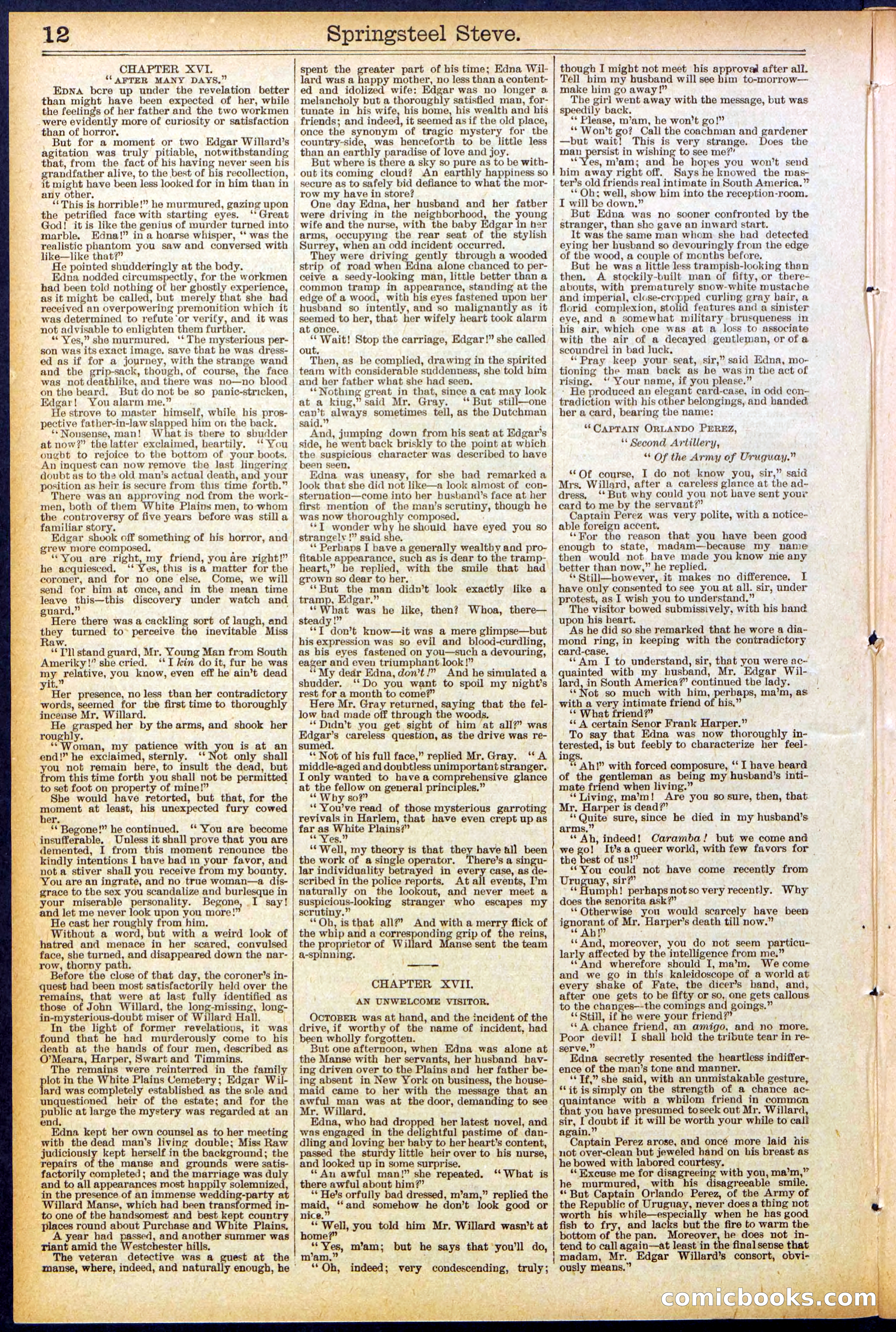
A restored page from Pulp Fiction, 1888. Page through the whole issue in the reader above.
📄 Transcribed text from this page (OCR, searchable)
Machine-transcribed from the original scan — historical spelling and the odd misread are preserved.
o ‘hed CHAPTER XVI. ‘“AYTER MANY DAYS.” Epna bere up under the revelation better than might have been expected of her, while the feelings of her father and the two workmen were evidently more of curiosity or satisfaction than of horror, But for a moment or two Edgar Willard’s agitation was truly that, from the fact of his having never seen bis ‘andfather alive, to the best of his recollection, it might have been less looked for in him than in any other. ‘‘ This is horrible!” he murmured, gazing upon the petrified face with starting eyes. ‘Great God! it is like the genius of murder turned into marble. Edna!” in a hoarse whisper, ‘* was the realistic phantom you saw and conversed with like—like that?” He pointed shudderingly at the body. Edna nodded circumspectly, for the workmen had been told nothing of ber ghostly experience as it might be called, but merely that she ha received an overpowering premonition which it was determined to refute or verify, and it was not advisable to enlighten them further. “Yes,” she murmured, ‘‘ The mysterious per- son was its exact image. save that he was dress- ed as if for a journey, with the strange wand and the grip-sack, though, of course, the face was not deathlike, and there was no—no blood on the beard. But do not be so panic-stricken, Edgar! You alarm me.” pective father-in-law slapped him on the back, ** Nonsense, man! Whatis there to shudder at now?” the latter exclaimed, heartily. ‘‘ You ougbt to rejoice to the bottom of your boots. An inquest can now remove the last lingering doubt as to the old man’s actual death, and your _ position as heir is secure from this time fortb.” | here was an approving nod from the work- | men, both of them White Plains men, to whom the controversy of five years before was stilla familiar story. | Edgar shook off something of his horror, and grew more composed. ; J ‘You are right, my friend, you are right!” he acquiesced. ‘‘ Yes, this isa matter for the coroner, and for no one else. Come, we will send for him at once, and in the mean time jeave this—this discovery under watch and guard,” ‘ Here there was a cackling sort of laugh, and they turned to» perceive the inevitable Miss aw. “Pll stand guard, Mr. Young Man from South Ameriky!” she cried. ‘I kin do it, fur he was a aaa you know, even eff he ain’t dead t. v2 i Her presence, no less than her contradictory words, seemed for the first time to thoroughly incense Mr, Willard. | He grasped her by the arms, and shook her _ roughly. “Woman, my patience with you is at an end!" he exclaimed, sternly. ‘‘ Not only shall you not remain here, to insult the dead, but _ from this time forth you shall not be permitted to set foot on property of mine!” - $he would have retorted, but that, for the ae aria at least, his umexpected fury cowed _ * Begone!” he continued, ‘“ You are become insufferable, Unless it shall prove that you are demented, I from this moment renounce the kindly intentions I bave bad in your favor, and _ nota stiver shall you receive from my bounty. _ You are an ingrate, and no true woman—a dis- grace to the sex you scandalize and burlesque in your miserable personality. Begone, I say! and let me never look upon you more!” He east her roughly from him. _ Without a word, but with a weird look of - hatred and menace in her scared, convulsed _ face, she turned, and disappeared down the nar- row, thorny path. _ Before the close of that day, the coroner’s in- quest had been most satisfactorily held over the - remains, that were at last fully identified as - those of John Willard, the long-missing, long- n-mysterious-doubt miser of Willard Hall. In the light of former revelations, it was _ found that he had murderously come to his death at the hands of four men, described as _ O'Meara, Harper, Swart and Timmins. The remains were reinterred in_the family _ plot in the White Plains Cemetery; Edgar Wil- _ lard was completely established as the sole and as et ha heir of the estate: and for the _ public at large the mystery was regarded at an at Bn va 4 * ‘ A ‘ . 7 d, | kept her own counsel as to her meeting _ with the dead man’s living double; Miss Raw a mclonaly, kept herself in the background; the _vepairs of the manse and grounds were satis- _ factorily completed; and the marriage was dul _ and to all appearances most happily solemnized, . in the presence of an immense wedding-party at _ Willard Manse, which had been transformed in- _ to one of the bandsomest and best kept country _ places round about Purchase and White Plains, Ayear had pace and another summer was o estchester hills, est at the r a - * ms Litt 7 Syn. - =e . 7 itiable, notwithstanding | e strove to master himself, while his pros- | _ manse, where, indeed, and naturally enough, he | UM ‘ oe P eet ae > “7 ‘ge oie te a P 7s) eve. _ spent the greater part of his time; Edna Wil- lard wus a happy mother, no less than a content- ed and idolized wife: Edgar was no longer a | melancholy but a thoroughly satisfied man, for- | tunate in his wife, his home, his wealth and his friends; and indeed, it seemed as if the old place, once the synonym of tragic mystery for the country-side, was henceforth to be little less than an earthly paradise of love and joy. But where is there a sky so pure as to be with- . out its coming cloud? An earthly happiness so secure as to safely bid defiance to what the mor- row my have in store? One day Edna, her husband and her fatber were driving in the neighborhood, the young wife and the nurse, with the baby Edgar in her arms, occupying the rear seat of the stylish Surrey, when an odd incident occurred. They were driving gently through a wooded strip of road when Edna alone chanced to per- ceive a seedy-looking man, little better than a common fearp in appearance, standing at the edge of a wood, with his eyes fastened upon her husband so intently, and so malignantly as it seemed to her, that her wifely heart took alarm at once. ‘‘ Wait! Stop the carriage, Edgar!” she called out, Then, as be complied, drawing in the spirited team with considerable suddenness, she told him and her father what she had seen. ‘*Nothing great in that, since a cat may look at a king,” said Mr. Gray. “ But still—one | capt always sometimes tell, as the Dutchman said.’ | And, jumping down from his seat at Hdgar’s | side, he went back briskly to the point at which | the suspicious character was described to have | been seen, | Edna was uneasy, for she bad remarked a _Jook that she did not like—a look almost of con- | sternation—come into her husband’s face at her | first mention of the man’s scrutiny, though he was now thoroughly composed. | ‘*T wonder why he should have eyed you so strangely!” said she. | ‘* Perhaps I bave a generally wealthy and pro- | fitable appearance, such as is dear to the tramp- heart,” be replied, with the smile that had | grown so dear to her. ‘*But the man didn’t look exactly like a tramp, Edgar.” ‘‘What was he like, then? Whoa, there— | steady hay “T don’t know—it was a mere glimpse—but his expression was so evil and blood-curdling, as his eyes fastened on you—such a devouring, eager and even triumphant look!” ‘*My dedr Edna, don’t!” And he simulated a shudder. ‘‘Do you want to spoil my night’s rest for a month to come?” Here Mr. Gray returned, saying that the fel- low had made off through the woods. ‘*Didn’t you get sight of him at all?’ was Hdgar ® careless question, as the drive was re- sumed. ‘** Not of his full face,” replied Mr.Gray. ‘SA middle-aged and doubtless unimportant stranger. I only wanted to have a comprehensive glance at the fellow on general principles.” “Why so?” ‘’You’ve read of those mysterious garroting revivals in Harlem, that have even crept up as far as White Plains?” “sé Yes.” ‘‘ Well, my theory is that they have all been the work of asingle operator. There’s a singu- lar individuality betrayed in every case, as de- scribed in the police reports, At all events, ’m naturally on the lookout, and never meet a suspicious-looking stranger who escapes my scrutiny.” “Oh, is that all? And with a merry flick of the whip and a oqreepana grip of the reins, the proprietor of Willard Pea sent the team a-spinning,. } ———— ee CHAPTER XVIL. AN UNWELCOME VISITOR, OCTOBER was at hand, and the incident of the drive, if worthy of the name of incident, had been wholly forgotten. | But one afternoon, when Edna was alone at the Manse with her servants, her husband hav- ing driven over to the Plains and her father be- ing absent in New York on business, the house- maid came to her with the message that an awful man was at the door, demanding to see Edna, who had dropped her latest novel, and was enga in the delightful pastime of dan- dling and loving ber baby to her heart’s content, the sturdy little heir over to his nurse, Mr. Willard passed and looked up in some surprise ** Anu awful man!” she repea “What is there awful about him?’ ‘* He’s orfully bad dressed, m’am,” replied the maid, “and somehow | “ Well, you told him Mr. Willard wasn’t at home ** Oh, indeed ; he don’t look good or nice. 4 Yes, mam; but he says that you'll do, ‘very condescending, truly; * ’ + eating See Sb nt 18 SS SE ES as ae Nl ee ede ~_ 9 ee ee co i though I might not meet his approval after all. Tell bim my husband will see him to-morrow— make him go away!” The girl went away with the message, but was speedily back. ‘** Please, m’am, he won't go!” **'Won’t go? Call the coachman and gardener —but wait! This is very strange. Does the mau persist in wishing to see me?” ‘Yes, m’am; and he hopes you won’t send him away right off. Says he knowed the mas- ter’s old friends real intimate in South America.” ‘* Oh; well, show him into the reception-room. I will be down.” _ But Edna was no sooner confronted by the stranger, than she gave an inward start. It was the same man whom she bad detected eying her husband so pr hapidicn from the edge of the wood, a couple of months before, But he was a little less trampish-looking than then. A stockily-built man of fifty, or there- abouts, with prematurely snow-white mustache and imperial, close-cropped curling gray bair, a florid complexion, stolid features and a sinister eye, and a somewhat military brusqueness in his air, which one was at a loss to associate with the air of a decayed gentleman, or ofa scoundrel in bad luck, ‘Pray keep your seat, sir,” said Edna, mo- tioning the man back as he was in the act of rising. ‘ Your name, if you please.” - He produced an elegant card-case, in odd con- tradiction with his other belongings, and handed. her a card, bearing the name: “CAPTAIN ORLANDO PEREZ, ** Second Artillery, “* Of the Army of Uruguay.” “Of course, I do not know you, sir,” said Mrs. Willard, after a careless glance at the ad- dress, ‘* But why could you not have sent your card to me by the servant?” Captain Perez was very polite, with a notice- able foreign accent, “For the reason that you have been good enough to state, madam—because my name then would not have made you know nie any better than now,” he replied. ‘* Still—however, it makes no difference. I have only consented to see you at all. sir, under protest, as I wish you to understand.” The visitor bowed submissively, with his hand upon his beart. As he did so she remarked that he wore a dia-~ mond ring, in keeping with the contradictory card-case. ‘‘Am I to understand, sir, that you were ac- quainted with my husband, Mr, Edgar Wil- lard, in South America?’ continued the lady. ‘Not so much with him, perbaps, ma’m, as ~ with a very intimate friend of his,” ‘¢ What friend?” ‘¢ A certain Senor Frank Harper.” To say that Edna was now thoroughly in- terested, is but feebly to characterize her feel- D Pah !” with forced composure, ‘‘ I have heard of the gentleman as being my husband’s inti- mate friend when living.” ‘* Living, ma’m! Are you so sure, then, that Mr. Harper is dead?” ‘‘Quite sure, since he died in my husband's arms,” ‘“* Ah, indeed! Caramba! but we come and wego! Itsa queer world, with few favors for the best of us!’ ‘““You could not have come recently from Uruguay, sir?” ‘‘ Humph! perhaps notso very recently. Why does the senorita ask?” ‘‘Otherwise you would scarcely have been ignorant of Mr, Harper’s death till now.” sé Ab!” . ‘¢ And, moreover, you do not seem particu- larly affected by the intelligence from me.” ‘“And wherefore should I, ma’m, We come and we go in this kaleidoscope of a world at every shake of Fate, the dicer’s band, and, after one gets to be fifty or so, one gets callous to the changes—-the comings and goings.” ‘‘ Still, if he were your friend?” ‘* A chance friend, an amigo, and no more. Poor devil! I shall hold the tribute tear in re- serve. Edna secretly resented the heartless indiffer- ence of the man’s tone and manner. ‘‘ Tf,” she said, with an unmistakable gesture, ‘it is simply on the strength of a chance ac- uaintance with a whilom friend in common that you have presumed toseek out Mr. Willard, sir, I doubt if it will be worth your while to call a , Captain Perez arose, and oncé more laid his not over-clean but jeweled hand on his breast as he bowed with labored courtesy. ‘Excuse me for disagreeing with you, ma’m,” he murmured, with his disagreeable é ‘* But Captain Orlando Perez, of the Army of the Republic of Uruguay, never does a thing not worth his while—especially when he has good fish to fry, and lacks but the fire to warm the bottom of the pan. Moreover, he does not in- tend to call again—at least in the final sense that madam, Mr. Edgar Willard’s consort, obvi- ously means.” . er ee Ce : an _ Dee? : -~ Ads Weds pe al 4 r. : a TOE + >? oad a 4. 2 ; 7 5.CO