
Pulp Fiction, 1888 · page 3 of 32
Beadle's Dime Library No. 490: 'The Lone Hand in Texas' — page 3: what you’re looking at
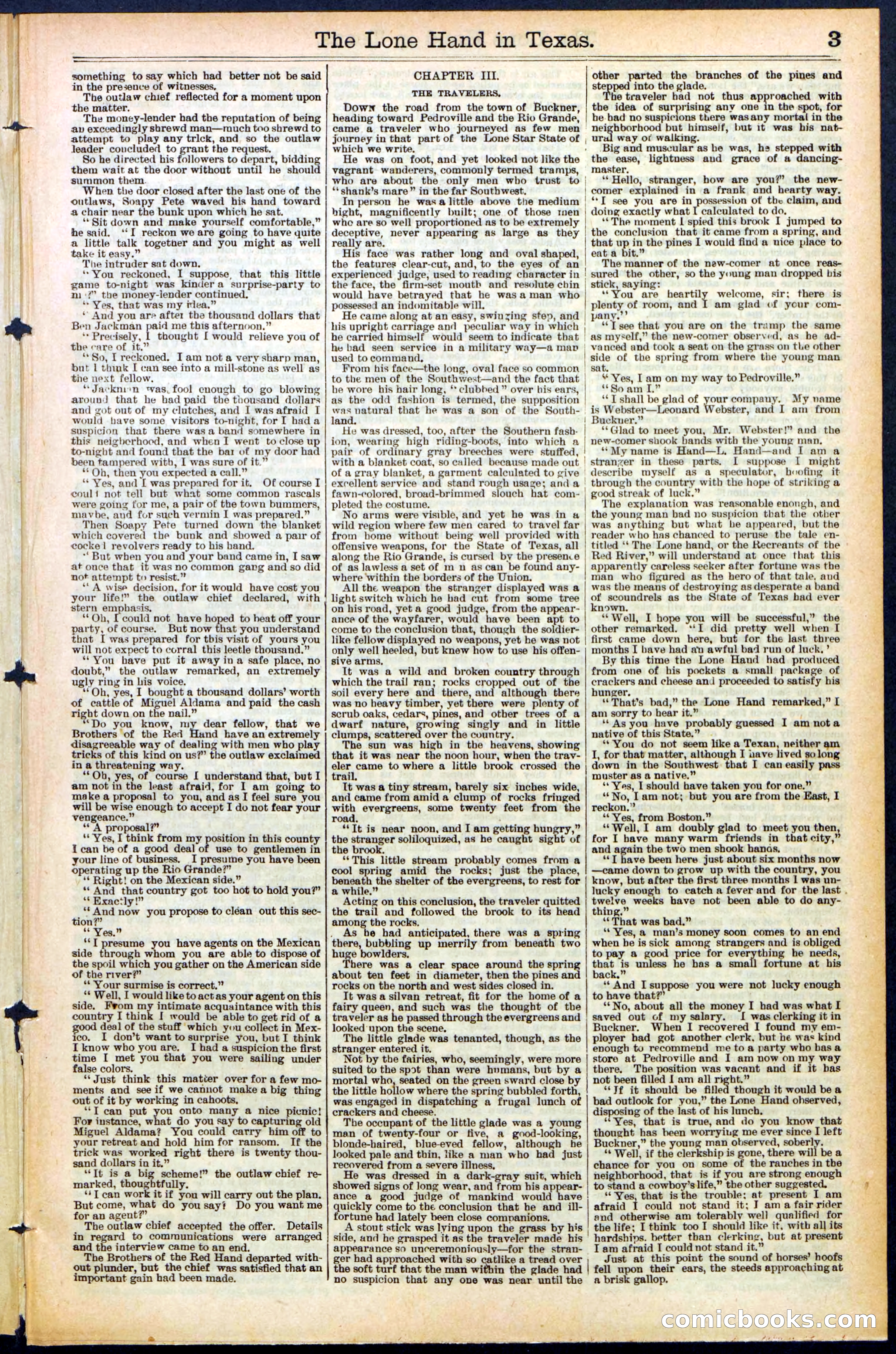
A restored page from Pulp Fiction, 1888. Page through the whole issue in the reader above.
📄 Transcribed text from this page (OCR, searchable)
Machine-transcribed from the original scan — historical spelling and the odd misread are preserved.
—_—--— —- ——_ ae. something to say which had better not be said in the presence of witnesses, The outlaw chief reflected for a moment upon the matter. The money-lender had the reputation of being av exceedingly shrewd man—much too shrewd to attempt to play any trick, and so the outlaw leader coucluded to grant the request. So he directed his followers to depart, bidding them wait at the door without until he should summon them. When tle door closed after the last one of the outlaws, Soapy Pete waved his hand toward a chair near the bunk upon which he sat. ‘Sit down and make yourself comfortable,” he said. ‘‘I reckon we are going to have quite a little talk together and you might as well take it easy.” The intruder sat down. ‘You reckoned, I suppose, that this little game to-night was kindera surprise-party to nm :?” the money-lender continued, ** Yes, that was my rea,” * And you are after the thousand dollars that Ben Jackman Tape me this afternoon,” * Precisely, | thought [ would relieve you of the eare of it.” ‘**So, [ reckoned. I am not a very sharp man, but | think [ can see into a mill-stone as well as the next fellow. *Jacknivn tvas. fool enough to go blowing aroun! that he bad paid the thousand dollars and got out of my clutches, and I was afraid I would bave some visitors to-night, for I hada suspicion that there was a band somewhere in this neigberhoed, and when I went to close up to-night and found that the bar of my door had been tampered with, I was sure of it.” ** Oh, then you expected a call.” ‘* Yes, and [ was prepared for it. Of course I coul! not tell but what some common rascals were going for me, a pair of the town bummers, mavbe, and for such vermin I was prepared.” Then Soapy Pete turned down the blanket which covered the bunk and showed a pair of cocke 1 revolvers ready to his band. “But when you and your band came in, I saw at once that it was no common gang and so did not attempt to resist.” ‘‘ A wise decision, for it would have cost you your life!” the outlaw chief declared, with stern emphasis, “Oh, [ could not have ho to beat off your party, of course. But now that you understand that I was prepared for this visit of yours you will not expect to corral this leetle thousand.” ** You have put it away ina safe place, no doubt,” the outlaw remarked, an extremely ugly ring in his voice. ‘**Oh, yes, I bought a thousand dollars’ worth of cattle of Miguel Aldama and paid the cash right down on the nail.” “Do you know, my dear fellow, that we Brothers of the Red nd have an extremely disagreeable way of dealing with men who play tricks of this kind on us?” the outlaw exclaimed in a threatening way. ** Ob, yes, of course [ understand that, but I am not in the least afraid, for I am going to make a proposal to you, and asI feel sure you will be wise enough to accept I do not fear your vengeance.” ‘* A proposal?” ‘* Yes, I think from my pon in this county I can be of a good deal of use to gentlemen in your line of business, I presume you have been operating up the Rio Grande?” ‘* Right! on the Mexican side.” ** And that country got too hot to hold you?” © Exactly!” ‘* And now you propose to cléan out this sec- tion?” °° ee.9 ‘*T presume you have agents on the Mexican side through whom you are able to dispose of the spoil which you gather on the American side of the river?” ‘** Your surmise is correct.” _‘* Well, I would like to act as your agent on this side. From my intimate acquaintance with this country I think I would be able to get rid of a deal of the stuff which you collect in Mex- ico. I don’t want to surprise you, but I think I know who you are, I had a suspicion the first time I met you that you were sailing under false colors. “Just think this matier over for a few mo- ments and see if we cannot make a big thing out of it by working in cahoots, “IT can put you onto many a nice picnic! For instance, what do you say to capturing old Miguel Aldama? You could carry him off to your retreat and hold him for ransom. If the trick was worked right there is twenty thou- sand dollars in it.” “It is a big scheme!” the outlaw chief re- marked, thoughtfully. ‘*T can work it if you will carry out the plan. But come, what do yousay# Do you want me for an agent?” — The outlaw chief accepted the offer. Details in to communications were arranged and the interview came to an end. The Brothers of the Red Hand departed with- out plunder, but the chief was satisfied that an important gain had been made. re ae Ps The Lone Hand in Texas. CHAPTER III. THE TRAVELERS, Down the road from the town of Buckner, heading toward Pedroville and the Rio Grande, came a traveler who journeyed as few men journey in that part of the Lone Star State of which we write. He was on foot, and yet looked not like the vagrant wanderers, commonly termed tramps, who are about the only men who trust to | ‘*shank’s mare” in the far Southwest. In person he was alittle above the medium hight, magnificently built; one of those rnoen whe are so well proportioned as to be extremely deceptive, never appearing as large as they really are. His face was rather long and oval shaped, the features clear-cut, and, to the eyes of an experienced judge, used to reading character in the face, the firm-set mouth and resolute chin would have betrayed that he was aman who possessed an indomitable will. He came along at an easy, swinzing step, and his upright carriage and peculiar way in which he carried himself would seem to indicate that he bad seen service in a military way—a map used to command, From his face—the long, oval face so common to the men of the Southwest—and the fact that he wore his hair long, ‘* clubbed” over his ears, as the odd fashion is termed, the supposition ie natural that he was a son of the South- and. He was dressed, too, after the Southern fasb- ion, wearing high riding-boots, into which a pair of ordinary gray breeches were stuffed, with a blanket coat, so called because made out of a gray blanket, a garment calculated to give excellent service and stand rough usage; anda fawn-colored, broad-brimmed slouch hat com- pleted the costume. No arms were visible, and yet he was in a wild region where few men cared to travel far from home without being well provided with offensive weapons, for the State of Texas, all along the Rio Grande, is cursed by the presence of as lawless a set of m n as can be found any- where within the borders of the Union. All the weapon the stranger displayed was a light switch which he had cut from some tree on his road, yet a good judge, from the appear- ance of the wayfarer, would have been apt to come to the conclusion that, though the soldier- like fellow displayed no weapons, yet he was not only well heeled, but knew how to use his offen- sive arms, It was a wild and broken country through which the trail ran; rocks cropped out of the soil every here and there, and although there was no heavy timber, yet there were plenty of scrub oaks, cedars, pines, and other trees of a dwarf nature, wing singly and in little clumps, scattered over the country. The sun was high in the heavens, showing that it was near the noon hour, when the trav- ee to where a little brook crossed the tra Tt was a tiny stream, barely six inches wide, and came from amid a clump of rocks fringed we evergreens, some twenty feet from the Tr . ” ‘Tt is near noon, and I am getting hungry,” the stranger soliloquized, as he caught sight of the brook. ‘*This little stream probably comes from a cool spring amid the rocks; just the place, beneath the shelter of the evergreens, to rest for a while.” Acting on this conclusion, the traveler quitted the trail and followed the brook to its head among the rocks. . As he had anticipated, there was a spring there, bubbling up merrily from beneath two huge bowlders. here was a clear space around the spring about ten feet in diameter, then the pines an rocks on the north and west sides cl Tt was a silvan retreat, fit for the home of a fairy queen, and such was the thought of the traveler as he passed through the evergreens and looked upon the scene, The little glade was tenanted, though, as the stranger entered it. Not by the fairies, who, seemingly, were more suited to the spot than were humans, but by a mortal who, seated on the green sward close by the little hollow where the spring bubbled forth, was engaged in dispatching a frugal lunch of crackers and cheese. The occupant of the little glade was a young men of twenty-four or tive, a good-looking, blonde-haired, blue-eved fellow, although he looked pale and thin, tike a man who had just recovered from a severe illness, He was dressed in a dark-gray suit, which showed signs of long wear, and from his appear- ance a good judge of mankind would have uickly come to the conclusion that he and ill- ortune had lately been close companions. side, and he grasped it as the traveler made his appearance so unceremoniously—for the stran- ger had approached with so catlike a tread over the soft turf that the man within the glade had no suspicion that any ope was near until the a ee eT ———————— LT A stout stick was lying upon the grass by his | . other parted the branches of the pines and stepped into the glade. he traveler had not thus approached with the idea of surprising any one in the spot, for be bad no suspicions there wasany mortal in the neighborhood but himself, but it was bis nat- | ural way of walking. Big and muscular as he was, he stepped with the ease, lightness and grace of a dancing- master. ‘Hello, stranger, how are you?’ the new- | comer explained in a frank and hearty way. '**T see you are in possession of tbe claim, and | doing exactly what I calculated to do, | ‘*The moment | spied this brook I jumped to the conclusion that it came from a spring, and that up in the pines I would find a nice place to eat a bit.” The manner of the new-comer at once reas- | sured the other, so the young man dropped bis | stick, saying: “You are heartil plenty of room, and any.’’ welcome, sir; there is am glad of your com- | Tsee that you are on the tramp the same 'as myself,” the new-comer observed, as he ad- ' vanced and took a seat on the grass on the other side of the spring from where the young man sat. “Yes, [am on my way to Pedroville.” “So am I.” ‘*T shall be glad of your compauy. My name is Webster—Leovard Webster, and I am from Buckuer.” ‘*Glad to meet you, Mr. Webster!” and the new-comer shook bands with the young man, ‘*My name is Hand—L. Hand—and I am a stranzer in these parts. I suppose | might describe myself as a speculator, boofing it through the country with the hope of striking a good streak of luck.” The explanation was reasonable enough, and the young man bad no suspicion that the other was anything but what be appeared, but the reader who has chanced to peruse the tale en- titled ‘‘ The Lone hand, or the Recreants of the Red River,” will understand at once that this apparently careless seeker after fortune was the man who figured as the hero of that tale, and was the means of destroying as desperate a band of scoundrels as the State of Texas bad ever nown. ‘‘ Well, I hope you will be successful,” the other remarked. ‘I did pretty well when I first came down here, but for the last three months I bave had an awful bad run of luck,’ By this time the Lone Hand had produced from one of his pockets a small package of crackers and cheese and proceeded to satisfy his hunger. ‘‘That’s bad,” the Lone Hand remarked,” I am sorry to hear it.” , ‘* As you have probably guessed I am nota native of this State.” . **You do not seem like a Texan, neither am I, for that matter, although I ave lived solong down in the Southwest tbat I can easily pass muster as a native,” ‘Yas, I should have taken you for one.” ‘“‘No, Lam not; but you are from the East, I reckon.” ‘* Yes, from Boston.” ‘Well, I am doubly glad to meet you then, for I bave many warm friends in that city, and —_— the two men shook hanas, ‘*T have been here just about six months now —came down to grow up with the country, you know, but after the first three months | was un- twelve weeks have not been able to do any- thing,” “That was bad.” . ‘* Yes, a man’s money soon comes to an end when be is sick among strangers and is obliged to pay a good price for everything he needs, that is unless he bas a small fo e at bis back,” “And I suppose you were not lucky enough to have that?’ ** No, about all the money I had was what I saved out of my salary. I was clerking it in Buckner. When I recovered I found my em- ployer had got another clerk, but he was kind enough to recommend me to a party who basa store at Pedroville and I am now on oF way there, The position was vacant and if it bas not been filled I am all right.” ‘“‘¥f it should be filled though it would be a bad outlook for you,” the Lone Hand observed, disposing of the last of his lunch, “Yes, that is true, and do you know that thought has been worryiug me ever since I left Buckner,” the young man observed, soberly. “* Well, if the clerkship is gone, there will be a chance for you on some of the ranches in the neighborhood, that is if you are strong enough to stand a cowboy’slife,” the other suggested, “Yes, that isthe trouble; at present I am afraid I could not stand it; J ama fair rider and otherwise am tolerably well qualified for the life; I think too I should like it, with all its hardshins. better than clerking, but at present I am afraid I could not stand it.” Just at this point the sound of horses’ hoofs | fell upon their ears, the steeds approaching at a brisk gallop. lucky enough to catch a fever and for the last . ee 4 EO NMMICE KOOKS (¢ hha a