
Pulp Fiction, 1888 · page 8 of 32
Beadle's New York Dime Library No. 483 — page 8: what you’re looking at
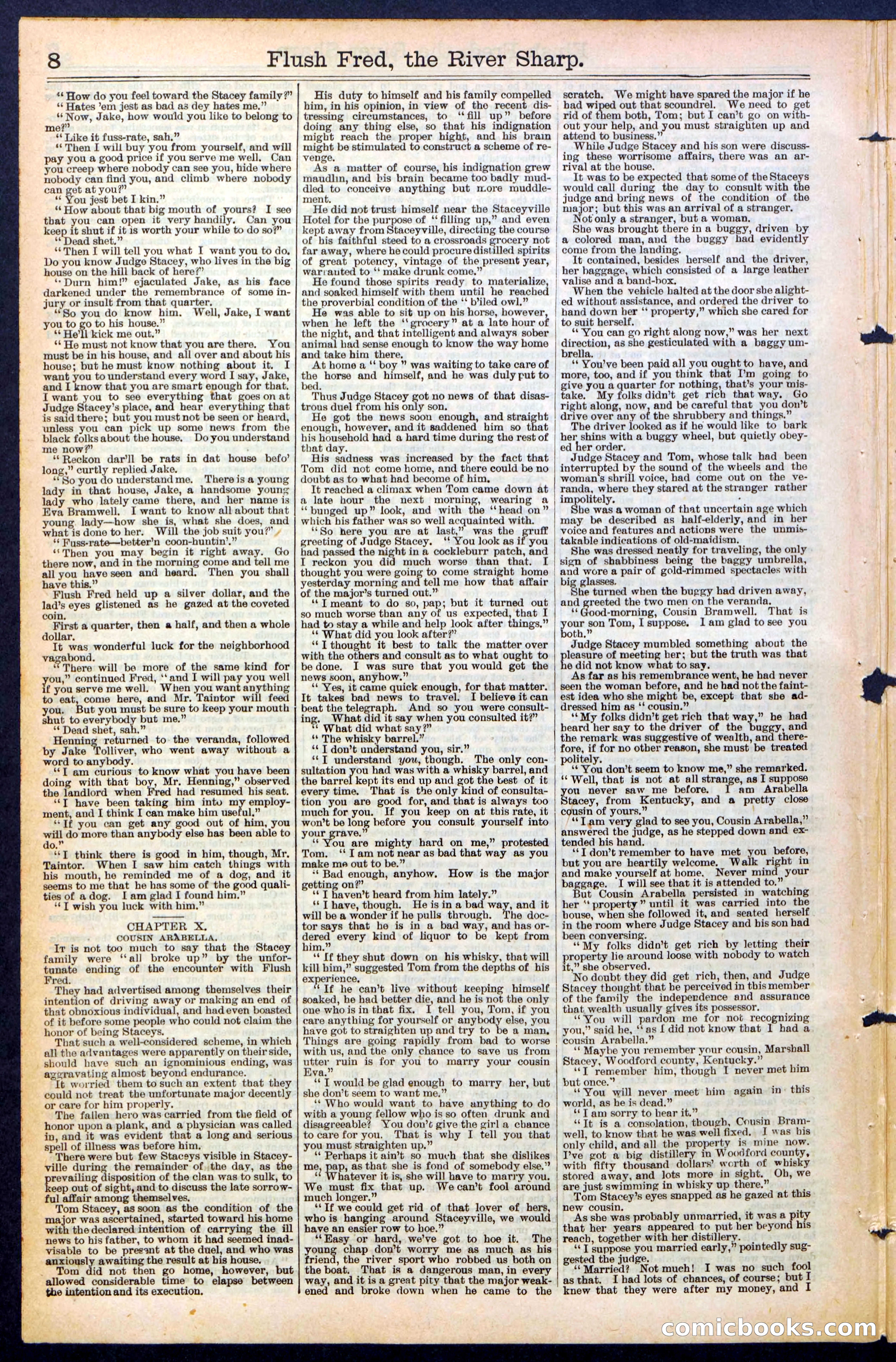
A restored page from Pulp Fiction, 1888. Page through the whole issue in the reader above.
📄 Transcribed text from this page (OCR, searchable)
Machine-transcribed from the original scan — historical spelling and the odd misread are preserved.
: ¢ - 8 *‘ How do you feel toward the Stacey family?” ‘‘ Hates ’em jest as bad as dey hates me.” ‘*‘ Now, Jake, how would you like to belong to rb] ‘‘ Like it fuss-rate, sah,” ‘‘ Then I will buy you from yourself, and will pay you a good price if you serve me well, Can you creep where nobody can see you, hide where nobody can find you, and climb where nobody can get at you?” ‘* You jest bet I kin.” “‘ How about that big mouth of yours? I see that you can open it very handily. Can you keep it shut if it is worth your while to do so?” ‘* Dead shet,” ‘Then I will tell you what I want you to do, Do you know Judge Stacey, who lives in the big house on the hill back of here?” ‘**Durn him!” ejaculated Jake, as his face darkened under the remembrance of some in- jury or insult from that quarter. ““So you do know him. Well, Jake, I want you to go to his house.” *¢ He'll kick me out.” ‘“ He must not know that you are there. You must be in his house, and all over and about his house; but he must know nothing about it. I want you to understand every word I say, Jake, and I know that you are smart enough for that. I want you to see everything that goes on at Judge Stacey’s place, and hear everything that is said there; but you must not be seen or heard, unless you can pick up some news from the black folks about the house. Do you understand me now?” ‘‘Reckon dar’ll be rats in dat house befo’ long,” curtly replied Jake, ‘“So you do understandme. Thereis a young lady in that house, Jake, a handsome young lady who lately came there, and her name is Eva Bramwell. I want to know all about that young. lady—how she is, what she does, and what is done to her. Will the job suit you?” / ‘¢ Wyuss-rate—better’n coon-huntin’.” ‘‘Then you may begin it right away. Go there now, and in the morning come and tell me all you have seen and heard, Then you shall have this.” Flush Fred held up a silver dollar, and the lad’s eyes glistened as he gazed at the coveted coin, First a quarter, then a half, and then a whole dollar. It was wonderful luck for the neighborhood vagabond. ; “There will be more of the same kind for ou,” continued Fred, ‘‘and I will pay you well you serve me well. When you want anything to eat, come here, and Mr. Taintor will feed you. But you must be sure to keep your mouth shut to everybody but me.” ‘“‘ Dead shet, sah.” Henning returned to the veranda, followed by Jake Tolliver, who went away without a word to anybody. ‘“*T am curious to know what you have been doing with that boy, Mr. Henning,” observed the landlord when Fred had resumed his seat. ‘““T have been taking him into my employ- ment, and I think I can make him useful.” “Tf you can get any good out of him, you will do more than anybody else has been able to y : do, ‘‘T think there is good in him, though, Mr. Taintor. When I saw him catch things with his mouth, he reminded me of a dog, and it seems to me that he has some of the good quali- ties of adog. Iam glad I found him.” ‘*T wish you luck with him.” CHAPTER X, COUSIN ARABELLA, Ir is not too much to say that the Stacey family were ‘“‘all broke up” by the unfor- tunate ending of the encounter with Flush Fred. They had advertised among themselves their intention of driving away or making an end of that obnoxious individual, and hadeven boasted of it before some people who could not claim the honor of being Staceys. That such a well-considered scheme, in which all the advantages were apparently on their side, oe as ts » - v “ > * 4 A, - should have such an ignominious ending, was azeravating almost beyond endurance. It worried them to such an extent that they could not treat the unfortunate major decently or care for him properly, The fallen hero was carried from the field of honor upon a plank, and a physician was called in, and it was evident that a long and serious ll of illness was before him. _ There were but few Staceys visible in Stacey- ville during the remainder of. the day, as the revailing disposition of the clan was to sulk, to p out of sight, and to discuss the late sorrow- ful affair among themselves, Tom Stacey, as soon as the condition of the major was ascertained, started toward his home with the declared intention of carrying the ill news to his father, to whom it had seemed inad- visable to be presant at the duel, and who was anxiously awaiting the result at bis house, Tom did not then go home, however, but allowed considerable time to elapse between the intention and its execution, @ ¢ Flush Fred, the River Sharp. His duty to himself and his family compelled him, in his opinion, in view of the recent dis- tressing circumstances, to ‘‘fill up” before doing any thing else, so that his indignation might reach the proper hight, and his brain might be stimulated to construct a scheme of re- venge. As a matter of course, his indignation grew maudlin, and bis brain became too badly mud- dled to conceive anything but more muddle- ment. He did not trust himself near the Staceyville Hotel for the purpose of ‘‘ filling up,” and even kept away from Staceyville, directing the course of his faithful steed to a crossroads grocery not far away, where he could procure distilled spirits of great potency, vintage of the present year, warrauted to ‘‘ make drunk come,” He found those spirits ready to materialize, and soaked himself with them until he reached the proverbial condition of the ‘‘ b’iled owl.” He was able to sit up on bis horse, however, when he left the ‘‘grocery” at a late hour of the night, and that intelligent and always sober animal had sense enough to know the way home and take him there, At home a ‘‘ boy ” was waiting to take care of — horse and himself, and he was duly put to Thus Judge Stacey got no news of that disas- trous duel from his only son. He got the news soon enough, and straight enough, however, and it saddened him so that his household had a hard time during the rest of that day. His sadness was increased by the fact that Tom did not come home, and there could be no doubt as to what had become of him, It reached a climax when Tom came down at a late hour the next morning, wearing a ‘‘bunged up” look, and with the ‘‘head on” which his father was so well acquainted with. ‘*So here you are at last,” was the gruff greeting of Judge Stacey. ‘ You look as if you had passed the night in a cockleburr patch, and I reckon you did much worse than that. I thought you were going to come straight home yesterday morning and tell me how that affair of the major’s turned out.” ‘‘T meant to do so, pap; but it turned out so much worse than any of us expected, that I had to stay a while and help look after things,” ‘* What did you look after?’ ‘‘T thought it best to talk the matter over with the others and consult as to what ought to be done. I was sure that you would get the news soon, anyhow.” ‘¢ Yes, it came quick enough, for that matter. It takes bad news to travel. I believe it can beat the telegraph. And so you were consult- ing. What did it say when you consulted it?” ‘ What did what say?” ‘* The whisky barrel.” ‘¢ T don’t understand you, sir.” ‘‘T understand you, though. The only con- sultation you had was with a whisky barrel, and the barrel kept its end up and got the best of it every time. That is the only kind of consulta- tion you are good for, and that is always too much for you. If you keep on at this rate, it won’t be long before you consult yourself into your grave.” ‘*‘ You are mighty hard on me,” protested Tom. ‘‘ Iam not near as bad that way as you make me out to be.” ** Bad enough, anyhow, getting on?” ‘* T haven’t heard from him lately.” ‘* T have, though. He isin a bad way and it will be a wonder if he pulls through. The doc- tor says that he is in a bad way, and has or- mpg: every kind of liquor to be kept from im. ‘¢ [f they shut down on his whisky, that will kill him,” suggested Tom from the depths of his experience, ‘If he can’t live without keeping himself soaked, he had better die, and he is not the only one who is in that fix. I tell you, Tom, if you care anything for yourself or anybody else, you have got to straighten up and try to be a man, Things are going rapidly from bad to worse with us, and the only chance to save us from utter ruin is for you to marry your cousin Eva.” ‘* T would be glad enough to marry her, but she don’t seem to want me.” ‘* Who would want to have anything to do with a young fellow who is so often drunk and disagreeable? You don’t give the girl a chance to care for you. That is why I tell you that you must straighten up.” ‘* Perhaps it ain’t so much that she dislikes me, PoP» as that she is fond of somebody else,” ‘* Whatever it is, she will have to marry you. We must fix that up. Wecan’t fool around much longer.” ‘* Tf we could get rid of that lover of hers who is hanging around Staceyville, we would have an easier row to hoe.” ‘*Easy or hard, we’ve got to hoe it. The young chap don’t worry me as much as his friend, the river sport who robbed us both on the boat. That is a dangerous man,in every way, and it is a great pity that the major weak- ened and broke down when he came to the How is the major scratch. We might have spared the major if he bad wi out that scoundrel. We need to get rid of them both, Tom; but I can’t go on with- out your help, and you must straighten up and _ attend to business.” While Judge Stacey and his son were discuss- ing these worrisome affairs, there was an ar- rival at the house. It was to be expected that some of the Staceys would call during the day to consult with the judge and bring news of the condition of the | major; but this was an arrival of a stranger. ot only a stranger, but a woman. She was brought there in a buggy, driven by a colored man, and the buggy had evidently come from the landing. It contained, besides herself and the driver, her baggage, which consisted of a large leather valise and a band-hox. When the vehicle halted at the door she alight- ed without assistance, and ordered the driver to hand down her ‘‘ property,” which she cared for to suit herself. cousin of yours, “Tam very glad to see you, Cousin Arabella,” “You can go right along now,” was her next direction, as she gesticulated with a baggy um- brella. ‘* You’ve been paid all you ought to have, and more, too, and if you think that Im going to give you a quarter for nothing, that’s your mis- take. My folks didn’t get rich that way. Go right along, now, and be careful that you don’t drive over any of the shrubbery and things.” The driver looked as if he would like to bark her shins with a buggy wheel, but quietly obey- ed her order. Judge Stacey and Tom, whose talk had been interrupted by the sound of the wheels and the womans shrill voice, had come out on the ve- randa, where they stared at the stranger rather impolitely. . he was a woman of that uncertain age which may be described as half-elderly, and in her voice and features and actions were the unmis- takable indications of old-maidism. She was dressed neatly for traveling, the only sign of shabbiness being the baggy umbrella, and wore a pair of gold-rimmed spectacles with pie glasses, ‘he turned when the buggy had driven away, reeted the two men on the sian ey ee at is and ‘‘(ood-morning, Cousin Bramwell. our son Tom, I suppose. Iam glad tosee you oth, Judge Stacey mumbled something about the ne of meeting her; but the truth was that e did not know what to say. As far as his remembrance went, he had never seen the woman before, and he had not the faint- est idea who she might be, except that she ad- dressed him as ‘‘ cousin.” ‘‘ My folks didn’t get rich that way,” he had heard her say to the driver of the buggy, and the remark was suggestive of wealth, and there- fore, if for no otber reason, she must be treated politely. ‘¢ You don’t seem to know me,” she remarked. ‘‘ Well, that is not at all strange, as I suppose ou never saw me before. am Arabella tacey, from Kentucky, and a pretty close answered the judge, as he stepped down and ex- tended his hand. ‘*T don’t remember to have met but you are heartily welcome, W : and make yourself at home. Never min baggage. I will see that it is attended to.” But Cousin Arabella persisted in watching her ‘‘ property ” until it was carried into the house, when she followed it, and seated herself in the room where Judge Stacey and his son had been conversing. f ‘‘My folks didn’t get rich by letting their roperty lie around loose with nobody to watch it,” she observed. No doubt they did get rich, then, and Judge Stacey thought that he perceived in tbis member of the family the independence and assurance that wealth usually gives its possessor. é ‘You will pardon me for not recognizing you,” said he, ‘tas { did not know that 1 hada cousin Arabella.” ‘‘ Maybe you remember your cousin, Marshall Stacey, Woodford county, Kentucky.” ; ‘‘T remember him, though I never met him but once.” ie - “You will never meet him again in: this world, as he is dead.” ‘*T am sorry to hear it.” ¢ “Tt is a consolation, though, Cousin Bram- well, to know that he was well fixed. I was bis only child, and all the property 1s mine now. I’ve got a big distillery in Woodford county, with fifty thousand dollars’ worth of miiees , we ou before, right in your stored away, and lots more in sight. are just swimming in whisky up there.” : Tom Stacey’s eyes snapped as he gazed at this new cousin. : As she was probably unmarried, it was a pity that her years appeared to put ber beyond his reach, together with her distillery. _ ‘‘T suppose you married early,” pointedly sug- ted the judge. ae Married? Not much! I was no such fool as that. I had lots of chances, of course; but I knew that they were after my money, and I = com C J00KS.c we — > . eo