
Pulp Fiction, 1888 · page 28 of 32
Beadle's New York Dime Library No. 483 — page 28: what you’re looking at
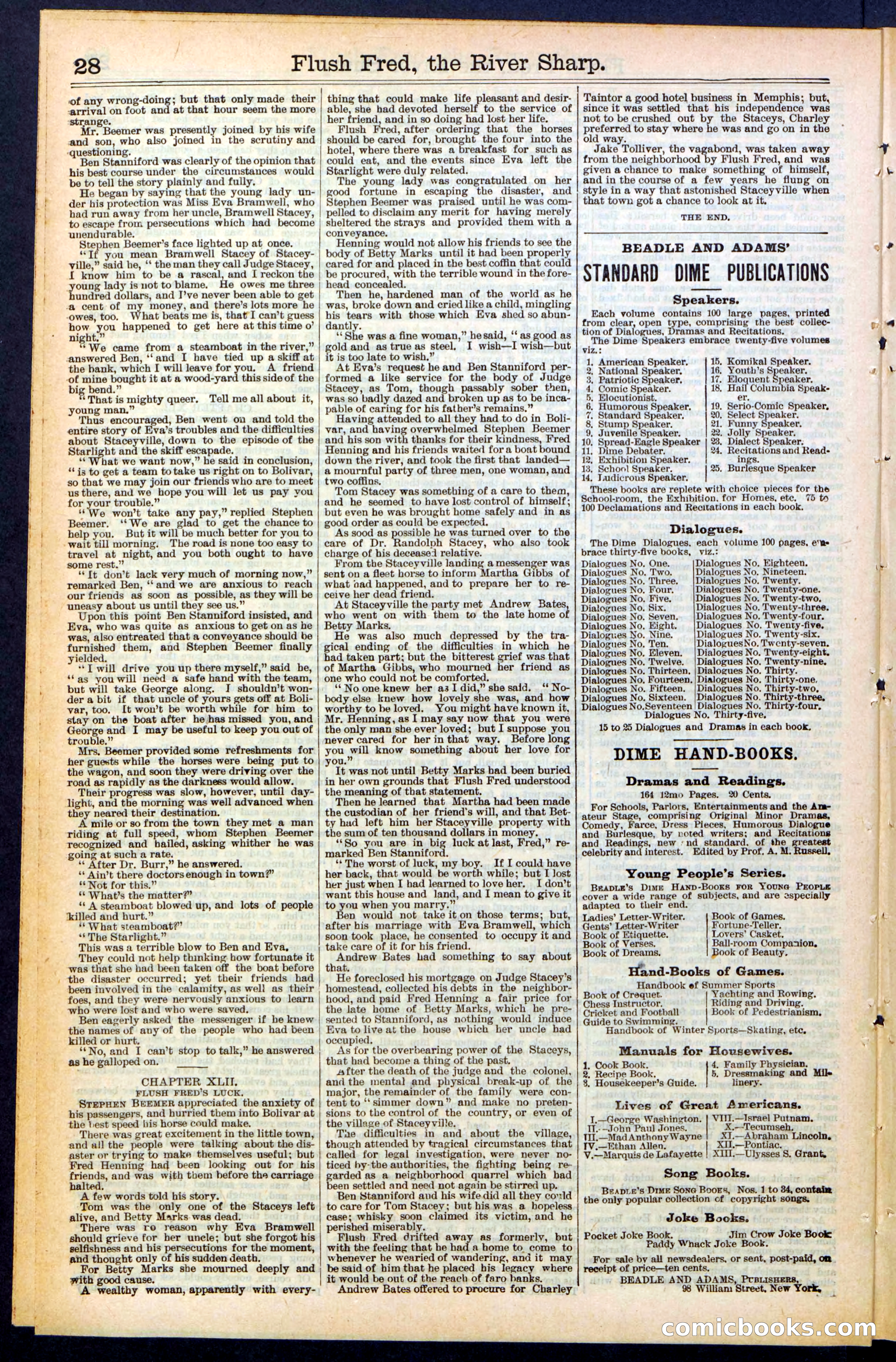
A restored page from Pulp Fiction, 1888. Page through the whole issue in the reader above.
📄 Transcribed text from this page (OCR, searchable)
Machine-transcribed from the original scan — historical spelling and the odd misread are preserved.
| Ft ae * ~~ =e _—— —_—-- - ~ * . — ee a + ekg ——— »eF sad a lope 28 —s ——~— Oe - —— a —— Flush Fred, the River Sharp. of any wrong-doing; but that only made their arrival on foot and at that hour seem the more strange. Mr. Beemer was presently joined by his wife and son, who also joined in the scrutiny and ‘questioning. Ben Stanniford was clearly of the opinion that his best course under the circumstances would be to tell the story plainly and fully, He began by saying that the young lady un- der his protection was Miss Eva Bramwell, who had run away from her uncle, Bramwell Stacey, to escape from persecutions which had become unendurable. Stephen Beemer’s face lighted up at once. “Tf you mean Bramwell Stacey of Stacey- ville,” said he, ‘‘ the man they call Judge Stacey, { know him to be a rascal, and I[ reckon the oung lady is not to blame. He owes me three hundred dollars, and I’ve never been able to get a cent of my money, and there’s lots more he owes, too. What beats me is, that I can’t guess how you happened to get here at this time o’ night.” ‘“*We came from a steamboat in the river,” answered Ben, ‘‘and I have tied up a skiff at the bank, which I will leave for you. A friend of mine bought it at a wood-yard this side of the big bend.” ‘That is mighty queer. Tell me all about it, young man.” Thus encouraged, Ben went on and told the entire story of Eva’s troubles and the difficulties about Staceyville, down to the episode of the Starlight and the skiff escapade. ‘* What we want now,” he said in conclusion, ‘is to get a team totake us right on to Bolivar, so that we may join our friends who are to meet us there, and we hope you will let us pay vou for your trouble.” ‘We won't take any pay,” replied Stephen Beemer. ‘‘We are glad to get the chance to help you. But it will be much better for you to -wait till morning. The road is none too easy to travel at night, and you both ought to have some rest.” ‘‘ Tt don’t lack very much of morning now,” remarked Ben, ‘‘and we are anxious to reach our friends as soon as possible, as they will be uneasy about us until they see us.” Upon this point Ben Stanniford insisted, and Eva, who was quite as anxious to get on as he was, also entreated that a conveyance should be furnished them, and Stephen Beemer finally yielded. **T will drive you up there myself,” said he, ‘‘as you will need a safe hand with the team, but will take George along. J] shouldn’t won- der a bit if that uncle of yours gets off at Boli- var, too. [t won’t be worth while for him to stay on the boat after he has missed you, and George and I may be useful to keep you out of trouble.” Mrs, Beemer provided some refreshments for her guests while the horses were being put to the wagon, and soon they were driving over the road as rapidly as the darkness would allow. Their pro was slow, however, until day- light, and the morning was well advanced when they neared their destination. A mile or so from the town they met a man riding at full speed, whom Stephen Beemer recognized and bailed, asking whither he was going at such a rate. ‘*‘ After Dr. Burr,” he answered. ‘* Ain’t there doctors enough in town?” ** Not for this.” ‘¢ What's the matter?” ‘¢ A steamboat blowed up, and lots of people ‘killed and burt.” ‘* What steamboat?” ‘* The Starlight.” This was a terrible blow to Ben and Eva, They could not help thinking bow fortunate it was that she had been taken off the boat before the disaster occurred; yet their friends had been involved in the calamity, as well as their foes, and they were nervously anxious to learn who were lost and who were saved, Ben eagerly asked the messenger if be knew the names of any of the people who had been killed or hurt. ‘‘No, and I can’t stop to talk,” he answered as he galloped on. CHAPTER XLII, FLUSH FRED’S LUCK. STEPHEN BeEEMER appreciated the anxiety of his passenger's, and hurried them into Bolivar at the best speed bis horse could make. There was great excitement in the little town, and all the people were talking about the dis- ter or trying to make themselves useful; but Fred Henning had been looking out for his friends, and was with them before the carriage A few words told his story. Tom was the only one of the Staceys left alive, and Betty Marks was dead. There was ro reason why Eva Bramwell should grieve for her unele; but she forgot his selfishness and his persecutions for the moment, and thought only of his sudden death. For Betty Marks she mourned deeply and with good cause. A wealthy woman, apparently with every- * 8 pon, LL DAD DDR sss ste thing that could make life pleasant and desir- able, she had devoted herself to the service of her friend, and in so doing had lost her life. Flush Fred, after ordering that the horses should be cared for, brought the four into the hotel, where there was a breakfast for such as could eat, and the events since Eva left the Starlight were duly related. The young lady was congratulated on her good fortune in escaping the disaster, and Stephen Beemer was praised until he was com- pelled to disclaim any merit for having merely sheltered the strays and provided them with a conveyance. Henning would not allow his friends to see the body of Betty Marks until it had been properly cared for and placed in the best coffin that could be procured, with the terrible wound in the fore- head concealed. Then he, hardened man of the world as he was, broke down and cried like a child, mingling his tears with those which Eva shed so abun- dantly. ‘‘She was a fine woman,” hesaid, ‘‘ as good as gold and as true as steel, I wish—I wish—but it is too late to wish,” At Eva’s request he and Ben Stanniford per- formed a like service for the body of Judge Stacey, as Tom, though passably sober then, was so badly dazed and broken up as to be inca- pable of caring for his father’s remains.” Having attended to all they had to do in Boli- var, and having overwhelmed Stephen Beemer and his son with thanks for their kindness, Fred Henning and his friends waited for a boat bound down the river, and took the first that landed— a mournful party of three men, one woman, and two coffins. Tom Stacey was something of a care to them, and he seemed to have lost control of himself; but even he was brought home safely and in as good order as could be expected. As sood as possible he was turned over to the care of Dr. Randolph Stacey, who also took charge of his decease relative. From the Staceyville landing a messenger was sent on a fleet horse to inform Martha Gibbs of what oad happened, and to prepare her to re- ceive her dead friend. At Staceyville the party met Andrew Bates who went on with them to the late home of Betty Marks. He was also much depressed by the tra- gical ending of the difficulties in which he had taken part; but the bitterest grief was that of Martha Gibbs, who mourned her friend as one who could not be comforted, ‘No one knew ber a3 I did,” she said. ‘* No- body else knew how lovely she was, and how worthy to be loved. You might have known it, Mr. Henning, as I may say now that you were the only man she ever loved; but I suppose you never cared for her in that way. Before long you will know something about her love for you. It was not until Betty Marks bad been buried in her own grounds that Flush Fred understood the meaning of that statement. Then he learned that Martha had been made the custodian of ber friend's will, and that Bet- ty hud left him her Staceyville property with the sum of ten thousand dollars in money, ‘*So you are in big luck at last, Fred,” re- marked Ben Stanniford. ‘* The worst of luck, my boy. If I could have her back, that would be worth while; but I Jost her just when I had learned to love her, I don’t want this house and land, and I mean to give it to you when you marry.” en would not take it on those terms; but, after his marriage with Eva Bramwell, which soon took place, he consented to occupy it and take care of it for his friend. or eli Bates had something to say about that. He foreclosed his mortgage on Judge Stacey’s homestead, collected his debts in the neighbor- hood, and paid Fred Henning a fair price for the late home of Betty Marks, which he pre- sented to Stanniford, as nothing would induce Eva to live at the house which her uncle had occupied, As for the overbearing power of the Staceys, that had become a thing of the past. after the death of the judge and the colonel, and the mental and physical break-up of the major, the remainder of the family were con- tent to “simmer down” and make no preten- sions to the control of the country, or even of the village of Staceyville. The difficulties in and about the village, though attended by tragical circumstances that called for legal investigation, were never no- ticed by-the authorities, the fighting being re- panied as a neighborhood quarrel which bad en settled and need not again be stirred up. Ben Stanniford and his wife did all they conld to care for Tom Stacey; but his was a hopeless case; whisky soon claimed its victim, and he perished miserably. Flush Fred drifted away as formerly, but with the feeling that he had a home to come to whenever he wearied of wandering, and it may be said of him that he placed his legacy where it would be out of the reach of faro a Andrew Bates offered to procure for Charley Taintor a good hotel business in Memphis; but, since it was settled that his independence was not to be crushed out by the Staceys, Charley preferred to stay where he was and go on in the old way. Jake Tolliver, the vagabond, was taken away from the neighborhood by Flush Fred, and was given a chance to make something of himself, and in the course of a few years he flung on style in a way that astonished Staceyville when that town got a chance to look at it. THE END. BEADLE AND ADAMS’ STANDARD DIME PUBLICATIONS Speakers. Each volume contains 100 large pages, printed from clear, open type, comprising the best collec- tion of Dialogues, Dramas and Recitations. The Dime Speakers embrace twenty-five volumes viz.: 1, American Speaker. 15 2, National Speaker. 16, ‘ . Komikal Speaker. Youth’s Speaker. 3. Patriotic Speaker, . Eloquent Speaker. 4. Comic Speaker. 18, Hail Columbia Speak- 5, Elocutionist, er. 6. Humorous Speaker. 19. Serio-Comic Speaker, 7. Standard Speaker. 20, Select Speaker. 8, Stump Speaker. 21. Funny Speaker. 9, Juvenile Speaker. 22. Jolly Speaker. 10, Spread-Eagle Speaker | 23. Dialect Speaker. 11, Dime Debater. 24. Recitations and Read- 12, Exhibition S ker. 13, School Speaker. 14, Taidicrous Speaker. These books are replete with choice pieces for the School-room, the Exhibition, for Homes, ete. 75 t 100 Declamations and Recitations in each book. ings. 25. Burlesque Speaker Dialogues. The Dime Dialogues. each volume 100 pages, eRe brace thirty-five books, viz.: Dialogues No, One. Dialogues No. Eighteen. Dialogues No, Two. Dialogues No, Nineteen. Dialogues No. Three. |Dialogues No. Twenty. Dialogues No. Four. Dialogues No. Twenty-one. Dialogues No, Five. Dialogues No. Twenty-two, Dialogues No. Six, Dialogues No. Twenty-three. Dialogues No, Seven. |Dialogues No. Twenty-four. Dialogues No. Hight. Dialogues No, Twenty-five, Dialogues No. Nine. Dialogues No. Twenty-six. Dialogues No, Ten. Dialogues No, Twenty-seven. Dialogues No. Eleven. /|Dialogues No. eee ee Dialogues No. Twelve. |Dialogues No. Twenty-nine. Dialogues No. Thirteen, |Dialogues No. Thirty. Dialogues No. Fourteen. |Dialogues No. Thirty-one. Dialogues No. Fifteen. |Dialogues No. Thirty-two, Dialogues No. Sixteen. [Dialogues No. Thirty-three, Dialogues No.Seventeen | Dialogues No, Thirty-four, Dialogues No. Thirty-five, 15 to 25 Dialogues and Dramas in each book, DIME HAND-BOOKS. Dramas and Readings, 164 12mo0 Pages. 20 Cents. For Schools, Parlors, Entertainments and the Anm- ateur Stage, comprising Original Minor Dramas, Comedy, Farce, Dress Pieces, Humorous Dialogue and Burlesque, by noted writers; and Recitations and Readings, new :nd standard, of the greatest celebrity and interest. Edited by Prof, A, M. Russell. Young People’s Series. Brapue’s Diag Hanp-Booxks ror Youna PEOPLE cover a wide range of subjects, and are especially adaptea to their end. Ladies’ Letter-Writer. Gents’ Letter-Writer Book of Etiquette. Book of Verses. Ball-room Companion, Book of Dreams. Book of Beauty. Hand-Books of Games. . Handbook ef Summer Sports Book of Crequet. Yachting and Rowing. Chess Instructor. Riding and Driving. Cricket and Football Book of Pedestrianism, Guide to Swimming. Handbook of Winter Sports—Skating, ete, Book of Games. Fortune-Teller. Lovers’ Casket. Manuals for Housewives. 1, Cook Book. 4. Family Physician. 2, Recipe Book, 5. Dressmaking and 8. Housekeeper’s Guide. linery. Lives of Great Americans. I.—George Washington. | VIJI.—Israel Putnam. TI.-—John Paul Jones. X.-—-Tecumseh, Tll.—MadAnthonyWayne! XI.—Abraham Lincoln, TV.—Ethan Allen. .—Pontiac. V.—Marquis de Lafayette | XIII.—Ulysses 8, Grant, Beapre’s Drums Sone Boors, Nos. 1 to 34, contaiz the only popular collection of copyright songs, Joke Books. Pocket Joke Book. Jim Crow Joke Book Paddy Whack Joke Book. For sale by all newsdealers, or sent, post-paid, om. receipt of price—ten cents, 98 William Stree BEADLE AND ADAMS, PURLIGE SRA : t, New ork, ‘ oe ae com av