
Pulp Fiction, 1888 · page 14 of 32
Beadle's New York Dime Library No. 483 — page 14: what you’re looking at
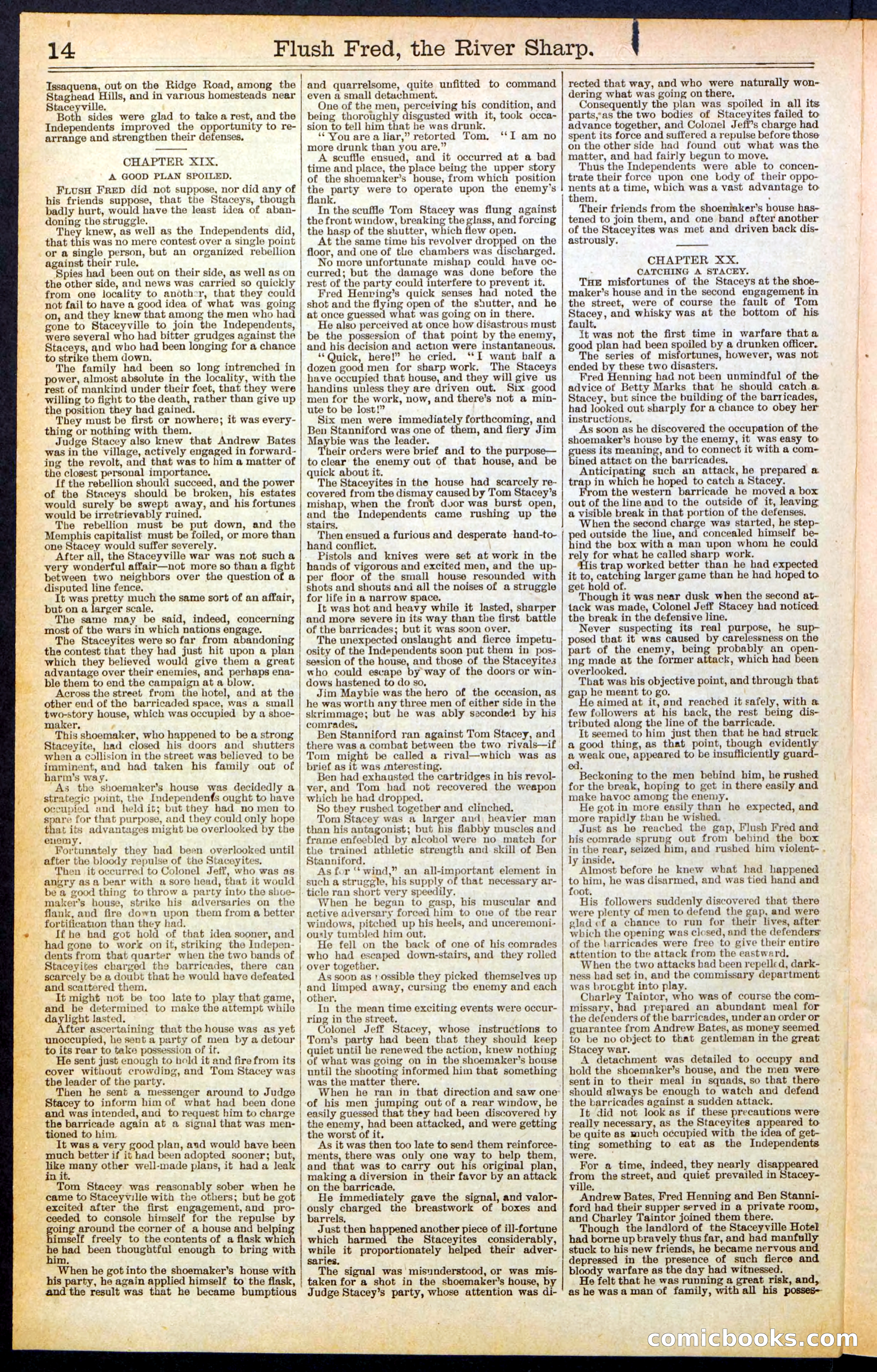
A restored page from Pulp Fiction, 1888. Page through the whole issue in the reader above.
📄 Transcribed text from this page (OCR, searchable)
Machine-transcribed from the original scan — historical spelling and the odd misread are preserved.
= * 14 uena, out on the Ridge Road, among the Staghead Hills, and in various homesteads near Staceyville. Both sides were glad to take a rest, and the Independents improved the opportunity to re- arrange and strengthen their defenses. CHAPTER XIX. A GOOD PLAN SPOILED. FiusH FRED did not suppose, nor did any of his friends suppose, that the Staceys, though badly hurt, would have the least idea of aban- doning the struggle. They knew, as well as the Independents did, that this was no mere contest over a single point or a single person, but an organized rebellion i against their rule, Spies had been out on their side, as well as on the other side, and news was carried so quickly from one locality to another, that they could not fail to have a good idea of what was going on, and they knew that among the men who had gone to Staceyville to join the Independents, were several who had bitter grudges against the Staceys, and who had been longing for a chance to strike them down. The family had been so long intrenched in power, almost absolute in the locality, with the rest of mankind under their feet, that they were willing to fight to the death, rather than give up -_ the position they had gained. They must be first or nowhere; it was every- thing or nothing with them. . Judge Stacey also knew that Andrew Bates was in the village, actively engaged in forward- ing the revolt, and that was to him a matter of the closest personal importance, ff the rebellion should succeed, and the power of the Staceys should be broken, his estates would surely be swept away, and his fortunes would be irretrievably ruined, The rebellion must be put down, and the Memphis capitalist must be foiled, or more than one Stacey would suffer severely. . After all, the Staceyville war was not sucha very wonderful affair—not more so than a fight between two neighbors over the question of a disputed line fence. > t was pretty much the same sort of an affair, i but on a larger scale. | The same may be said, indeed, concerning most of the wars in which nations engage. _ The Staceyites were so far from abandoning wed the contest that they had just hit upon a plan which they believed would give them a great a4 advantage over their enemies, ana perhaps ena- ble them to end the campaign at a blow. Across the street from the hotel, and at the other end of the barricaded space, was a small 7 “te Re I te Sn maker, P This shoemaker, who happened to be a strong Staceyite, had closed his doors and shutters when a collision in the street was believed to be imminent, and had taken his family out of _ harm's way. As the shoemaker’s house was decidedly a _ strategic point, the Independenfs ought to have | occupied and held it; but they had no men to _ spare for that purpose, and they could only hope that its advantages might be overlooked by the enemy. Fortunately they had been overlooked until after the bloody repulse of the Staceyites. ‘hen it occurred to Colonel Jeff, who was as ae | bea good thing to throw a party into the shoe- maker’s house, strike his adversaries on the flank, and fire down upon them from a better | fortification than they had. ~ Ifthe had got hold of that idea sooner, and had gone to work onit, striking the Indepen- dents from that quarter when the two bands of | Staceyites charged the barricades, there can | . scarcely be a doubt that he would have defeated \ ies and scattered them. Itmight not be too late to play that game, and he determined to make the attempt while daylight lasted. 4s fter ascertaining that the house was as yet | -- unoccupied, he sent a party of men by a detour to its rear to take possession of if. -He sent just enough to bold it and fire from its cover without crowding, and Tom Stacey was _ the leader of the party. ry Then he sent a messenger around to Judge | Stacey to inform him of what had been done | and was intended, and to request him to charge | _ the barricade again at a signal that was men- tioned to him. | -—s« Ut was a very good plan, aud would have been “much better if it had been adopted sooner; but, ee oe Sane other well-made plans, it had a leak | Tom Stacey was reasonably sober when he came to Staceyville with the others; but be got excited after the first engagement, and pro- _ ceeded to console himself for the repulse by _ going around the corner of a house and belping himself freely to the contents of a flask which he had been thoughtful enough to bring with rag) When he got into the shoemaker’s house with his party, he again applied himself to the flask, andthe result was that he became bumptious |= i. -y é “fo | | _ two-story house, which was occupied by a shoe- | ' re er TL and quarrelsome, quite unfitted to command even a small detachment. One of the men, perceiving bis condition, and being thoroughly disgusted with it, took occa- sion to tell him that he was drunk. ‘You are a liar,” retorted Tom, more drunk than you are,” A scuffle ensued, and it occurred at a bad time and place, the place being the upper story of the shoemaker’s house, from which position me Salad were to operate upon the enemy’s ank. In the scuffle Tom Stacey was flung against the front window, aaa the glass, and forcing the hasp of the shutter, which flew open. At the same time his revolver dropped on the floor, and one of the chambers was discharged. No more unfortunate mishap could have oc- curred; but the damage was done before the rest of the party could interfere to prevent it. Fred Henring’s quick senses had noted the shot and the flying open of the shutter, and he at once guessed what was going on in there. He also perceived at once bow disastrous must be the possession of that point by the enemy, and his decision and action were instantaneous. ‘“Quick, here!” he cried. ‘“‘I want half a dozen good men for sharp work. The Staceys have occupied tbat house, and they will give us handins unless they are driven out. Six good men for the work, now, and there’s not a min- ute to be lost!” Six men were immediately forthcoming, and Ben Stanniford was one of them, and fiery Jim Maybie was the leader. beir orders were brief and to the purpose— to clear the enemy out of that house, and be quick about it. The Staceyites in the house had scarcely re- covered from the dismay caused by Tom Stacey’s mishap, when the front dvor was burst open, and the Independents came rushing up the stairs. Then ensued a furious and desperate hand-to- hand conflict. Pistols and knives were set at work in the hands of vigorous and excited men, and the up- per floor of the small house resounded with shots and shouts and all the noises of a struggle for life in a narrow space, It was hot and heavy while it lasted, sharper and more severe in its way than the first battle of the barricades; but it was soon over, The unexpected onslaught and fierce impetu- osity of the Independents soon put them in pos- session of the house, and those of the Staceyites who could eseape by way of the doors or win- dows hastened to do so, Jim Maybie was the hero of the occasion, as he was worth any three men of either side in the skrimmage; but he was ably saconded by his comrades, Ben Stanniford ran against Tom Stacey, and there was a combat between the two rivals—if Tom might be called a rival—which was as brief as it was mteresting. Ben had exhausted the cartridges in his revol- ver, and Tom had not recovered the weapon which he had dropped. So they rushed togetber and clinched. Tom Stacey was a larger and, heavier man than his antagonist; but his flabby muscles and frame enfeebled by alcohol were no match for the trained athletic strength and skill of Ben Stanniford. As for “wind,” an all-important element in ‘*T am no wry asa bear with a sore head, that it would | such a struggle, his supply of that necessary ar- ' ticle ran short very speedily. When he began to gasp, his muscular and active adversary forced him to one of the rear windows, pitched up his heels, and unceremoni- ously tumbled him out. He fell on the back of one of his comrades who had escaped down-stairs, and they rolled over together. As soon as) ossible they picked themselves up it limped away, cursing the enemy and each other. In the mean time exciting events were occur- ring in the street. Colonel Jeff Stacey, whose instructions to Tom’s party had been that they should keep quiet until he renewed the action, knew nothing of what was going on in the shoemaker’s house until the shooting informed him that something was the matter there. When he ran in that direction and saw one: of his men jumping out of a rear window, be easily guessed that they had been discovered by the enemy, had been attacked, and were getting the worst of it. As it was then too late to send them reinforce- ments, there was only one way to belp them, and that was to carry out his original plan, making a diversion in their favor by an attack on the barricade. He immediately gave the signal, and valor- ously charged the breastwork of boxes and barrels, Just then happened another piece of ill-fortune which harm the Staceyites considerably, while it proportionately helped their adver- saries. The signal was misunderstood, or was mis- taken for a shot in the shoemaker’s house, by Judge Stacey’s party, whose attention was di- Flush Fred, the River Sharp. TT es es — rected that way, and who were naturally won- dering what was going on there, Consequently the plan was spoiled in all its parts,*as the two bodies of Staceyites failed to advance together, and Colonel Jeff’s charge had spent its force and suffered a repulse before those on the other side had found out what was the matter, and had fairly begun to move. Thus the Independents were able to concen- trate their force upon one Lody of their oppo- os at a time, which was a vast advantage to them. ' Their friends from the shoeniaker’s house has- tened to join them, and one band after another of the Staceyites was met and driven back dis- astrously. CHAPTER XX. CATCHING A STACEY. THE misfortunes of the Staceys at the shoe-~ maker’s house and in the second engagement in the street, were of course the fault of Tom Stacey, and whisky was at the bottom of his fault, it was not the first time in warfare thata good plan had been spoiled by a drunken officer. The series of misfortunes, however, was not ended by these two disasters. Fred Henning had not been unmindful of the advice ot Betty Marks that he should catch.a Stacey, but since the building of the barricades, had looked out sharply for a chance to obey her instructions. As soon as he discovered the occupation of the shoemaker’s house by the enemy, it was easy to guess its meaning, and to connect it with a com- bined attact on the barricades, Anticipating such an attack, he prepared a trap in which he hoped to catch a Stacey. From the western barricade he moved a box out of the line and to the outside of it, leaving a visible break in that portion of the defenses, When the second charge was started, he step- ped outside the line, and concealed himself be- hind the box with a man upon whom he could 3s for what he called sharp work. is trap worked better than he had expected it to, catching larger game than he had hoped to get hold of. Though it was near dusk when the second at- tack was made, Colonel Jeff Stacey had noticed the break in the defensive line. Never suspecting its real purpose, he sup- posed that it was caused by carelessness on the part of the enemy, being probably an open- ing made at the former attack, which had been overlooked, That was his objective point, and through that gap he meant to go. tte aimed at it, and reached it safely, with @& few followers at his back, the rest being dis- tributed along the line of the barricade. It seemed to him just then that he had struck a good thing, as that point, though evagerity a weak one, appeared to be insufficiently guard- Beckoning to the men bebind him, he rushed for the break, hoping to get in there easily and make havoc among the enemy. He got in more easily than he expected, and more rapidly than he wished. Just as he reached the gap, Flush Fred and his comrade sprung out from bebind the box in the rear, seized him, and rushed him violent- . ly inside, Almost before he knew what had happened to him, he was disarmed, and was tied hand and foot. His followers suddenly discovered that there were plenty of men to defend the gap, and were glad of a chance to run for their lives, after which the opening was closed, and the defenders of the barricades were free to give their entire attention to the attack from the eastward. When the two attacks had been repelled, dark- ness had set in, and the commissary department was brought into play. Charley Taintor, who was of course the com- missary, had prepared an abundant meal for the defenders of the barricades, under an order or guarantee from Andrew Bates, as money seemed to be no object to that gentleman in the great Stacey war. A detachment was detailed to occupy and hold the shoemaker’s house, and the men were sent in to their meal in squads, so that there should always be enough to watch and defend the barricades against a sudden attack. It did not look as if these precautions were really necessary, as the Staceyites appeared to be quite as much occupied with the idea of get- ting something to eat as the Independents were. For a time, indeed, they nearly disappeared oe the street, and quiet prevailed in Stacey- ville. , Andrew Bates, Fred Henning and Ben Stanni- ford had their supper served in a private room, and Charley Taintor joined them there. Though the landlord of the Staceyville Hotel — had borne up bravely thus far, and had manfully stuck to his new friends, he became nervous and depressed in the presence of such fierce and bloody warfare as the day had witnessed. He felt that he was running a t risk, and, grea as he wasa man of family, with all his posses- m - Eo Cal of St al.