
Pulp Fiction, 1888 · page 10 of 32
Beadle's New York Dime Library No. 483 — page 10: what you’re looking at
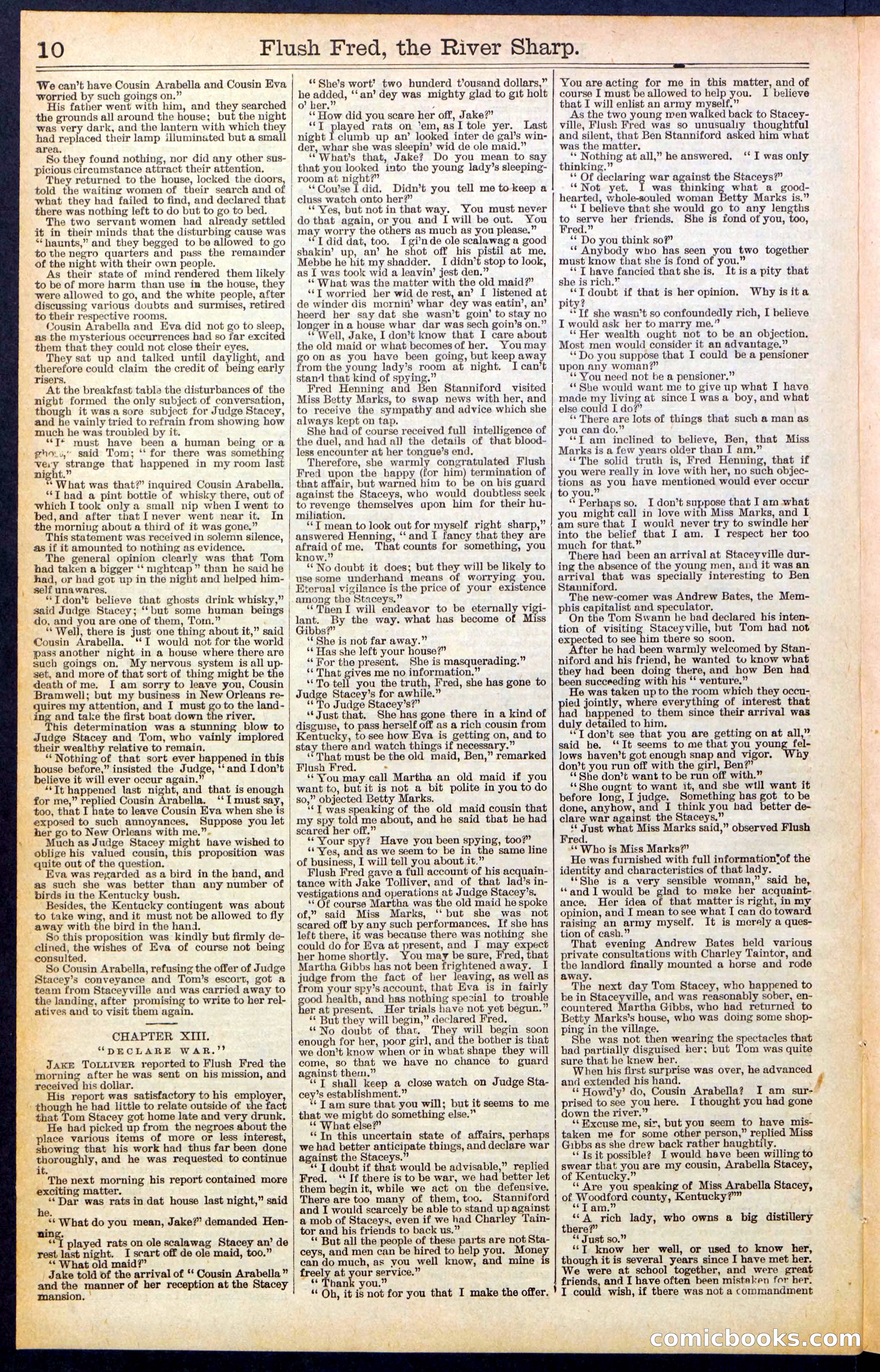
A restored page from Pulp Fiction, 1888. Page through the whole issue in the reader above.
📄 Transcribed text from this page (OCR, searchable)
Machine-transcribed from the original scan — historical spelling and the odd misread are preserved.
_ ass another night in a house where there are _ do, and you are one of them, Torn.” ‘ st 4 A) _ had taken a bigger ‘‘ mghtcap ” than he said he | 10 We can’t have Cousin Arabella and Cousin Eva worried by such goings on.” His father went with him, and they searched the grounds all around the house; but the night was very dark, and the lantern with which they had replaced their lamp illuminated but a small area. So they found nothing, nor did any other sus- picious circumstance attract their attention. They returned to the house, locked the doors, told the waiting women of their search and of | what they had failed to find, and declared that | there was nothing left to do but to go to bed. The two servant women had already settled it in their minds that the disturbing cause was *“‘haunts,” and they begged to be allowed to go to the negro quarters and puss the remainder of the night with their own people. As their state of mind rendered them likely to be of more harm than use in the house, they were allowed to go, and the white people, after discussing various doubts and surmises, retired | to their respective rooms. Cousin Arabella and Eva did not go to sleep, as the mysterious occurrences had so far excited them that they could not close their eyes. They sat up and talked until daylight, and therefore could claim the credit of being early risers. At the breakfast table the disturbances of the night formed the only subject of conversation, though it wasa sore subject for Judge Stacey, | and he vainly tried to refrain from showing how much he was troubled by it. **T* must have been a human being or a 'do that again, or you and I will be out. gho.i,” said Tom; ‘‘ for there was something very strange that happened in my room last night.” ‘What was that?” inquired Cousin Arabella. “‘T had a pint bottle of whisky there, out of | which I took only a small nip when I went to bed, and after that I never went near it. In the morniug about a third of it was gone.” This statement was received in solemn silence, as if it amounted to nothing as evidence. The general opinion clearly was that Tom | had, or had got up in the night and helped him- self unawares. *Tdon’t believe that ghosts drink whisky,” | said Judge Stacey; ‘‘but some buman beings ‘Well, there is just one thing about it,” said Cousin Arabella. ‘*I would not for the world such goings on, My nervous system is all up- set, and more of that sort of thing might be the death of me. I am sorry to leave you, Cousin Bramwell; but my business in New Orleans re- _ quires my attention, and I must go to the land- and take the first boat down the river. | ing a as This determination was a stunning blow to ‘ea Judge Stacey and Tom, who vainly implored their wealthy relative to remain. ‘Nothing of that sort ever happened in this house before,” insisted the Judge, ‘‘ and I don’t believe it will ever occur again.’ _“*Tt happened last night, and that is enough for me,” replied Cousin Arabella. ‘‘ I must say, te too, that I hate to leave Cousin Eva when she is 4 exposed to such annoyances, Suppose you let - _ her go to New Orleans with me.”. Much as Judge Stacey might have wished to | oblige his valued cousin, this proposition was _ quite out of the question, as such she was better than any number of birds iu the Kentucky bush. | Besides, the Kentucky contingent was about ; _ away with the bird in the hand. ‘toa e _ lined, the wishes of Eva of course not being ¥ hel — i¥ Ce a - $Stacey’s conveyance and Eva was reyzarded asa bird in the hand, and to take wing, and it must not be allowed to fly So this proposition was kindly but firmly de- consulted. So Cousin Arabella, refusing the offer of Judge | Tom’s escort, got a _ team from Staceyville and was carried away to the landing, after promising to write to her rel- Yes fa) \ 2% >. al ‘receiv atives and to visit them again. CHAPTER XIII. “DECLARE WABRB.’”’ _ Jake TOLLIVER reported to Flush Fred the ‘morning after he was sent on his mission, and his dollar. His report was satisfactory to his employer, (s bag he had little to relate outside of the fact % ei om Stacey got home late and very drunk. He had picked up from the negroes about the place various items of more or less interest, showing that his work had thus far been done thoroughly, and he was requested to continue it. | The next morning his report contained more | exciting matter. ¢ —— r - ‘“‘Dar was rats in dat house last night,” said __** What do you mean, Jake?” demanded Hen- re Ys, - < *- me played rats on ole scalawag Stacey an’ de ast last night. I scart off de ole maid, too.” ** What old maid?” ° | Jake told of the arrival of ‘‘ Cousin Arabella” and the ‘Mansion. "tea fe manner of her reception at the Stacey ‘‘ She’s wort’ two hunderd t’ousand dollars,” he added, ‘‘an’ dey was mighty glad to git holt o’ her.” ‘¢ How did you scare her off, Jake?” ee Ppaser rats on ‘em, asI tole yer. night I clumb up an’ looked inter de gal’s win- der, whar she was sleepin’ wid de ole maid.” ‘“What’s that, Jake? Do you mean to say that you looked into the young lady’s sleeping- room at night?” ‘“Cou’se I did. Didn’t you tell me to keep a cluss watch onto her?” ‘* Yes, but not in that way. Last You must never You may worry the others as much as you please,” ‘*T did dat, too. Igi’nde ole scalawag a good shakin’ up, an’ he shot off his pistil at me. Mebbe he hit my shadder. I didn’t stop to look, as I was took wid a leavin’ jest den.” ‘‘ What was the matter with the old maid?” ‘“‘T worried ber wid de rest, an’ [ listened at de winder dis morniri’ whar dey was eatin’, an’ heerd her say dat she wasn’t goin’ to stay no longer in a house whar dar was sech goin’s on.” ‘* Well, Jake, I don’t know that I care about the old maid or what becomes of her. You may goon as you have been going, but keep away from the young lady’s room at night. I can’t stand that kind of spying.” Fred Henning and Ben Stanniford visited Miss Betty Marks, to swap news with her, and to receive the sympathy and advice which she always kept on tap. She had of course received full intelligence of the duel, and had al) the details of that blood- less encounter at her tongue’s end. Therefore, she warmly congratulated Flush Fred upon the bappy (for him) termination of that affair, but warned him to be on bis guard against the Staceys, who would doubtless seek to revenge themselves apon him for their hu- miliation. ‘‘T mean to look out for myself right sharp,” answered Henning, ‘‘ and I fancy that they are afraid of me. That counts for something, you know.” ‘No doubt it does; but they will be likely to use some underhand means of worrying you. Eternal vigilance is the price of your existence among the Staceys.” ‘Then I will endeavor to be eternally vigi- lant. By the way. what has become of Miss Gibbs?” ‘¢ She is not far away.” ‘* Has she left your house?” ‘“‘For the present. She is masquerading.” ‘That gives me no information.” ‘To tell you the truth, Fred, she has gone to Judge Stacey’s for awhile.” “To Judge Stacey’s?” ‘‘ Just that. She has gone there in a kind of disguise, to pass herself off as a rich cousin from Kentucky, to see how Eva is getting on, and to stay there and watch things if necessary.” ‘'That must be the old maid, Ben,” remarked Flush Fred. ‘‘- You may call Martha an old maid if you want to, but it is not a bit polite in you to do so,” objected Betty Marks. ‘‘T was speaking of the old maid cousin that my spy told me about, and he said that he had scared her off.” ‘‘- Your spy? Have you been spying, too?” ‘‘-Yes, and as we seem to be in the same line of business, I will tell you about it.” Flush Fred gave a full account of his acquain- tance with Tate Tolliver, and of that lad’s in- vestigations and operations at Judge Stacey’s. ‘* Of course Martha was the old maid he spoke of,” said Miss Marks, ‘‘ but she was not scared off by any such performances, If she has left there, it was because there was nothing she could do for Eva at present, and IJ ged expect her home shortly. You may be sure, Fred, that Martha Gibbs has not been frightened away. judge from the fact of her leaving, as well as from your spy’s account, that Eva is in fairly ood health, and has nothing special to trouble rat present. Her trials have not yet begun.” ““ But they will begin,” declared Fred. ‘No doubt of that. They will begin soon enough for her, poor girl, and the bother is that we don’t know when or in what shape they will come, so that we have no chance to guard against them.” When his first surprise was over, he advanced ‘‘T shall keep a close watch on Judge Sta- | and extended his hand. f cey’s establishment.” ‘¢ Howd’y’ do, Cousin Arabella? I am sur- ‘‘ T am sure that you will; but it seems to me | prised to see youhere. I thought you had gone that we might do something else.” *¢ ‘What else?” ‘‘In this uncertain state of affairs, perhaps we had better anticipate things, and declare war against the Staceys.” ’ «J doubt if that would be advisable,” replied Fred. ‘‘ If there is to be war, we had better let them begin it, while we act on the defensive. There are too many of them, too. Stanniford and I would scarcely be able to stand up against a mob of Staceys, even if we had Charley Tain- tor and his friends to back us.” ‘* But all the people of these parts are not Sta- ceys, and men can be hired to help you. Money can do much, as you well know, and mine is freely at: your service.” eTt you.” “ Oh, it is not for you that I make the offer. Flush Fred, the River Sharp. | | You are acting for me in this matter, and of course I must be allowed to help you. I believe that I will enlist an army myself.” As the two young wen walked back to Stacey- ville, Flusk Fred was so unusualiy thoughtful and silent, that Ben Stanniford asked him what was the matter. ‘* Nothing at all,” he answered. thinking.” ‘* Of declaring war against the Staceys?” ‘“* Not yet. was thinking what a good- hearted, whole-souled woman Betty Marks is.” ‘** T believe that she would go to any lengths to serve her friends, She is fond of you, too, Fred.” ‘* Do you think so?” ‘* Anybody who has seen you two together must know that she is fond of you.” ‘‘T have fancied that she is, It isa pity that Why isita ** T was only she is rich.” ‘*T doubt if that is her opinion. pity? ‘“Tf she wasn’t so confoundedly rich, I believe I would ask her to marry me.” ‘Her wealth ought not to be an objection. Most men would consider it an advantage.” ‘‘ Do you suppose that I could be a pensioner upon any woman?” ‘‘- You need not be a pensioner.” ‘‘She would want me to give up what I have made my living at since I was a boy, and what else could I do?” ‘‘ There are lots of things that such a man as you can do,” ‘“‘T am inclined to believe, Ben, that Miss Marks is a few year's older than I am.” ‘The solid truth is, Fred Henning, that if you were really in love with her, no such objec- tions as you have mentioned would ever occur to you.” “ Perhaps so. I don’t suppose that I am what you might call in love with Miss Marks, and I am sure that I would never try to swindle her into the belief that I am. I respect her too much for that.” There had been an arrival at Staceyville dur- ing the absence of the young men, and it was an arrival that was specially interesting to Ben Stanniford. The new-comer was Andrew Bates, the Mem- phis capitalist and speculator. On the Tom Swann he bad declared his inten- tion of visiting Staceyville, but Tom had not expected to see him there so soon. After he had been warmly welcomed by Stan- niford and his friend, he wanted to know what they had been doing there, and how Ben had been succeeding with his ‘‘ venture,” He was taken up to the room which they occu- ied jointly, where everything of interest that ad happened to them since their arrival was duly detailed to him. | ‘“T don’t see that you are getting on at all,” | said he. ‘It seems to me that you young fel- lows haven’t got enough snap and vigor. y | don’t you run off with the girl, Ben?” , ‘She don’t want to be run off with.” | ‘‘She ougnt to want it, and she will want it before long, I judge. Something has got to be done, anyhow, and I think you had better de- clare war against the Staceys,” ‘¢ Just what Miss Marks said,” observed Flush red. ‘¢ Who is Miss Marks?” He was furnished with full informationfof the identity and characteristics of that lady. ‘‘She is a very sensible woman,” said he, ‘‘and 1 would be glad to make her acquaint- ance. Her idea of that matter is right, in my opinion, and I mean to see what I can do toward raising an army myself. It is merely a ques- tion of cash.” That evening Andrew Bates held various private consultations with Charley Taintor, and the landlord finally mounted a horse and rode away. The next day Tom Stacey, who happened to be in Staceyville, and was reasonably sober, en- countered Martha Gibbs, who had returned to Betty Marks’s house, who was doing some shop- ping in the village. She was not then wearing the spectacles that had partially disguised her; but Tom was quite sure that he knew her. i ee le — eae ae down the river.” ‘‘ Hxcuse me, sir, but you seem to have mis- taken me for some other person,” replied Miss Gibbs as she drew back rather haughtily. ‘Is it possible? I would have been willing to swear that you are my cousin, Arabella Stacey, of Kentucky.” ‘‘ Are you speaking of Miss Arabella Stacey, of Woodford county, Kentucky?” sé T am.” ‘“A rich lady, who owns a big distillery there?” ** Just so.” ‘““T know her well, or used to know her, though it is several years since I have met her. We were at school together, and were friends, and I have often been mistaken for her. I could wish, if there was not a commandment