
Pulp Fiction, 1888 · page 5 of 32
Beadle's New York Dime Library No. 482 — page 5: what you’re looking at
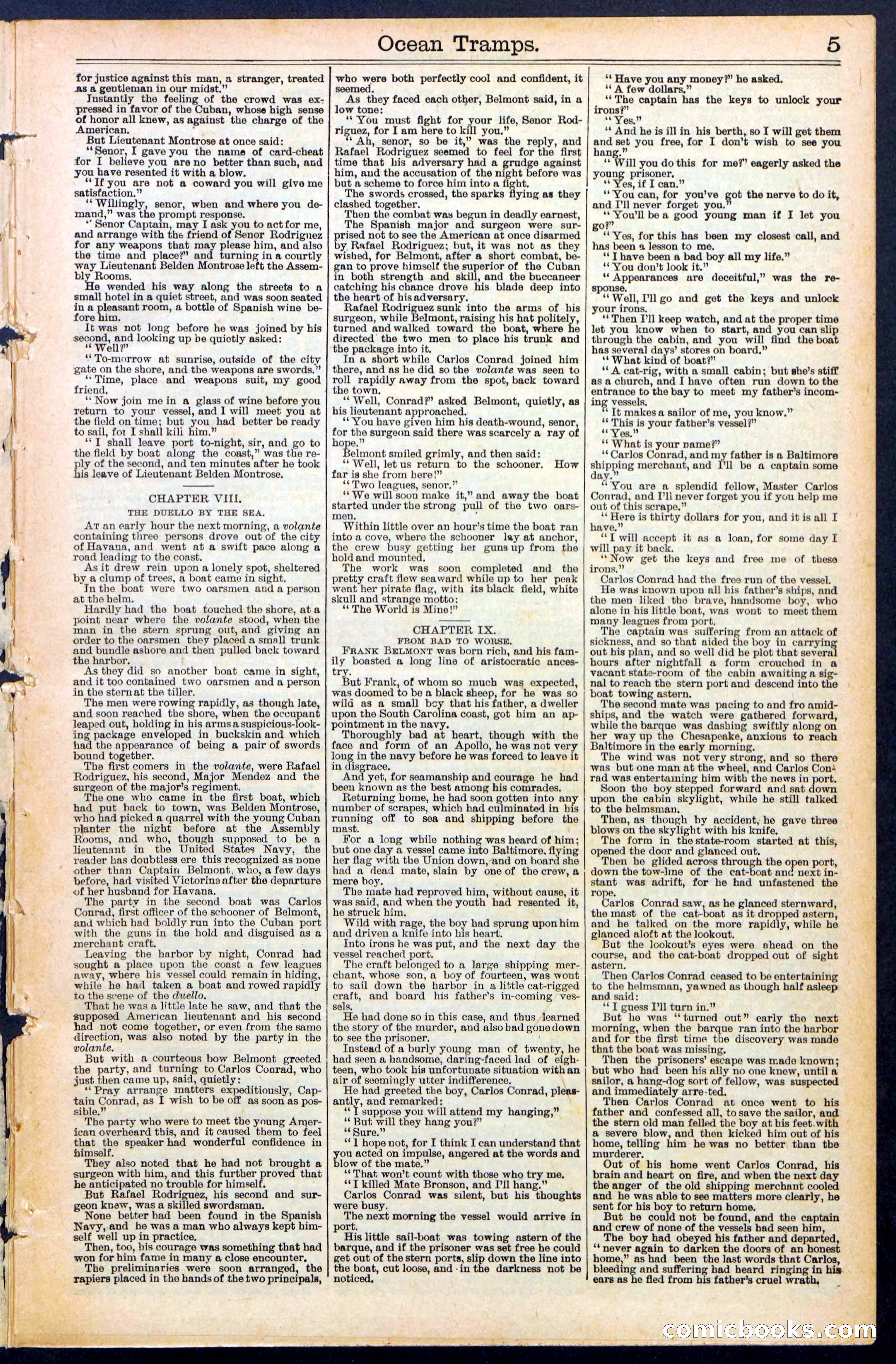
A restored page from Pulp Fiction, 1888. Page through the whole issue in the reader above.
📄 Transcribed text from this page (OCR, searchable)
Machine-transcribed from the original scan — historical spelling and the odd misread are preserved.
| Ocean Tramps. 5 for justice against this man, a stranger, treated as a gentleman in our midst,” Instantly the feeling of the crowd was ex- pressed in favor of the Cuban, whose high sense of honor all knew, as against the charge of the American. But Lieutenant Montrose at once said: “Senor, I gave you the name of card-cheat for I believe you are no better than such, and you have resented it with a blow. “If you are not a coward you will give me satisfaction.” ‘* Willingly, senor, when and where you de- mand,” was the prompt response. *“ Senor Captain, may I ask you to act for me, and arrange with the friend of Senor Rodriguez for any weapons that may please him, and also the time and place?” and turning in a courtly way Lieutenant Belden Montrose left the Assem- i Bgeniaay e wended his way along the streets to a small hotel in a quiet street, and was soon seated in a pleasant room, a bottle of Spanish wine be- fore him. It was not long before he was joined by his second, and looking up be quictly asked: ‘* Well?” “To-morrow at sunrise, outside of the city gate on the shore, and the weapons are swords.” ‘*Time, place and weapons suit, my good friend, ‘* Now join mein a glass of wine before you return to your vessel, and I will meet you at the field on time; but you had better be ready to sail, for I shall kili him,” ‘*T shall leave port to-night, sir, and go to the field by boat along the coast,” was the re- ply of the second, and ten minutes after he took his leave of Lieutenant Belden Montrose, CHAPTER VIII. THE DUELLO BY THE SEA, AT an early hour the next morning, a volante containing three persons drove out of the city of Havana, and went at a swift pace along a road leading to the coast. As it drew rein upon a lonely spot, sheltered by a clump of trees, a boat came in sight, In the boat were two oarsmen and a person at the helm. Hardly had the boat touched the shore, ata point near where the volante stood, when the man in the stern sprung out, and giving an order to the oarsmen they placed a small trunk and bundle ashore and then pulled back toward the harbor, As they did so another boat came in sight, and it too contained two oarsmen and a person in the sternat the tiller, The men were rowing rapidly, as though late, and soon reached the shore, when the occupant leaped out, holding in his armsa suspicious-look- ing package enveloped in buckskin and which had the appearance of being a pair of swords bound together. The first comers in the volante, were Rafael Rodriguez, his second, Major Mendez and the surgeon of the major’s regiment. The one who came in the first boat, which had put back to town, was Belden Montrose, who had picked a quarrel with the young Cuban planter the night before at the Assembly Rooms, and who, though supposed to be a lieutenant in the United States Navy, the reader has doubtless ere this recognized as none other than Captain Belmont, who, a few days before, had visited Victorins after the departure of her husband for Havana. The party in the second boat was Carlos Conrad, first officer of the schooner of Belmont, and which had boldly run into the Cuban port with the guns in the hold and disguised as a merchant craft. Leaving the harbor by night, Conrad had sought a place upon the coast a few leagues away, where his vessel could remain in hiding, while he had taken a boat and rowed rapidly to the scene of the duello, That he was a little late he saw, and that the supposed American lieutenant and his second had not come together, or even from the same direction, was also noted by the party in the volante. But with a courteous bow Belmont greeted the party, and turning to Carlos Conrad, who just then came up, said, quietly: ‘Pray arrange matters expeditiously, Cap- tain Conrad, as I wish to be off as soon as pos- sible.” The party who were to meet the young Amer- ican overheard this, and it caused them to feel that the speaker had wonderful confidence in himself, They also noted that he had not brought a surgeon with him, and this further proved that he anticipated no trouble for himself. But Rafael Rodriguez, his second and sur- geon knew, was a skilled swordsman, None better had been found in the Spanish Navy, and he was a man who always kept him- self well up in practice, Then, too, his courage was something that had won for him fame in many a close encounter, The preliminaries were soon arranged, the rapiers placed in the hands of the two principals, who were both perfectly cool and confident, it seemed. As they faced each other, Belmont said, in a low tone: ‘*'You must fight for your life, Senor Rod- riguez, for I am bere to kill you,” ‘Ah, senor, so be it,” was the reply, and Rafael Rodriguez seemed to feel for the first time that his adversary had a grudge against him, and the accusation of the night before was but a scheme to force him into a fight, The swords crossed, the sparks flying as they clashed together. Then the combat was begun in deadly earnest, The Spanish major and surgeon were sur- prised not to see the American at once disarmed by Rafael Rodriguez; but, it was not as they wished, for Belmont, after a short combat, be- gan to prove himself the superior of the Cuban in both strength and skill, and the buccaneer catching his chance drove his blade deep into the heart of hisadversary. Rafael Rodriguez sunk into the arms of his surgeon, while Belmont, raising his hat politely, turned and walked toward the boat, where he directed the two men to place his trunk and the package into it. In a short while Carlos Conrad joined him there, and as he did so the volante was seen to roll rapidly away from the spot, back toward the town, ‘* Well, Conrad?’ asked Belmont, quietly, as his lieutenant approached. ‘You have given him his death-wound, senor, Sp the surgeon said there was scarcely a ray of ope. elmont smiled grimly, and then said: ‘* Well, let us return to the schooner, far is she from bere!” ‘* Two leagues, senor,” ** We will soon make it,” and away the boat started under the strong pull of the two oars- men, Within little over an hour’s time the boat ran into a cove, where the schooner lay at anchor, the crew busy getting her gunsup from the hold and mounted, The work was soon completed and the pretty craft flew seaward while up to her peak went her pirate flag, with its black field, white skull and strange motto: ‘*The World is Mine!” CHAPTER IX. FROM BAD TO WORSE. FRANK BELMONT was born rich, and his fam- ily boasted a long line of aristocratic ances- How try. But Frank, of whom so much was expected, was doomed to be a black sheep, for he was so wild as a small bey that his father, a dweller upon the South Carolina coast, got him an ap- pointment in the navy, Thoroughly bad at heart, though with the face and form of an Apollo, he was not ver long in the navy before he was forced to leave it in disgrace, And yet, for seamanship and courage he had been known as the best among his comrades, Returning home, he had soon gotten into an number of scrapes, which had culminated in his Enunlng off to sea and shipping before the mast. for a long while nothing was heard of him; but one day a vessel came into Baltimore, flying her flag with the Union down, and on board she had a dead mate, slain by one of the crew, a mere boy. The mate had reproved him, without cause, it was said, and when the youth had resented it, he struck him, Wild with rage, the boy had sprung upon him and driven a knife into his heart. Into irons he was put, and the next day the vessel reached port. The craft belonged to a large shipping mer- chant, whose son, a boy of fourteen, was wont to sail down the harbor in a little cat-rigged craft, and board his father’s in-coming ves- sels, He had done so in this case, and thus learned the story of the murder, and also bad gonedown to see the prisoner. | Instead of a burly young man of twenty, he had seen a handsome, daring-faced lad of eigh- teen, who took his unfortunate situation with an air of seemingly utter indifference. \ He had greeted the boy, Carlos Conrad, pleas- antly, and remarked: **T suppose you will attend my hanging,” ‘* But will they hang you?” “Sure.” **] hope not, for I think I can understand that ou acted on impulse, angered at the words and low of the mate.” ‘**That won’t count with those who try me, **T killed Mate Bronson, and Pll hang.” Carlos Conrad was silent, but his thoughts were busy. The next morning the vessel would arrive in rt. His little sail-boat was towing astern of the barque, and if the prisoner was set free he could get out of the stern ports, slip down the line into the boat, cut loose, and-in the darkness not be noticed, i —— ‘* Have you any money?” he asked. ‘* A few dollars,” ‘*The captain has the keys to unlock your irons?” sb Yes. ” ‘“* And he is ill in his berth, so I will get them and set you free, for I don’t wish to see you prin ‘* Will you dothis for me?” eagerly asked the young prisoner, ‘* Yes, if I can,” ‘You can, for you've and [ll never forget you. ‘* You'll be a good young man if I let you 0?” ‘Yes, for this has been my closest call, and has been « lesson to me. ‘*T have been a bad boy all my life.” **’You don’t look it.” ‘* Appearances are deceitful,” was the re- sponse. ‘Well, Pl go and get the keys and unlock your irons. ‘*Then Pll keep watch, and at the proper time let you know when to start, and you can slip through the cabin, and you will find the boat has several days’ stores on board,” ** What kind of boat?” ‘* A cat-rig, with a small cabin; but she’s stiff as a church, and I have often run down to the entrance to the bay to meet my father’s incom- ing vessels, ‘It makes a sailor of me, you know,” ‘“* This is your father’s vessel?” “ Yes,” ‘* What is your name?” ‘*Carlos Conrad, and my father is a Baltimore ee merchant, and Vll be a captain some ay. got the nerve to do it, ‘You are a splendid fellow, Master Carlos Conrad, and Ill never forget you if you help me out of this scrape.” ‘* Here is thirty dollars for you, and it is all I have.” ‘I will accept it as a loan, for some day I will pay it back. ‘Now get the keys and free me of these irons.” Carlos Conrad had the free run of the vessel. He was known upon all his father’s ships, and the men liked the brave, handsome boy, who alone in his little boat, was wont to meet them many leagues from port, The captain was suffering from an attack of sickness, and so that aided the boy in carryin out his plan, and so well did he plot that sever hours after nightfall a form crouched in a vacant state-room of the cabin awaiting a sig- nal to reach the stern port and descend into the boat towing astern. The second mate was pacing to and fro amid- ships, and the watch were gathered forward, while the barque was dashing swiftly along on her way up the Chesapeake, anxious to reach Baltimore in the early morning. The wind was not very strong, and so there was but one man at the wheel, and Carlos Con4 rad was entertaiming him with the news in port. Soon the boy stepped forward and sat doven upon the cabin skylight, while he still talked to the belmsman, Then, as though by accident, he gave three blows on the skylight with his knife, The form in thestate-room started at this, opened the door and glanced out. Then he glided across through the open port, down the tow-line of the cat-boat anc next in- stant was adrift, for he had unfastened the rope. Carlos Conrad saw, as he glanced sternward, the mast of the cat-boat as it dro ped astern, and he talked on the more rapidly, while he glanced aloft at the lookout. But the lookout’s eyes were ahead on the Sunray and the cat-boat dropped out of sight astern, Then Carlos Conrad ceased to be entertaining to the helmsman, yawned as though half asleep and said: ‘**T guess I'll turn in.” But he was ‘turned out” early the next morning, when the barque ran into the harbor and for the first time the discovery was made that the boat was missing. Then the prisoners’ escape was made known; but who had been his ally no one knew, until a sailor, a hang-dog sort of fellow, was suspected and immediately arre-ted. Then Carlos Conrad at once went to his father and confessed all, tosave the sailor, a the stern old man felled the boy at his feet. wit a severe blow, and then kicked him out of his home, telling him he was no better than the murderer, Out of his home went Carlos Conrad, his brain and heart on fire, and when the next day the anger of the old shipping merchant cooled and he was able to see matters more clearly, he sent for his boy to return home. But he could not be found, and the captain and crew of none of the vessels had seen him, The boy had obeyed his father and departed ‘*never again to darken the doors of an honest home,” as had been the last words that Carlos, bleeding and suffering had heard ringing in his ears as he fled from his father’s cruel wrath, [= aaa - ~ a : eS, a. h 5 ~ : i Ji] mIEboo con 4 -