
Pulp Fiction, 1888 · page 27 of 32
Beadle's New York Dime Library No. 482 — page 27: what you’re looking at
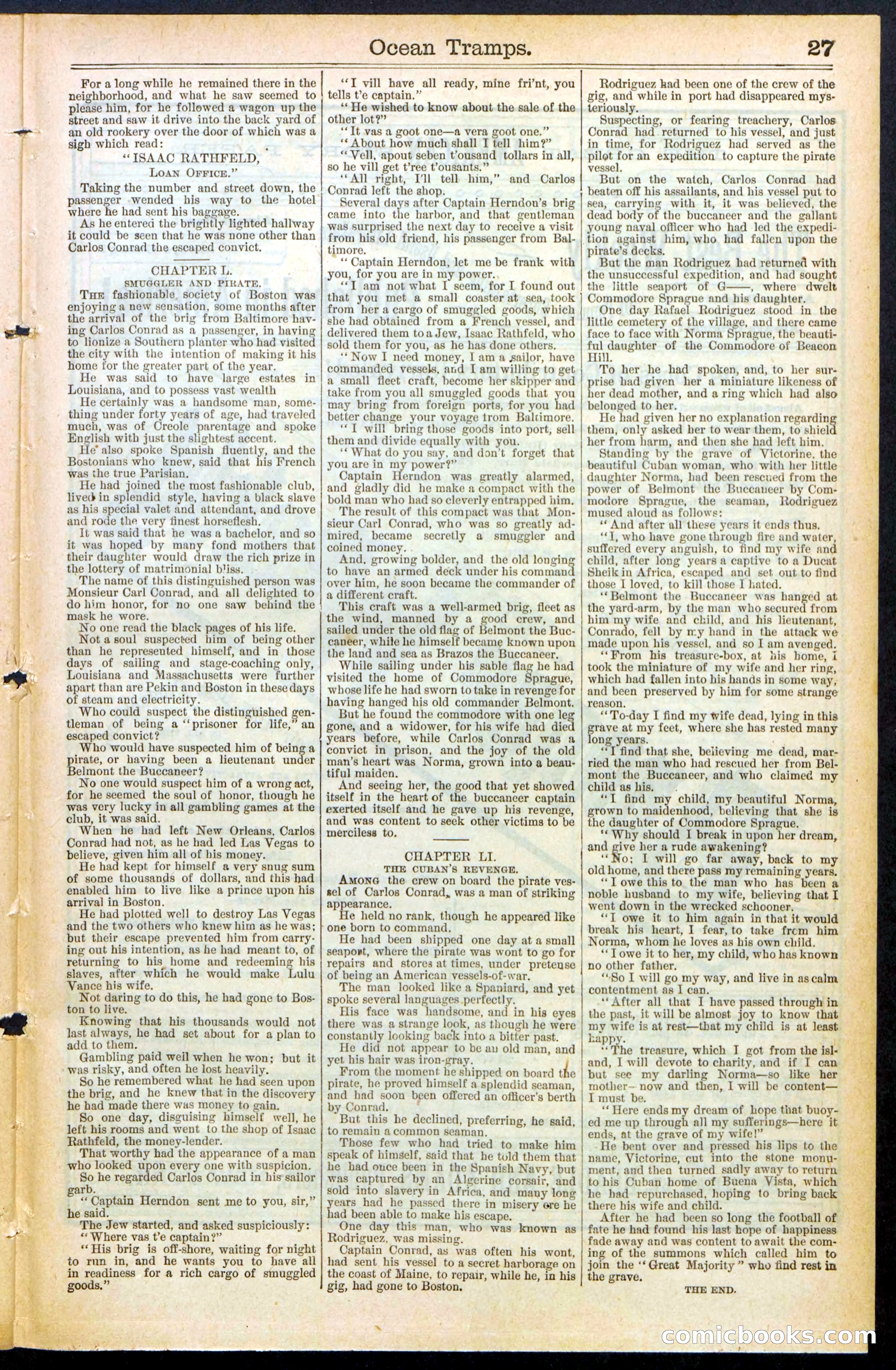
A restored page from Pulp Fiction, 1888. Page through the whole issue in the reader above.
📄 Transcribed text from this page (OCR, searchable)
Machine-transcribed from the original scan — historical spelling and the odd misread are preserved.
+ % * y> = Pury “ » = ll r i... “¥ — 4 — a; > - . Sy oe . - . a ee fe. 4 v4 wer S* 3 7 4 = : oa 4 a4 i wet . “4 ys % » : . pas Pale Do For a long while he remained there in the neighborhood, and what he saw seemed to please him, for he followed a wagon up the street and saw it drive into the back yard of an old rookery over the door of which was a sigh which read: “ISAAC RATHFELD, Loan OFFICE.” Taking the number and street down, the passenger -wended his way to the hotel where he had sent his baggave. As he entered the brightly lighted hallway it could be seen that he was none other than Carlos Conrad the escaped convict. CHAPTER L. SMUGGLER AND PIRATE, Tur fashionable, society of Boston was enjoying a new sensation, some months after the arrival of the brig from Baltimore hav- ing Carlos Conrad as a passenger, in having to lionize a Southern planter who had visited the city with the intention of making it his home for the greater part of the year. He was said to have large estates in Louisiana, and to possess vast wealth He certainly was a handsome man, some- thing under forty years of age, had traveled much, was of Creole parentage and spoke English with just the slightest accent. He’ also spoke Spanish fluently, and the Bostonians who knew, said that his French was the true Parisian. He had joined the most fashionable club, lived in splendid style, having a black slave as his special valet and attendant, and drove and rode the very finest horseflesh. It was said that he was a bachelor, and so it was hoped by many fond mothers that their daughter would draw the rich prize in the lottery of matrimonial bliss. The name of this distinguished person was Monsieur Carl Conrad, and all delighted to do him honor, for no one saw behind the mask he wore. No one read the black pages of his life. Not a soul suspected him of being other than he represented himself, and in those days of sailing and stage-coaching only, Louisiana and Massachusetts were further apart than are Pekin and Boston in these days of steam and electricity. Who could suspect the distinguished tleman of being a ‘‘prisoner for life, escaped convict? Who would have suspected him of being a irate, or having been a lieutenant under elmont the Buccaneer? No one would suspect him of a wrong act, for he seemed the soul of honor, though he was very lucky in all gambling games at the club, it was said. When he had left New Orleans, Carlos Conrad had not, as he had led Las Vegas to believe, given him all of his money. He had kept for himself a very snug sum of some thousands of dollars, and this had enabled him to live like a prince upon his arrival in Boston. He bad plotted well to destroy Las Vegas and the two others who knew him as he was; but their escape prevented him from carry- ing out his intention, as he had meant to, of returning to his home and redeeming his slaves, after which he would make Lulu Vance his wife. Not daring to do this, he had gone to Bos- ton to live. Knowing that his thousands would not last always, he had set about for a plan to add to them. Gambling paid weil when he won: but it ven- m an was risky, and often he lost heavily. So he remembered what he had seen upon the brig, and he knew that in the discovery he had made there was money to gain, So one day, disguising himself well, he left his rooms and went to the shop of Isaac Rathfeld, the money-lender. That worthy had the appearance of a man _ who looked upon every one with suspicion. So he regarded Carlos Conrad in his sailor rb. - “Captain Herndon sent me to you, sir,” he said. The Jew started, and asked suspiciously: «* Where vas t’e captain?” ‘*His brig is off-shore, waiting for night to run in, and he wants you to have all in readiness for a rich cargo of smuggled e SE LL ees ry Allien he - . = ¢ . . e7 j cP ee ee? Pe Ocean Tramps. **T vill have all ready, mine fri’nt, you tells t’e captain.” ‘* He wished to know about the sale of the other lot?” ‘It vas a goot one—a vera goot one.” ** About how much shall I tell him?” “Vell, apout seben t’ousand tollars in all, so he vill get t’ree t’ousants.” ‘*All right, Ill tell him,” and Carlos Conrad left the shop. Several days after Captain Herndon’s brig came into the harbor, and that gentleman was surprised the next day to receive a visit from his old friend, his passenger from Bal- timore. ‘* Captain Herndon, let me be frank with you, for you are in my power. ‘*T am not what I seem, for I found out that you met a small coaster at sea, took from her a cargo of smuggled goods, which she had obtained from a French vessel, and delivered them toa Jew, Isaac Rathfeld, who sold them for you, as he has done others, ‘* Now I need money, | am a sailor, have commanded vessels, and I am willing to get a small fleet craft, become her skipper and take from you all smuggled goods that you may bring from foreign ports, for you had better change your voyage trom Baltimore. ‘‘ Tt will bring those goods into port, sell them and divide equally with you. ‘* What do you say, and don’t forget that you are in my power?” Captain Herndon was greatly alarmed, and gladly did he make a compact with the bold man who had so cleverly entrapped him. The result of this compact was that Mon- sieur Carl Conrad, who was so greatly ad- mired, became secretly a smuggler and coined money. And, growing bolder, and the old longin to have an armed deck under his comman over him, he soon became the commander of a different craft. This craft was a well-armed brig, fleet as the wind, manned by a good crew, and sailed under the old flag of Belmont the Buc- caneer, while he himself became known upon the land and sea as Brazos the Buccaneer. While sailing under his sable flag he had visited the home of Commodore Sprague, whose life he had sworn to take in revenge for having hanged his old commander Belmont. But he found the commodore with one leg gone, and a widower, for his wife had died years before, while Carlos Conrad was a convict in prison, and the joy of the old man’s heart was Norma, grown into a beau- tiful maiden. And seeing her, the good that yet showed itself in the heart of the buccaneer captain exerted itself and he gave up his revenge, and was content to seek other victims to be merciless to. CHAPTER LI. THE CUBAN’S REVENGE, AMONG the crew on board the pirate ves- sel of Carlos Conrad, was a man of striking appearance. He held no rank, though he appeared like one born to command. He had been shipped one day at a small seaport, where the pirate was wont to go for repairs and stores at times, under pretense of being an American vessels-of-war. The man looked like a Spaniard, and yet spoke several languages perfectly, His face was handsome, and in his eyes there was a strange look, as though he were constantly looking back into a bitter past. He did not appear to be av old man, and yet his hair was iron-gray. From the moment he shipped on board the pirate, he proved himself a splendid seaman, and had soon been offered an officer’s berth by Conrad, But this he declined, preferring, he said, to remain a common seaman. Those few who had tried to make him speak of himself, said that he tuld them that he had once been in the Spanish Navy, but was captured by an Algerine corsair, and sold into slavery in Africa, and many long years had he passed there in misery ere he had been able to make his escape. One day this man, who was known as Rodriguez, was missing. Captain Conrad, as was often his wont, had sent his vessel to a secret harborage on the coast of Maine, to repair, while he, in his gig, had gone to Boston, a = = * * Oe Ne ss _arnN——— | CDE ee ee eee 27 Rodriguez had been one of the crew of the gig, and while in port had disappeared mys- teriously. Suspecting, or fearing treachery, Carlos Conrad had returned to his vessel, and just in time, for Rodriguez had served as the pilot for an expedition to capture the pirate vessel. But on the watch, Carlos Conrad had beaten off his assailants, and his vessel put to sea, carrying with it, it was believed, the dead body of the buccaneer and the gallant young naval officer who had led the expedi- tion against him, who had fallen upon the pirate’s decks. But the man Rodriguez had returned with the unsuccessful expedition, and had sought the little seaport of G , Where dwelt Commodore Sprague and his daughter, One day Rafael Rodriguez stood in the little cemetery of the village, and there came face to face with Norma Sprague, the beauti- ful daughter of the Commodore of Beacon Hill. To her he had spoken, and, to her sur- prise had given her a miniature likeness of her dead mother, and a ring which had also belonged to her. He had given her no explanation regardin them, only asked her to wear them, to shiel her from harm, and then she had left him. Standing by the grave of Victorine, the beautiful Cuban woman, who with her little daughter Norma, had been rescued from the power of Belmont the Buccaneer by Com- modore Sprague, the seaman, Rodriguez mused aloud as follows: ‘* And after all these years it ends thus, ‘1, who have gone through fire and water, suffered every anguish, to find my wife and child, after long years a captive to a Ducat Sheik in Africa, escaped and set out to find those I loved, to kill those I hated. ‘Belmont the Buccaneer was hanged at the yard-arm, by the man who secured from him my wife and child, and his lieutenant, Conrado, fell by my hand in the attack we made upon his vessel, and so I am avenged. ‘From his treasure-box, at his home, i took the miniature of my wife and her ring, which had fallen into his hands in some way, and been preserved by him for some strange reason. “To-day I find my wife dead, lying in this grave at my feet, where she has rested many long years. **T find that she, believing me dead, mar- ried the man who had rescued her from Bel- mont the Buccaneer, and who claimed my child as his, “1 find my child, my beautiful Norma, grown to maidenhood, believing that she is the daughter of Commodore Sprague. ‘Why should I break in upon her dream, and give her a rude awakening? ‘*No; [ will go far away, back to my old home, and there pass my remaining years. ‘*] owe this to the man who has been a noble husband to my wife, believing that I went down in the wrecked schooner. | “T owe it to him again in that it would break his heart, I fear, to take from him Norma, whom he loves as his own child, ‘*T owe it to her, my child, who has known | no other father. “So I will go my way, and live in as calm contentment as | can. ‘After all that I have passed through in the past, it will be almost joy to know that my wife is at rest—tbat my child is at least happy. ‘“The treasure, which I got from the isl-« : and, I will devote to charity, and if I can — but see my darling Norma—so like her — mother— now and then, I will be content— I must be. ‘*Here ends my dream of hope that buoy- ed me up through all my sufferings—here it _ ends, at the grave of my wife!” -He bent over and pressed his lips to the name, Victorine, cut into the stone monu- ment, and then turned sadly away to return: to his Cuban home of Buena Vista, which he had repurchased, hoping to bring back After he had been so long the football of | iG there his wife and child. ; fate he had found his last hope of happiness fade away and was content to await the com- ing of the summons which called him to join the ‘‘Great Majority ” who find rest in the grave. , THE END. cy te y "srs », * > ’ ’ " oa $ ol \ ere f “ty a * ~ — ote fa » « ww. EORNICLOOKS: (C U