
Pulp Fiction, 1888 · page 2 of 32
Beadle's New York Dime Library No. 482 — page 2: what you’re looking at
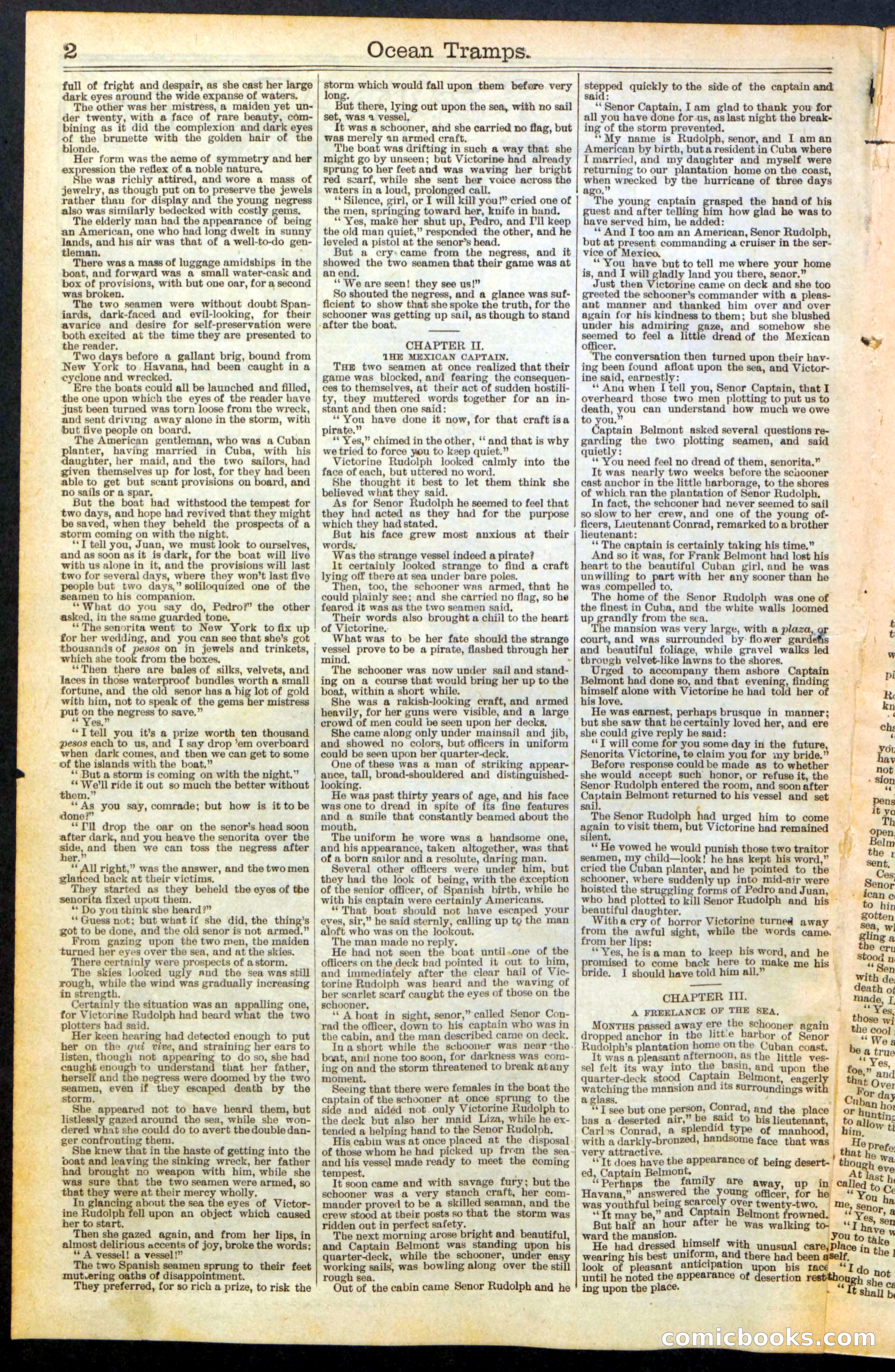
A restored page from Pulp Fiction, 1888. Page through the whole issue in the reader above.
📄 Transcribed text from this page (OCR, searchable)
Machine-transcribed from the original scan — historical spelling and the odd misread are preserved.
2 ; Ocean Tramps. full of fright and despair, as she cast her large dark eyes around the wide expanse of waters, The other was her mistress, a maiden yet un- der twenty, with a face of rare beauty, com- bining as it did the complexion and dark eyes of the brunette with the golden hair of the blonde. Her form was the acme of symmetry and her expression the reflex of a noble nature, She was richly attired, and wore a mass of jewelry, as though put on to preserve the jewels rather thau for display and the young negress also was similarly bedecked with costly gems, The elderly man had the appearance of being an American, one who had long dwelt in sunny | lands, and his air was that of a well-to-do gen- tleman. There was a mass of luggage amidships in the boat, and forward was a small water-casik and box of provisions, with but one oar, for a second was broken. The two seamen were without doubt Span- iards, dark-faced and evil-looking, for their avarice and desire for self-preservation were both excited at the time they are presented to the reader. Two days before a gallant brig, bound from New York to Havana, had been caught in a eyclone and wrecked. | Ere the boats could all be launched and filled, | the one upon which the eyes of the reader have | just been turned was torn loose from the wreck, and sent driving away alone in the storm, with but five people on board. The American gentleman, who was a Cuban planter, having married in Cuba, with his daughter, her maid, and the two sailors, had | given themselves up for lost, for they had been able to get but scant provisions on rd, and no sails or a spar, But the boat had withstood the tempest for two days, and hope had revived that they might be saved, when they beheld the prospects of a storm coming on with the night. ‘*T tell you, Juan, we must look to ourselves, and as soon as it is dark, for the boat will live with us alone in if, and the provisions will last | two for several days, where they won’t last five | people but two days,” soliloquized one of the | seamen to his companion. “What do you say do, Pedro?” the other asked, in the same guarded tone, ‘** The senorita went to New York to fix up for her wedding, and you can see that she’s got | thousands of pene on in jewels and trinkets, which she took from the boxes, ‘*Then there are bales of silks, velvets, and laces in those waterproof bundles worth a small fortune, and the old senor has a big lot of gold with him, not to speak of the pi mistress put on the negress to save.” ac Yes ” “Ttell you it’s a prize worth ten thousand pesos each to us, and I say drop ’em overboard when dark comes, and then we can get to some of the islands with the boat,” ‘** But a storm is coming on with the night.” “We'll ride it out so much the better without them.” ‘**As you say, comrade; but how is it to be done?” **[Pll drop the oar on the senor’s head soon after dark, and you heave the senorita over the en then we can toss the negress after | er. ** All right,” was the answer, and the two men glanced back at their victims. They started as they beheld the eyes of the senorita fixed upou them. ** Do you think she heard?” ** Guess not; but whatif she did, the thing’s got to be done, and the old senor is not armed.” From gazing upon the two men, the maiden turned her eyes over the sea, and at the skies. There certainly were ahs of astorm. The skies looked ugly and the sea was still rough, while the wind was gradually increasing in strength. Certainly the situation was an appalling one, for Victorine Rudolph had heard what the two plotters had said. Her keen hearing had detected enough to put her on the qui vive, and straining her ears to listen, thongh not appearing to do so, she had caught enough to understand that her father, herself and the negress were doomed by the two seamen, even if they escaped death by the storm. She appeared not to have heard them, but listlessly gazed around the sea, while she won- dered what she could do to avert the double dan- ger confronting them. She knew that in the haste of getting into the ooat and leaving the ing wreck, her father had brought no weapon with him, while she was sure that the two seamen were armed, so that they were at. their mercy wholly, In glancing about the sea the eyes of Victor- ine Rudolph her to start. Then she gazed again, and from her lips, in almost delirious accents of joy, broke the words: ** A vessel! a vessel!” The two Spanish seamen sprung to their feet mutvering oaths of disappointment. They preferred, for so rich a prize, to risk the - ell upon an object which caused tt? Te 3 a oat which would fall upon them before very ong. But there, lying out upon the sea, with no sail set, Was 2 vessel, It was a schooner, and she carried no flag, but was merely 2n armed craft. The boat was drifting in such a way that she might go by unseen; but Victorine had already sprung to her feet and was waving her bright red scarf, while she sent her vaice across the waters in a loud, prolonged call. ‘* Silence, girl, or I will kill you!” cried one of the men, springing toward her, knife in hand. ‘Yes, make her shut up, Pedro, and [ll keep the old man quiet,” responded the other, and he leveled a pistol at the senor’s head. But a cry»came from the negress, and it showed the two seamen that their game was at an end. ‘* We are seen! they see us!” So shouted the negress, and a glance was suf- ficient to show that she spoke the truth, for the schooner was getting up sail, as though to stand -after the boat. CHAPTER II. 1HE MEXICAN CAPTAIN. THE two seamen at once realized that their game was blocked, and fearing the consequen- ces to themselves, at their act of sudden hostili- ty, they muttered words together for an in- stant and then one said: ‘*You have done it now, for that craft isa pirate.” ‘** Yes,” chimed in the other, ‘‘ and that is why we tried to force you to keep quiet.” Viectorine Rudolph looked calmly into the face of each, but uttered no word. She thought it best to let them think she believed what they said. As for Senor Rudolph he seemed to feel that they had acted as they had for the purpose which they had stated. But his face grew most anxious at their words, Was the strange vessel indeed a pirate? It certainly looked strange to find a craft lying off there at sea under bare poles. Then, too, the schooner was armed, that he could plainly see; and she carried no flag, so he feared it was as the two seamen said, Their words also brought a chiil to the heart of Victorine, What was to be her fate should the strange hay prove to be a pirate, flashed through her mind. . The schooner was now under sail and stand~- ing on a course that would bring her up to the boat, within a short while. She was a rakish-looking craft, and armed heavily, for her guns were visible, and a large crowd of men could be seen upon her decks, She came along only under mainsail and jib, and showed no colors, but officers in uniform could be seen upon ber quarter-deck, One of these was a man of striking appear- ance, tall, broad-shouldered and distinguished- looking. He was past thirty years of age, and his face was one to dread in spite of its fine features and a smile that constantly beamed about the mouth, The uniform he wore was a handsome one, and his appearance, taken altogether, was that of a born sailor and a resolute, daring man. Several other officers were under him, but they had the look of being, with the éxception of the senior officer, of Spanish birth, while he with his captain were certainly Americans. ‘That boat should not have escaped your eves, sir,” he said sternly, calling up tg the man aloft who was on the lookout. The man made no reply. He had not seen the boat until.one of the officers on the deck bad pointed it out to him, and immediately after the clear hail of Vic- torine Rudolph was heard and the waving of her scarlet scarf caught the eyes of those on the schooner. ‘A boat in sight, senor,” called Senor Con- rad the officer, down to his captain who was in the cabin, and the man described came on deck, In ashort while the schooner was near ‘the baat, and none too soon, for darkness was com- ing on and the storm threatened to break atany moment. 4 Seeing that there were females in the boat the captain of the schooner at_once sprung to the side and aidéd not only Victorine Rudolph to the deck but also her maid Liza, while he ex- tended a helping hand to the Senor Rudolph. His cabin was at once placed at the disposal of those whom he had picked up frem the sea- and his vessel made ready to meet the coming tempest. . ; It soon came and with savage fury; but the schooner was a very stanch craft, her com- mander proved to be a skilled seaman, and the crew stood at their posts so that the storm was ridden out in perfect safety. _ The next morning arose bright and beautiful, and Captain Belmont was standing upon his quarter-deck, while the schooner, under eas working sails, was bowling along over the sti rough sea. Out of the cabin came Senor Rudolph and he a * ~ a ee. ‘ - —_ Ee eemummanmmmmmmmsmeemsss= nese: a quickly to the side of the captain and Said: ‘** Senor Captain, [am glad to thank yow for , all you have done for us, as last night the break- ” ing of the storm prevented. ‘My name is Rudolph, senor, and I am an American by birth, buta resident in Cuba where [ married, and my daughter and myself were returning to our plantation home on the coast, when wrecked by the hurricane of three days ago, The young captain grasped the hand of his guest and after telling him how glad he was to have served him, he added: ‘* And I too am an American, Senor Rudolph, but at present commanding a cruiser in the ser- ’ vice of Mexico, _ “You have but to tell me where your home is, and I will gladly land you there, senor. Just then Victorine came on deck and she too greeted the schooner’s commander with a pleas- ant manner and thanked him over and over ayain for his kindness to them; but she blushed under his admiring gaze, and somehow she seemed to feel a little dread of the Mexican officer. The conversation then turned upon tbeir hav- ing been found afloat upon the sea, and Victor- ine said, earnestly: ‘* Ana when I tell you, Senor Captain, that I overheard those two men plotting to put us to death, you can understand how much we owe ' to you.” f Cadtein Belmont asked several questions re- garding the two plotting seamen, and said quietly : ‘** You need feel no dread of them, senorita.” It was nearly two weeks before the schooner cast anchor in the little harborage, to the shores of which ran the plantation of Senor Rudolph, In fact, the schooner had never seemed to sail so slow to her crew, and one of the young of- ficers, Lieutenant Conrad, remarked to a brother lieutenant: ‘* The captain is certainly taking his time.” And so it was, for Frank Belmont had lost his heart to the beautiful Cuban girl, and he was unwilling to posi with her any sooner than he was compelled to, The home of the Senor Rudolph was one of the finest in Cuba, and the white walls loomed up grandly from the sea. The mansion was very large, with a plaza, court, and was surrounded by: flower mgt é\ and beautiful foliage, while gravel walks led # = tbrovgh velvet-like lawns to the shores. , Urged to accompany them ashore Captain pi Belmont had done so, and that evening, findin f himself alone with Victorine he had told her o ‘ R; his love. ! kn He was earnest, perhaps brusque in manner; ny but she saw that he certainly loved her, and ere Pe ahs she could give reply he said: ‘ ‘*T will come for you some day in the future, Gu Senorita Victorine, te claim you for my bride.” __ ; Before response couldbe made as to whether now she would accept such honor, or refuseit, the sion Senor. Rudolph entered the room, and soon after ' ree Captats Belmont returned to his vessel and set ns sail. ‘ The Senor Rudolph had urged him to come : Fe apts to visit them, but Victorine had remained — Open s1lient. | ‘* He vowed he would punish those two traitor ih rer seamen, my child—look! he has kept his word,” sent . cried the Cuban planter, and he pointed to the — Ces schooner, where suddenly up into mid-air were Sa hoisted the struggling forms of Pedro and J UGH) Yplean : who had plotted to kill Senor Rudolph and his ° 46°" ° beautiful daughter, gotten Witha cry of horror Victorine turned away Sea, w from the awful sight, while the words came. lin vs from ber lips: 8 ore ‘Yes, he isa man to keep bis word, and he stood promised to come back here to make me his } rp Ser, ride. 1 should have told him all.” with de. death of CHAPTER III. made F A FREELANCE OF THE SEA, oh ee iced es, Monrus passed away ere the schooner again tha nea 3 dropped anchor in the litt'e harbor of Senor “Wes Rudolph’s plantation home on the Cuban coast. be a tr . It was a pleasant afternoon, as the little ves- Y a sel felt its way into_the basin, and upon the foe,” anu quarter-deck stood Captain Belmont, eagerly tOw watching the mansion and its surroundings wi Ford, a@ glass, cian : - Cuban he “‘T see but one person, Conrad, and the place or hung; has a deserted air,” be said to his lieutenant, to alloy 15 Carlos Conrad, a splendid type of manhood, him, tk with a darkly-bronzed, handsome face that was He Prefe very attractive. that - ‘Tt does have the appearance of being d ' titi = wa ed, Captain Belmont. — 7 Ate’ “Perhaps the family are away, up called Havana,” answered the y oung officer, for h = ae = was youthful being scarcely Over twenty-two. Me, senor = sé t may be,” and Captain Belmont wn Von » 4 But half an hour after he was walking ‘“ I i ward the mansion. you to thle vi He had dressed himself With unusual 8Ce in th wearing his best uniform, and there had 3 e1 look of pleasant anticipation upon his Ido n until he noted the appearance of desertion h sh aa ing upon the place. bo IKS.CE (E(o) 1®