
Pulp Fiction, 1888 · page 14 of 32
Beadle's New York Dime Library No. 482 — page 14: what you’re looking at
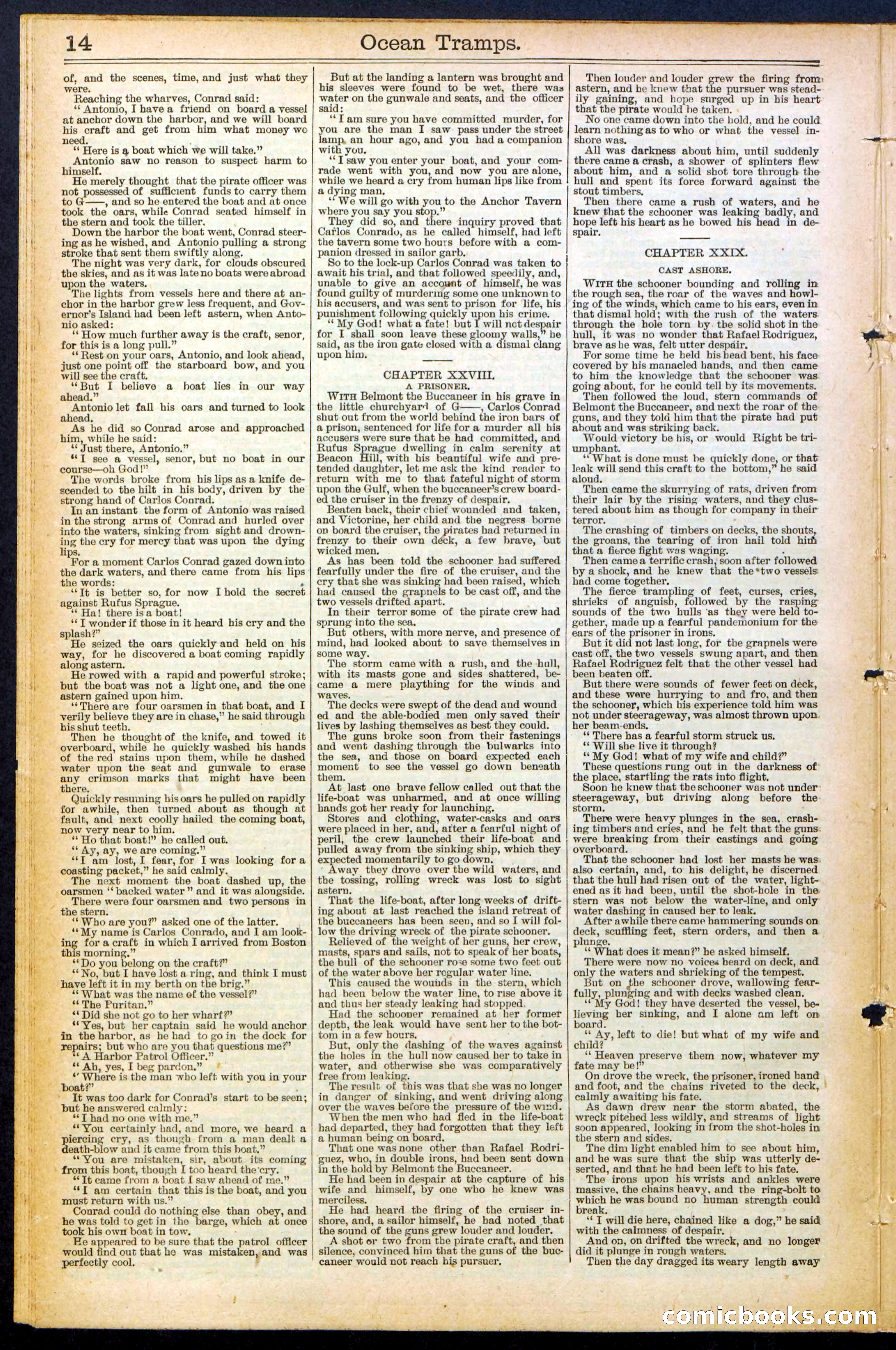
A restored page from Pulp Fiction, 1888. Page through the whole issue in the reader above.
📄 Transcribed text from this page (OCR, searchable)
Machine-transcribed from the original scan — historical spelling and the odd misread are preserved.
— —— ~~. 14 es Nn ge 6 oe a on oe eres: t— Ocean Tramps. of, and the scenes, time, and just what they were. Reaching the wharves, Conrad said: ‘¢ Antonio, I havea friend on board a vessel at anchor down the harbor, and we will board his craft and get from him what money wo need. ‘* Here is a boat which we will take,” Antonio saw no reason to suspect harm to himself. He merely thought that the pirate officer was not possessed of sufficient funds to carry them to G——, and so he entered the boat and at once took the oars, while Conrad seated himself in the stern and took the tiller. Down the harbor the boat went, Conrad steer- ing as he wished, and Antonio pulling a strong stroke that sent them swiftly along. The night was very dark, for clouds obscured the skies, and as it was late no boats were abroad upon the waters. The lights from vessels here and there at an- chor in the harbor grew less frequent, and Gov- ernor’s Island had been left astern, when Anto- nio asked: ** How much further away is the craft, senor, for this is a long pull.” ** Rest on your oars, Antonio, and look ahead, just one point off the starboard bow, and you will see the craft. “But I believe a ahead.” Antonio let fall his oars and turned to look ahead, As he did so Conrad arose and approached him, while he said: * Just there, Antonio.” “IT see a vessel, senor, but no boat in our course—oh God!” The words broke from his lips as a knife de- scended to the hilt in his body, driven by the strong hand of Carlos Conrad. In an instant the form of Antonio was raised in the strong arms of Conrad and hurled over into the waters, sinking from sight and drown- ing the cry for mercy that was upon the dying lips. Tor a moment Carlos Conrad gazed down into the dark waters, and there came from his lips the words: . “Tt is better so. for now I hold the secret against Rufus Sprague. ‘* Ha! there isa boat! ‘*T wonder if those in it heard his cry and the splash?” He seized the oars quickly and held on his way, for he discovered a boat coming rapidly along astern. He rowed with a rapid and powerful stroke; but the boat was not a light one, and the one astern gained upon him. ‘‘There are four oarsmen in that boat, and I verily believe they are in chase,” he said through his shut teeth. Then he thought of the knife, and towed it overboard, while he quickly washed his hands of the red stains upon them, while he dashed water upon the seat and gunwale to erase any crimson marks that might have been there. Quickly resuining his oars he pulled on rapidly for awhile, then turned about as though at fault, and next coolly hailed the coming boat, now very near to him. ** Ho that boat!” he called out. ‘* Ay, ay, we are coming.” ‘“‘T am lost, I fear, for I was looking fora coasting packet,” he said calmly. The next moment the boat dashed up, the oarsmen ‘‘ backed water” and it was alongside. There were four oarsmen and two persons in the stern. ‘* Who are you?” asked one of the latter. ‘*My name is Carlos Conrado, and I am look- ing foracraft in which I arrived from Boston this morning.” **Do you belong on the craft?” **No, but I have lost a ring, and think I must have left it in my berth on the brig.” “What was the name of the vessel?” **'The Puritan.” ** Did she not go to her wharf?” ‘Yes, but her captain said he would anchor in the harbor, as he had to goin the dock for repairs; but who are you that questions me?’ ‘A Harbor Patrol Officer.” ** Ah, yes, I beg pardon.” * Where is the man who left with you in your boat?” ! It was too dark for Conrad’s start to be seen; but he answered calmly: **T had no one with me.” ‘You certainly had, and more, we heard a piercing cry, as though from a man dealt a death-blow and it came from this boat,” **You are mistaken, sir, about its coming from this boat, thouyh [ too heard the’cry. “Tt came from a boat [ saw ahead of me.” *‘T am certain that this is the boat, and you | must return with us.” Conrad could do nothing else than obey, and he was told to getin the barge, which at once | took his own boat in tow. Be Lippe to be sure that the patrol officer | would find out that ho was mistaken,and was | perfectly cool. boat lies in our way But at the landing a lantern was brought and his sleeves were found to be wet, there was Ms on the gunwale and seats, and the officer said: ‘*T am sure you have committed murder, for you are the man I saw pass under the street lamp, an hour ago, and you had a companion with you. ‘*T saw you enter your boat, and your com- rade went with you, and now you are alone, while we heard a cry from human lips like from a dying man, ‘* We will go with you to the Anchor Tavern where you say you stop.” They did so, and there inquiry proved that Carlos Conrady, as he called himself, had left the tavern some two hours before with a com- panion dressed in sailor garb, So to the lock-up Carlos Conrad was taken to await his trial, and that followed speedily, and, unable to give an accownt of himself, he was found guilty of murdering some one unknown to his accusers, and was sent to prison for life, his punishment following quickly upon his crime. ‘*My God! what a fate! but 1 will not despair for I shall soon leave these gloomy walls,” he said, as the iron gate closed with a dismal clang upon him, CHAPTER XXVIUTI, A PRISONER, Wri Belmont the Buccaneer in his grave in the little churchyar’ of G——, Carlos Conrad shut out from the world behind the iron bars of a prison, sentenced for life for a murder all bis accusers were sure that he had committed, and Rufus Sprague dwelling in calm serenity at Beacon Hill, with his beantiful wife and pre- tended daughter, let me ask the kind reader to return with me to that fateful night of storm upon the Gulf, when the buccaneer’s crew board- ed the cruiser in the frenzy of despair. Beaten back, their chief wounded and taken, and Victorine, her child and the negress borne on board the cruiser, the pirates had returned in frenzy to their own déck, a few brave, but wicked men. As has been told the schooner had suffered fearfully under the fire of the cruiser, and the ery that she was sinking had been raised, which had caused the grapnels to be cast off, and the two vessels drifted apart. In their terror some of the pirate crew had sprung into the sea, But others, with more nerve, and presence of mind, had looked about to save themselves in some way. The storm came with a rush, and the hall, with its masts gone and sides shattered, be- came a mere plaything for the winds and waves. The decks were swept of the dead and wound ed and the able-bodied men only saved their lives by lashing themselves as best they could. The guns broke soon from their fastenings and went dashing through the bulwarks into the sea, and those on board expected each moment to see the vessel go down beneath them. At last one brave fellow called out that the life-boat was unharmed, and at once willing bands got her ready for launching. Stores and clothing, water-casks and oars were placed in her, and, atter a fearful night of peril, the crew launched their life-boat and pulled away from the sinking ship, which they expected momentarily to go down, ‘Away they drove over the wild waters, and the tossing, rolling wreck was lost to sight astern. That the life-boat, after long weeks of drift- ing about at last reached the island retreat of the buccaneers has been seen, and so [ will fol- low the driving wreck of the pirate schooner. Relieved of the weight of her guns, her crew, masts, spars and sails, not to speak of her boats, the bull of the schooner rose some two feet out of the water above her rogular water line. This caused the wounds in the stern, which had been below the water line, to rise above it and thus ber steady leaking had stopped, Had the schooner remained at her former depth, the leak would have sent her to the bot- tom in a few hotrs. But, only the dashing of the waves against the holes in the hull now caused her to take in water, and otherwise she was comparatively free from leaking. The result of this was that she was no longer in danger of sinking, and went driving along over the waves before the pressure of the wind. When the men who had fled in the life-boat had departed, they had forgotten that they left a human being on board. That one wasnone other than Rafael Rodri- guez, who, in double irons, had been sent down in the hold by Belmont the Buccaneer. He had been in despair at the capture of his wife and himself, by one who he knew was merciless. He had heard the firing of the cruiser in- shore, and, a sailor himself, he had noted that the sound of the guns grew louder and louder. A shot or two from the pirate craft, and then silence, convinced him that the guns of the buc- caneer would not reach bis pursuer, epee neta eee eee LLL TE LN ETD a, 2 ES RMS. ENTS EE Then louder and louder grew the firing from: astern, and he knew that the pursuer was stead- ily gaining, and hope surged up in his heart that the pirate would be taken. No one came down into the hold, and he could learn nothing as to who or what the vessel in- shore was, All was darkness about him, until suddenly there came a crash, a shower of splinters flew about him, and a solid shot tore through the hull and spent its force forward against the stout timbers, Then there came a rush of waters, and he knew that the schooner was leaking badly, and hope left his heart as he bowed his head in de- spair. CHAPTER XXIX. CAST ASHORE, WITH the schooner bounding and rolling in the rough sea, the roar of the waves and howl- ing of the winds, which came to his ears, even in that dismal hold; with the rush of the waters through the hole torn by. the solid shot in the hull, it was no wonder that Rafael Rodriguez, brave as he was, felt utter despair. For some time he held his head bent, his face covered by his manacled bands, and then came to him the knowledge that the schooner was going about, for he could tell by its movements. Then followed the loud, stern commands of Belmont the Buccaneer, and next the roar of the guns, and they told him that the pirate had put about and was striking back. Would victory be his, or would Right be tri- umphant. ** What is done must be quickly done, or that leak will send this craft to the bottom,” he said aloud. Then came the skurrying of rats, driven from their lair by the rising waters, and they clus- tered about him as though for company in their terror. The crashing of timbers on decks, the shouts the groans, the tearing of iron hail told hirh that a fierce fight was waging. = Then came a terrific crash, soon after followed by a shock, and he knew that the *two vessels had come together. The fierce trampling of feet, curses, cries, shrieks of anguish, followed by the rasping sounds of the two hulls ‘as they were held to- gether, made up a fearful pandemonium for the ears of the prisoner in irons, But it did not last long, for the grapnels were cast off, the two vessels swung apart, and then Rafael Rodriguez felt that the other vessel had been beaten off. But there were sounds of fewer feet on deck, and these were hurrying to and fro, and then the schooner, which bis experience told him was not under steerageway, was almost thrown upon. her beam-ends, ‘“* There has a fearful storm struck us. ** Will she live it through? ‘My God! what of my wife and child?” These questions rung out in the darkness of the place, startling the rats into flight. Soon he knew that the schooner was not under’ steerageway, but driving along before the: storm. There were heavy plunges in the sea, crash- ing timbers and cries, and he felt that the guns: were breaking from their castings and going overboard. That the schooner had lost her masts he was: also certain, and, to his delight, be discerned that the hull had risen out of the water, light- ened as it had been, until the shot-hole in the stern was not below the water-line, and only water dashing in caused her to leak, After awhile there came hammering sounds on oar scuffling feet, stern orders, and then a unge, pe What does it mean?” he asked himself. There were now no voices beard on deck, and only the waters and shrieking of the tempest. But on the schooner drove, wallowing fear- fully, plunging and with decks washed clean. ‘* My God! they have deserted the vessel, be- lieving ber sinking, and I alone am left on board. ** Ay, left to die! but what of my wife and child? ‘* Heaven preserve them now, whatever my fate may be!” On drove the wreck, the prisoner, ironed hand and foot, and the chains riveted to the deck, calmly awaiting his fate. As dawn drew near the storm abated, the wreck pitehed less wildly, and streams of light soon appeared, looking in from the shot-holes in the stern and sides. The dim light enabled him to see about him, and he was sure that the ship was utterly de- serted, and that he had been left to his fate. The irons upon his wrists and ankles were massive, the chains heavy, and the ring-bolt to er he was bound no human strength could reak. ‘* T will die here, chained like a dog,” he said with the calmness of despair. And on, on drifted the wreck, and no longer did it plunge in rough waters. Then the day dragged its weary length away 900) com C ‘S Cc (o)