
Pulp Fiction, 1887 · page 17 of 32
Beadle's New York Dime Library No. 476 — page 17: what you’re looking at
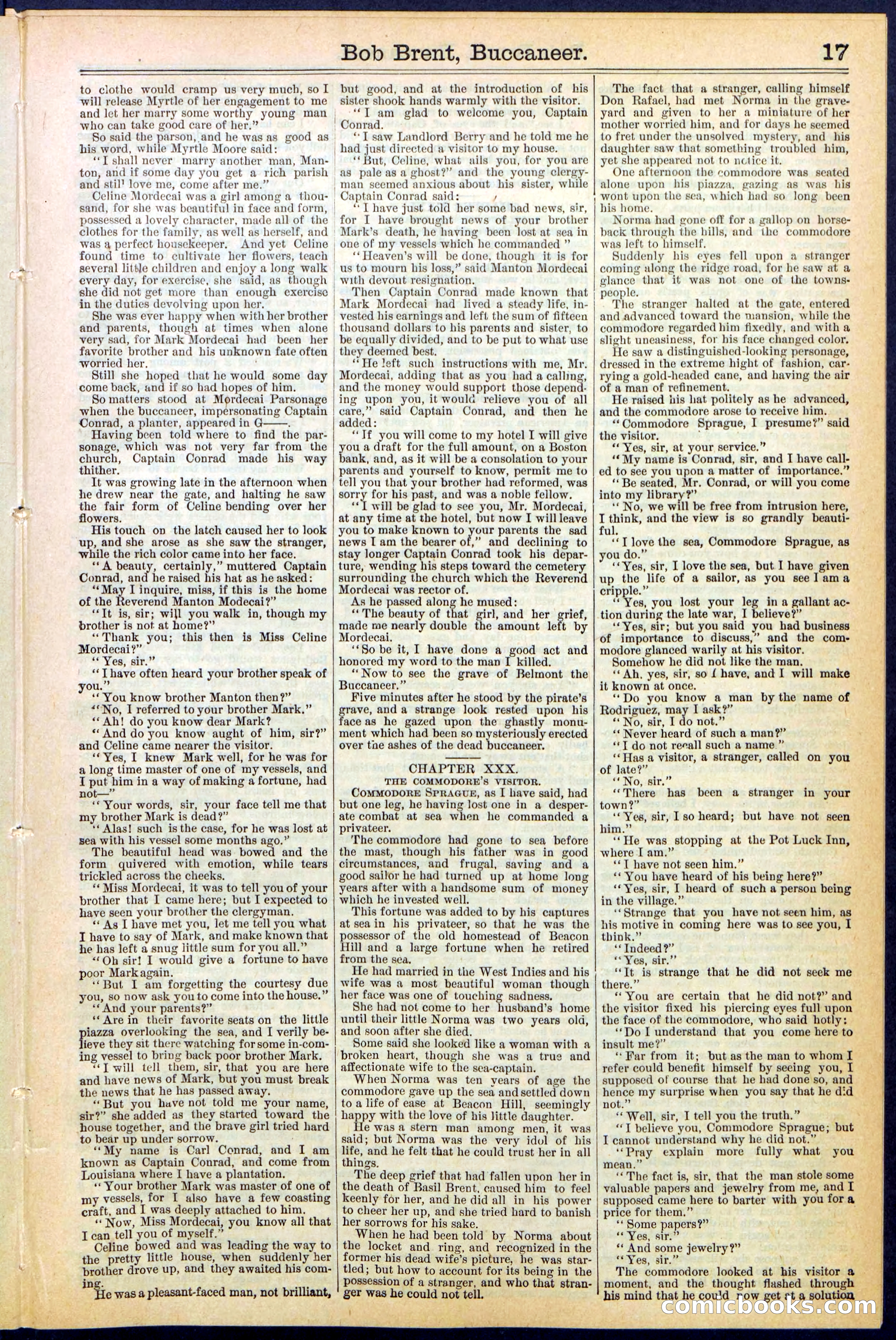
A restored page from Pulp Fiction, 1887. Page through the whole issue in the reader above.
📄 Transcribed text from this page (OCR, searchable)
Machine-transcribed from the original scan — historical spelling and the odd misread are preserved.
A 4 ee : Bp a . | a Ae: — - a — —_— — a ~~ oy Bob Brent, Buccaneer. 17 to clothe would cramp us very much, sol but good, and at the introduction of his will release Myrtle of her engagement to me and let her marry some worthy young man who can take good care of her.” So said the parson, and he was as good as his word, while Myrtle Moore said: “T shall never marry another man, Man- ton, and if some day you get a rich parish and stil’ love me, come after me.” Celine Mordecai was a girl among a thou- sand, for she was beautiful in face and form, possessed a lovely character, made all of the clothes for the family, as well as herself, and was a perfect housekeeper. And yet Celine | found time to cultivate her flowers, teach | several little children and enjoy a long walk every day, for exercise, she said, as though she did not get more than enough exercise | in the duties devolving upon her. She was ever happy when with her brother and parents, though at times when alone very sad, for Mark Mordecai had been her favorite brother and his unknown fate often worried her, Still she hoped that he would some day come back, and if so had hopes of him. So matters stood at Mordecai Parsonage when the buccaneer, impersonating Captain Conrad, a planter, appeared in G Having been told where to find the par- sonage, which was not very far from the church, Captain Conrad made his way thither. It was growing late in the afternoon when he drew near the gate, and halting he saw the fair form of Celine bending over her flowers. His touch on the latch caused her to look up, and she arose as she saw the stranger, while the rich color came into her face. oh: genet certainly,” muttered Captain Conrad, and he raised his hat as he asked: **May I inquire, miss, if this is the home of the Reverend Manton Modecai?” “It is, sir; will you walk in, though my brother is not at home?” ‘“Thank you; this then is Miss Celine Mordecai?” i Yes, ar.” ‘‘T have often heard your brother speak of ou.” Ger You know brother Manton then?” **No, I referred to your brother Mark.” ** Ah! do you know dear Mark? **And do you know aught of him, sir?” and Celine came nearer the visitor. ‘€ Yes, I knew Mark well, for he was for a long time master of one of my vessels, and T put him in a way of making a fortune, had not—” ‘* Your words, sir, your face tell me that my brother Mark is dead?” ‘* Alas! such is the case, for he was lost at sea with his vessel some months ago.” The beautiful head was bowed and the form quivered with emotion, while tears trickled across the cheeks. ** Miss Mordecai, it was to tell you of your brother that I came here; but I expected to have seen your brother the clergyman. ‘* Ag I have met you, let me tell you what T have to say of Mark, and make known that he has left a snug little sum for you all.” ‘(Oh sir! I would give a fortune to have poor Markagain. ‘‘But I am forgetting the courtesy due you, so now ask you to come into the house.” ‘And your parents?” **Arein their favorite seats on the little iazza overlooking the sea, and I verily be- ieve they sit there watching for some in-com- ing vessel to bring back poor brother Mark. ‘‘7 will tell them, sir, that you are here and have news of Mark, but you must break the news that he has passed away. ‘But you have not told me your name, sir?” she added as they started toward the house together, and the brave girl tried hard to bear up under sorrow. . “My name is Carl Conrad, and I am known as Captain Conrad, and come from Louisiana where I have a plantation. ‘* Your brother Mark was master of one of my vessels, for I also have a few coasting craft, and I was deeply attached to him. ‘* Now, Miss Mordecai, you know all that I can tell you of myself.” Celine bowed and was leading the way to the pretty little house, when suddenly her brother drove up, and they awaited his com- r ate was a pleasant-faced man, not brilliant, - , ays « = oa"? Y <i eee oA : hag a > > . A q » <t Fae oo La 2 sister shook hands warmly with the visitor. ‘““T am glad to welcome you, Captain Conrad. “I saw Landlord Berry and he told me he had just directed a visitor to my house. ‘* But, Celine, what ails you, for you are as pale as a ghost?” and the young clergy- man seemed anxious about his sister, while Captain Conrad said: / “T have just told her some bad news, sir, for I have brought news of your brother Mark’s death, he having been lost at sea in one of my vessels which he commanded ” ‘*Heaven’s will be done, though it is for us to mourn his loss,” said Manton Mordecai with devout resignation. Then Captain Conrad made known that Mark Mordecai had lived a steady life, in- vested his earnings and left the sum of fifteen thousand dollars to his parents and sister, to be equally divided, and to be put to what use _ they deemed best. : s oS 07, i > ee Ga > ne : ‘He left such instructions with me, Mr. Mordecai, adding that as you had a calling and the money would support those depend ing upon you, it would relieve you of all care,” said Captain Conrad, and then he added: “Tf you will come to my hotel I will give ou a draft for the full amount, on a Boston ank, and, as it will be a consolation to your parents and yourself to know, permit me to tell you that your brother had reformed, was sorry for his past, and was a noble fellow. ‘*T will be glad to see you, Mr. Mordecai, at any time at the hotel, but now I willleave you to make known to ‘ph parents the sad news [ am the bearer of,” and declining to stay longer Captain Conrad took his depar- ture, wending his steps toward the cemetery surrounding the church which the Reverend Mordecai was rector of. As he passed along he mused: ‘‘The beauty of that girl, and her grief, made me nearly double the amount left by Mordecai. ‘*So be it, I have done a good act and honored my word to the man [ killed. “Now to see the grave of Belmont the Buccaneer.” Five minutes after he stood by the pirate’s grave, anda strange look rested upon his face as he gazed upon the ghastly monu- ment which had been so mysteriously erected over tne ashes of the dead buccaneer. CHAPTER XXX. THE COMMODORE’S VISITOR. COMMODORE SPRAGUE, as I have said, had but one leg, he having lost one in a desper- ate combat at sea when he commanded a privateer. The commodore had gone to sea before the mast, though his father was in good circumstances, and frugal, saving and a good sailor he had turned up at home long years after with a handsome sum of money which he invested well. This fortune was added to by his captures at sea in his privateer, so that he was the possessor of the old homestead of Beacon Hill and a large fortune when he retired from the sea, He had married in the West Indies and his wife was a most beautiful woman though her face was one of touching sadness. She had not come to her husband’s home until their little Norma was two years old, and soon after she died. Some said she looked like a woman with a broken heart, though she was a true and affectionate wife to the sea-captain. When Norma was ten years of age the commodore gave up the sea and settled down to a life of ease at Beacon Hill, seemingly happy with the love of his Jittle daughter. He was a stern man among men, it was said; but Norma was the very idol of his life, and he felt that he could trust her in all things. The deep grief that had fallen upon her in the death of Basil Brent, caused him to feel keenly for her, and he did all in his power to cheer her up, and she tried hard to banish her sorrows for his sake. When he had been told by Norma about the locket and ring, and recognized in the former his dead wife's picture, he was star- tled; but how to account for its being in the possession of a stranger, and who that stran- ’ ger was he could not tel. : CIS F a his mind that he could row get rt a solution i comicbooks:co The fact that a stranger, calling himself Don Rafael, had met Norma in the grave- yard and given to her a miniature of her mother worried him, and for days he seemed to fret under the unsolved mystery, and his daughter saw that something troubled him, yet she appeared not to nctice it. One afternoon the commodore was seated alone upon his piazza, gazing as was his wont upon the sea, which had so long been his home. | Norma had gone off for a gallop on horse- | back through the hills, and the commodore was left to himself. | Suddenly his eyes fell upon a stranger | coming along the ridge road, for he saw at a glance that it was not one of the towns- people. The stranger halted at the gate, entered and advanced toward the mansion, while the commodore regarded him fixedly, and with a slight uneasiness, for his face changed color. | He saw a distinguished-looking personage, dressed in the extreme hight of fashion, car- ql rying a gold-headed cane, and having the air of a man of refinement. He raised his hat politely as he advanced, “7 and the commodore arose to receive him. | ‘“‘Commodore Sprague, I presume?” said | the visitor. | ‘Yes, sir, at your service.” ‘¢My name is Conrad, sir, and I have call- ed to see you upon a matter of importance,” ‘Be seated, Mr. Conrad, or will you come into my library?” ‘* No, we will be free from intrusion here, I think, and the view is so grandly beauti- ful. ‘‘T love the sea, Commodore Sprague, as | ou do.” ‘‘Yes, sir, I love the sea, but I have given up the life of a sailor, as you seelama cripple.” | “Yes, you lost your leg ina gallant ac- 3 tion during the late war, I believe?” ‘Yes, sir; but you said you had business of importance to discuss,” and the com- } modore glanced warily at his visitor. Somehow he did not like the man, “ee ‘‘Ah, yes, sir, so { have, and 1 will make is it known at once, a: “Do you know a man bythe name of Rodriguez, may I ask?” ‘‘No, sir, I do not.” ‘* Never heard of such a man?” ’ ‘*T do not recall such a name ” : ‘‘Has a visitor, a stranger, called on you ~ of late?” ar “No, -air,.”” a) “There has been a stranger in your town?” 7 ow ‘Ves, sir, Iso heard; but have not seen % him.” roy | ‘‘He was stopping at the PotLuckInn, | where I am.” a, ‘You have heard of his being here?” ‘Yes, sir, I heard of such a person being ‘*T have not seen him.” e 4 in the village.” ‘Strange that you have notseenhim,as his motive in coming here wastosee you,Il ink.” “ay | think. ty fo ‘* Indeed?” *"SYes, sir.” “Tt is strange that he did not seek me there.” ‘You are certain that he did not?” and — the visitor fixed his piercing eyes full upon — the face of the commodore, who said hotly; ‘‘Do I understand that you come hereto _ insult me?” ae “Far from it; butasthemantowhomI — refer could benefit himself by seeing you,I | supposed of course that he had done so, and | hence my surprise when you say that he did not.” * ay ‘‘ Well, sir, I tell you the truth.” oy “T believe you, Commodore Sprague; but I cannot understand why he did not.” “> ‘“Pray explain more fully what you © mean.” mF ‘The fact is, sir, that the man stolesome valuable papers and jewelry from me, andb supposed came here to barter with youfora a 7 a price for them,” i ‘‘ Some papers?” Oth vce sé Yes, sir.” / es 45 a8 ; ** And some jewelry?” 52 gave ‘Yes, sir.” re The commodore looked at his visitor ¢ e moment, and the thought flashed through - inl i» a. mph