
Pulp Fiction, 1887 · page 18 of 32
Beadle's New York Dime Library, No. 475 — page 18: what you’re looking at
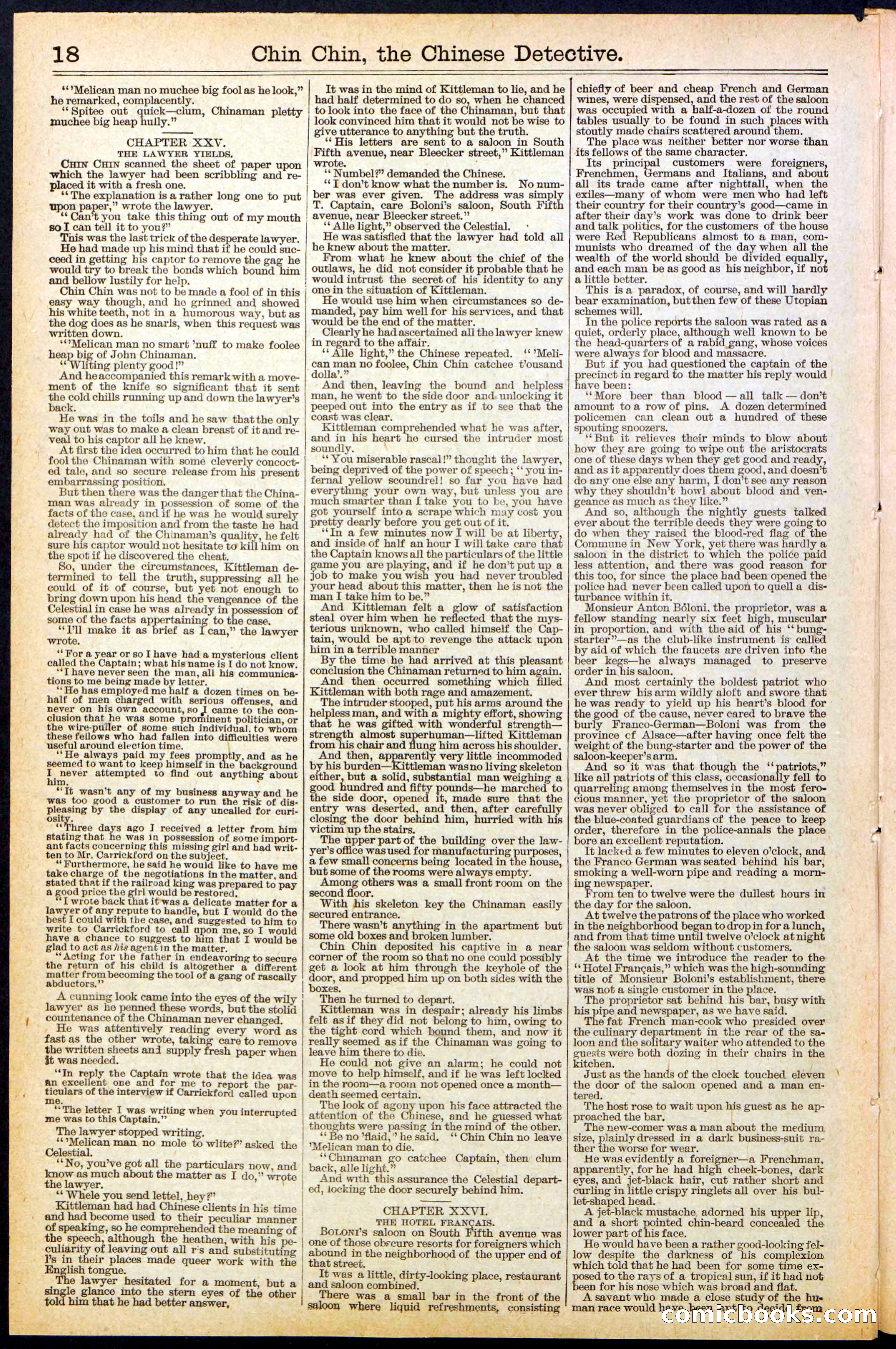
A restored page from Pulp Fiction, 1887. Page through the whole issue in the reader above.
📄 Transcribed text from this page (OCR, searchable)
Machine-transcribed from the original scan — historical spelling and the odd misread are preserved.
* . . . i’ . 4 - he ~ “& » 4 ‘ ra Py . , Lh! & ° ; n i] ial ee hank ‘Fe ~ a “i ~y * a .* 18 ***Melican man no muchee big fool as he look,” he remarked, complacently. **Spitee out quick—clum, muchee big heap hully.” CHAPTER XXV. THE LAWYER YIELDS, CuIn CHIN scanned the sheet of paper upon which the lawyer had been scribbling and re- it with a fresh one. “The explanation is a rather long one to put | ber nm paper,” wrote the lawyer. ne Ca tyou take this thing out of my mouth so I can tell it to you?” This was the last trick of the desperate lawyer. He had made up his mind that if he could suc- ceed in getting his captor to remove the gag he would try to break the bonds which bound him and bellow lustily for help. Chin Chin was not to be made a fool of in this way though, and he grinned and showed his white teeth, not in a humorous way, but as the dog does as he snarls, when this request was written down. ‘“Melican man no smart ’nuff to make foolee ene of John Chinaman. “ Wliting plenty good!” And heaccompanied this remark with a move- ment of the knife so significant that it sent a on chills running up and down the lawyer’s He was in the toils and he saw thatthe only way out was to make a clean breast of it and re- veal to his captor all he knew. At first the idea occurred to him that he could fool the Chinaman with some cleverly concoct- ed tale, and so secure release from his present embarrassing position, But then there was the danger that the China- man was already in possession of some of the facts of the case, and if he was he would surely detect the imposition and from the taste he had already had of the Chinaman’s quality, he felt sure his peptic would not hesitate to kill him on the spot if he discovered the cheat. So, under the circumstances, Kittleman de- termined to tell the truth, suppressing all he could of it of course, but yet not enough to bring down upon his head the vengeance of the Celestial in case he was already in possession of some of the facts appertaining to the case, ‘*T'll make it as brief as wrote, ‘** For a year or so I have had a mysterious client called the Captain; what his name is I do not know. ‘“*T have never seen the man, all his communica- tions to me being made by letter. ‘He has employed me half a dozen times on be- half of men charged with serious offenses, and never on his own account, so I came to the con- clusion that he was some prominent politician, or the wire-puller of some such individual. to whom these fellows who had fallen into difficulties were useful around election time. : ‘*He always paid my fees prom tly, and as he seemed to want to keep himself in the background Le never attempted to find out anything about a : can,” the lawyer “Tt wasn't any of my business anyway and he was too good a customer to run the risk of dis- Rossing by the display of any uncalled for curi- osi “Three days ago I received a letter from him stating that he was in possession of some import- ant facts concerning this missing girl and had writ- ten to Mr, Carrickford on the subject. ‘Furthermore, he said he would like to have me take charge of the negotiations in the matter, and stated that if the railroad king was prepared to pay a good price the girl would be restored, ‘I wrote back that itwas a delicate matter for a lawyer of any repute to handle, but I would do the best I could with the case, and suggested to him to write to Carrickford to call apon me,so I would have a chance to suggest to him that I would be glad to act as his agent in the matter. “Acting for the father in endeavoring to secure the return of his child is altogether a different matter from becoming the tool of a gang of rascally abductors.”’ A cunning look came into the eyes of the wil lawyer as he penned these Some but the stolid countenance of the Chinaman never changed. . He was attentively reading every word as fast as the other wrote, taking care to remove the written sheets and supply fresh paper when it was needed. “In reply the Captain wrote that the idea was an excellent one and for me to report the par- ticulars of the interview if Carrickford called upon me. **The letter I was writing when me was to this Captain.”’ x er map ages dee mae wehbe stopped sek om elican man no mole to wlite?’ ask ws a bn oe 0, you’ve go the particulars now, an know as much about the antici as I do,” wrote the lawyer. ** Whele you send lettel, hey?” Kittleman had had Chinese clients in his time and had become used to their peculiar manner of speaking, so he comprehended the meaning of the speech, although the heathen, with his pe- of leaving out all r’s and substituting Ps in their places made queer work with the lish tongue. lawyer hesitated for a moment, but a aoe glance into the stern eyes of the other told him that he had better answer, fos yee eal + 7 Ee eee | ’ It was in the mind of Kittleman to lie, and he had half determined to do so, when he chanced Chinaman pletty | to look into the face of the Chinaman, but that look convinced him that it would not be wise to give utterance to anything but the truth. “* His letters are sent to a saloon in South Fifth avenue, near Bleecker street,” Kittleman wrote, ‘* Numbel?’ demanded the Chinese. **T don’t know what the number is. No num- was ever given. The address was simpl Captain, care Boloni’s saloon, South Fift avenue, near Bleecker street.” ** Alle light,” observed the Celestial. - He was satisfied that the lawyer had told all he knew about the matter. From what he knew about the chief of the outlaws, he did not consider it probable that he would intrust the secret of his identity to any one in the situation of Kittleman. He would use him when circumstances so de- manded, pay him well for his services, and that would be the end of the matter. Clearly he had ascertained all the lawyer knew in regard to the affair. ** Alle light,” the Chinese repeated. ‘* ’Meli- can man no foolee, Chin Chin catchee t’ousand dolla’.” And then, leaving the bound and _ helpless man, he went to the side door and. unlocking it peeped out into the entry as if to see that the coast was clear. Kittleman comprehended what he was after, and in his heart he cursed the intruder most soundly. ‘** You miserable rascal!” thought the lawyer, being deprived of the power of speech; ‘‘ you in- fernal yellow scoundrel! so far you have had everything your own way, but unless you are much smarter than [ take you to be, you have got yourself into a scrape which may cost you pretty dearly before you get out of it. ‘‘In a few minutes now I will be at liberty, and inside of half an hour I will take care that the Captain knows all the particulars of the little ame you are playing, and if he don’t put up a job to make you wish you had never troubled your head about this matter, then he is not the man I take him to be.” And Kittleman felt a glow of satisfaction steal over him when he reflected that the mys- terious unknown, who called himself the Cap- tain, would be apt to revenge the attack upon him in a terrible manner By the time he had arrived at this pleasant conclusion the Chinaman returned to him again. And then occurred something which filled Kittleman with both rage and amazement. The intruder stooped, put his arms around the helpless man, and with a mighty effort, showing that he was gifted with wonderful strength— strength almost superhuman—lifted Kittleman from his chair and flung him across his shoulder. And then, on ney very little incommoded by his burden—Kittleman wasno living skeleton either, but a solid, substantial man weighing a ood hundred and ao 8 pounds—he marched to the side door, opened it, made sure that the entry was deserted, and then, after carefully closing the door behind him, hurried with his victim up the stairs. The upper part of the building over the law- yer’s office was used for manufacturing purposes, a few small concerns being located in the house, but some of the rooms were always empty. Among others was a small front room on the second floor. With his skeleton key the Chinaman easily secured entrance. There wasn’t anything in the apartment but some old boxes and broken lumber. in Chin deposited his captive in a near corner of the room so that no one could possibly get a look at him through the keyhole of the Sens and propped him up on both sides with the xes, Then he turned to depart. Kittleman was in despair; already his limbs felt asif they did not belong to him, owing to the tight cord which bound them, and now it really seemed asif the Chinaman was going to leave him there to die. He could not give an alarm; he could not move to help himself, and if he was left locked in the room—a room not opened once a month— death seemed certain. The look of agony upon his face attracted the attention of the Chinese, and he guessed what thoughts were passing in the mind of the other. ** Be no ’flaid,” he said, ‘‘ Chin Chin no leave ’*Melican man to die. **Chinaman go catchee Captain, then clum back, alle light.” And with this assurance the Celestial depart- ed, locking the door securely behind him. CHAPTER XXVI. THE HOTEL FRANCAIS. Botont’s saloon on South Fifth avenue was one of those obreure resorts for foreigners which abound in the neighborhood of the upper end of that street. It was a little, dirty-looking place, restaurant and saloon combined. as a small in the front of the saloon Where liquid elreshm ents, Bi aS ow ar wht > nro: Chin Chin, the Chinese Detective. chiefly of beer and cheap French and German wines, were dispensed, and the rest of the saloon was occupied with a half-a-dozen of the round tables usually to be found in such places with stoutly made chairs scattered around them, The place was neither better nor worse than its fellows of the same character. Its principal customers were foreigners Frenchmen, Germans and Italians, and abou all its trade came after nightfall, when the exiles—many of whom were men who had left their country for their country’s good—came in after their day’s work was done to drink beer and talk politics, for the customers of the house were a Republicans almost to a man, com- munists who dreamed of the day when all the wealth of the world should be divided equally, and each man be as good as his neighbor, if not a little better. This isa paradox, of course, and will hardly bear examination, butthen few of these Utopian schemes will. In the police reports the saloon was rated as a quiet, orderly place, although well known to be the head-quarters of a rabid gang, whose voices were always for blood and massacre. But if you had questioned the captain of the ‘dace in regard to the matter his reply would ave been: ‘*More beer than blood — all talk — don’t amount toa row of pins. A dozen determined policemen can clean out a hundred of these spouting snoozers. ‘*But it relieves their minds to blow about how they are going to wipe out the aristocrats one of these days when they get good and ready, and as it apparently does them good, and doesn’t do any one else any harm, I don’t see any reason why they shouldn’t howl about blood and ven- geance as much as they like.” And so, although the nightly guests talked ever about the terrible deeds they were going to do when they raised the blood-red flag of the Commune in New York, yet there was hardly a saloon in the district to which the police paid less attention, and there was good reason for this too, for since the place had been opened the police had never been called upon to quella dis- turbance within it. Monsieur Anton Bédloni, the proprietor, was a fellow standing nearly six feet high, muscular in proportion, and with the aid of his ‘* bung- starter”—as the club-like instrument is’ called by aid of which the faucets are driven into the beer kegs—he always managed to preserve order in his saloon. And most certainly the boldest patriot who ever threw his arm wildly aloft and swore that he was ready to yield up his heart’s blood for the good of the cause, never cared to brave the burly Franco-German—Boloni was from the province cf Alsace—after having once felt the weight of the bung-starter and the power of the saloon-keeper’s arm. And so it was that though the ‘ patriots,” like all patriots of this class, occasionally fell to quarreling among themselves in the most fero-~ cious manner, yet the proprietor of the saloon was never obliged to call for the assistance of the blue-coated guardians of the peace to keep order, therefore in the police-annals the place bore an excellent reputation. It lacked a few minutes to eleven o’clock, and, the Franco German was seated behind his bar, smoking a well-worn pipe and reading a morn- ing newspaper. rom ten to twelve were the dullest hours in the day for the saloon. At twelve the patrons of the place who worked in the neighborhood began to drop in fora lunch, and from that time until twelve o’clock at night the saloon was seldom without customers, At the time we introduce the reader to the ‘ Hotel Francais,” which was the high-sounding title of Monsieur Boloni’s establishment, there was not a single customer in the place. The proprietor sat behind his bar, busy with his pipe and newspaper, as we have said. e fat French man-cook who presided over the culinary department in the rear of the sa- loon and the solitary waiter who attended to the guests were both dozing in their chairs in the kitchen. ) Just as the hands of the clock touched eleven the She 3 of the saloon opened and a man en- tered. The host rose to wait upon his guest as he ap- proached the bar, The new-comer was a man about the medium. size, plainly dressed in a dark business-suit ra- ther the worse for wear. He was evidently a foreigner—a Frenchman, apparently, for he had high cheek-bones, dark eyes, and jet-black hair, cut rather short and curling in little crispy ringlets all over his bul- let-shaped head. A jet-black mustache adorned his Ape lip, and a short pointed chin-beard concealed the lower part of his face. He would have been a rather good-looking fel- low despite the darkness of his complexiom which told that he had been for some time ex- poet to the rays of a tropical sun, if it had not for his nose which was broad and flat. _ A savant who made a close study of =) *©=comicbooks.com — cid pes OER pe Ue = fy eh en aa er os + ‘ 4 ra a {