
Pulp Fiction, 1887 · page 27 of 32
Beadle's New York Dime Library No. 471 — page 27: what you’re looking at
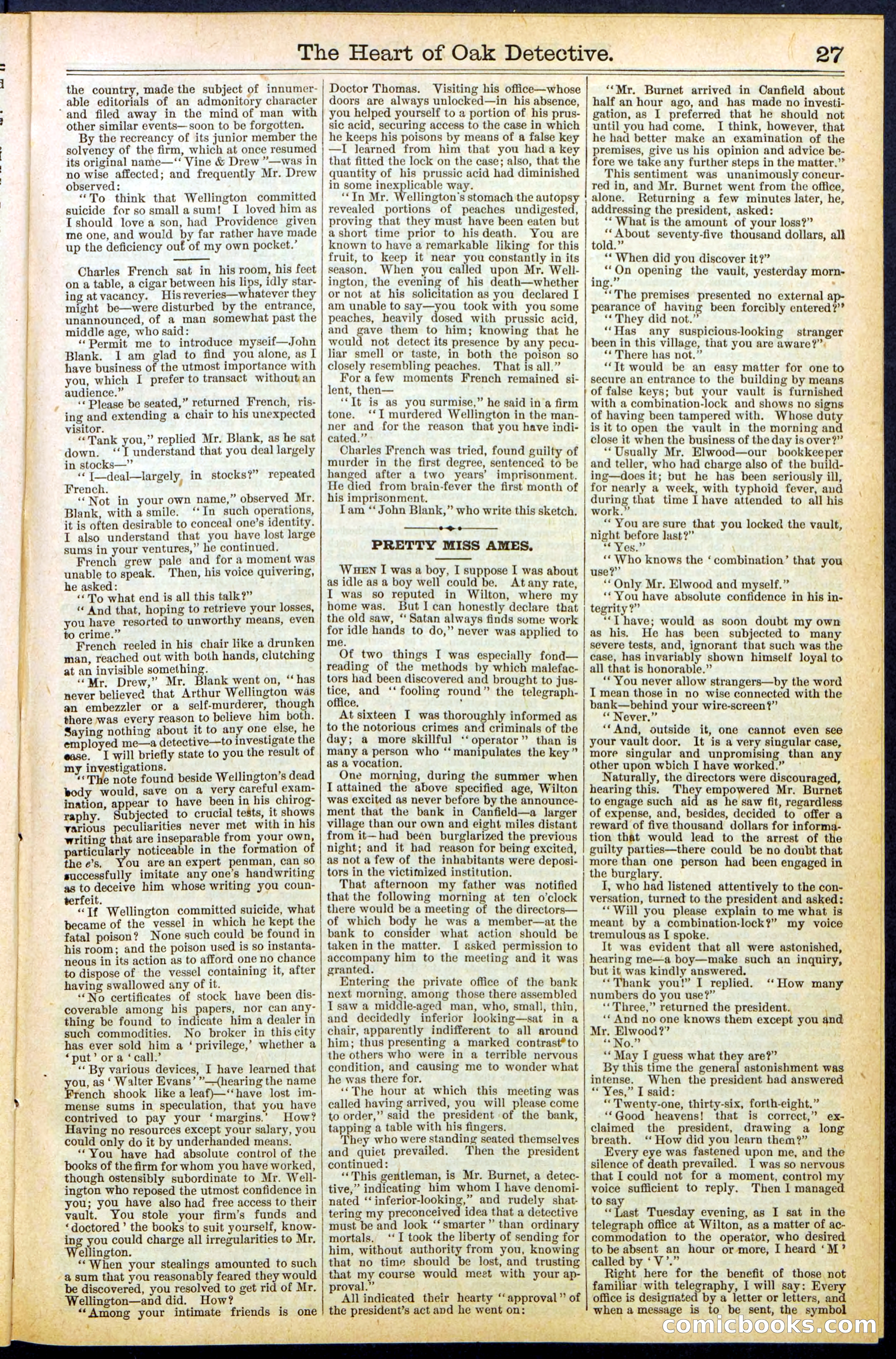
A restored page from Pulp Fiction, 1887. Page through the whole issue in the reader above.
📄 Transcribed text from this page (OCR, searchable)
Machine-transcribed from the original scan — historical spelling and the odd misread are preserved.
| | | s he Heart of Oak Detective. 27 —— — —— the country, made the subject of innumer- able editorials of an admonitory character ‘and filed away in the mindof man with other similar events— soon to be forgotten. By the recreancy of its junior member the solvency of the firm, which at once resumed its original name—‘‘ Vine & Drew ”—was in no wise affected; and frequently Mr. Drew observed: “To think that Wellington committed | suicide for sosmallasum! I loved him as [should love a son, had Providence given me one, and would by far rather have made up the deficiency ouf of my own pocket. Charles French sat in his room, his feet on a table, a cigar between his lips, idly star- ing at vacancy. Hisreveries—whatever they might be—were disturbed by the entrance, unannounced, of a man somewhat past the middle age, who said: ; ‘Permit me to introduce myseif—John Blank. 1 am glad to find you alone, as I have business of the utmost importance with you, which I prefer to transact without an audience.” ; ‘Please be seated,” returned French, ris- ing and extending a chair to his unexpected isitor. ue Tank you,” replied Mr. Blank, as he sat down. ‘‘I understand that you deal largely in stocks—” a {—deal—largely, in stocks?” repeated French. 7 ‘Not in your own name,” observed Mr. Blank, with asmile. ‘In such operations, it is often desirable to conceal one’s identity. I also understand that you have lost large sums in your ventures,” he continued, French grew pale and for a moment was unable to speak. Then, his voice quivering, he asked: ‘To what end is all this talk?” “ And that, hoping to retrieve your losses, you have resorted to unworthy means, even crime.” rs Wreaneh reeled in his chair like a drunken man, reached out with both hands, clutching at an invisible something. “Mr, Drew,” Mr. Blank went on, “has never believed that Arthur Wellington was an embezzler or a self-murderer, though there was every reason to believe him both. Saying nothing about it to an one else, he employed me—a detective—to investigate the ease. I will briefly state to you the result of investigations. me The aie found beside Wellington’s dead body would, save on a very careful exam- ination, appear to have been in his chirog- raphy. Subjected to crucial tests, it shows various peculiarities never met with in his writing that are inseparable from your own, particularly noticeable in the formation of the e’s. ou are an expert penman, can so successfully imitate any one’s handwriting as to deceive him whose writing you coun- terfeit. ee “Tf Wellington committed suicide, what became of the vessel in which he kept the fatal poison? None such could be found in his room; and the poison used is so instanta- neous in its action as to afford one no chance to dispose of the vessel containing 1t, after having swallowed any of it. “No certificates of stock have been dis- coverable among his papers, nor can any- thing be found to indicate him a dealer in such commodities. No broker in this city has ever sold him a ‘privilege,’ whether a ‘put’ or a ‘call.’ ‘‘ By various devices, I have learned that ou, as ‘ Walter Evans’ ”—(hearing the name ‘ench shook like a leaf)—‘‘have lost im- mense sums in speculation, that you have contrived to pay your ‘margins.’ How? Having no resources except your salary, you could only do it by underhanded means. ‘You have had absolute control of the books of the firm for whom you have worked, though ostensibly subordinate to Mr. Well- ington who reposed the utmost confidence in you; you have also had free access to their vault. You stole your firm’s funds and ‘doctored ’ the books to suit yourself, know- ing you could charge all irregularities to Mr. Wellington. ‘*When your stealings amounted to such -@ sum that you reasonably feared they would be discovered, you resolved to get rid of Mr. Doctor Thomas. Visiting his office—whose doors are always unlocked—in his absence, you helped yourself to a portion of his prus- sic acid, securing access to the case in which he keeps his poisons by means of a false key —I learned from him that you had a key that fitted the lock on the case; also, that the quantity of his prussic acid had diminished in some inexplicable way. ‘“‘In Mr. Wellington's stomach the autops revealed portions of peaches undigested, proving that they must have been eaten but ashort time prior to his death. You are known to have a remarkable liking for this fruit, to keep it near you constantly in its season. When you called upon Mr. Well- ington, the evening of his death—whether or not at his solicitation as you declared I am unable to say—you took with you some peaches, heavily dosed with prussic acid, and gave them to him; knowing that he would not detect its presence by any pecu- liar smell or taste, in both the poison so closely resembling peaches. That is all.” For a few moments French remained si- lent, then— ‘‘It is as you surmise,” he said in‘a firm tone. ‘‘I murdered Wellington in the man- ner and for the reason that you have indi- cated.” Charles French was tried, found guilty of murder in the first degree, sentenced to be hanged after a two years’ imprisonment. He died from brain-fever the first month of his imprisonment. Iam ‘‘ John Blank,” who write this sketch. ——— oe —__. PRETTY MISS AMES. WHEN I was a boy, I suppose I was about as idle as a boy well could be. Atany rate, I was so reputed in Wilton, where my home was. But I can honestly declare that the old saw, “ Satan always finds some work for idle hands to do,” never was applied to me. Of two things I was especially fond— reading of the methods by which malefac- tors had been discovered and brought to jus- tice, and ‘‘ fooling round” the telegraph- office. At sixteen I was thoroughly informed as to the notorious crimes and criminals of tbe day; a more skillful ‘‘operator” than is many a person who “‘manipulates the key” as a vocation. One morning, during the summer when I attained the above specified age, Wilton was excited as never before by the announce- ment that the bank in Canfield—a larger village than our own and eight miles distant from it—had been burglarized the previous night; and it had reason for being excited, as not a few of the inhabitants were deposi- tors in the victimized institution. That afternoon my father was notified that the following morning at ten o'clock there would be a meeting of the directors— of which body he was a member—at the bank to consider what action should be taken in the matter. I asked permission to accompany him to the meeting and it was granted. Entering the private office of the bank next morning, among those there assembled I saw a middle-aged man, who, small, thin, and decidedly inferior looking—sat in a chair, apparently indifferent to all around him; thus presenting a marked contrast*to the others who were in a terrible nervous condition, and causing me to wonder what he was there for. ‘‘The hour at which this meeting was called having arrived, you will please come to order,” said the president of the bank, tapping a table with his fingers. They who were standing seated themselves and quiet prevailed. Then the president continued: “This gentleman, is Mr. Burnet, a detec- tive,” indicating him whom I have denomi- nated Bin ahah ties and rudely shat- tering my preconceived idea that a detective must be and look ‘‘ smarter” than ordinary mortals. ‘‘ I took the liberty of sending for him, without authority from you, knowing that no time sbould be lost, and trusting that my course would meet with your ap- proval.” ——— LL LLL LD SC ttt **Mr. Burnet arrived in Canfield about half an hour ago, and has made no investi- gation, as 1 preferred that he should not until you had come. I think, however, that he had better make an examination of the premises, give us his opinion and advice be- fore we take any further steps in the matter.” This sentiment was unanimously concur- red in, and Mr. Burnet went from the office, alone. Returning a few minutes later, he, addressing the president, asked: ‘What is the amount of your loss?” - About seventy-five thousand dollars, all O ads ** When did you discover it?” _ “Qn opening the vault, yesterday morn- ing.” . ‘“The premises presented no external ap- pearance of having been forcibly entered?” “‘They did not.” “‘Has any suspicious-looking stranger been in this village, that you are aware?”: ** There has not.” ‘‘It would be an easy matter for one to secure an entrance to the building by means of false keys; but your vault is furnished with a combination-lock and shows no signs of having been tampered with. Whose duty is it to open the vault in the morning and close it when the business of the day is over?” ‘“Usually Mr. Elwood—our bookkeeper and teller, who had charge also of the build- ing—does it; but he has been seriously ill, for nearly a week, with typhoid fever, and we that time Il have attended to all his work.” ‘You are sure that you locked the vault, — night before lust?” ee Yes.”’ use?” ‘*Only Mr. Elwood and myself.” ‘* You have absolute confidence in his in- tegrity?” ‘‘T have; would as soon doubt my own as his. He has been subjected to many severe tests, and, ignorant that such was the case, has invariably shown himself loyal to all that is honorable.” ‘* You never allow strangers—by the word I mean those in no wise connected with the bank—behind your wire-screen?”’ “* Never.” ‘‘And, outside it, one cannot even see your vault door. It is a very singular case, more singular and unpromising than any other upon wdich I have worked.” — Naturally, the directors were discouraged, hearing this. They empowered Mr. Burnet to engage such aid as he saw fit, regardless of expense, and, besides, decided to offer a reward of five thousand dollars for informa- tion that would lead to the arrest of the guilty parties—there could be no doubt that more than one person had been engaged in the burglary. I, who had listened attentively to the con- versation, turned to the president and asked: ‘“Will you please explain to me what is meant by a combination-lock?” my voice tremulous as I spoke. It was evident that all were astonished, hearing me—a boy—make such an inquiry, but it was kindly answered. ‘“*Thank you!” I replied. numbers do you use?” ‘‘ Three,” returned the president ‘* And no one knows them except Mr. Elwood?” és No.” ** May I guess what they are?” e By this time the general astonishment was intense. “Yes,” I said: “Twenty-one, thirty-six, forth-eight.” ‘‘Good heavens! that is correct,” ex- “How many you and “Who knows the ‘ combination’ that you. When the president had answered ~ claimed the president, drawing a long — breath. k Every eye was fastened upon me, and the silence of death prevailed. 1 was so nervous © that I could not for a moment, control my voice sufficient to reply, Then I managed to sa “Last Tuesday evening, as I sat in the telegraph office at Wilton, as a matter of ac- commodation to the operator, who desired to be absent an hour or more, called by ‘V’.” | Right here for the benefit of those not familiar with telegraphy, I will say: Ey “How did you learn them?” aeer 2 ITheard‘M? — w= t's Cy | & * " ¥ & - “Wellincton—and did. How? All indicated their hearty ‘“‘approval” of | office is designated by a letter or letters, and _ Wes re fea your intimate friends is one! the president’s actand he wenton: = ' when a message is to, be sent, the symbo ia Re Re er reomn ee OTN OF SEC ONMGIOOKS. CC Po PA Ee OR I Me ge ee Lhe EE ee ae