
Pulp Fiction, 1878 · page 8 of 32
Beadle's Dime Library No. 42 — page 8: what you’re looking at
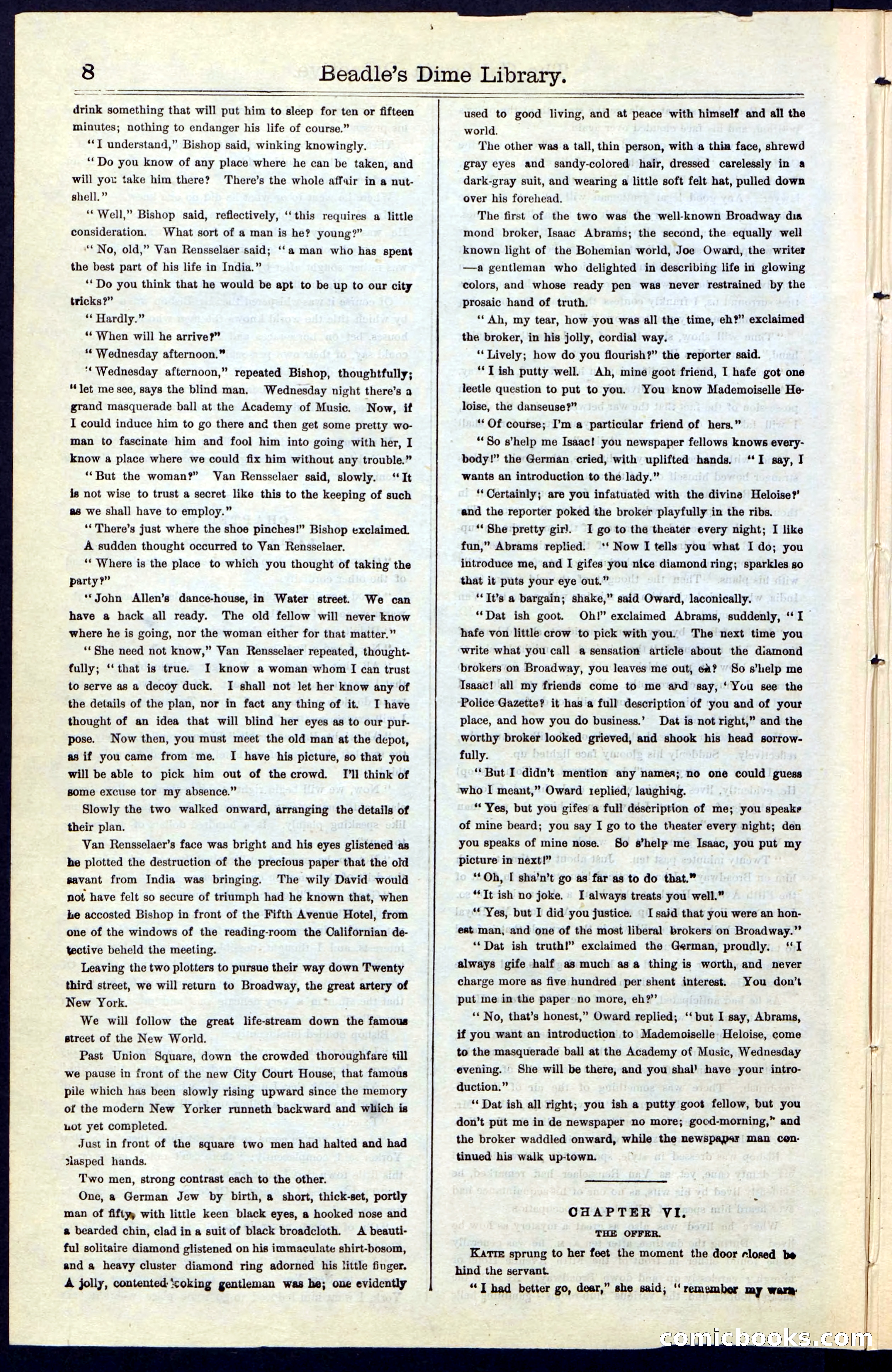
A restored page from Pulp Fiction, 1878. Page through the whole issue in the reader above.
📄 Transcribed text from this page (OCR, searchable)
Machine-transcribed from the original scan — historical spelling and the odd misread are preserved.
8 Beadle’s Dime Library. drink something that will put him to sleep for ten or fifteen minutes; nothing to endanger his life of course.” *“‘T understand,” Bishop said, winking knowingly. ‘“‘Do you know of any place where he can be taken, and will you take him there? There’s the whole affair in a nut- shell.” ‘“‘ Well,” Bishop said, reflectively, ‘‘this requires a little consideration. What sort of a man is he? young?” “No, old,” Van Rensselaer said; ‘‘a man who has spent the best part of his life in India.” ‘‘Do you think that he would be apt to be up to our city tricks?” ** Hardly.” ‘* When will he arrive?” ‘ Wednesday afternoon.” ‘‘ Wednesday afternoon,” repeated Bishop, thoughtfully; ‘let me see, says the blind man. Wednesday night there’s a grand masquerade ball at the Academy of Music. Now, if I could induce him to go there and then get some pretty wo- man to fascinate him and fool him into going with her, I know a place where we could fix him without any trouble.” ‘‘But the woman?” Van Rensselaer said, slowly. ‘It is not wise to trust a secret like this to the keeping of such as we shall have to employ.” ‘“There’s just where the shoe pinches!” Bishop exclaimed. A sudden thought occurred to Van Rensselaer. “‘ Where is the place to which you thought of taking the party?” ‘*John Allen’s dance-house, in Water street. We can have a back all ready. The old fellow will never know where he is going, nor the woman either for that matter.” “She need not know,” Van Rensselaer repeated, thought- fully; ‘“‘that is true. I know a woman whom I can trust to serve as a decoy duck. I shall not let her know any of the details of the plan, nor in fact any thing of it. I have thought of an idea that will blind her eyes as to our pur- pose. Now then, you must meet the old man at the depot, as if youcame from me. I have his picture, so that you will be able to pick him out of the crowd. [I'll think of some excuse tor my absence.” Slowly the two walked onward, arranging the details of their plan. Van Rensselaer’s face was bright and his eyes glistened as he plotted the destruction of the precious paper that the old savant from India was bringing. The wily David would not have felt so secure of triumph had he known that, when he accosted Bishop in front of the Fifth Avenue Hotel, from one of the windows of the reading-room the Californian de- tective beheld the meeting. Leaving the two plotters to pursue their way down Twenty third street, we will return to Broadway, the great artery of New York. | We will follow the great life-stream down the famous street of the New World. Past Union Square, down the crowded thoroughfare till we pause in front of the new City Court House, that famous pile which has been slowly rising upward since the memory of the modern New Yorker runneth backward and which is not yet completed. Just in front of the square two men had halted and had slasped hands. Two men, strong contrast each to the other. One, a German Jew by birth, a short, thick-set, portly man of fifty) with little keen black eyes, a hooked nose and a bearded chin, clad in a suit of black broadcloth. A beauti- ful solitaire diamond glistened on his immaculate shirt-bosom, and a heavy cluster diamond ring adorned his little finger. A jolly, contented: ‘coking gentleman was he; one evidently used to good living, and at peace with himself and all the world. The other was a tall, thin person, with a thin face, shrewd gray eyes and sandy-colored hair, dressed carelessly in a dark-gray suit, and wearing a little soft felt hat, pulled down over his forehead. The first of the two was the well-known Broadway dia mond broker, Isaac Abrams; the second, the equally well known light of the Bohemian world, Joe Oward, the writer —a gentleman who delighted in describing life in glowing colors, and whose ready pen was never restrained by the prosaic hand of truth. ‘‘ Ah, my tear, how you was all the time, eh?” exclaimed the broker, in his jolly, cordial way. ‘“‘ Lively; how do you flourish?” the reporter said. ‘Tish putty well. Ah, mine goot friend, I hafe got one leetle question to put to you. You know Mademoiselle He- loise, the danseuse?” “‘Of course; I’m a particular friend of hers.” “So s’help me Isaac! you newspaper fellows knows every- body!” the German cried, with uplifted hands. ‘I say, I wants an introduction to the lady.” ‘Certainly; are you infatuated with the divine Heloise?’ and the reporter poked the broker playfully in the ribs. ‘‘ She pretty girl. I go to the theater every night; I like fun,” Abrams replied. ‘*' Now I tells you what I do; you introduce me, and I gifes you nice diamond ring; sparkles so that it puts your eye out.” ‘‘ It’s a bargain; shake,” said Oward, laconically. “Dat ish goot. hafe von little crow to pick with you. The next time you write what you call a sensation article about the diamond brokers on Broadway, you leaves me out, em? So s’help me Isaac! all my friends come to me and say, ‘You see the Police Gazette? it has a full description of you and of your place, and how you do business.’ Dat is not right,” and the worthy broker looked grieved, and shook his head sorrow- fully. ‘‘But I didn’t mention any names; no one could guess who I meant,” Oward replied, laughiag. ** Yes, but you gifes a full description of me; you speake of mine beard; you say I go to the theater every night; den you speaks of mine nose. §o s’help me Isaac, you put my picture in next!” “Oh, I sha’n’t go as far as to do that.” “It ish no joke. I always treats you well.” “Yes, but I did you justice. I said that you were an hon- eat man, and one of the most liberal brokers on Broadway.” ‘*Dat ish truth!” exclaimed the German, proudly. ‘I always gife half as much asa thing is worth, and never charge more as five hundred per shent interest. You don’t put me in the paper no more, eh?” ‘* No, that’s honest,” Oward replied; ‘‘ but I say, Abrams, if you want an introduction to Mademoiselle Heloise, come to the masquerade ball at the Academy of Music, Wednesday evening. ' She will be there, and you shal’ have your intro- duction.” ‘* Dat ish all right; you ish a putty goot fellow, but you don’t put me in de newspaper no more; good-morning,” and the broker waddled onward, while the newspapsr man cen- tinued his walk up-town. CHAPTER VI. THE OFFER. Katte sprung to her feet the moment the door closed be hind the servant. “‘I had better go, dear,” she said; ‘‘ remember my warn Oh!” exclaimed Abrams, suddenly, ‘I — VJOOKS