
Pulp Fiction, 1878 · page 23 of 32
Beadle's Dime Library No. 42 — page 23: what you’re looking at
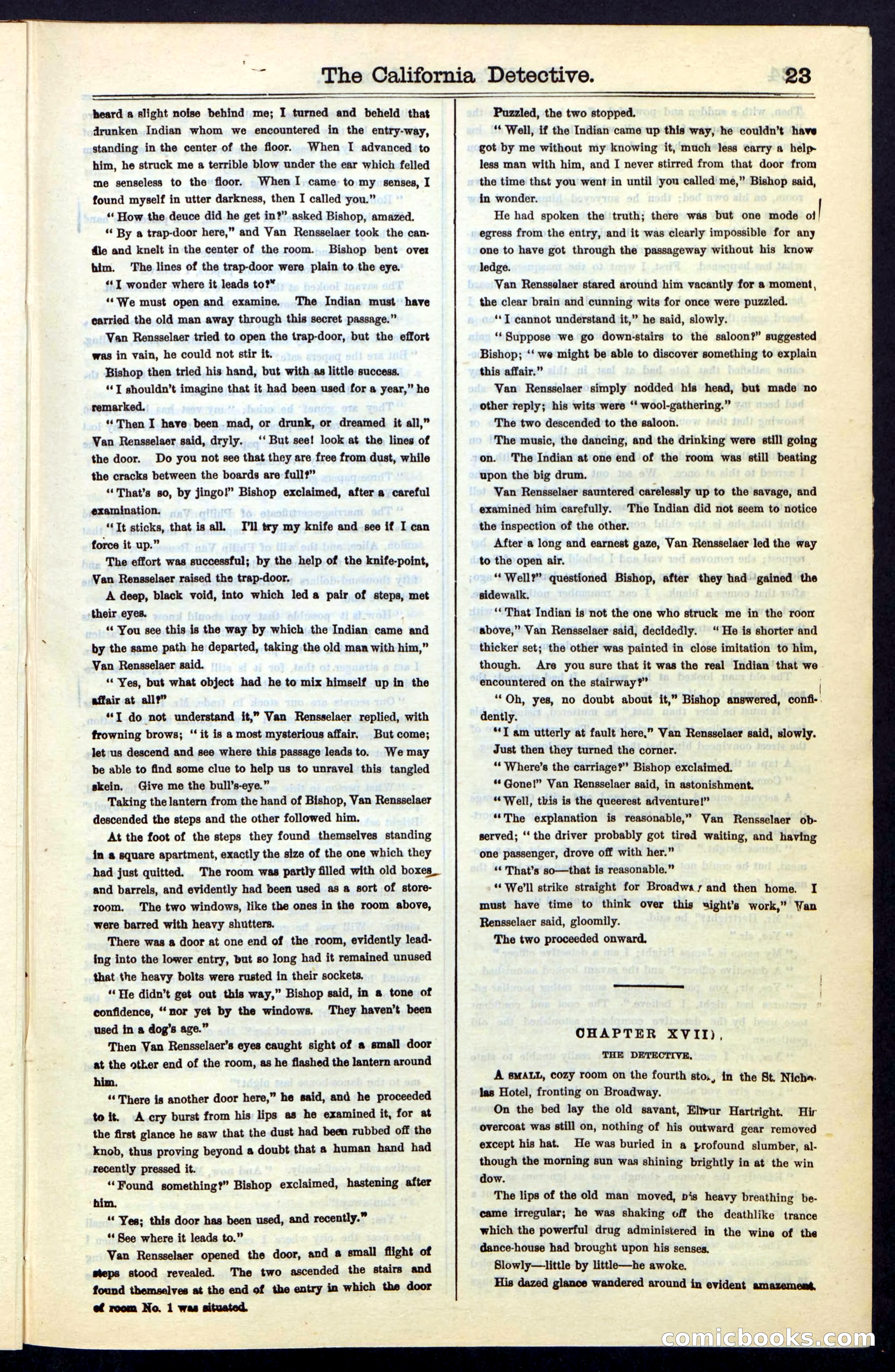
A restored page from Pulp Fiction, 1878. Page through the whole issue in the reader above.
📄 Transcribed text from this page (OCR, searchable)
Machine-transcribed from the original scan — historical spelling and the odd misread are preserved.
a — Se =. The California Detective. 23 heard a slight noise behind me; I turned and beheld that drunken Indian whom we encountered in the entry-way, standing in the center of the floor. When I advanced to him, he struck me a terrible blow under the ear which felled me senseless to the floor. When I came to my senses, I found myself in utter darkness, then I called you.” ‘‘ How the deuce did he get in?” asked Bishop, amazed. ‘‘ By a trap-door here,” and Van Rensselaer took the can- dle and knelt in the center of the room. Bishop bent over him. The lines of the trap-door were plain to the eye. ‘‘] wonder where it leads to?” ‘‘We must open and examine. The Indian must have carried the old man away through this secret passage.” Van Rensselaer tried to open the trap-door, but the effort was in vain, he could not stir it. Bishop then tried his hand, but with as little success. ‘‘T shouldn’t imagine that it had been used for a year,” he remarked. ‘‘Then I have been mad, or drunk, or dreamed it all,” Van Rensselaer said, dryly. ‘‘ But see! look at the lines of the door. Do you not see that they are free from dust, while the cracks between the boards are full?” ‘“‘That’s so, by jingo!” Bishop exclaimed, after a careful examination. ‘‘Tt sticks, that is all. I'll try my knife and see if I can force it up.” The effort was successful; by the help of the knife-point, Van Rensselaer raised the trap-door. A deep, black void, into which led a pair of steps, met their eyes. ‘¢ You see this is the way by which the Indian came and by the same path he departed, taking the old man with him,” Van Rensselaer said. ‘* Yes, but what object had he to mix himself up in the affair at all?” “I do not understand it,” Van Rensselaer replied, with frowning brows; ‘it is a most mysterious affair. But come; let us descend and see where this passage leads to. We may be able to find some clue to help us to unravel this tangled skein. Give me the bull’s-eye.” Taking the lantern from the hand of Bishop, Van Rensselaer descended the steps and the other followed him. At the foot of the steps they found themselves standing in a square apartment, exactly the size of the one which they had just quitted. The room was partly filled with old boxes_ and barrels, and evidently had been used as a sort of store- room. The two windows, like the ones in the room above, were barred with heavy shutters. There was a door at one end of the room, evidently lead- ing into the lower entry, but so long had it remained unused that the heavy bolts were rusted in their sockets. ‘‘ He didn’t get out this way,” Bishop said, in a tone of confidence, “‘nor yet by the windows. They haven’t been used in a dog’s age.” Then Van Rensselaer’s eyes caught sight of a small door at the other end of the room, as he flashed the lantern around him. ‘‘'There is another door here,” he said, and he proceeded to it. A cry burst from his lips as he examined it, for at the first glance he saw that the dust had been rubbed off the knob, thus proving beyond a doubt that s human hand had recently pressed it. ‘Found something?” Bishop exclaimed, hastening after him. “‘ Yes; this door has been used, and recently.” ** Bee where it leads to.” Van Rensselaer opened the door, and a small flight of steps stood revealed. The two ascended the stairs and found themselves at the end of the entry in which the door ef room No. 1 was situated. Puzzled, the two stopped. ** Well, if the Indian came up this way, he couldn’t have got by me without my knowing it, much less carry a help- less man with him, and I never stirred from that door from the time that you went in until you called me,” Bishop said, in wonder. He had spoken the truth; there was but one mode ol egress from the entry, and it was clearly impossible for any one to have got through the passageway without his know ledge. Van Rensselaer stared around him vacantly for a moment, the clear brain and cunning wits for once were puzzled. ‘‘T cannot understand it,” he said, slowly. ‘‘ Suppose we go down-stairs to the saloon?” suggested Bishop; ‘‘ we might be able to discover something to explain this affair.” Van Rensselaer simply nodded his head, but made no other reply; his wits were ‘‘ wool-gathering.” The two descended to the saloon. The music, the dancing, and the drinking were atill going on. The Indian at one end of the room was still beating upon the big drum. Van Rensselaer sauntered carelessly up to the savage, and examined him carefully. The Indian did not seem to notice the inspection of the other. After a long and earnest gaze, Van Rensselaer led the way to the open air. ‘‘ Well?” questioned Bishop, after they had gained the sidewalk. ‘That Indian is not the one who struck me in the roor above,” Van Rensselaer said, decidedly. ‘ He is shorter and thicker set; the other was painted in close imitation to him, though. Are you sure that it was the real Indian that we encountered on the stairway?” | ““Oh, yes, no doubt about it,” Bishop answered, confi-. dently. “I am utterly at fault here,” Van Rensselaer said, slowly. Just then they turned the corner. ‘* Where’s the carriage?” Bishop exclaimed. **Gone!” Van Rensselaer said, in astonishment. “Well, this is the queerest adventure!” “The explanation is reasonable,” Van Rensselaer ob- served; ‘‘ the driver probably got tired waiting, and having one passenger, drove off with her.” ‘‘ That’s so—that is reasonable.” ‘¢ We'll strike straight for Broadway and then home. I must have time to think over this sight’s work,” Yan Rensselaer said, gloomily. The two proceeded onward, OHAPTER XVII), THE DETECTIVE, A SMALL, cozy room on the fourth sto, in the St. Niche. las Hotel, fronting on Broadway. On the bed lay the old savant, Elwur Hartright. Hir overcoat was still on, nothing of his outward gear removed except his hat. He was buried in a profound slumber, al- though the morning sun was shining brightly in at the win dow. The lips of the old man moved, nis heavy breathing be- came irregular; he was shaking off the deathlike trance which the powerful drug administered in the wine of the dance-house had brought upon his senses, Slowly—little by little—he awoke. His dazed glance wandered around in evident amazement. Gomilcbooks (E (0)