
Pulp Fiction, 1878 · page 20 of 32
Beadle's Dime Library No. 42 — page 20: what you’re looking at
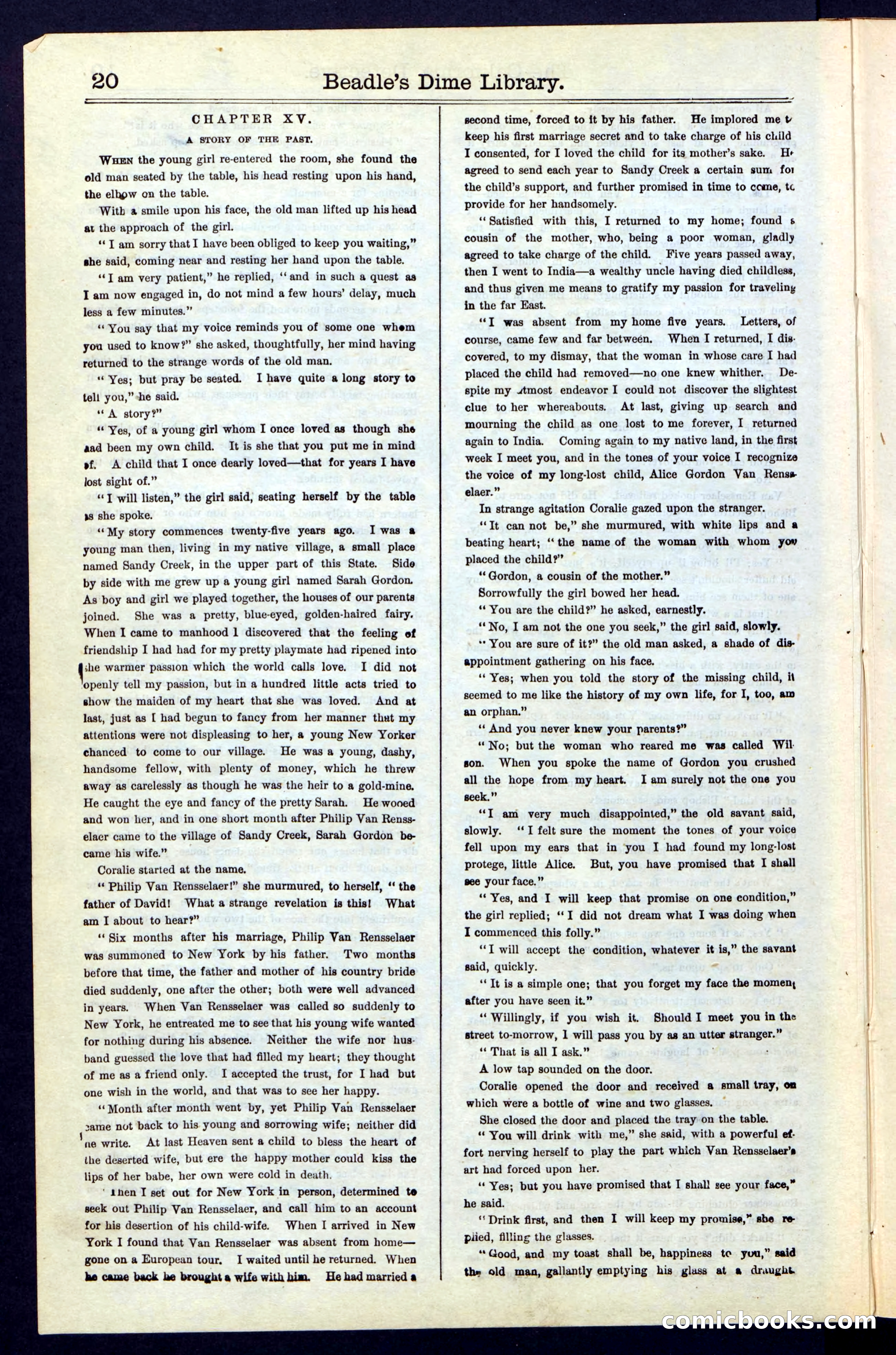
A restored page from Pulp Fiction, 1878. Page through the whole issue in the reader above.
📄 Transcribed text from this page (OCR, searchable)
Machine-transcribed from the original scan — historical spelling and the odd misread are preserved.
20 Beadle’s Dime Library. al CHAPTER XV. A STORY OF THE PAST. WueEn the young girl re-entered the room, she found the old man seated by the table, his head resting upon his hand, the elhow on the table. Witb a smile upon his face, the old man lifted up his head at the approach of the girl. ‘‘T am sorry that I have been obliged to keep you waiting,” she said, coming near and resting her hand upon the table. ‘‘T am very patient,” he replied, ‘‘and in such a quest as I am now engaged in, do not mind a few hours’ delay, much less a few minutes.” ‘You say that my voice reminds you of some one whem you used to know?” she asked, thoughtfully, her mind having returned to the strange words of the old man. “ Yes; but pray be seated. Ihave quite a long story to teli you,” she said. ‘A story?” “Yes, of a young girl whom I once loved as though she aad been my own child. It is she that you put me in mind ef. A child that I once dearly loved—that for years I have lost sight of.” ‘J will listen,” the girl said, seating herself by the table 38 she spoke. ‘*My story commences twenty-five years ago. I was a young man then, living in my native village, a small place named Sandy Creek, in the upper part of this State. Side by side with me grew up a young girl named Sarah Gordon. As boy and girl we played together, the houses of our parents joined. She was a pretty, blue-eyed, golden-haired fairy. When I came to manhood 1 discovered that the feeling of friendship I had had for my pretty playmate had ripened into ie warmer passion which the world calls love. I did not openly tell my passion, but in a hundred little acts tried to show the maiden of my heart that she was loved. And at last, just as [ had begun to fancy from her manner thet my attentions were not displeasing to her, a young New Yorker chanced to come to our village. He was a young, dashy, handsome fellow, with plenty of money, which he threw away as carelessly as though he was the heir to a gold-mine, He caught the eye and fancy of the pretty Sarah. He wooed and won her, and in one short month after Philip Van Renss- elacr came to the village of Sandy Creek, Sarah Gordon be- came his wife.” Coralie started at the name, “Philip Van Rensselaer!” she murmured, to herself, ‘‘ the father of David! What a strange revelation is this!) What am I about to hear?” ‘‘ Six months after his marriage, Philip Van Rensselaer was summoned to New York by his father. Two months before that time, the father and mother of his country bride died suddenly, one after the other; both were well advanced in years. When Van Rensselaer was called so suddenly to New York, he entreated me to see that his young wife wanted for nothing during his absence. Neither the wife nor hus- band guessed the love that had filled my heart; they thought of me as a friend only. I accepted the trust, for I had but one wish in the world, and that was to see her happy. ‘Month after month went by, yet Philip Van Rensselaer same not back to his young and sorrowing wife; neither did ne write. At last Heaven sent a child to bless the heart of the deserted wife, but ere the happy mother could kiss the lips of her babe, her own were cold in death. ‘ ghen I set out for New York in person, determined te seek out Philip Van Rensselaer, and call him to an account for his desertion of his child-wife. When I arrived in New York I found that Van Rensselaer was absent from home— gone on a European tour, I waited until he returned. When he came back he brought a wife with him. He had married a second time, forced to it by his father. He implored me t keep his first marriage secret and to take charge of his child I consented, for I loved the child for its mother’s sake. H+ agreed to send each year to Sandy Creek a certain sum for the child’s support, and further promised in time to ccme, tc provide for her handsomely. ‘‘ Satisfied with this, I returned to my home; found 56 cousin of the mother, who, being a poor woman, gladly agreed to take charge of the child. Five years passed away, then I went to India—a wealthy uncle having died childless, and thus given me means to gratify my passion for traveling in the far East. ‘‘T was absent from my home five years. Letters, of course, came few and far betweén. When I returned, I dis- covered, to my dismay, that the woman in whose care I had placed the child had removed—no one knew whither. De- spite my utmost endeavor I could not discover the slightest clue to her whereabouts. At last, giving up search and mourning the child as one lost to me forever, I returned again to India. Coming again to my native land, in the first week I meet you, and in the tones of your voice I recognize the voice of my long-lost child, Alice Gordon Van Renss elaer.” In strange agitation Coralie gazed upon the stranger. ‘‘Tt can not be,” she murmured, with white lips and a beating heart; ‘‘the name of the woman with whom yow placed the child?” — ‘*Gordon, a cousin of the mother.” Sorrowfully the girl bowed her head. ‘** You are the child?” he asked, earnestly. ‘No, I am not the one you seek,” the girl said, slowly. ‘** You are sure of it?” the old man asked, a shade of dis- appointment gathering on his face. ‘‘ Yes; when you told the story of the missing child, it seemed to me like the history of my own life, for I, too, am an orphan.” ‘* And you never knew your parents?” “No; but the woman who reared me was called Wil son. When you spoke the name of Gordon you crushed all the hope from my heart. Iam surely not the one you seek.”’ “T am very much disappointed,” the old savant said, slowly. ‘I felt sure the moment the tones of your voice fell upon my ears that in you I had found my long-lost protege, little Alice. But, you have promised that I shall see your face.” “Yes, and I will keep that promise on one condition,” the girl replied; ‘‘I did not dream what I was doing when I commenced this folly.” ‘“‘T will accept the condition, whatever it is,” the savant said, quickly. “ ‘It is a simple one; that you forget my face the momen; after you have seen it.” ‘‘Willingly, if you wish it. Should I meet you in the street to-morrow, 1 will pass you by as an utter stranger.” ‘* That is all I ask.” A low tap sounded on the door. Coralie opened the door and received a small tray, on which were a bottle of wine and two glasses, She closed the door and placed the tray on the table. “ You will drink with me,” she said, with a powerful ef.- fort nerving herself to play the part which Van Rensselaer’s art had forced upon her. ‘‘ Yes; but you have promised that I shall see your face,” he said. ‘‘ Drink first, and then I will keep my promise,” she re piied, filling the glasses. ‘“Good, and my toast shall be, happiness te yuu,” said th= old man, gallantly emptying his glass at a draught LT Hoo E@ 0 Q