
Pulp Fiction, 1878 · page 8 of 32
Beadle's New York Dime Library, No. 41 — page 8: what you’re looking at
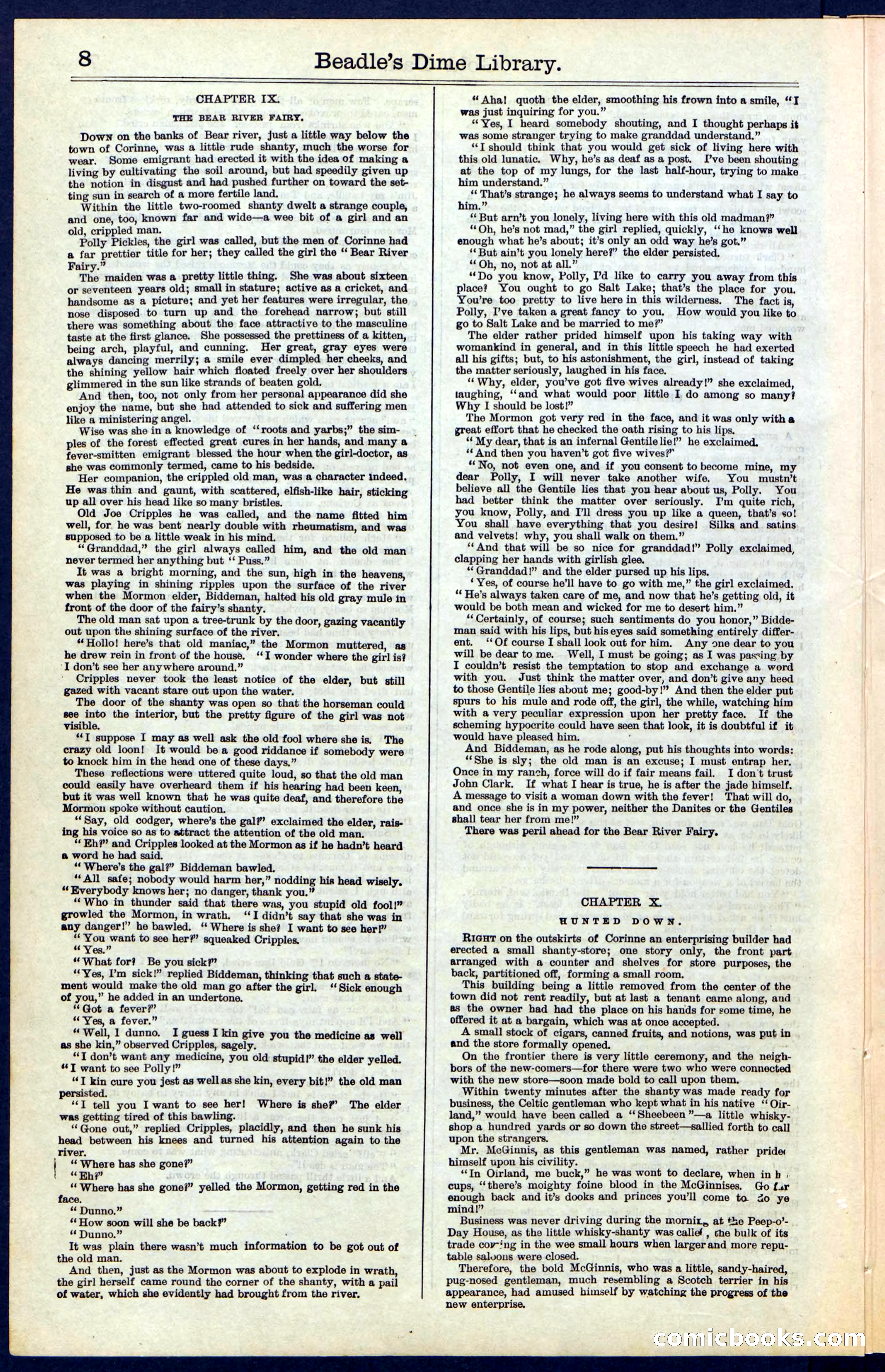
A restored page from Pulp Fiction, 1878. Page through the whole issue in the reader above.
📄 Transcribed text from this page (OCR, searchable)
Machine-transcribed from the original scan — historical spelling and the odd misread are preserved.
8 Beadle’s Dime Library. CHAPTER IX. THE BEAR RIVER FAIRY, Down on the banks of Bear river, just a little way below the town of Corinne, was a little rude shanty, much the worse for wear. Some emigrant had erected it with the idea of making a living by cultivating the soil around, but had speedily given up the notion in disgust and had pushed further on toward the set- ting sun in search of a more fertile land. Within the little two-roomed shanty dwelt a strange couple, and one, too, known far and wide—a wee bit of a girl and an old, crippled man. ' Polly Pickles, the girl was called, but the men of Corinne had a far prettier title for her; they called the girl the “‘ Bear River ” werk maiden was a pretty little thing. She was about sixteen or seventeen years old; small in stature; active as a cricket, and handsome as a picture; and yet her features were irregular, the nose disposed to turn up and the forehead narrow; but still there was something about the face attractive to the masculine taste at the first glance. She possessed the prettiness of a kitten, being arch, playful, and cunning. Her great, gray eyes were always dancing merrily; a smile ever dimpled her cheeks, and the shining yellow hair which floated freely over her shoulders glimmered in the sun like strands of beaten gold. And then, too, not only from her personal appearance did she enjoy the name, but she had attended to sick and suffering men like a ministering angel. Wise was she in a knowledge of ‘‘roots and yarbs;” the sim- ples of the forest effected great cures in her hands, and many a — fever-smitten emigrant blessed the hour when the girl-doctor, as she was commonly termed, came to his bedside. Her companion, the crippled old man, was a character indeed. He was thin and gaunt, with scattered, elfish-like hair, sticking up all over his head like so many bristles. Old Joe Cripples he was called, and the name fitted him well, for he was bent nearly double with rheumatism, and was supposed to be a little weak in his mind. “Granddad,” the girl always called him, and the old man never termed her anything but ‘‘ Puss,” It was a bright morning, and the sun, high in the heavens, was playing in shining ripples upon the surface of the river when the Mormon elder, Biddeman, halted his old gray mule in front of the door of the fairy’s shanty. The old man sat upon a tree-trunk by the door, gazing vacantly out upon the shining surface of the river. *Hollo! here’s that old m ” the Mormon muttered, as he drew rein in front of the house. ‘I wonder where the girl is? ‘I don’t see her anywhere around.” Cripples never took the least notice of the elder, but still gazed with vacant stare out upon the water. The door of the shanty was open so that the horseman could see into the interior, but the pretty figure of the girl was not visible. **T suppose I may as well ask the old fool where she is. The crazy old loon! It would bea good riddance if somebody were to knock him in the head one of these days.” These reflections were uttered quite loud, so that the old man could easily have overheard them if his hearing had been keen, but it was well known that he was quite deaf, and therefore the Mormon spoke without caution. “Say, old codger, where’s the gal?” exclaimed the elder, rais- ing his voice so as to attract the attention of the old man. “Eh?” and Cripples looked at the Mormon as if he hadn’t heard a word he had said. “‘ Where’s the gal?” Biddeman bawled. ‘All safe; nobody would harm her,” nodding his head wisely. “Everybody knows her; no danger, thank you.” “Who in thunder said that there was, you stupid old fool!” growled the Mormon, in wrath. ‘I didn’t say that she was in any danger!” he bawled. “ Where is she? I want to see her!” ““'You want to see her?” squeaked Cripples. iT Yes. ” “What for? Be you sick?” “Yes, I’m sick!” replied Biddeman, thinking that such a state- ment would make the old man go after the girl. ‘Sick enough of you,” he added in an undertone. “Got a fever?’ ‘Yes, a fever.” * Well, 1 dunno. as she kin,” observed Cripples, sagely. “I don’t want any medicine, you old stupid!” the elder yelled. “T want to see Polly!” ““T kin cure you jest as wellas she kin, every bit!” the old man persisted. “IT tell you I want to see her! Where is she?’ The elder was getting tired of this bawling. “Gone out,” replied Cripples, placidly, and then he sunk his head between his knees and turned his attention again to the river. ‘‘ Where has she gone?” cs Eh?” ‘¢ Where has she gone?” yelled the Mormon, getting red in the ** Dunno.” ‘* How soon will she be back?” ** Dunno.” ' It was plain there wasn’t much information to be got out of the old man. And then, just as the Mormon was about to explode in wrath, the girl herself came round the corner of the shanty, with a pail of water, which she evidently had brought from the river. I guess I kin give you the medicine as well “ Aha! quoth the elder, smoothing his frown into a smile, “I was just inquiring for you.” ‘Yes, I heard somebody shouting, and I thought perhaps it was some stranger trying to make granddad understand.” ‘*T should think that you would get sick of living here with this old lunatic. Why, he’s as deaf as a post. I’ve been shouting at the top of my lungs, for the last half-hour, trying to make him understand.” ‘“‘ That’s strange; he always seems to understand what I say to him.” ‘¢ But arn’t you lonely, living here with this old madman?” ‘Oh, he’s not mad,” the girl replied, quickly, ‘‘he knows well enough what he’s about; it’s only an odd way he’s got.” ‘* But ain’t you lonely here?” the elder persisted. “Oh, no, not at all.” ‘*Do you know, Polly, ’'d like to carry you away from this place? You ought to go Salt Lake; that’s the place for you. You’re too pretty to live here in this wilderness. The fact is, Polly, I’ve taken a great fancy to you. How would you like to go to Salt Lake and be married to me?” The elder rather prided himself upon his taking way with womankind in general, and in this little speech he had exerted all his gifts; but, to his astonishment, the girl, instead of taking the matter seriously, laughed in his face. “Why, elder, you’ve got five wives already!” she exclaimed, laughing, ‘‘and what would poor little I do among so many? Why I should be lost!” The Mormon got very red in the face, and it was only witha great effort that he checked the oath rising to his lips, “* My dear, that is an infernal Gentilelie!” he exclaimed, ‘* And then you haven’t got five wives?” “No, not even one, and if you consent to become mine, my dear Polly, I will never take another wife. You mustn’t believe all the Gentile lies that you hear about us, Polly. You had better think the matter over seriously. I’m quite rich, you know, Polly, and I'll dress you up like a queen, that’s so! You shall have everything that you desire! Silks and satins and velvets! why, you shall walk on them.” ‘‘And that will be so nice for granddad!” Polly exclaimed, clapping her hands with girlish glee. “Granddad!” and the elder pursed up his lips. . ‘Yes, of course he'll have to go with me,” the girl exclaimed. “‘He’s always taken care of me, and now that he’s getting old, it would be both mean and wicked for me to desert him.” “‘Certainly, of course; such sentiments do you honor,” Bidde- man said with his lips, but his eyes said something entirely differ- ent. ‘‘Of course I shall look out for him. Any one dear to you will be dear tome. Well, I must be going; as I was passing by I couldn’t resist the temptation to stop and exchange a word with you. Just think the matter over, and don’t give any heed to those Gentile lies about me; good-by!” And then the elder put spurs to his mule and rode off, the girl, the while, watching him with a very peculiar expression upon her pretty face. If the scheming hypocrite could have seen that look, it is doubtful if it would have pleased him. ; And Biddeman, as he rode along, put his thoughts into words: “She is sly; the old man is an excuse; I must entrap her. Once in my ranch, force will do if fair means fail. I don't trust John Clark. If what I hear is true, he is after the jade himself. A message to visit a woman down with the fever! That will do, and once she is in my power, neither the Danites or the Gentiles shall tear her from me!” There was peril ahead for the Bear River Fairy. CHAPTER X. HUNTED DOWN. RIGHT on the outskirts of Corinne an enterprising builder had erected a small shanty-store; one story only, the front part arranged with a counter and shelves for store purposes, the back, partitioned off, forming a small room. This building being a little removed from the center of the town did not rent readily, but at last a tenant came along, and as the owner had had the place on his hands for some time, he offered it at a bargain, which was at once accepted. A small stock of cigars, canned fruits, and notions, was put in and the store formally opened. On the frontier there is very little ceremony, and the neigh bors of the new-comers—for there were two who were connected with the new store—soon made bold to call upon them, Within twenty minutes after the shanty was made ready for business, the Celtic gentleman who kept what in his native ‘‘ Oir- land,” would have been called a ‘‘Sheebeen ”—a little whisky- shop a hundred yards or so down the street—sallied forth to call upon the strangers. Mr. McGinnis, as this gentleman was named, rather pride himself upon his civility. “In Oirland, me buck,” he was wont to declare, when in b | cups, “‘there’s moighty foine blood in the McGinnises, Go fur enough back and it’s dooks and princes you'll come ta Zo ye mind!” Business was never driving during the mornix,, at #ie Peep-o’- Day House, as the little whisky-shanty was callie , che bulk of its trade coy-‘ng in the wee small hours when largerand more repu- table saluons were closed. Therefore, the bold McGinnis, who was a little, sandy-haired, pug-nosed gentleman, much resembling a Scotch terrier in his appearance, had amused himself by watching the progress of the new enterprise, (EO) = Eomicbook S hee A mage