
Pulp Fiction, 1886 · page 19 of 32
Beadle's Dime Library, No. 406 — page 19: what you’re looking at
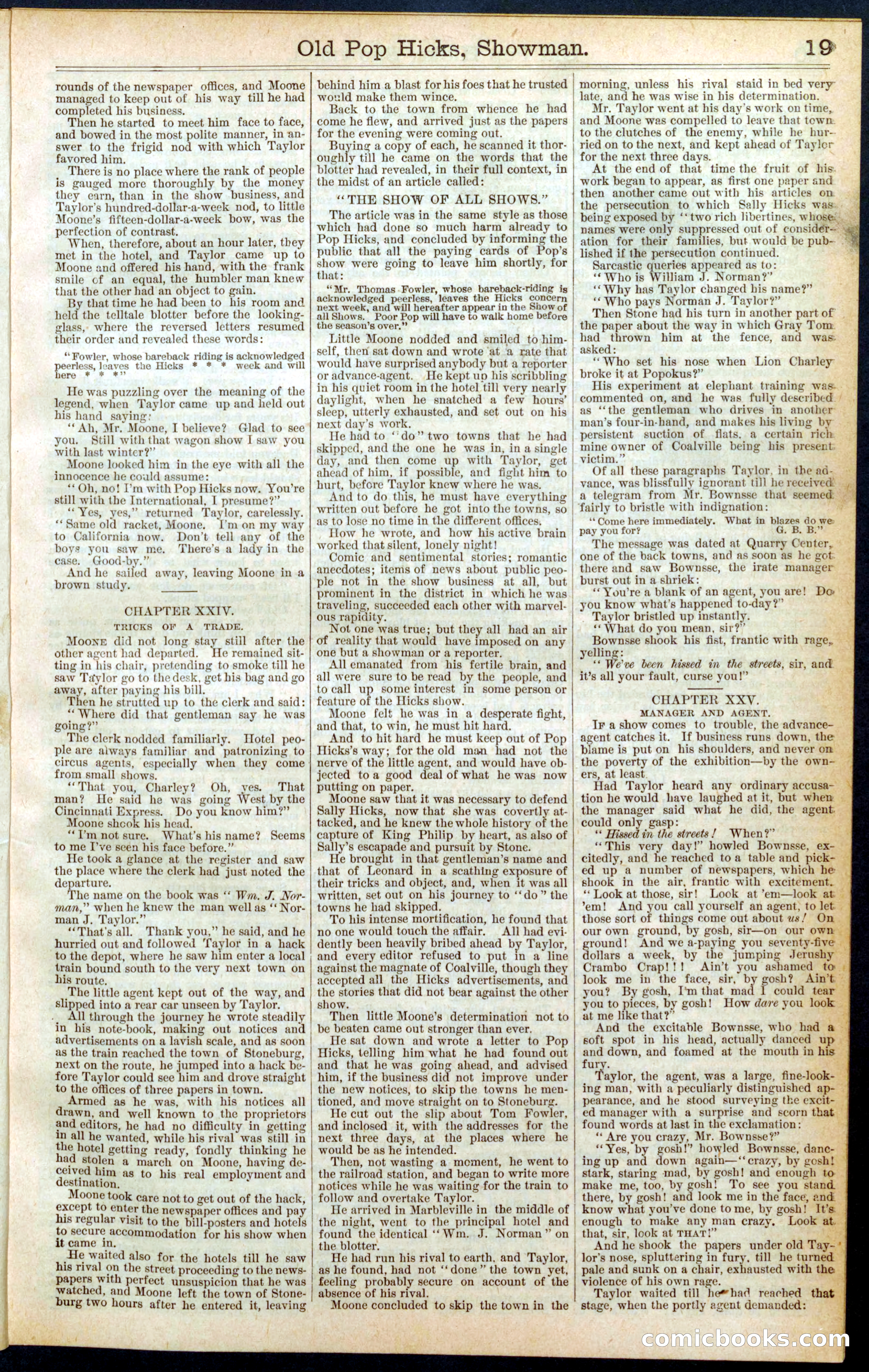
A restored page from Pulp Fiction, 1886. Page through the whole issue in the reader above.
📄 Transcribed text from this page (OCR, searchable)
Machine-transcribed from the original scan — historical spelling and the odd misread are preserved.
ce ~*~ a ne ele etc ee ee ee ee Old Pop Hicks, Showman. -—— rounds of the newspaper offices, and Moone managed to keep out of his way till he had completed his business. Then he started to meet him face to face, and bowed in the most polite manner, in an- swer to the frigid nod with which Taylor favored him. There is no place where the rank of people is gauged more thoroughly by the money they earn, than in the show business, and Taylor’s hundred-dollar-a-week nod, to little Moone’s fifteen-dollar-a-week bow, was the perfection of contrast. When, therefore, about an hour later, they met in the hotel, and Taylor came up to Moone and offered his hand, with the frank smile of an equal, the humbler man knew that the other had an object to gain. By that time he had been to his room and held the telltale blotter before the looking- glass, where the reversed letters resumed their order and revealed these words: ‘**Fowler, whose bareback riding is acknowledged peerless, leaves the Hicks * * * week and will pere .° 7 *” He was puzzling over the meaning of the legend, when Taylor came up and held out his hand saying: ‘*Ah, Mr. Moone, I believe? Glad to see you. Still with that wagon show I saw you With last winter?” : Moone looked him in the eye with all the innocence he could assume: ** Oh, no! I’m with Pop Hicks now. You’re still with the International, Il presume?” ‘Yes, yes,” returned Taylor, carelessly. ‘‘Same old racket, Moone. I’m on my way to California now. Don’t tell any of the boys you saw me. There’s a lady in the case. Good-by.” And he sailed away, leaving Moone in a brown study. CHAPTER XXIV. TRICKS OF A TRADE. Moone did not long stay still after the other agent had departed. He remained sit- ting in his chair, pretending to smoke till he saw Taylor go to the desk, get his bag and go away, after paying his bill. Then he strutted up to the clerk and said: “Where did that gentleman say he was going?” The clerk nodded familiarly. Hotel peo- ple are always familiar and patronizing to circus agents, especially when they come from small shows. “That you, Charley? Oh, ves. That man? He said he was going West by the Cincinnati Express. Do you know him?” Moone shcok his head. “I’m not sure. What's his name? Seems to me I’ve seen his face before.” He took a glance at the register and saw the place where the clerk had just noted the departure. The name on the book was ‘‘ Wm. J. Nor- man,’ when he knew the man well as ‘‘ Nor- man J. Taylor.” ‘That's all. Thank you,” he said, and he hurried out and followed Taylor in a hack to the depot, where he saw him enter a local train bound south to the very next town on his route, ‘The little agent kept out of the way, and slipped into a rear car unseen by Taylor. _ All through the journey he wrote steadily In his note-book, making out notices and advertisements on a lavish scale, and as soon as the train reached the town of Stoneburg, next on the route, he jumped into a hack be- fore Taylor could see him and drove straight to the offices of three papers in town. Armed as he was, with his notices all drawn, and well known to the proprietors and editors, he had no difficulty in getting in all he wanted, while his rival was still in the hotel getting ready, fondly thinking he had stolen a march on Moone, having de- ceived him as to his real employment and destination. ; Moone took care not to get out of the hack, except to enter the newspaper offices and pay his regular visit to the bill-posters and hotels to secure accommodation for his show when it came in. He waited also for the hotels till he saw his rival on the street proceeding to the news- papers with perfect unsuspicion that he was watched, and Moone left the town of Stone- burg two hours after he entered it, leaving kad i Ss SS ee behind him a blast for his foes that he trusted would make them wince. Back to the town from whence he had come he flew, and arrived just as the papers and Moone was compelled to leave that tewm | | for the evening were coming out. Buying a copy of each, he scanned it thor- oughly till he came on the words that the blotter had revealed, in their full context, in | the midst of an article called: “THE SHOW OF ALL SHOWS.” The article was in the same style as those which had done so much harm already to Pop Hicks, and concluded by informing the public that all the paying cards of Pop’s show were going to leave him shortly, for that: “Mr. Thomas Fowler, whose bareback-riding ig acknowledged peerless, leaves the Hicks concern next week, and will hereafter appear in the Show of all Shows. Poor Pop will have to walk home before the season’s over,” Little Moone nodded and smiled to him- self, then sat down and wrote at a rate that would have surprised anybody but a reporter or advance-agent. He kept up his scribbling in his quiet room in the hotel till very nearly daylight, when he snatched a few hours’ sleep, utterly exhausted, and set out on his | next day’s work. He had to ‘‘do” two towns that he had skipped, and the one he was in, in a single day, and then come up with Taylor, get ahead of him, if possible, and fight him to hurt, before Taylor knew where he was. And to do this, he must have everything written out before he got into the towns, so as to lose no time in the different offices, How he wrote, and how his active brain | worked that silent, lonely night! Comic and sentimental stories; romantic anecdotes; items of news about public peo- ple not in the show business at all, but prominent in the district in which he was traveling, succeeded each other with marvel- ous rapidity. Not one was true; but they all had an air of reality that would have imposed on any one but a showman or a reporter. Allemanated from his fertile brain, and all were sure to be read by the people, and to call up some interest in some person or feature of the Hicks show. Moone felt he was in a desperate fight, and that, to win, he must hit hard. And to hit hard he must keep out of Pop Hicks’s way; for the old man had not the nerve of the little agent, and would have ob- jected toa good deal of what he was now putting on paper. Moone saw that it was necessary to defend Sally Hicks, now that she was covertly at- tacked, and he knew the whole history of the capture of King Philip by heart, as also of Sally’s escapade and pursuit by Stone. He brought in that gentleman’s name and that of Leonard in a scathing exposure of their tricks and object, and, when it was all written, set out on his journey to ‘‘do” the towns he had skipped. To his intense mortification, he found that no one would touch the affair. All had evi- dently been heavily bribed ahead by Taylor, and every editor refused to put in a line against the magnate of Coalville, though they accepted all the Hicks advertisements, and the stories that did not bear against the other show. Then little Moone’s determination not to be beaten came out stronger than ever. He sat down and wrote a letter to Pop Hicks, telling him what he had found out and that he was going ahead, and advised him, if the business did not improve under the new notices, to skip the towns he men- tioned, and move straight on to Stoneburg. He cut out the slip about Tom Fowler, and inclosed it, with the addresses for the next three days, at the places where he would be as he intended. Then, not wasting a moment, he went to the railroad station, and began to write more notices while he was waiting for the train to follow and overtake Taylor. He arrived in Marbleville in the middle of the night, went to the principal hotel and found the identical ‘‘Wm. J. Norman” on the blotter. He had run his rival to earth, and Taylor, as he found, had not ‘‘done” the town yet, feeling probably secure on account of the absence of his rival. Moone concluded to skip the town in the _mine owner of Coalville being his present — _ victim.” +: EEE nt fairly to bristle with indignation: RN - --+- SEE oe ig morning, unless his rival staid in bed very late, and he was wise in his determination, Mr. Taylor went at his day’s work on time, . to the clutches of the enemy, while he hur- ried on to the next, and kept ahead of Taylor for the next three days. At the end of that time the fruit of his. work began to appear, as first one paper and then another came out with his articles on the persecution to which Sally Hicks was | being exposed by ‘‘two rich libertines, whose names were only suppressed out of considér= ation for their families, but would be pub- “4 lished if the persecution continued. Sarcastic queries appeared as to: ‘*Who is William J. Norman?” ‘“Why has Taylor changed his name?” ‘“Who pays Norman J. Taylor?” Then Stone had his turn in another partof the paper about the way in which Gray Tom ~ had thrown him at the fence, and was asked : ‘Who set his nose when Lion Charley broke it at Popokus?” . His experiment at elephant training was commented on, and he was fully described. as ‘‘the gentleman who drives in another | man’s four-in-hand, and makes his living by ~ persistent suction of flats, a certain ric = a f ‘ . » hh ~ * Of all these paragraphs Taylor, in thead- — vance, was blissfully ignorant till he received a telegram from Mr. Bownsse that seemed — ‘*Come here immediately. What in blazes do we pay you for? G. B. B.” The message was dated at Quarry Center, one of the back towns, and as soon as he got there and saw Bownsse, the irate manager burst out in a shriek: =é ‘You're a blank of an agent, you are! Da you know what’s happened to-day?” NI Taylor bristled up instantly. | Maa ** What do you mean, sir?” sa Bownsse shook his fist, frantic with rage, — yelling: = ‘* We've been hissed in the streets, sir, and it’s all your fault, curse you!” % ; CHAPTER XXY. eee MANAGER AND AGENT. es Ir a show comes to trouble, the advance- agent catches it. If business runs down, pos we blame is put on his shoulders, and never ' ore the poverty of the exhibition—by the own- ers, at least. 2: ie Had Taylor heard any ordinary accusa~ — - , tion he would have laughed at it, but , i the manager said what he did, the agent — could only gasp: cle =: “« Hissed in the streets! When?” ee “This very day!’ howled Bownsse, ex- — citedly, and he reached toa table and ee ed up a number of newspapers, which he shook in the air, frantic with excitement. — ‘‘ Look at those, sir! Look at ’em—look at ’em! And you call yourself an agent, to le’ those sort of things come out about ws/ On. our own ground, by gosh, sir—on our own ground! And we a-paying you seventy-five dollars a week, by the jumping Jerushy — Crambo Crap!!! Ain’t you ashamed to look me in the face, sir, by gosh? Ain't — you? By gosh, I'm that mad | could tear — you to pieces, by gosh! How dare you loc ic at me like that?” | *; And the excitable Bownsse, who had a soft spot in his head, actually danced up — a 4 oJ > > ey and down, and foamed at the mouth in hi aa aS aylor, the agent, was a large, fine-look- — ing man, with a peculiarly distinguished ap- — pearance, and he stood surveying the excit- — ed manager with a surprise and scorn that found words at last in the exclamation; = .-« ‘* Are you crazy, Mr. Bownsse?” > “Yes, by gosh!” howled Bownsse, danc- ing up and down again—‘‘crazy, by gosh! — tack. staring mad, by gosh! and enough to — make me, too, by gosh! To see you stand there, by gosh! and look me in the face, and — know what you’ve done to me, by gosh! It’s enough to make any man crazy. Look at. that, sir, look at THAT!” Sy ie And he shook the papers under old Tay- lor’s nose, spluttering in fury, till he a ned pale and sunk on a chair, exhausted with the violence of his own rage. ae Taylor waited till hewhad reached that stage, when the portly agent demanded: Gomicboo cS