
Pulp Fiction, 1878 · page 25 of 32
Beadle's New York Dime Library, No. 40 — page 25: what you’re looking at
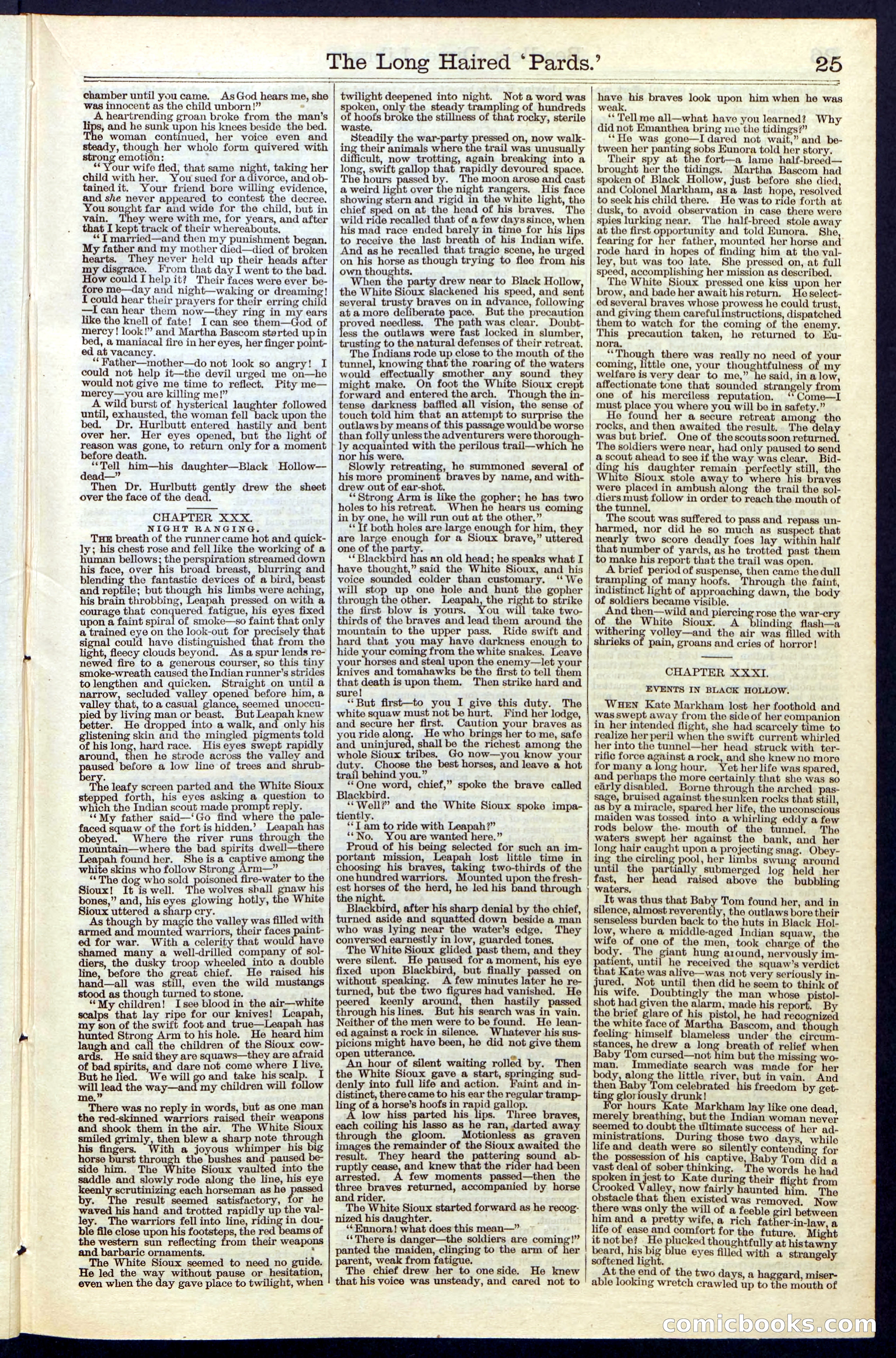
A restored page from Pulp Fiction, 1878. Page through the whole issue in the reader above.
📄 Transcribed text from this page (OCR, searchable)
Machine-transcribed from the original scan — historical spelling and the odd misread are preserved.
gee : > : The Long H ——————EEEE chamber until youcame. As God hears me, she was innocent as the child unborn!” ' A heartrending groan broke from the man’s lips, and he sunk upon his knees beside the bed. @ woman continued, her voice even and steady, though her whole form quivered with strong emotion: , wp our wife fled, that same night, taking her child with her. ‘You sued for a divorce, and ob- tained it. Your friend bore willing evidence, and she never appeared to contest the decree. You sought far and wide for the child, but in vain. 1ey were with me, for years, and after that I kept track of their whereabouts. ‘“‘T married—and then my punishment began. My father and my mother died—died of broken hearts. They never held up their heads after my disgrace. Krom that day I went to the bad. How could [help it?) Their faces were ever be- fore me—day and night—waking or dreaming! { could hear their prayers for their erring child —I can hear them now—they ring in my ears like the knell of fate! Ican ‘see them—God of mercy! look!” and Martha Bascom started up in bed, a maniacal fire in her eyes, her finger point- ed at vacancy. “ Father—mother—do not look so angry! I could not help it—the devil urged me on—he would not give me time to reflect. Pity me— mercy—you are killing me!” A wild burst of hysterical laughter followed until, exhausted, the woman fell back upon the bed. Dr. Hurlbutt entered hastily and bent over her. Her eyes opened, but the light of reason was gone, to return only for a moment before death. ‘*Tell him—his daughter—Black Hollow-- dead—” Then Dr. Hurlbutt gently drew the sheet over the face of the dead. CHAPTER XXX. NIGHT RANGING. THE breath of the runner came hot and quick- ly; his chest rose and fell like the working of a human bellows; the perspiration streamed down his face, over his broa breast, blurring and blending the fantastic devices of a bird, beast and reptile; but though his limbs were aching, his brain throbbing, Leapah pressed on with a courage that conemerte fatigue, his eyes fixed upon a faint spiral of smoke—so faint that only a trained eye on the look-out for precisely that signal could have distinguished that from the light, fleecy clouds beyond. As a spur lends re- newed fire to a generous courser, so this tiny smoke-wreath caused the Indian runner’s strides to lengthen and quicken. Straight on until a narrow, secluded valley opened before him, a valle that, to a casual glance, seemed unoccu- ied by living man or beast. But Leapah knew tter. He dropped into a walk, and only his glistening skin and the mingled pigments told of his long, hard race. His eyes swept rapidly around, then he strode across the valley and poses before a low line of trees and shrub- ry. The leafy screen parted and the White Sioux stepped forth, his eyes asking a question to which the Indian scout made eerqe reply. ‘“My father said—‘Go find where the pale- faced squaw of the fort is hidden.’ Leapah has obeyed. Where the river runs through the mountain—where the bad spirits dwell—there Leapah found her. She is a captive among the white skins who follow Strong Arm—” “The dog who sold poisoned fire-water to the Sioux! It is well. The wolves shall gnaw his bones,” and, his eyes glowing hotly, the White Sioux uttered as cry. : As though by nets the valley was filled with armed and mounted warriors, their faces paint- ed for war. With a celerity that would have shamed many a well-drilled company of sol- diers, the dusky troop wheeled_into a double line, before the great chief. He raised his hand—all was still, even the wild mustangs stood as though turned to stone. ; : “My children! Isee blood in the air—white scalps that lay ripe for our knives! Leapah, my son of the swift foot and true—Leapah has hunted Strong Arm to his hole. He heard him laugh and call the children of the Sioux cow- ards. He said they are squaws—they are afraid of bad spirits, and dare not come where [I live. But he lied. We will go and take his scalp. will lead the way—and my children will follow me.” There was no reply in words, but as one man the red-skinned warriors raised their weapons and shook them in the air. The White Sioux ap grimly, then blew a sharp note through ers. With a joyous whimper his big hore Bee through the bushes and paused be- side him. The White Sioux vaulted into the saddle and slowly rode along the line, his eye keenly scrutinizing each horseman as he pamee by. The result seemed satisfactory, for he waved his hand and trotted rapidly up the val- ley. The warriors fell into line, riding in dou- ble file close upon his footsteps, the red of the western sun reflecting from their weapons and barbaric ornaments. ; The White Sioux seemed to need no guide. He led the way without pause or hesitation, even when the day gave place to twilight, when twilight deepened into night. Not a word was spoken, only the steady trampling of hundreds of hoofs broke the stillness of that rocky, sterile waste. Steadily the war- pressed on, now walk- ing their animals where the trail was unusually difficult, now trotting, again breaking into a long, swift gallop that rapidly devoured space. The hours a by. The moon arose and cast a weird light over the night rangers. His face showing stern and rigid in the white light, the chief sped on at the head of his braves. The wild ride recalled that of a few days since, when his mad race ended barely in time for his lips to receive the last breath of his Indian wife. And as he recalled that tragic scene, he urged on his horse as though trying to flee from his own thoughts. When the party drew near to Black Hollow, the White Sioux slackened his speed, and sent several trusty braves on in advance, following at amore deliberate pace. But the precaution roved needless. The path was clear. Doubt- ess the outlaws were fast locked in slumber, trusting to the natural defenses of their retreat. The Indians rode up close to the mouth of the tunnel, knowing that the roaring of the waters would effectually smother _any sound they might make. On foot the White Sioux crept forward and entered the arch. Though the in- tense darkness baffled all vision, the sense of touch told him that an attempt to surprise the outlaws by means of this passage would be worse than folly unless the adventurers were pa ly acquainted with the perilous trail—which he nor his were. Slowly retreating, he summoned several of his more prominent braves by name, and with- drew out of ear-shot. “Strong Arm is like the ecEners he has two holes to his retreat. When he hears us coming in by one, he will run out at the other,” ‘Tf both holes are large enough for him, they are large enough for a Sioux brave,” uttered one of the party. ‘* Blackbird has an old head; he speaks what I have thought,” said the White Sioux, and his voice sounded colder than customary. ‘‘ We will stop up one hole and hunt the gopher through the other. Leapah, the right to strike the first blow is yours. ou wi @ two- thirds of the braves and lead them around the mountain to the upper pass. Ride swift and hard that you may have darkness enough to hide your coming from the white snakes. Leave our horses and steal upon the enemy—let your rives and tomahawks be the first to tell them that death is upon them. Then strike hard and sure! ‘But first—to you I give this duty. The white squaw must not be hurt. Find her lodge, and secure her first. Caution your braves as you ride along. He who brings her to me, safe and uninjured, shall be the richest among the whole Sioux tribes. Go now—you know your duty. Choose the best horses, and leave a hot trail behind you.” ‘“‘One word, chief,” spoke the brave called Blackbird. ‘“Well?” and the White Sioux spoke impa- tiently. ‘*T am to ride with Leapah?” ‘*No. You are wanted here.” Proud of his being selected for such an im- portant mission, Lea lost little time in choosing his braves, ing two-thirds of the one hundred warriors. Mounted upon the fresh- est horses of the herd, he led his band through the night. Blackbird, after his s denial by the chief, turned aside and squatted down beside a man who was lying near the water’s edge. They conversed earnestly in low, guarded tones. The White Sioux glided past them, and they were silent. He paused for a moment, his eye fixed upon Blackbird, but finally passed on without speaking. A few minutes later he re- turned, but the two Sparse had vanished. He red_ keenly around, then hastily passed fhrongh his lines. But his search was in vain. Neither of the men were to be found. He lean- ed against a rock in silence. Whatever his sus- picions might have been, he did not give them open utterance. ; v4 An hour of silent waiting rolled by. Then the White Sioux gave a start, springing sud- denly into full life and action. Faint and in- distinct, there came to his ear the regular tramp- ling of a horse’s hoofs in rhb gallop. x low hiss parted his lips. Three braves, each coiling his lasso as he ran, darted away through the gloom. Motionless as graven i es the remainder of the Sioux awaited the result. They heard the pattering sound ab- ruptly cease, and knew that the rider had been phe few moments passed—then the three braves returned, accompanied by horse and rider. The White Sioux started forward as he recog- ‘‘Eunora! what does this mean—” ‘‘There is danger—the soldiers are coming!” panted the maiden, clinging to the arm of her parent, weak from fatigue. s The chief drew her to oneside. He knew that his voice was unsteady, and cared not to aired °Pards.’ $$ ree 25 eo ee -_— ee eee pe 2 + 2 ee eee | have his braves look upon him when he was weak ** Tell me all—what have you learned?) Why did not Emanthea bring me the tidings?” ‘‘He was gone—I dared not wait,” and be- tween her panting sobs Eunora told her story. Their spy at the fort—a lame half-breed— brought her the tidings. Martha Bascom had spoken of Black Hollow, just before she died and Colonel Markham, asa last hope, resolved to seek his child there. He was to ride forth at dusk, to avoid observation in case there were spies lurking near. The half-breed stole away at the first opportunity and told Eunora. She fearing for her father, mounted her horse and rode hard in hopes of finding him at the val- ley, but was too late. She pressed on, at full speed, accomplishing her mission as described. The White Sioux pressed one kiss geen her brow, and bade her await hisreturn. He select- ed several braves whose prowess he could trust and giving them carefulinstructions, dispatche them to watch for the coming of the enemy. This precaution taken, he returned to Eu- ora. “Though there was really no need of your coming, little one, your thoughtfulness of my welfare is very dear to me,” he said, in alow, affectionate tone that sounded strangely from one of his merciless reputation, ‘‘ Come—I must place res where you will be in safety.” He found her a secure retreat among tho rocks, and then awaited the result. The dela was but brief. One of the scoutssoon return The soldiers were near, had only paused to send a scout ahead to see if the way was clear, Bid- ding his daughter remain perfectly still, tho White Sioux stole away to where his braves were placed in ambush along the trail the sol- diers must follow in order to reach the mouth of the tunnel. The scout was suffered to pass and repass un- harmed, nor did he so much as suspect that nearly two score deadly foes lay within half that number of yards, as he trotted past them to make his report that the trail was open. A brief period of suspense, then came the dull trampling of many hoofs. Through the faint, indistinct light of approaching dawn, the body of soldiers became visible. And then—wild and piercing rose the war-cry of the White Sioux. A _ blinding flash—a withering volley—and the air was filled with shrieks of pain, groans and cries of horror! CHAPTER XXXII. EVENTS IN BLACK HOLLOW. WHEN Kate Markham lost her foothold and was swept away from the sideof her companion in her intended flight, she had scarcely time to realize her peril when the swift current whirled her into the tunnel—her head struck with ter- rific force against a rock, and she knew no moro for many a long hour, Yet her life was spared, and perhaps the more certainly that she was so eirly disabled, Borne thous the arched pas- sage, bruised against thesunken rocks that still, as by a miracle, spared her life, the unconscious maiden was tossed into a whirling eddy a few rods below the- mouth of the net . The waters swept her against the bank, and her long hair caught upon a projecting snag. Obey- ing the circling pool, her limbs swung around until the partially submerged log ‘held her fast, her head raised above the bubbling waters, It was thus that ae Tom found her, and in silence, almost reverently, the outlaws bore their senseless burden back to the huts in Black Hol- low, where a middle-aged Indian squaw, the wife of one of the men, took charge of the body. The giant hung around, nervously im- tient, until he received the squaw’s verdict t te was alive—was not very seriously in- ured. Not until then did he seem to think of wife. Doubtingly the man whose pistol- shot had given the alarm, made his report, By the brief glare of his pistol, he had reco the white face of Martha Bascom, and t ough feeling: himself blameless under the circum- stances, he drew a long breath of relief when Baby Tom cursed—not him but the missing wo- man. Immediate search was made for her body, along the little river, but in vain. And then Baby om celebrated his freedom by get- tin Grex toute Arun! or hours Kate Markham lay like one dead, merely breathing, but the Indian woman never seemed to doubt he ultimate success of her ad- ministrations. During those two days, while life and death were so silently contending for e on of his captive Baby Tom did a vast deal of sober thinking. The words he had spent in 3 a4 to Kate during their flight from rooked Valley, now fairly haunted him. The obstacle that then exi was removed. Now there was only the will of a feeble girl between him and a pretty wife, a rich father-in-law, a life of ease and comfort for the future. Might Wd net ad ae aceon thoughtfally at histawny ard, his big blue eyes filled with a strangel e end of the two days, a h d able looking wretch crawled up to themoute of Eomicbooks,. Go