
Pulp Fiction, 1878 · page 22 of 32
Beadle's New York Dime Library, No. 40 — page 22: what you’re looking at
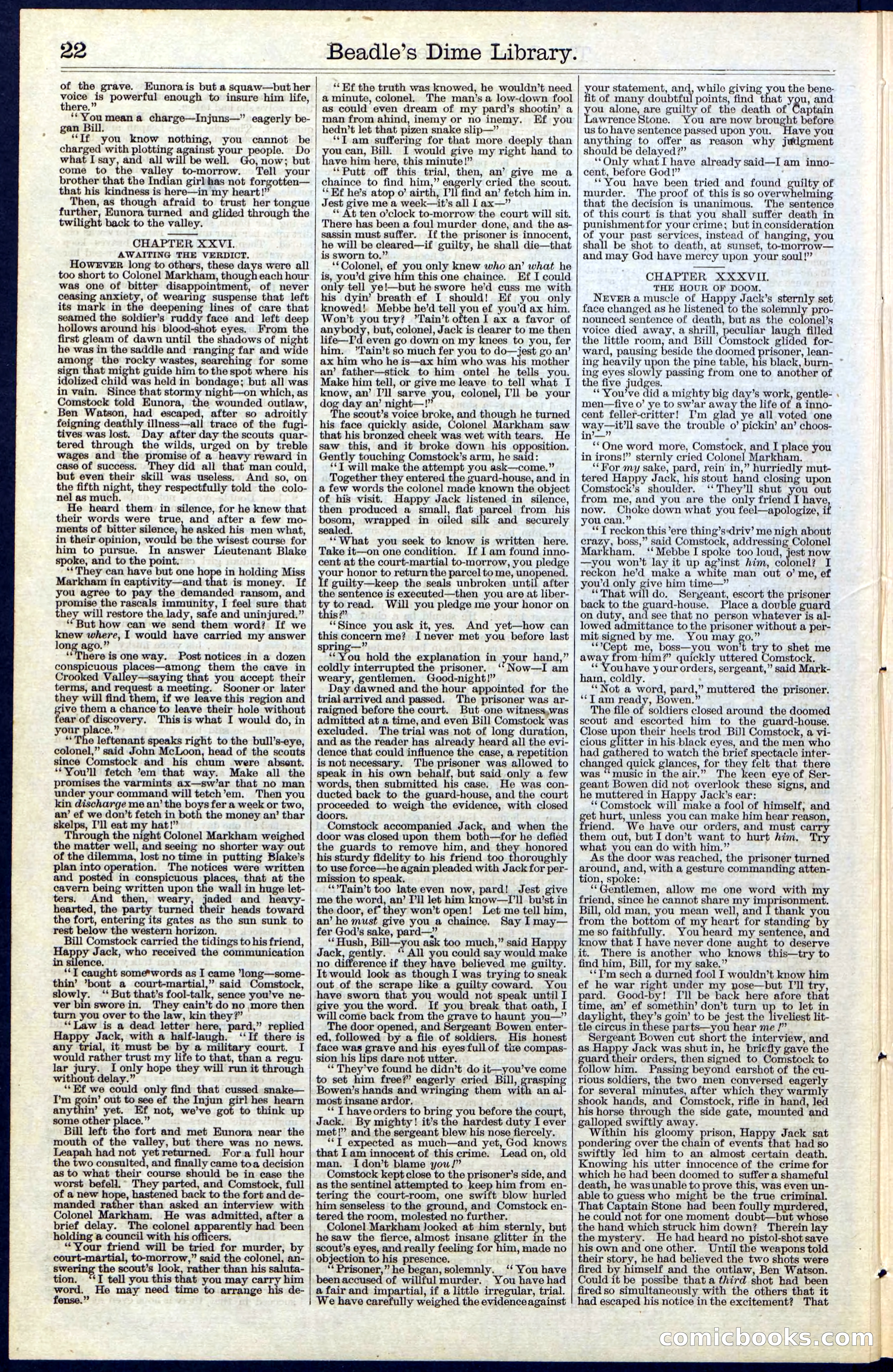
A restored page from Pulp Fiction, 1878. Page through the whole issue in the reader above.
📄 Transcribed text from this page (OCR, searchable)
Machine-transcribed from the original scan — historical spelling and the odd misread are preserved.
22 of the grave. Eunorais but a squaw—but her voice is powerful enough to insure him life, there.” ee aan mean a charge—Injuns—” eagerly be- gan Bill. “Tf you know nothing, you cannot be charged with plotting against ces people. Do what I say, and all will be well. Go, now; but | come to the valley to-morrow. Tell your brother that the Indian girl has not forgotten— that his kindness is here—in my heart!’ Then, as though afraid to trust her tongue further, Eunora turned and glided through the twilight back to the valley. CHAPTER XXVI. AWAITING THE VERDICT. HOWEVER long to others, these days were all too short to Colonel Markham, though each hour was one of bitter disappointment, of never ceasing anxiety, of wearing suspense that left its mark in the deepening lines of care that seamed the soldier’s ruddy face and left deep hollows around his blood-shot eyes. From the first gleam of dawn until the shadows of night he was in the saddle and ranging far and wide among the rocky wastes, searching for some sign that might guide him to the spot where his idolized child was held in bondage; but all was in vain. Since that stormy night—on which, as Comstock told Eunora, the wounded outlaw, Ben Watson, had escaped, after so adroitly feigning deathly illness—all trace of the fugi- tives was lost. Day after day the scouts quar- tered through the wilds, urged on by treble wages and the pager of a heavy reward in case of success. ey did all that man could, but even their skill was useless. And so, on the fifth om ger they respectfully told the colo- nel as much. He heard them in silence, for he knew that their words were true, and after a few mo- ments of bitter silence, he asked his men what, in their opinion, would be the wisest course for him to pursue. In answer Lieutenant Blake spoke, and to the point. ‘* They can have but one es in holding Miss Markham in captivity—and that is money. If you agree to pay the demanded ransom, and promise the rascals immunity, I feel sure that they will restore the lady, safe and uninjured.” ‘*But how can we send them word? If we knew where, I would have carried my answer rong obo ‘There is one way. Post notices in a dozen laces—among them the cave in Crooked Valley—saying that you accept their terms, and request a meeting. Sooner or later they will find them, if we leave this region and give them a chance to leave their hole without ear of discovery. This is what I would do, in your eer ‘The leftenant speaks right to the bull’s-eye, colonel,” said John McLoon, head of the scouts since Comstock and his chum were absent. ‘*You’ll fetch ’em that way. Make all the promises the varmints ax—sw’ar that no man under your command will tetch’em. Then you kin discharge me an’ the boys fer a week or two, an’ ef we don’t fetch in both the money an’ thar skelps, I'll eat my hat!” Through the night Colonel Markham weighed the matter well, and seeing no shorter = out of the dilemma, lost no time in putting Blake’s plan into operation. The notices were written and in conspicuous places, that at the cavern being written upon the wall in huge let- ters. d then, weary, eg and heavy- hearted, the party turned their heads toward the fort, entering its gates as the sun sunk to rest below the western horizon. Bill Comstock carried the tidings to his friend, ree Jack, who received the communication in silence. ‘**T caught some*words as I came ’long—some- thin’ ’bout a court-martial,” said ; slowly. ‘But that’s fool-talk, sence you’ve ne- ver bin sworein. They cain’t do no more then turn you over to the law, kin they?’ ““Law is a dead letter here, pard,” replied Happy Jack, with a half-laugh. ‘If there is any trial, it must be " a mili court. I would rather trust my life to that, than a regu- lar jury. I only hope they will run it through without delay.” ‘‘Ef we could only find that cussed snake— bin ashe I’m goin’ out to see ef the Injun girl hes hearn anythin’ yet. Ef not, we’ve got to think up some other place.” Bill left the fort and met Eunora near the mouth of the valley, but there was no news. Leapah had not yet returned. Fora full hour the two consulted, and finally came toa decision as to what their course should be in ease the worst befell." They parted, and Comstock, full of a new hope, hastened back to the fort and de- manded rather than asked an interview with Colonel Markham. He was admitted, after a brief delay. The colonel apparently had been holding a council with his officers. “Your friend will be tried for murder, by co ial, to-morrow,” said the colonel, an- swering the scout’s look, rather than his saluta- tion. “‘T tell you this that you may carry him om He may need time to arrange his de- ense. Beadle’s Dime Library. “Ef the truth was knowed, he wouldn’t need a minute, colonel. The man’s a low-down fool as could even dream of my pard’s shootin’ a man from ahind, inemy or no inemy. Ef you hedn’t let that pizen snake slip—” ‘*T am suffering for that more deeply than pon can, Bill. I would give my right hand to ave him here, this minute!” ‘*Putt off this trial, then, an’ give me a chaince to find him,” eagerly cried the scout. ‘* Ef he’s atop o’ airth, [ll find an’ fetch him in. Jest give me a week—it’s all I ax—” ** At ten o’clock to-morrow the court will sit. There has been a foul murder done, and the as- sassin must suffer. Ifthe prisoner is innocent, he will be cleared—if guilty, he shall die—that is sworn to.” ‘*Colonel, ef you only knew who an’ what he is, you’d give him this one chaince. Ef I could only tell ye!—but he swore he’d cuss me with his dyin’ breath ef I should! Ef you only knowed! Mebbe he’d tell you ef you’d ax him. Won't youtry? ’Tain’t often I ax a favor of anybody, but, colonel, Jack is dearer to me then life—I’d even go down on my knees to you, fer him. ’Tain’t so much fer you to do—jest go an’ ax him who he is—ax him who was his mother an’ father—stick to him ontel he tells you. Make him tell, or give me leave to tell what I know, an’ [ll sarve you, colonel, [ll be your dog day an’ night—!” he scout’s voice broke, and though he turned his face quickly aside, Colonel Markham saw that his bronzed cheek was wet with tears. He saw this, and it broke down his opposition. Gently touching Comstock’s arm, he said: **T will make the crag you ask—-come,” Together they entered the guard-house, and in a few words the colonel made known the object of his visit. Happy Jack listened in silence, then produced a small, flat parcel from his bosom, wrapped in oiled silk and securely sealed. ‘*What you seek to know is written here. Take it—on one condition. If I am found inno- cent at the court-martial to-morrow, you pledge — honor to return the parcel to me, unopened. guilty—keep the seals unbroken until after the sentence is executed—then you are at liber- 1 he Base Will you pledge me your honor on thi ‘Since you ask it, yes. And yet—how can this concern me? Inever met you before last pet = pa ‘You hold the explanation in your hand,” coldly interrupted the prisoner. ‘‘Now—I am weary, gentlemen. Good-night!” Day dawned and the hour appointed for the trial arrived and passed. The prisoner was ar- raigned before the court. But one witness,was admitted at a time, and even Bill Comstock was excluded. The trial was not of long duration, and as the reader has already heard all the evi- dence that could influence the case, a repetition is not necessary. The prisoner was allowed to speak in his own behalf, but said only a few words, then submitted his case. He was con- ducted back to the guard-house, and the court Sige to weigh the evidence, with closed oors. Comstock accompanied Jack, and when the door was closed upon them both—for he defied the guards to remove him, and they honored his sturdy fidelity to his friend too thoroughly to use force—he again pleaded with Jack for per- mission to speak. “"Tain’t too late even now, pard! Jest give me the word, an’ [ll let him know—I’ll bu’st in the door, ef they won’t open! Let me tell him, an’ he must give you a chaince. Say I may— fer God’s sake, pard—” ‘*Hush, Bill—you ask too much,” said Happy Jac ntly. ‘All you could say would make no erence if they have believed me guilty. It would look as though I was trying to sneak out of the scrape like a anlity coward. You have sworn that you would not speak until I give you the word. If you break that oath, I will come back from the peeve to haunt you—” The door opened, and Sergeant Bowen enter- ed, followed by a file of soldiers, His honest face was grave and his eyesfullof the compas- sion his lips dare not utter. ** They’ve found he didn’t do it—you’ve come to set him free?’ eagerly cried Bill, grasping Bowen’s hands and wringing them with an al- most insane ardor. ** T have orders to Sole you before the court, Jack. By mighty! it’s the hardest duty I ever met!” and the sergeant blew his nose fiercely. **T expected as much—and yet, God knows that Iam innocent of this crime. Lead on, old man. I don’t blame you!” : Comstock kept close to the prisoner’s side, and as the sentinel attempted to keep him from en- tering the court-room, one swift blow hurled him senseless to the ground, and Comstock en- tered the room, molested no further, Colonel. Jooked at him sternly, but he saw the fierce, almost insane glitter in the scout’s eyes, and really feeling for hie, made no objection to his presence. ‘* Prisoner,” he began, solemnly. ‘‘ You have been ac of willful murder. You have had a fair and impartial, if a little irregular, trial. We have carefully weighed the evidenceagainst LE our statement, and, while giving you the bene- t of many doubtful points, find that ygu, and a alone, are guilty of the death of Captain awrence Stone. You are now brought before us to have sentence passed upon you. Have you anything to offer as reason why judgment should be delayed?’ ‘*Only what I have already said—I am inno- cent, before God!” ‘*You have been tried and found guilty of murder. The proof of this is so overwhelming that the decision is unanimous. The sentence of this court is that you shall suffer death in punishment for your crime; but in consideration of your past services, instead of hanging, you shall be shot to death, at sunset, to-morrow— and may God have mercy upon your soul!’ CHAPTER XXXVI. THE HOUR OF DOOM. NEVER a muscle of Happy Jack’s sternly set face changed as he listened to the solemnly pro- nounced sentence of death, but as the colonel’s voice died away, a shrill, peculiar laugh filled the little room, and Bill Comstock glided for- ward, pausing beside the doomed prisoner, lean- ing heavily open the pine table, his black, burn- ~ ing eyes slowly passing from one to another of the five judges. ‘*'You’ve did a mighty big day’s work, gentle- men—five 0’ ye to sw’ar away the life of a inno- cent feller-critter! [’m glad ye all voted one way—it’ll save the trouble o’ pickin’ an’ choos- in’— ; **One word more, Comstock, and I place you in irons!” sternly cried Colonel Markham, ‘For my sake, pard, rein’ in,” hurriedly mut- tered Happy Jack, his stout hand closing upon Comstock’s shoulder. ‘‘They’ll shut you out from me, and you are the only friend I have now. Choke down what you feel—apologize, if you can.” ‘*T reckon this ere thing’s:driv’ me nigh about erazy, boss,” said Comstock, addressing Colonel Markham, ‘‘Mebbe I spoke too loud, jest now —you won’t lay it up ag’inst him, colonel? I reckon he’d make a white man out o’ me, ef you’d only give him time—” __.. *“That will do. Sergeant, escort the prisoner back to the guard-house. Place a double guard on duty, and see that no person whatever is al- lowed admittance to the prisoner without a per- mit signed by me. You may go.” ‘“’Cept me, boss—you won't try to shet me wit Sti him?” quickly uttered Comstock, ‘* Youhave your orders, sergeant,” said Mark- hain, coldly. ' ‘* Not a word, pard,” muttered the prisoner. ‘‘T am ready, Bowen.” The file of soldiers closed around the doomed scout and escorted him to the d-house. Close upon their heels trod Bill Comstock, a vi- cious glitter in his black eyes, and the men who had gathered to watch the brief spectacle inter- changed quick glances, for they felt that there was “‘music in the air.” The keen eye of Ser- pesur Bowen did not overlook these signs, and e muttered in Happy Jack’s ear: ‘* Comstock will make a fool of himself; and et hurt, unless you can make him hear reason, riend. We have our orders, and must carry them out, but I don’t want to hurt him. Try what you can do with him.” As the door was reached, the prisoner turned around, and, with a gesture commanding atten- tion, spoke: ‘‘Gentlemen, allow me one word with my friend, since he cannot share my imprisonment. Bill, old man, you mean well, and I thank you from the bottom of my heart for standing by me so faithfully. You heard my sentence, and know that I have never done aught to deserve it. There is another who knows this—try to find him, Bill, for my sake.” ‘*[’m sech a durned fool I wouldn’t know him ef he war right under my pose—but I'll try, pard. Good-by! Ill be back here afore that time, an’ ef somethin’ don’t turn up to let in daylight, i Me goin’ to be jest the liveliest lit- tle circus in these parts—you hear me !” Sergeant Bowen cut short the interview, and as Happy Jack was shut in, he briefly gave the paard their orders, then signed to Comstock to ollow him. Passing beyond earshot of the cu- rious soldiers, the two men conversed eagerly for several minutes, after which they warmly shook hands, and Comstock, rifle in hand, led his horse through the side gate, mounted and galloped swiftly away. Within his gloomy prison, Happy Jack sat pondering over the chain of events that had so swiftly led him to an almost certain death. Knowing his utter innocence of the crime for which he had been doomed to suffer a shameful death, he was unable to prove this, was even un- able to guess who might be the true criminal. That Captain Stone had been foully murdered, he could not for one moment doubt—but whose Therein lay ry. He had heard no pistol-shot save his own and one other. Until the weapons told their story, he had believed the two shots were fired by himself and the outlaw, Ben Watson. Could it be possibe that a third shot had been fired so simultaneously with the others that it had escaped his notice in the excitement? That the hand which struck him down? the myste MIGDOOKS (E(e) (E(9)