
Pulp Fiction, 1878 · page 16 of 32
Beadle's New York Dime Library, No. 40 — page 16: what you’re looking at
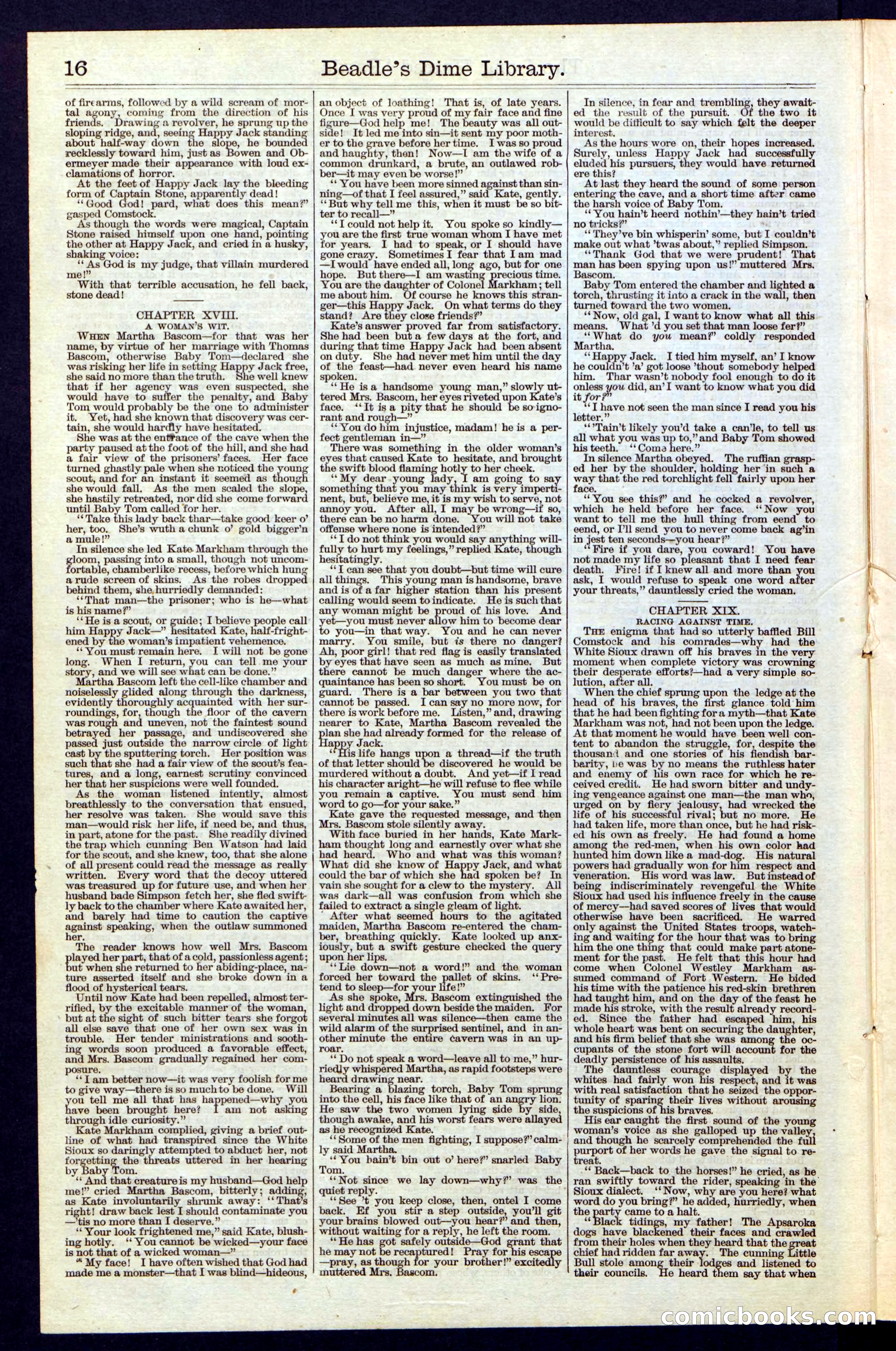
A restored page from Pulp Fiction, 1878. Page through the whole issue in the reader above.
📄 Transcribed text from this page (OCR, searchable)
Machine-transcribed from the original scan — historical spelling and the odd misread are preserved.
16 of firearms, followed by a wild scream of mor- agony, coming from the direction of his friends. Drawing a revolver, he sprung up the sloping ridge, and, seeing Happy Jack standin about half-way down the —— he bounde recklessly toward him, just as Bowen and Ob- ermeyer made their appearance with loud ex- clamations of horror. At the feet of Happy Jack lay the bleeding form of Captain Stone, apparently dead! ‘*Good God! pard, what does this mean?’ gasped Comstock. As though the words were magical, Captain Stone raised himself wee one hand, pointing the other at Happy Jack, and cried in a husky, shaking voice: be As God is my judge, that villain murdered me! With that terrible accusation, he fell back, stone dead! CHAPTER XVIIL. A WOMAN’S WIT. WueEn Martha Bascom—for that was her name, by virtue of her marriage with Thomas Bascom, otherwise Baby Tom—declared she was risking her life in setting Happy Jack free, she said no more than thetruth. } ia well knew that if her agency was even suspected, she would have to suffer the penalty, and Baby Tom would ee be the one to administer it. Yet, had she known that discovery was cer- tain, she would hardly have hesitated. She was at the entfance of the cave when the party paused at the foot of the hill, and she had a fair view of the prisoners’ faces. Her face turned ghastly pale when she noticed the young scout, and for an instant it seemed as though she would fall. As the men scaled the slope, she hastily retreated, nor did she come forward until Baby Tom called for her. ‘*Take this lady back thar—take good keer o’ her, too. She’s wuth a chunk o’ gold bigger’n a mule!” In silence she led Kate Markham through the loom, passing into a small, though not uncom- ort ble, chamberlike recess, before which hung a rude screen of skins. As the robes dropped behind them, she, hurriedly demanded: ‘That man—the prisoner; who is he—what is his name?” ‘* He is a scout, or guide I believe people call him Happy Jack—” hesitated Kate, half-fright- ened by woman’s impatient vehemence. ‘*' You must remain here. I will not be gone long. When I return, you can tell. me your story, and we will see what can be done.” Martha Bascom left the cell-like chamber and noiselessly glided along through the darkness, evidently thoroughly acquainted with her sur- roundings, for, though the floor of the cavern was rough and uneven, not the faintest sound betrayed her passage, and undiscovered she passed just outside the narrow circle of light cast by the sputtering torch. Her position was such that she had a fair view of the scout’s fea- tures, and a long, earnest scrutiny convinced her that her suspicions were well founded. As the woman listened intently, almost breathlessly to the conversation that ensued, her resolve was taken. She would save this man—would risk her life, if need be, and thus, in part, atone for the past. She readily divined the trap which cunning Ben Watson had laid for the scout, and she knew, too, that she alone of all present could read the message as really written. Every word that the decoy uttered was treasured up for future use, and when her husband bade Simpson fetch her, she fled swift- ly back to the chamber where Kate awaited her, and barely had time to caution the captive aati speaking, when the outlaw summoned er. The reader oe He nt Velie a Bascom la get pene at of acold, passionless agent; ia aes she returned to her abiding-place, na- ture asserted itself and she broke flood of hysterical tears. Until now Kate had been repelled, almost ter- rified, by the excitable manner of the woman, but at the sight of such bitter tears she forgot all else save that one of her own sex was in trouble. Her tender ministrations and sooth- ing words soon produced a favorable effect, and Mrs. Bascom gradually regained her com- own ina osure. ‘*T am better now—it was very foolish for me to give way—there is so muchto be done. Will rou tell me all that has happenedee ike you ave been brought here? am not asking through idle curiosity.” Kate Markham complied, giving a brief out- line of what had transpired since the White Sioux so daringly attempted to abduct her, not a Spite” the ihbente uttered in her hearing by Baby Tom. ‘“* And that creatureis my husband—God help me!” cried Martha Bascom, bitterly; adding, as Kate involuntarily shrunk away: ‘‘ That’s right! draw back lest I should contaminate you —'tis no more than I deserve.” “Your look frightened me,” said Kate, blush- ing hotly. ‘‘ You cannot be wicked—your face is not that of a wicked woman—” “My face! I have often wished that God had made me a monster—that I was blind—hideous, ‘ | Beadle’s Dime Library. an object of loathing! That is, of late years. Once I was very proud of my fair face and fine figure—God help me! The beauty was all out- side! It led me into sin—it sent my poor moth- er to the grave before her time. Iwas so proud and haughty, then! Now—I am the wife of a common drunkard, a brute, an outlawed rob- ber—it may even be worse!” ** ‘You have been more sinned against than sin- ning—of that I feel assured,” said Kate, gently. ‘*But why tell me this, when it must be so bit- ter to recall—” ‘**T could not help it. You spoke so kindly— you are the first true woman whom I have met for years. I had to speak, or I should have gone crazy. SometimesI fear that Iam mad —I would have ended all, long ago, but for one hope. But there—I am wasting precious time. You are the daughter of Colonel Markham; tell me about him. Of course he knows this stran- ger—this Happy Jack. On what terms do they stand? Are they close friends?” Kate’s answer proved far from satisfactory. She had been but a few days at the fort, and during that time Happy Jack had been absent on duty. She had never met him until the day of the feast—had never even heard his name spoken. ‘‘He isa handsome young man,” slowly ut- tered Mrs. Bascom, her eyes riveted upon Kate’s face. “It isa pity that he should so igno- rant and rough—” ‘**'You do him injustice, madam! he is a per- fect gentleman in—” There was something in the older woman’s eyes that caused Kate to hesitate, and brought the swift blood flaming hotly to her cheek. 5 rs dear young lady, I am going to sa something that you may think is very imperti- nent, but, believe me, it is my wish to serve, not annoy you. After all, I may be wrong—if so, there can be no harm done. You will not take offense where none is intended?” ‘I do not think you would say anything will- fully to hurt my feelings,” replied Kate, though hesitatingly. ‘**T can see that you doubt—but time will cure all things. This young man is handsome, brave and is of afar higher station than his present calling would seem toindicate. He is such that any woman might be proud of his love. And yet—you must never allow him to become dear to you—in that way. You and he can never marry. You smile, but is there no danger? Ah, poor girl! that red flag is easily translated by eyes that have seen as much as mine. But there cannot be much danger where the ac- quaintance has been so short. You must be on guard. There is a bar between you two that cannot be passed. I can say no more now, for there is work before me. Listen,” and, drawing nearer to Kate, Martha Bascom revealed the — she had already formed for the release of appy Jack. ‘* His life hangs upon a thread—if the truth of that letter should be discovered he would be murdered without a doubt. And yet—if I read his character aright—he will refuse to flee while you remain a captive. You must send him word to go—for your sake.” Kate gave the requested message, and then Mrs. Bascom stole silently away. With face buried in her hands, Kate Mark- ham Mb, es long and earnestly over what she had heard. Who and what was this woman? What did she know of Happy Jack, and what could the bar of which she had spoken be? In vain she sought for a clew to the myste All was dark—all was confusion from which she failed to extract a single gleam of light. After what seemed hours to the agitated maiden, Martha Bascom re-entered the cham- ber, breathing quickly. Kate looked up anx- iously, but a swift gesture checked the query upon her lips. ‘* Lie down—not a word!” and the woman forced her toward the et of skins. ‘‘ Pre- tend to sleep—for your life!” As she spoke, . Bascom extinguished the light and dropped down beside the maiden. For several minutes all was silence—then came the wild alarm of the rised sentinel, and in an- other minute the entire cavern was in an up- roar. ‘** Do not speak a word—leave all to me,” hur- riedly whispered Martha, as rapid footsteps were heard drawing near. Bearing a blazing torch, Baby Tom sprung into the cell, his face like that of an lion. He saw the two women lying side by side though awake, and his worst fears were allayed OriGene ot ainsi ight ? cal ‘Some of the men fighting, I suppose m- ly said Martha. = : 2 ‘*You bain’t bin out o’ here?’ snarled Baby om. ‘“‘Not since we lay down—why?’ was the quiet reply. ‘*See *t you keep close, then, ontel I come back. Ef you stir a step outside, you’ll git your brains blowed out—you hear?’ and then, without waiting for a reply, he left the room. ‘**He has got safely outsid rant that he may not Psi oan Pray for his esca —pray, as though for your brother!” excitedly m, muttered Mrs. | Sioux dialect. ——-— ee In silence, in fear and a gee they await- ed the result of the pursuit. f the two it would be difficult to say which felt the deeper interest. As the hours wore on, their ho increased, Surely, unless Happy Jack had successfully eluded his pursuers, they would have returned ere this? At last they heard the sound of some person entering the cave, and a short time after came the harsh voice of Baby Tom. ‘You hain’t heerd nothin’—they hain’t tried no tricks?” ‘*'They’ve bin whisperin’ some, but I couldn’t make out what ’twas about,” replied Simpson. “Thank God that we were prudent! That man has been spying upon us!” muttered Mrs. Bascom. Baby Tom entered the chamber and lighted a torch, thrusting it into a crack in the wall, then turned toward the two women. ** Now, old gal, I want to know what all this means. What ’d you set that man loose fer?” ‘“What do you mean?’ coldly responded Martha. ‘‘Happy Jack. I tied him myself, an’ I know he couldn’t ’a’ got loose ’thout somebody helped him. Thar wasn’t nobody fool enough to do it onless you did, an’ I want to know what you did it for?” ‘*T have not seen the man since I read you his letter.” ‘’Tain’t likely you’d take a can’le, to tell us all what you was mp ,’and Baby Tom showed his teeth. ‘‘Coma here.” In silence Martha obeyed. The ruffian grasp- ed her by the shoulder, holding her in such a Nhe that the red torchlight fell fairly upon her ace “You see this?’ and he cocked a revolver, which he held before her face. ‘‘Now you want to tell me the hull thing from eend to eend, or I’ll send you to never come back ag’in in jest ten seconds—you hear?” ‘Fire if you dare, hs coward! You have not made my life so pleasant that I need fear death. Fire! if I knew all and more than you ask, I would refuse to speak one word r your threats,” dauntlessly cried the woman. CHAPTER XIX. RACING AGAINST TIME. THE enigma that had so utterly baffled Bill Comstock and his comrades—why had the White Sioux drawn off his braves in the very moment when complete victory was crowning their desperate efforts?—had a very simple so- lution, after all. When the chief sprung upon the ledge at the head of his braves, the first glance told him that he had been fighting for a myth—that Kate Markham was not, had not been upon the ledge. At that moment he would have been well con- tent to abandon the struggle, for, despite the thousand and one stories of his fiendish bar- barity, be was by no means the ruthless hater and enemy of his own race for which he re- ceived credit. He had sworn bitter and undy- ing vengeance against one man—the man who, urged on by fiery ern had wrecked the life of his successful rival; but no more. He had taken life, more than once, but he had risk- ed his own as freely. He had found a home among the red-men, when his own color had hunted him down like a mad-dog. His natural powers had gradually won for him respect and veneration. His word was law. But instead of being indiscriminately revengeful the White Sioux had used his influence freely in the cause of mercy—had saved scores of lives that would otherwise have been sacrificed. He warred only ——, the United States troops, watch- ing and waiting for the hour that was to bring him the one thing that could make part atone- ment for the p He felt that this hour had come when Colonel Westley Markham as- sumed command of Fort Western. He bided his time with the patience his red-skin brethren had taught him, and on the day of the feast he made his stroke, with the result already record- ed. Since the father had i him, his whole heart was bent on securing the daughter, and his firm belief that she was amon @ oc- cupants of the stone fort will account for the deadly persistence of his assaults. The dauntless courage displayed by the whites had fairly woliciie respect, and ew with real satisfaction that he seized the oppor- tunity of ee lives without arousing the suspicions of his braves. His ear caught the first sound of the young woman’s voice as she galloped up the valle and though he scarcely comprehended the f pare rt of her words he gave the signal to re- treat. ‘‘ Back—back to the horses!” he cried, as he ran swiftly toward the rider, in the “*Now, why are you here? what word do you bring?” he added, hurriedly, when the pert came to a halt. “Black tidings, my father! The Apsaroka dogs have blackened their faces and crawled from their holes when they heard that the chief had ridden far away. The cunning Little Bull stole among their and listened to their councils. He heard them say that when SFOHnIGDIOO Kk 7 Elo) ory