
Pulp Fiction, 1886 · page 19 of 32
Beadle's Dime Library No. 391 — page 19: what you’re looking at
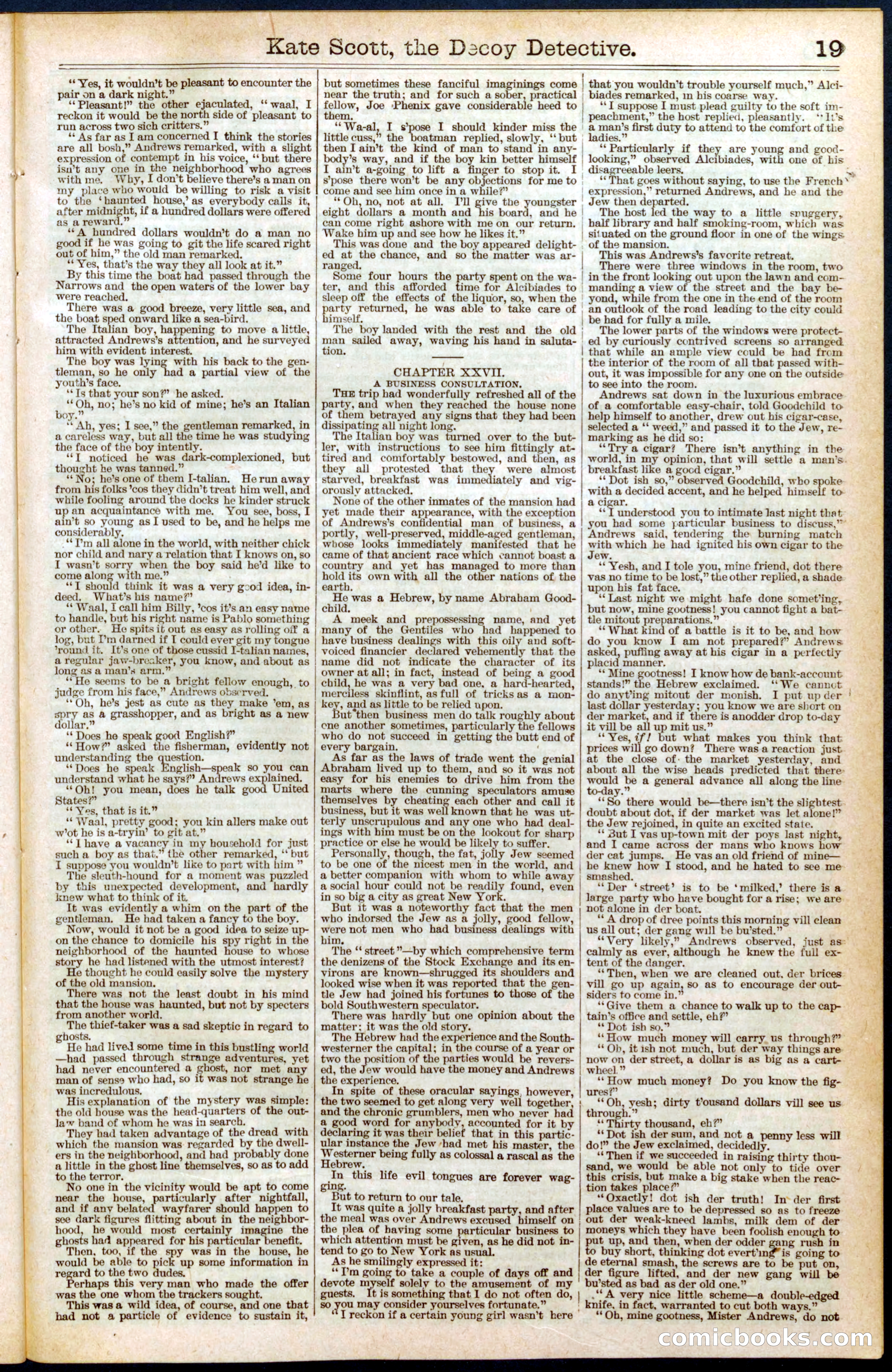
A restored page from Pulp Fiction, 1886. Page through the whole issue in the reader above.
📄 Transcribed text from this page (OCR, searchable)
Machine-transcribed from the original scan — historical spelling and the odd misread are preserved.
‘tae aT x ~ ‘Yes, it wouldn’t be pleasant to encounter the pair on a dark night.” ‘ ‘‘ Pleasant!” the other ejaculated, ‘“‘ waal, I reckon it would be the north side of pleasant to run across two sich critters.” ‘* As far as I am concerned I think the stories are all bosh,” Andrews remarked, with a slight expression of contempt in his voice, ‘‘ but there isn’t any one in the neighborhood who agrees with me. Why, I don’t believe there’s a man on my place who would be willing to risk a visit to the ‘haunted house,’ as everybody calls it, after myaient, if a hundred dollars were offered as a reward,” ‘*A hundred dollars wouldn’t do a man no good if he was going to git the life scared right out of him,” the old man remarked. ‘Yes, that’s the way they all look at it.” By this time the boat had passed through the Narrows and the open waters of the lower bay were reached. There was a good breeze, very little sea, and the boat sped onward like a sea-bird. The Italian boy, happening to move a little, attracted Andrews’s attention, and he surveyed him with evident interest. The boy was lying with his back to the gen- tleman, so he only had a partial view of the youth’s face. ‘* Is that your son?” he asked. ! Oh, no; he’s no kid of mine; he’s an Italian boy.’ An, yes; I see,” the gentleman remarked, in a careless way, but all the time he was studying the face of the boy intently. ‘‘T noticed he was dark-complexioned, but thought he was tanned.” ‘** No; he’s one of them I-talian. Herun away from his folks ’cos they didn’t treat him well, and while fooling around the docks he kinder struck up an acquaintance with me. You see, boss, I ain’t so young as I used to be, and he helps me considerably, ‘“*1’'m all alone in the world, with neither chick nor child and nary a relation that I knows on, so I wasn’t sorry when the boy said he’d like to come along with me.” “T should think it was a very good idea, in- deed. What’s his name?” ‘** Waal, I call him Billy, ’cos it’s an easy name to handle, but his right name is Pablo something or other. He spits it out as easy as rolling off a log, but I’m darned if I could ever git my tongue round it. It’s one of those cussid I-talian names, a regular jaw-breaker, you know, and about as long as a man’s arm.” ‘He seems to be a bright fellow enough, to judge from his face,” Andrews observed. ‘*Oh, he’s jest as cute as they make ’em, as spry as a grasshopper, and as bright as a new dollar,” ; ‘Does he speak good English?” _ ‘‘ How?” asked the fisherman, evidently not understanding the question. ‘*Does he speak English—speak so you can understand what he says?’ Andrews explained, ‘Oh! you mean, does he talk g United States?” ‘6 Yes, that is it.” ‘Waal, pretty good: you kin allers make out w’ot he is a-tryin’ to git at.” ‘“‘T have a vacancy in my household for just such a boy as that.” the other remarked, ‘* but I suppose you wouldn’t like to part with him ” The sleuth-hound for a moment was puzzled by this unexpected development, and hardly knew what to think of it. It was evidently a whim on the part of the gentleman. He had taken a fancy to the boy. Now, would it not be a good idea to seize up- on the chance to domicile his spy right in the neighborhood of the haunted house to whose story he had listened with the utmost interest? He thought he could easily solve the mystery of the old mansion. There was not the least doubt in his mind that the house was haunted, but not by specters from another world. The thief-taker was a sad skeptic in regard to hosts. P He had lived some time in this bustling world —had passed through strange adventures, yet had never encountered a ghost, nor met any man of sense who had, so it was not strange he was incredulous. His explanation of the mystery was simple: the old house was the head-quarters of the out- law band of whom he was in search. They had taken advantage of the dread_with which the mansion was regarded by the dwell- ers in the neighborhood, and had probably done a little in the ghost line themselves, so as to add to the terror. No one in the vicinity would be apt to come near the house, particularly after nightfall, and if any belated wayfarer should happen to see dark figures flitting about in the neighbor- hood, he would most certainly imagine the ghosts had appeared for his particular benefit. Then, too, if the spy was in the house, he would be able to pick up some information in regard to the two dudes. erhaps this very man who made the offer was the one whom the trackers sought. This was a wild idea, of course, and one that bad not a particle of evidence to sustain it, * = } Kate Scott, the Dscoy Detective. 1 ' but sometimes these fanciful imaginings come | that you wouldn't trouble yourself much,” Alci- near the truth; and for such a sober, practical | follow, Joe Phenix gave considerable heed to | them, Wa-al, I rot I should kinder miss the little cuss,” the boatman replied, slowly, ‘‘ but then I ain’t the kind of man to stand in any- body’s way, and if the boy kin better himself | I ain’t a-going to lift a finger to stop it. I s’pose there won’t be any objections for me to come and see him once in a while?” **Oh, no, not at all. Tl give the youngster eight dollars a month and his board, and he can come right ashore with me on our return. Wake him up and see how he likes it.” This was done and the boy appeared delight- ed at the chance, and so the matter was ar- ranged. Some four hours the party spent on the wa- ter, and this afforded time for Alcibiades to sleep off the effects of the liquor, so, when the lh Bigg hap, he was able to take care of | himself, The boy landed with the rest and the old | man sailed away, waving his hand in saluta- tion. CHAPTER XXVII. A BUSINESS CONSULTATION, THE ie had wonderfully refreshed all of the party, and when they reached the house none of them betrayed any signs that they had been dissipating all night long, The Italian boy was turned over to the but- ler, with instructions to see him fittingly at- tired and comfortably bestowed, and then, as they all protested that they were almost | starved, breakfast was immediately and vig- orously attacked. None of the other inmates of the mansion had yet made their appearance, with the exception of Andrews’s confidential man of business, a portly, well-preserved, middle-aged gentleman, whose looks immediately manifested that he came of that ancient race which cannot boast a country and yet has managed to more than oer own with all the other nations of the earth. Ree was a Hebrew, by name Abrabam Good- child, | A meek and prepossessing name, and yet many of the Gentiles who had happened to have business dealings with this cat and soft- voiced financier declared vehemently that the name did not indicate the character of its owner at all; in fact, instead of being a good child, he was a very bad one, a hard-hearted, merciless skinflint, as full of tricks as a mon- Key, and as little to be relied upon. ut then business men do talk roughly about ene another sometimes, particularly the fellows who do not succeed in getting the butt end of every bargain. ‘ As far as the laws of trade went the genial Abraham lived up to them, and so it was not easy for his enemies to drive him from the marts where the cunning speculators amuse themselves by cheating each other and call it business, but it was well known that he was ut- terly unscrupulous and any one who had deal- ings with bim must be on the lookout for sharp practice or else he would be likely to suffer. Personally, though, the fat, jolly Jew seemed | to be one of the nicest men in the world, and a better companion with whom to while away a social hour could not be readily found, even in so big a city as great New York. But it was a noteworthy fact that the men who indorsed the Jew as a jolly, good fellow, were not men who had business dealings with im. The “‘ street ”°—by which comprehensive term the denizens of the Stock Exchange and its en- virons are known—shrugged its shoulders and looked wise when it was reported that the gen- tle Jew had joined his fortunes to those of the bold Southwestern speculator. — | There was hardly but one opinion about the matter: it was the old story. The Hebrew had the experience and the South- westerner the capital; in the course of a year or two the position of the parties would be revers- ed, the Jew would have the money and Andrews the experience. ; In spite of these oracular sayings, however, the two seemed to get along very well together, and the chronic grumblers, men who never had a good word for anybody, accounted for it by declaring it was their belief that in this ic- ular instance the Jew ‘had met his master, the Westerner being fully as colossal a rascal as the Hebrew. In this life evil tongues are forever wag- ging. But to return to our tale. It was quite a jolly breakfast and after the meal was over Andrews excused himself on the plea of having some particular business to which attention must be given, as he did not in- tend to go to New York as usual. As he smilingly expressed it: devote m guests. It is something that 1 do not often do, so you may consider yourselves fortunate.” **T reckon if a certain young girl wasn’t here rr a rrr es ee de eternal smash, the screws are to “Tm going to take a couple of days off and | der figure lifted, and der new solely to the amusement of my | bu’sted as bad as der old one.” biades remarked, 1n his coarse way. ‘**I suppose I must plead guilty to the soft im- peachment,” the host replied, pleasantly. ‘*1t’s a man’s first duty to attend to the comfort of the ladies.” ‘ Particularly if they are young and good- looking,” observed Alcibiades, with one of his disagreeable leers. ' ‘That goes without saying, to use the French expression,” returned Andrews, and he and the Jew then apaee. The host led the way to a little snuggery, balf library and half smoking-room, which was | situated on the ground floor in one of the wings. of the mansion. This was Andrews’s favorite retreat. There were three windows in the room, two in the front looking out upon the lawn and com- manding a view of the street and the bay be- yond, while from the one in the end of the room an outlook of the road leading to the city could be had for fully a mile. The lower parts of the windows were protect- ed by curiously contrived screens so arran that while an ample view could be had from the interior of the room of all that passed with- out, it was impossible for any one on the outside to see into the room. Andrews sat down in the luxurious embrace of a comfortable easy-chair, told Goodchild to help himself to another, drew out his cigar-case, selected a ‘* weed,” and passed it to the Jew, re- marking as he did so: “Try a cigar? There isn’t anything in the world, in my opinion, that will settle a man’s. breakfast like a gocd cigar.” ‘* Dot ish so,” observed Goodchild, who spoke with a decided accent, and he helped himself to a cigar. ‘“*T understood you to intimate last night that you had some particular business to discuss,” Andrews said, tendering the burning match fa which he had ignited his own cigar to the ew. ‘** Yesh, and I tole you, mine friend, dot there vas no time to be lost,” the other replied, a shade upon his fat face. ‘Last night we might hafe done somet’ing, but now, mine gootness! you cannot fight a bat- tle mitout preparations.” ‘* What kind of a battle is it to be, and how do you know I am not prepared?” Andrews asked, pufling away at his cigar in a perfectly placid manner. ‘* Mine gootness! I know how de bank-account stands!” the Hebrew exclaimed. last dollar yesterday; you know we are short on der market, and if there is anodder drop to-day it vill be all up mit us.” ‘Yes, if! but what makes you think that prices will godown? There was a reaction just at the close of: the market yesterday, and about all the wise heads predicted that there» ha be a general advance all along the line ay.’ ‘*So there would be—there isn’t the slightest. doubt about dot, if der market was let alone!” the Jew rejoined, in quite an excited state. ** Sut I vas up-town mit der poys last night, and I came across der mans who knows how der cat jumps. He vas an old friend of mine— | he knew how I stood, and he hated to see me smashed. ‘Der ‘street’ is to be ‘milked,’ there is a large party who have bought for a rise; we are. not alone in der boat. ‘“‘ A drop of dree points this morning vill clean us all out; der gang will be bu’sted.” “Very likely,” Andrews observed, just as: calmly as ever, although he knew the full ex- tent of the danger. “Then, when we are cleaned out, der brices vill go up again, so as to encourage der out- siders to come in.’ ‘*Give them a chance to walk up to the cap- tain’s office and settle, eh?’ ** Dot ish so,” ‘‘How much money will carry_us through?” ‘Ob, it ish not much, but der way things are _ now on der street, a dollar is as big as a cart-— wheel.” c How much money? Do you know the fig- ures?’ ‘*Oh, yesh; dirty t’ousand dollars vill see us through.” “Thirty thousand, eh?” ‘Dot ish der sum, and not a penny less will — do!” the Jew exclaimed, decidedly. ‘Then if we succeeded in raising thirty thou- sand, we would be able not only to tide over this crisis, but make a big stake when the reac- tion takes place?” ‘““Oxactly! dot ish der truth! In der first place values are to be depressed so as to freeze out der weak-kneed lambs, milk dem of der moneys which they have been foolish enough to pot up, and then, when der odder gang rush in buy short, thinking dot evert is going to be put on, gang will be .“*‘A very nice little scheme—a doubl knife, in fact, warranted to cut both ways.” ‘“*Ob, mine gootness, Mister Andrews, do not Gomicbooks ‘We cannot . do anyt’ing mitout der monish. I put up der ' aes ~ com,