
Pulp Fiction, 1886 · page 13 of 32
Beadle's Dime Library No. 391 — page 13: what you’re looking at
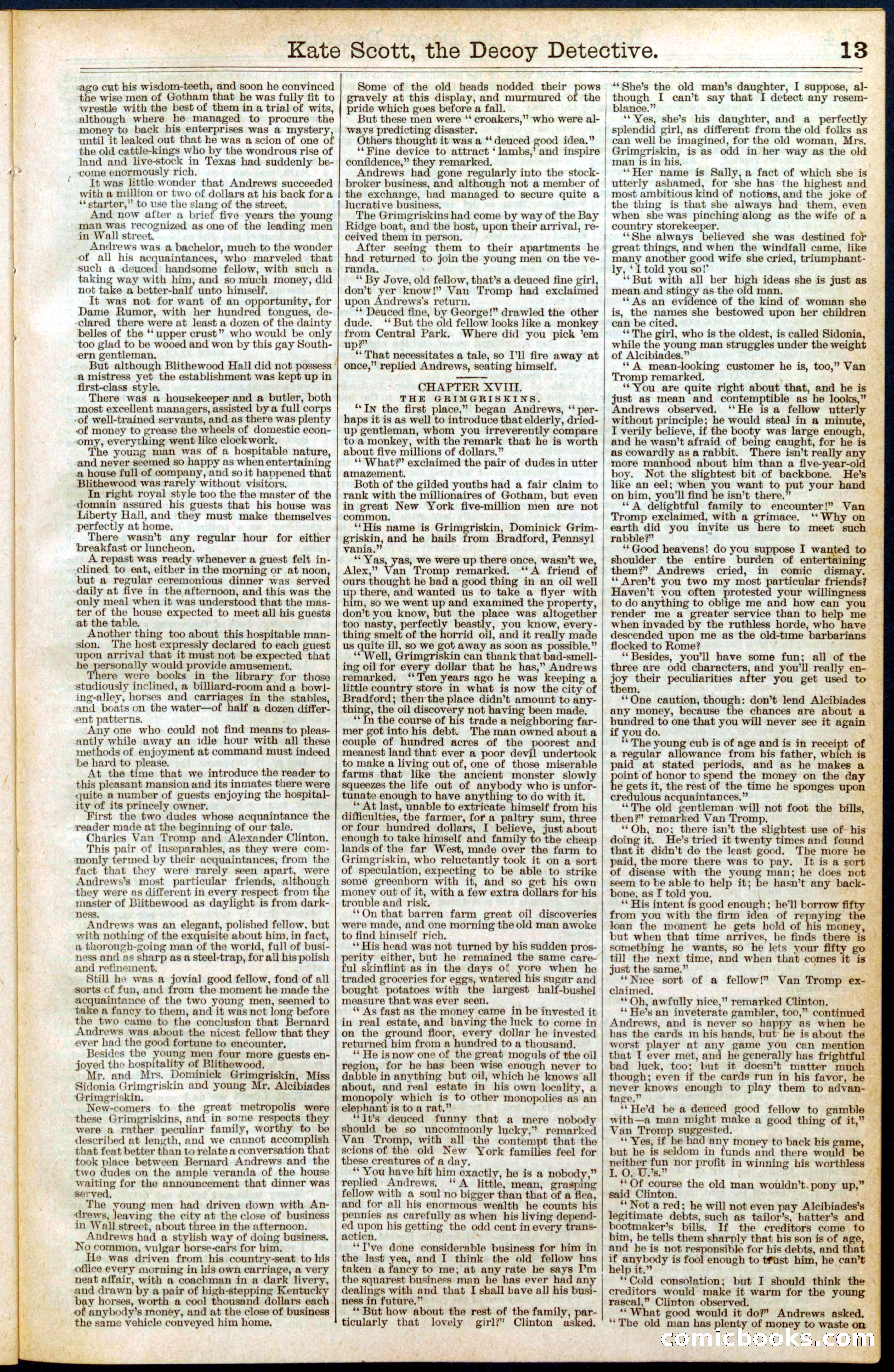
A restored page from Pulp Fiction, 1886. Page through the whole issue in the reader above.
📄 Transcribed text from this page (OCR, searchable)
Machine-transcribed from the original scan — historical spelling and the odd misread are preserved.
-and drawn by a , » ; : ’ ° % : . rh - Bike _- — eee ee the wise men of Gotham that he was fully fit to wrestle with the best of them in a trial of wits, although where he managed to procure the money te back his enterprises was a mystery until it leaked out that he was a scion of one of the old cattle-kings who by the wondrous rise of land and live-stock in Texas had suddenly be- _ «come enormously rich. It was litthe wonder that Andrews succeeded with a million or two of dollars at his back fora ‘¢ starter,” to use the slang of the street. And now after a brief five years the young man was recognized as one of the leading men in Wall street. Andrews was a bachelor, much to the wonder of all his acquaintances, who marveled that such a damned handsome fellow, with such a taking way with him, and so much money, did not take a better-half unto himself. It was not for want of an opportunity, for Dame Rumor, with her ened 4 tongues, de- clared there were at least a dozen of the dainty belles of the ‘‘ upper crust” who would be only too glad to be wooed and won by this gay South- ern gentleman, But although Blithewood Hall did not possess * a mistress yet the establishment was kept up in first-class style. There was a housekeeper and a butler, both most excellent managers, assisted by a full corps -of well-trained servants, and as there was plenty of money to grease the wheels of domestic econ- omy, everything went like clockwork, The young man was of a hospitable nature, and never seemed so happy as when entertaining a house full of company, and soit happened that Blithewood was rarely without visitors. In right royal style too the the master of the domain assured his guests that his house was Liberty Hall, and they must make themselves perfectly at home. There wasn’t any regular hour for either breakfast or luncheon. A repast was ready whenever a guest felt in- clined to eat, either in the morning or at noon, but a regular ceremonious dinner was served daily at five in the afternoon, and this was the only meal when it was understood that the mas- ter of the house expected to meet all his guests at the table. Another thing too about this hospitable man- sion. The host expressly declared to each guest upon arrival that it must not be expected that he personally would provide amusement. ere were books in the library for those studiously inclined, a billiard-room and a bowl- ing-alley, horses and carria in the stables, and boats on the water—of half a dozen differ- ent patterns. Any one who could not find means to pleas- antly while away an idJe hour with all these methods of enjoyment at command must indeed be hard to please. At the time that we introduce the reader to this pleasant mansion and its inmates there were quite a number of guests enjoying the hospital- ity of its princely owner. First the two dudes whose acquaintance the reader made at the beginning of our tale. Charles Van Tromp and Alexander Clinton. This pair of inseparables, as they were com- monly termed by their acquaintances, from the fact that they were rarely seen apart, were Andrews’s most particular friends, although they were as different in every respect from the master of Blithewood as daylight is from dark- ness. Andrews was an elegant, polished fellow, but with nothing of the exquisite about him, in fact, a thorough-going man of the world, full of busi- ness and as sharp as a steel-trap, for all his polish and refinement. Still he was a jovial good fellow, fond of all sorts of fun, and from the moment he made the acquaintance of the two young men, seemed to take a fancy to them, and it was not long before the two came to the conclusion that Bernard Andrews was about the nicest fellow that they ever had the good fortune to encounter, Besides the young men four more guests en- joyed the hospitality of Blithewood. r. and Mrs. Dominick Grimgriskin, Miss r. Alcibiades Sidonia Grimgriskin and young Grimgriskin. New-comers to the great metropolis were these Grimgriskins, and in some respects they were a rather peculiar family, worthy to be described at length, and we cannot accomplish that feat better than to relate a conversation that took place between Bernard Andrews and the two dudes on the ample veranda of the house waiting for the announcement that dinner was served, The young men had driven down with An- drews, Jeaving the city at the close of business in Wall street, about three in the afternoon. Andrews had a stylish way of doing business. No common, vulgar horse-cars for him. He was driven from his country-seat to his oflice every morning in his own carriage, a very neat affair, with a coachman in a dark livery, ir of high-stepping Kentucky bey horses, worth a cool thousand dollars eac o any body’s money, and at the close of business the same vehicle conveyed him home, +> ee eee ago cut his wisdom-teeth, and soon he convinced Some of the old heads nodded their pows gravely at this display, and murmured of the pride which gues before a fall. But these men were ‘‘ croakers,” who were al- ways predicting disaster. thers thought it was a ‘‘deuced good idea.” ‘*Fine device to attract ‘lambs,’ and inspire confidence,” they remarked. Andrews had gone regularly into the stock- broker business, and although not a member of the exchange, had managed to secure quite a lucrative business, The Grimgriskins had come by way of the Bay Kate Scott, the Decoy Detective. | Ridge boat, and the host, upon their arrival, re- | ceived them in person, After seeing them to their apartments he had returned to join the young men on the ve- randa. ** By Jove, old fellow, that’s a deuced fine girl don’t yer know!” Van Tromp had exclaimed upon Andrews'’s return. ‘** Deuced fine, by George!” drawled the other dude. ‘‘ But the old fellow looks like a monkey ge Central Park. Where did you pick ’em up ** That necessitates a tale, so Ill fire away at once,” replied Andrews, seating himself. CHAPTER XVIII. THE GRIMGRISKINS. ‘*‘In the first place,” began Andrews, “‘ per- haps it is as well to introduce that elderly, dried- up gentleman, whom you irreverently compare to a monkey, with the remark that he is worth about five millions of dollars.” ‘What?’ exclaimed the pair of dudes in utter amazement. Both of the gilded youths had a fair claim to rank with the millionaires of Gotham, but even in great New York five-million men are not common. ‘‘His name is Grimgriskin, Dominick Grim- griskin, and he hails from Bradford, Pennsyl vania.” ‘Yas, yas, we were up there once, wasn’t we, Alex,” Van Tromp remarked. ‘‘A friend of ours thought he bad a good thing in an oil well up there, and wanted us to take a flyer with him, so we went up and examined the property, don’t you know, but the place was altogether too nasty, perfectly beastly, you know, every- thing smelt of the horrid oil, and it really made us oa ill, so we got away as soon as possible.” ‘* Well, Grimgriskin can thank that bad-smell- ing oil for every dollar that he has,” Andrews remarked. ‘‘Ten years ago he was keeping a little country store in what is now the city of Bradford; then the place didn’t amount to any- thing, the oil discovery not having been made, ‘* In the course of his trade a neighboring far- mer got into his debt. The man owned about a couple of hundred acres of the rest and meanest land that ever a poor devil undertook to make a living out of, one of those miserable farms that like the ancient monster slowly squeezes the life out of ent who is unfor- tunate enough to have anything to do with it. ‘* At last, unable to extricate himself from his difficulties, the farmer, for a paltry sum, three or four hundred dollars, I believe, just about enough to take himself and family to the cheap lands of the far West, made over the farm to Grimgriskin, who reluctantly took it on a sort of speculation, expecting to be able to strike some greenhborn with it, and so get his own money out of it, with a few extra dollars for his trouble and risk. ‘*On that barren farm great oil discoveries were made, and one morning the old man awoke to find himself rich. ‘* His head was not turned by his sudden pros- perity either, but he remained the same care- ful skinflint as in the days of yore when he traded groceries for eggs, watered his sugar and bought potatoes with the largest half-bushel measure that was ever seen. ‘* As fast as the money came in he invested it in real estate, and having the luck to come in on the ground floor, every dollar he invested returned him from a hundred to a thousand. ‘* He is now one of the great moguls of the oil region, for he has been wise enough never to dabble in anything but oil, which he knows all about, and real estate in his own locality, a monopoly which is to other monopolies as an elephant is to a rat.” ‘It’s deuced funny that a mere nobody should be so uncommonly lucky,” remarked Van Tromp, with all the contempt that the scions of the old New ‘York families feel for these creatures of a day. ‘* You have hit him exactly, he is a nobody,” replied Andrews, “A little, mean, grasping fellow with a soul no bigger than that of a flea, and for all his enormous wealth he counts his pennies as carefully as when his living depend- oe cree his getting the odd cent in every trans- actien., ; ‘*TPve done considerable business for him in the last yea, and I think the old fellow has taken a fancy to me; at any rate he says I’m the squarest business man he has ever had any dealings with and that I shall bave all his busi- ness in future.” ‘* But how about the rest of the family, - ticularly that lovely girl?” Clinton asked. ' | a A TT 13 _—- Oo Gag eens —— oe - - - -l eSC “*She’s the old man’s daughter, I suppose, al- though I can’t say that I detect any resem- blance.” ‘‘'Yes, she’s his daughter, and a_ perfectly splendid girl, as different from the old folks as can well be imagined, for the old woman, Mrs. Grimegriskin, is as odd in her way as the old man is in his. ‘‘Her name is Sally, a fact of which she is utterly ashamed, for she has the highest and most ambitious kind of notions, and the joke of the thing is that she always had them, even when she was pinching along as the wife of a country storekeeper. ‘She always believed she was destined for great things, and when the windfall came, like many another good wife she cried, triumphant- ly, ‘I told you so!’ ‘*But with all ber high ideas she is just as mean and stingy as the old man. ‘*As an evidence of the kind of woman she is, the names she bestowed upon her children — can be cited. ‘* The girl, who is the oldest, is called Sidoni while the young man struggles under the weig of Alcibiades.” ‘* A mean-looking customer he is, too,” Van Tromp remarked. | ‘*You are quite right about that, and he is just as mean and contemptible as he looks,” Andrews observed. ‘‘He is a fellow utter without principle; he would stea] in a minute, I verily believe, if the booty was large enough, — f . and he wasn’t afraid of being caught, for he is _ as cowardly as arabbit. There isn’t really any more manhood about him than a five-year-old Not the slightest bit of backbone. He's — boy. like an eel; when — want to put your hand on him, you'll find he isn’t there.” ‘“‘A delightful family to encounter!” Van Tromp exclaimed, with a grimace. earth did rabble?” ‘* Good heavens! do you suppose I w shoulder the entire burden of ente iz ‘** Aren’t you two my most particular friends? Haven’t vou often prot your willingness to do anything to oblige me and how can you render me a greater service than to help'me _ when invaded by the ruthless horde, who have — descended upon me as the old-time barbarians flocked to Rome? ‘** Besides, you'll have some fun; all of the three are odd characters, and you'll really en-— joy their peculiarities after you get used to — them. ‘ ‘**One caution, though: don’t lend Alcibiades any money, because the chances are about a hundred to one that you will never see it again if you do. "ec The young cub is of age and is in receipt of a regular allowance from his father, which is _ paid at stated periods, and as he makes a poe of honor to spend the money on the day e gets it, the rest of the time he sponges upon — credulous acquaintances,” “The old gentleman will not foot the then?” remarked Van Tromp. ‘*Oh, no; there isn’t the slightest use of- his | doing it. He’s tried it twenty times and found | " | i.” 2 ie d, v “Why on — you invite us here to meet such ~ to ° “MM ie i | them?’ Andrews cried, in comic dismay. — wal -, eT i, a “~~ i ¥ “| 2 a ¥, sé Lj ’ a ~~. , SA ie bills, fp « ‘ that it didn’t do the least good. The more he paid, the more there was to pay. It is a sort. of disease with the 7 man; he does not | e hasn’t any back-— ier? oe seem to be able to help it; bone, as [ told you. Joan the moment he gets hold of his money, but when that time arrives, he finds there is | * r hae ad » * a - by .* ‘* His intent is good enough; he'll borrow fifty © from you with the firm idea of repaying the | Ps -_ ®e, ‘Ad . - ; *. something he wants, so he lets your ~~. 20 till the next time, and when that comes it is — just the same.” ‘Nice sort of a fellow!” Van Tromp ex claimed. ‘**Oh, awfully nice,” remarked Clinton. ' ‘* He’s an inveterate gambler, too,” continued | Andrews, and is never so happy as when he | has the cards im his hands, but he is about the worst player at any game you can mentior that I ever met, and he generally has fright bad luck, too; but it doesn’t matter mu though; even if the cards run in his favor, > a never knows enough to play them to advan- ‘‘He’d be a deuced good fellow to gamble — with—a man might make a good thing of it,” “q tage.” Van Tromp suggested. ‘* Yes, if he had any money to back his i 4 « but he is seldom in funds and there would be — neither fun nor profit in winning his worthless — oS Ay ‘ I. O. “Of course the old man wouldn't. pony up,” said Clinton. #4 ** Not a red; he will not even pay Alcibiades’s legitimate debts, such as tailor’s, batter’s and bootmaker’s bills. If the creditors come to — him, he tells them sharply that bis son is of ape, and he is not responsible for his debts, and if anybody is fool enough to tfust him, he can’t help it.” ‘**Cold consolation; but I should think creditors would make it warm for the rascal,” Clinton observed. ~ ¢ ¥. ” young t good would it do?” Andrews asked. a ‘*The old man has plenty of money to waste on — cS GOMEE JOO com wh yy 4