
Pulp Fiction, 1886 · page 11 of 32
Beadle's Dime Library No. 391 — page 11: what you’re looking at
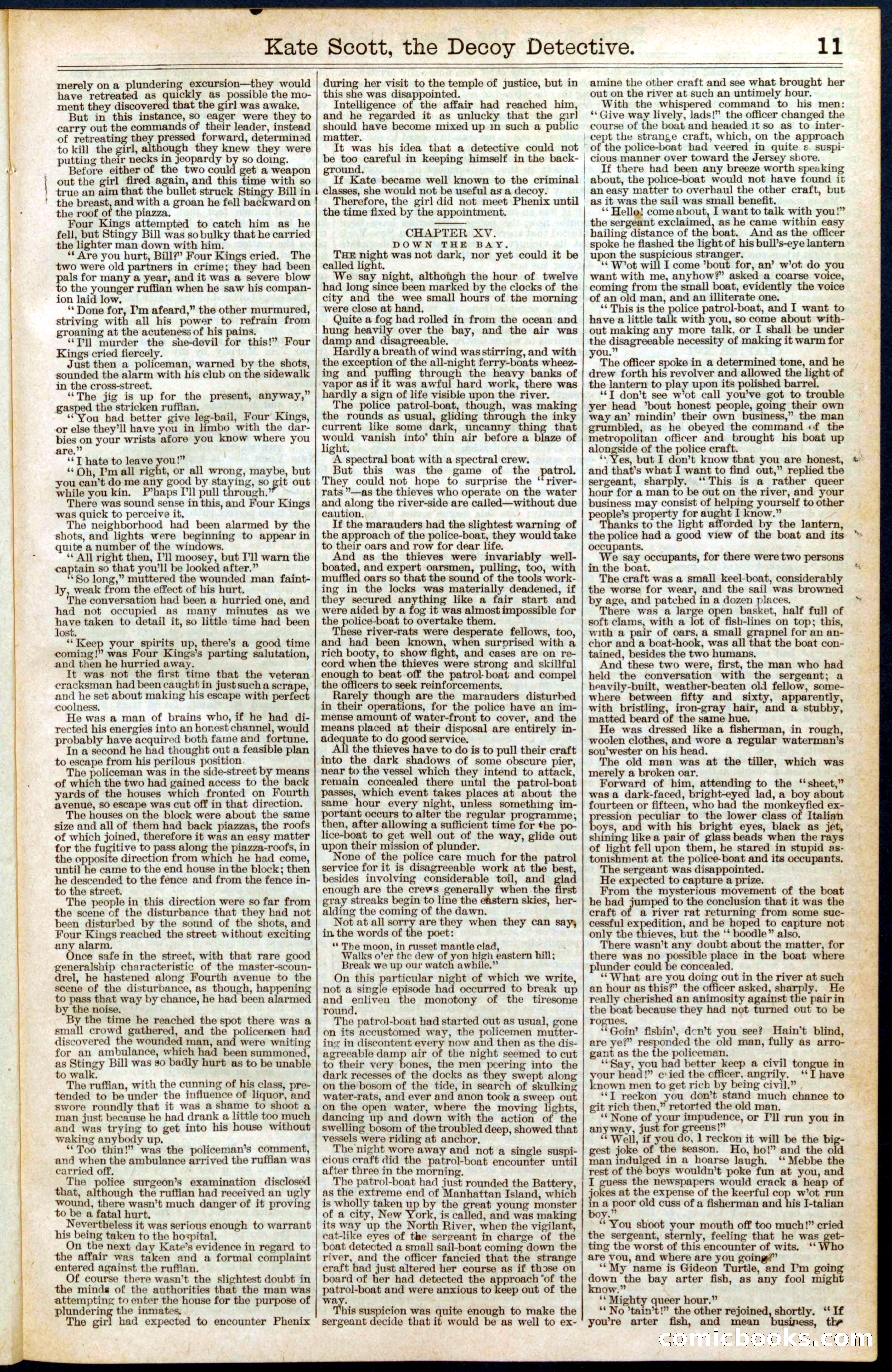
A restored page from Pulp Fiction, 1886. Page through the whole issue in the reader above.
📄 Transcribed text from this page (OCR, searchable)
Machine-transcribed from the original scan — historical spelling and the odd misread are preserved.
i ¥, © te -— —— ’ aes Kate Scott, the Decoy Detective. 11 merely on a plundering excursion—they would have retreated as quickly as possible the mo- ment they discovered that the girl was awake. But in this instance, so eager were they to carry out the commands of their leader, instead of retreating they pressed forward, determined to kill the girl, although they knew they were putting their necks in Jeopardy by so doing. Before either of the two could get a weapon out the girl fired again, and this time with so true an aim that the bullet struck Stingy Bill in the breast, and with a groan he fell backward on the roof of the piazza. Four Kings attempted to catch him as he fell, but Stingy Bill was so bulky that he carried the lighter man down with him. ** Are you hurt, Bill?’ Four Kings cried. The two were old partners in crime; they had been pals for many a year, and it was a severe blow to the younger ruffian when he saw his compan- ion laid low. ‘* Done for, I’m afeard,” the other murmured, striving with all his power to refrain from groaning at the acuteness of his pains. ‘‘T’]] murder the she-devil for this!” Four Kings cried fiercely. Just then a policeman, warned by the shots, sounded the alarm with his club on the sidewalk in the cross-street. “The jig is up for the present, anyway,” gasped the stricken ruffian. ‘You had better give leg-bail, Four Kings, or else they'll have you in limbo with the dar- bies on your wrists afore you know where you are.” ‘‘T hate to leave you!” “Oh, I’m all right, or all wrong, maybe, but you can’t do me any good by staying; so git out while you kin. P’haps Ill pull through.’ There was sound sense in this, and Four Kings was quick to perceive it. The neighborhood had been alarmed by the shots, and lights were beginning to appear in quite a number of the windows. ‘* All right then, V’'ll moosey, but I'll warn the captain so that you'll be looked after.” ‘*So long,” muttered the wounded man faint- ly, weak from the effect of his hurt. The conversation had beer. a hurried one, and had not occupied as many minutes as we aa taken to detail it, so little time had been ost. ‘Keep your spirits UP, there’s a good time coming!” was Four Kings’s parting salutation, and then he hurried away. It was not the first time that the veteran cracksman had been caught in just such a scrape and he set about making his escape with perfect coolness. He was a man of brains who, if he had di- rected his energies into an honest channel, would probably have acquired both fame and fortune. In a second he had thought out a feasible plan to escape from his perilous position. The policeman was in the side-street by means of which the two had gained access to the back yards of the houses which fronted on Fourth avenue, so escape was cut off in that direction. The houses on the block were about the same size and all of them had back piazzas, the roofs of which joined, therefore it was an easy matter for the fugitive to pass along the piazza-roofs, in the opposite direction from which he had come, until he came to the end house in the block; then he descended to the fence and from the fence in- to the street. The people in this direction were so far from the scene of the disturbance that they had not been disturbed by the sound of the shots, and Four Kings reached the street without exciting any alarm. nce safein the street, with that rare good generalship characteristic of the master-scoun- drel, he hastened along Fourth avenue to the scene of the disturbance, as though, happening to pass that way by chance, he had been alarmed by the noise. By the time he reached the spot there was a small crowd gathered, and the policemen had discovered the wounded man, and were waiting for an ambulance, which had been summoned, as Stingy Bill was so badly hurt as to be unable to walk. ; The ruffian, with the cunning of his class, pre- tended to be under the influence of liquor, and swore roundly that it was ashame to shoot a man just because he had drank a little too much and was trying to get into his house without waking anybody up. **Too thin!” was the policeman’s comment, and when the ambulance arrived the ruffian was carried off. The police surgeon’s examination disclosed that, although the ruffian had received an ugly wound, there wasn’t much danger of it proving to be a fatal hurt, Nevertheless it was serious enough to warrant his being taken to the hospital. On the next day Kate’s evidence in regard to the affair was taken and a formal complaint entered against the ruffian. Of course there wasn’t the slightest doubt in the minds of the authorities that the man was attempting to enter the house for the purpose of plundering the inmates. The gir] had expected to encounter Phenix Ltt 'MH/ii CU CCCUCCw§ELEE-i.—..«<<<.<—<.«<..{—._.....— SL during her visit to the temple of justice, but in this she was disappointed. Intelligence of the affair had reached him, and he regarded it as unlucky that the girl should have become mixed up in such a public matter. It was his idea that a detective could not be too careful in keeping himself in the back- | ground, amine the other craft and see what brought her out on the river at such an untimely bour. With the whispered command to his men: ** Give way lively, lads!” the officer changed the course of the boat and headed it so as to inter- | cept the strange craft, which, on the approach | of the police-boat had veered in quite « suspi- cious manner over toward the Jersey shore. If there had been any breeze worth speaking If Kate became well known to the criminal about, the police-boat would not have tound it classes, she would not be useful as a decoy. Therefore, the girl did not meet Phenix until the time fixed by the appointment. CHAPTER XV. DOWN THE BAY. THE “7g was not dark, nor yet could it be called light. We say night, althotgh the hour of twelve had long since been marked by the clocks of the city and the wee small hours of the morning were close at hand. Quite a fog had rolled in from the ocean and hung heavily over the bay, and the air was damp and disagreeable. Hardly a breath of wind wasstirring, and with the exception of the all-night ferry-boats wheez- ing and rage through the heavy banks of vapor as if it was awful hard work, there was hardly a sign of life visible upon the river. The police patrol-boat, though, was making the rounds as usual gliding through the inky current like some dark, uncanny thing that Mba» vanish into’ thin air before a blaze of ight. A spectral boat with a spectral crew. But this was the game of the patrol. They could not hope to surprise the “ river- rats ’—as the thieves who operate on the water and along the river-side are called—without due caution. If the marauders had the slightest warning of the approach of the police-boat, they would take to their oars and row for dear life. And as the thieves were invariably well- boated, and expert oarsmen, pulling, too, with muffled oars so that the sound of the tools work- ing in the locks was materially deadened, if they secured anything like a fair start and were aided by a fog it was almost impossible for the police-boat to overtake them. These river-rats were desperate fellows, too, and had been known, when surprised with a rich booty, to show fight, and cases are on re- cord when the thieves were strong and skillful enough to beat off the patrol-boat and compel the officers to seek reinforcements. _ Rarely though are the marauders disturbed in their operations, for the police have an im- mense amount of water-front to cover, and the means placed at their disposal are entirely in- adequate to do good service. the thieves have to do is to pull their craft into the dark shadows of some obscure pier, near to the vessel which they intend to attack, remain concealed there until the patrol-boat passes, which event takes places at about the same hour every night, unless something im- Seago occurs to alter the regular programme, hen, after allowing a sufficient time for the po- lice-boat to get well out of the way, glide out upon their mission of plunder. None of the police care much for the patrol service for it is disagreeable work at the best besides involving considerable toil, and glad enough are the crevs generally when the first gray streaks begin to line the chstern skies, her- alding the coming of the dawn. Not at all sorry are they when they can say, in the words of the poet: ** The moon, in russet mantle clad, Walks o’er the dew of yon high eastern hill; Break we up our watch awhile.” On this particular night of which we write, not a single episode had occurred to break up and enliven the monotony of the tiresome round, The patrol-boat bad started out as usual, gone on its accustomed way, the policemen mutter- ine in discontent every now and then as the dis- agreeable damp air of the night seemed to cut to their very bones, the men ring into the dark recesses of the docks as they swept along on the bosom of the tide, in search of skulking water-rats, and ever and anon took a sweep out on the open water, where the moving lights, dancing up and down with the action of the swelling bosom of the troubled deep, showed that vessels were riding at anchor. The night wore away and not a single suspi- cious craft did the patrol-boat encounter until after three in the morning. The patrol-boat had just rounded the Battery, as the extreme end of Manhattan Island, which is wholly taken up by the t young monster of a city, New York, is called, and was making its way up the North River, when the vigilant, cat-like eyes of the sergeant in charge of the boat detected a small sail-boat coming down the river, and the officer fancied that the strange craft had just altered her course as if those on board of her had detected the approach ‘of the patrol-boat and were anxious to keep out of the way. his suspicion was quite enough to make the sergeant decide that it would be as well to ex- ; an easy matter to overhaul the other craft, but as it was the sail was small benefit. ‘‘ Hello! come about, I want to talk with you!” the sergeant exclaimed, as he came witbin easy hailing distance of the boat. And as the officer spoke he flashed the light of his bull’s-eye lantern upon the suspicious stranger. ‘* Wot will I come ’bout for, an’ w’ot do you want with me, anyhow?” asked a coarse voice, coming from the small boat, evidently the voice of an old man, and an illiterate one. ‘‘ This is the police patrol-boat, and I want to have a little talc with you, so come about with- out making any more talk, or I shall be under the disagreeable necessity of making it warm for ou.” The officer spoke in a determined tone, and he drew forth his revolver and allowed the light of the lantern to play upon its polished barr “‘T don’t see w’ot call you’ve got to trouble yer head "bout honest people, going their own way an’ mindin’ their own business,” the man grumbled, as he obeyed the command «f the metropolitan officer and brought his boat up a of the police craft. ‘Yes, but I don’t know that you are honest, and that’s what I want to find out,” replied the sergeant, sharply. ‘‘ This is a rather queer hour for a man to be out on the river, and your business may consist of helping yourself to other people’s property for aught I know.” Thanks to the light afforded by the lantern, the police had a good view of the boat and its occupants. We say occupants, for there were two persons in the boat. The craft was a small keel-boat, considerably the worse for wear, and the sail was browned by age, and patched in a dozen places. There was a large open basket, half full of soft clams, with a lot of fish-lines on top; this, with a pair of oars, a small grapnel for an an- chor and a boat-hook, was all that the boat con- tained, besides the two humans. And these two were, first, the man who had held the conversation with the sergeant; a heavily-built, weather-beaten old fellow, some- where between fifty and sixty, apparently, with bristling, iron-gray hair, and a stubby, matted beard of the same hue, He was dressed like a fisherman, in rough, woolen clothes, and wore a regular waterman’s sou’wester on his head. The old man was at the tiller, which was merely a broken oar. Forward of him, attending to the “sheet,” was a dark-faced, bright-eyed lad, a boy about fourteen or fifteen, who had the monkeyfied ex- ression peculiar to the lower class of Ital oys, and with his bright eyes, black as jet, shining like a pair of glass beads when the rays of light fell upon them, he stared in stupid as- tonishment at the police-boat and its occupants, The sergeant was disappointed. He expected to capture a prize. From the mysterious movement of the boat he bad jumped to the conclusion that it was the craft of a river rat returning from some suc- cessful yo cena and he hoped to capture not only the thieves, but the ‘‘ boodle” also. There wasn’t any doubt about the matter, for there was no ee place in the boat where plunder could be concealed. ‘““What are you doing out in the river atsuch an hour as this?” the officer asked, sharply. He really cherished an animosity against the pairin — the boat because they had not turned out to be rogues. ‘Goin’ fishin’, den’t you see? Hain't blind, are ye?” responded the old man, fully as arro- gant as the the policeman. aft ‘Say, Fey had better keep a civil tongue in your head!” c: ied the officer, angrily. * mown men to get rich by being civil.” . ‘*T reckon you don’t stand much chance to git rich then,” retorted the old man. ‘None of your impudence, or Pll run you in anyway, just for greens!” “ Well, if you do, 1 reckon it will be the big- gest joke of the season. Ho, ho!” and the old man indulged in a hoarse laugh. ‘' Mebbe the rest of the boys wouldn’t poke fun at you, and I guess the newspapers would crack a heap of jokes at the expense of the keerful cop w’ot run ina poor old cuss of a fisherman and his I-talian Vy. “You shoot your mouth off too much!” cried the sergeant, sternly, feeling that he was get- ting the worst of this encounter of wits. “ Oo are vou, and where are you going?” ‘“My name is Gideon Turtle, and I’m going down the bay arter fish, as any fool might know.” ‘* Mighty queer hour.” ‘* No ’tain’t!” the other rejoined, shortly. ‘‘ If you’re arter fish, and mean business, (Ele) Eomicbooks have — t bes