
Pulp Fiction, 1886 · page 6 of 32
Beadle's New York Dime Library, No. 390 — page 6: what you’re looking at
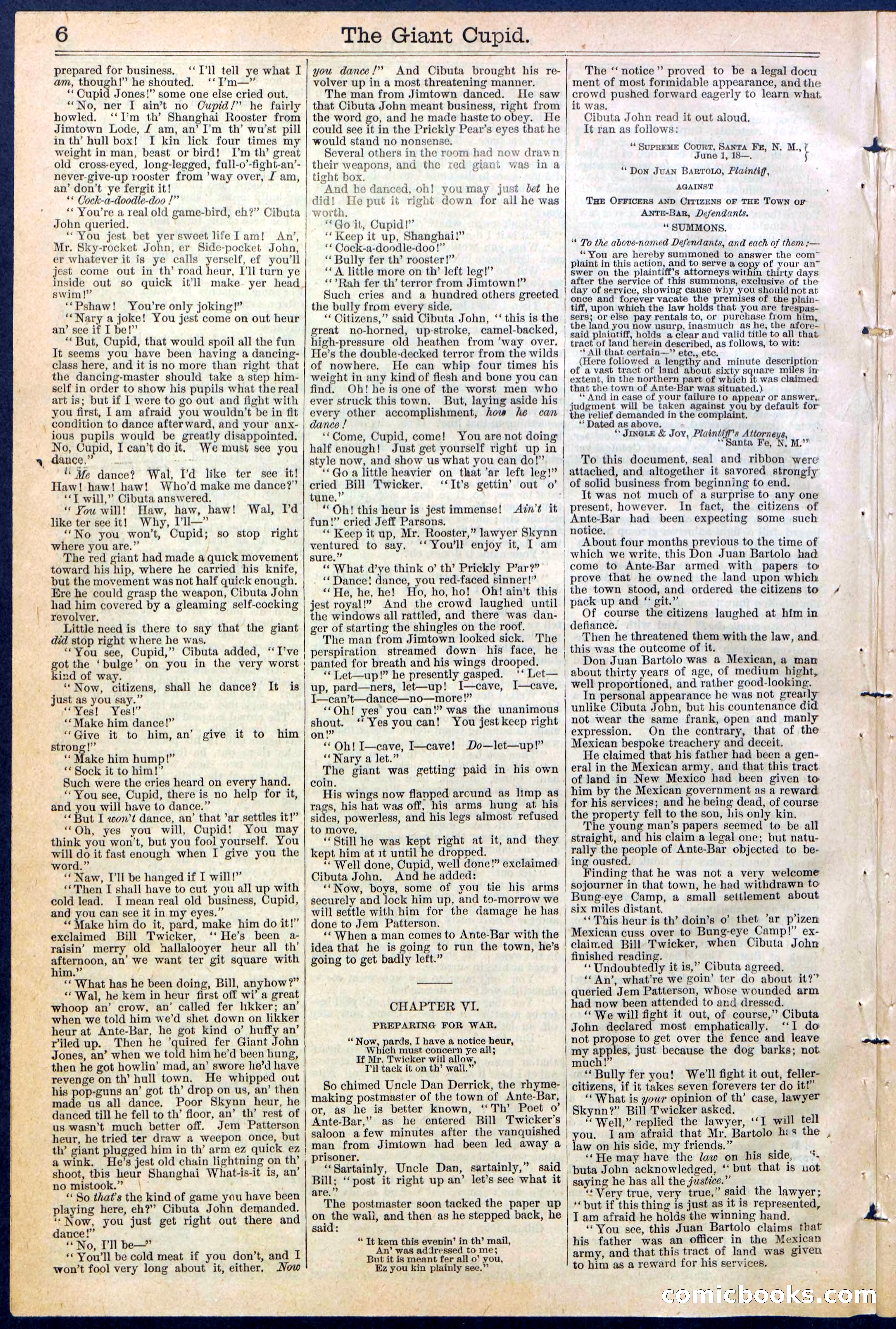
A restored page from Pulp Fiction, 1886. Page through the whole issue in the reader above.
📄 Transcribed text from this page (OCR, searchable)
Machine-transcribed from the original scan — historical spelling and the odd misread are preserved.
prepared for business. ‘‘ Ill tell ye what I am, though!” he shouted. ‘* l’m—” **Oupid Jones!” some one else cried out. “No, ner I ain’t no Cupid!” he fairly howled. ‘‘l’m th’ Shanghai Rooster from Jimtown Lode, J am, an’ I’m th’ wu’st pill in th’ hull box! I kin lick four times my weight in man, beast or bird! I’m th’ great old cross-eyed, long-legged, full-o’-fight-an’- never-give-up rooster from ’way over, J am, an’ don’t ye fergit it! ** Oock-a-doodle-doo !” ‘** You’re a real old game-bird, eh?” Cibuta John queried. “You jest bet yer sweet lifeIam! An’, Mr. Sky-rocket John, er Side-pocket John, er whatever it is ye calls yerself, ef you'll jest_ come out in th’ road heur, I'll turn ye inside out so quick itll make. yer head swim!” ‘‘Pshaw! You’re only joking!” *Nary a joke! You jest come on out heur an’ see if I be!” ** But, Cupid, that would spoil all the fun It seems you have been having a dancing- class here, and it is no more than right that the dancing-master should take a step him- self in order to show his pupils what the real art is; but if | were to go out and fight with you first, lam afraid you wouldn’t be in fit \ condition to dance afterward, and your anx- ious pupils would be greatly disappointed. No, Cupid, I can’t do it, We must see you dance,” " Ye dance? Wal, I'd like ter see it! Haw! haw! haw! Who'd make me dance?” ‘«T will,” Cibuta answered. ** You will! Haw, haw, haw! Wal, Id like ter see it! Why, Pil—” ‘‘No you won't, Cupid; so stop right where you are.” The red giant had made a quick movement toward his hip, where he carried his knife, but the movement was not half quick enough. Ere he could grasp the weapon, Cibuta John had him covered by a gleaming self-cocking revolver. Little need is there to say that the giant did stop right where he was. ‘You see, Cupid,” Cibuta added, “I’ve ot the ‘bulge’ on you in the very worst ind of way. “Now, citizens, shall he dance? It is just as you say.” ‘““Yes! Yes!” ‘‘Make him dance!” ‘‘Give it to him, an’ give it to him strong!” “Make him hump!” ** Sock it to him!” Such were the cries heard on every hand, ‘You see, Cupid, there is no help for it, and you will have to dance.” ‘But I 2on’t dance, an’ that ’ar settles it!” “Oh, yes you will, Cupid! You may think you won't, but you fool yourself. You will do it fast enough when I give you the word.” ‘Naw, I'll be hanged if I will!” ‘Then I shall have to cut you all up with cold lead. I mean real old business, Cupid, and you can see it in my eyes.” ‘Make him do it, pard, make him do it!” exclaimed Bill Twicker, ‘* He’s been a- raisin’ merry old hallalooyer heur all th’ afternoon, an’ we want ter git square with b » / im. ‘‘ What has he been doing, Bill, anyhow?” ‘‘ Wal, he kem in heur first off wi’ a great whoop an’ crow, an’ called fer likker; an’ when we told him we’d shet down on likker heur at Ante-Bar, he got kind o’ huffy an’ riled up. Then he SS arb fer Giant John Jones, an’ when we told him he’d been hung, then he got howlin’ mad, an’ swore he’d have revenge on th’ hull town. He whipped out his pop-guns an’ got th’ drop on us, an’ then e us all dance. Poor Skynn heur, he danced till he fell to th’ floor, an’ th’ rest of us wasn’t much better off. Jem Patterson _ heur, he tried ter draw a weepon once, but th’ giant plugged him in th’ arm ez quick ez a wink. He’s jest old chain lightning on th’ shoot, this heur Shanghai What-is-it is, an’ no mistook.” | * So that’s the kind of game you have been playing here, eh?” Cibuta John demanded. ; No , you just get right out there and dance!” ‘*No, I'll be—” ‘You'll be cold meat if you don’t, and I won’t fool very long about it, either, Now ————————EE— aE aE Se Tae, SALT TAA ee pce cng sce, CT you dance!” And Cibuta brought his re- volver up in a most threatening manner. The man from Jimtown danced. [He saw that Cibuta John meant business, right from the word go, and he made haste to obey. He could see it in the Prickly Pear’s eyes that he would stand no nonsense. Several others in the room had now drawn their weapons, and the red giant was in a tight box. And he danced, oh! you may just bet he did! He put it right down for all he was worth. “Go it, Cupid!” ‘* Keep it up, Shanghai!” ‘* Cock-a-doodle-doo!” “Bully fer th’ rooster!” ‘**A little more on th’ left leg!” ‘*’Rah fer th’ terror from Jimtown!” Such cries and a hundred others greeted the bully from every side. ‘** Citizens,” said Cibuta John, ‘‘ this is the great no-horned, upstroke, camel-backed, high-pressure old heathen from ’way over. He’s the double-decked terror from the wilds of nowhere. He can whip four times his weight in any kind of flesh and bone you can find. Oh! he is one of the worst men who ever struck this town. But, laying aside his every other accomplishment, how he can dance | ‘‘Come, Cupid, come! You are not doing half enough! Just get yourself right up in style now, and show us what you can do!” ‘Go a little heavier on that ‘ar left leg!” cried Bill Twicker, ‘‘It’s gettin’ out 0’ tune.” ‘Oh! this heur is jest immense! Adn’t it fun!” cried Jeff Parsons. ‘“ Keep it up, Mr. Rooster,” lawyer Skynn ventured to say. ‘‘ You'll enjoy it, 1 am sure.” ‘‘ What d’ye think o’ th’ Prickly P’ar?” ‘Dance! dance, you red-faced sinner!” ‘‘He, he, he! Ho, ho, ho! Oh! ain’t this jest royal!” And the crowd laughed until the windows all rattled, and there was dan- ger of starting the shingles on the roof. The man from Jimtown looked sick. The perspiration streamed down his face, he panted for breath and his wings drooped. ‘“Let—up!” he presently gasped. ** Let— up, pard—ners, let-—up! I—cave, I—cave. I—can’t—dance—no—more!” ‘‘Oh! yes you can!” was the unanimous shout. ‘‘ Yes youcan! You jest keep right on!” ‘‘ Oh! I—cave, I—cave! ‘‘Nary a let.” The giant was getting paid in his own coin. His wings now flavped around as limp as rags, his hat was off, his arms hung at his sides, powerless, and his legs almost refused to move. ‘Still he was kept right at it, and they kept him at it until he dropped. ‘Well done, Cupid, well done!” exclaimed Cibuta John. And he added: Do—\et—up!” ‘‘Now, boys, some of you tie his arms securely and lock him up, and to-morrow we will settle with him for the damage he has done to Jem Patterson. ‘When a man comes to Ante-Bar with the idea that he is going to run the town, he’s | Cla finished reading. going to get badly left.” CHAPTER VI. PREPARING FOR WAR, ‘* Now, pards, I have a notice heur, Which must concern ye all; If Mr. Twicker will allow, I'll tack it on th’ wall.” So chimed Uncle Dan Derrick, the rhyme- making postmaster of the town of Ante-Bar, or, as he is better known, ‘“‘Th’ Poet o’ Ante-Bar,” as he entered Bill Twicker’s saloon afew minutes after the vanquished man from Jimtown had been led away a _ prisoner. “Sartainly, Uncle Dan, sartainly,” said Bill; ‘‘post it right up an’ let’s see what it are.” The postmaster soon tacked the paper up on on wall, and then as he stepped back, he said: “ It kem this evenin’ in th’ mail, An’ was addressed to me; But it is meant fer all o’ you, Ez you kin plainly see.” | | The ‘‘ notice” proved to be a legal docu ment of most formidable appearance, and the crowd pushed forward eagerly to learn what. it was. tibuta John read it out aloud. It ran as follows: “Supreme Court, SAnTa Fr, N. M.,? June 1, 18—. “Don Juan Barrow, Plaintiff, AGAINST Tue OFFICERS AND CITIZENS OF THE TOWN or AnTE-Bar, Defendants. ‘* SUMMONS. ‘* To the above-named Defendants, and each of them :— * You are hereby summoned to answer the com” plaint in this action, and to serve a co ay of your an™ swer on the plaintiff’s attorneys within thirty days after the service of this summons, exclusive of the day of service, showing cause why hei? should not at once and forever vacate the premises of the plain- tiff, upon which the law holds that you are trespas- sers; or else pay rentals to, or purchase from him, the land you now usurp, inasmuch as he, the afore- said plaintiff, holds a clear and valid title to all that tract of land herein described, as follows, to wit: * All that certain—” etc., etc. (Here followed a lengthy and minute description of a vast tract of land about sixty square miles in extent, in the northern part of which it was claimed that the town of Ante-Bar was situated.) ‘** And in case of your failure to appear or answer, judgment will be taken against you by default for he relief demanded in the complaint, ‘* Dated as above. ** JINGLE & Joy, Plaintiff’s Attorneys, ‘*Santa Fe, N M.”’ To this document, seal and ribbon were attached, and altogether it savored strongly of solid business from beginning to end. It was not much of a surprise to any one present, however. In fact, the citizens of Ante-Bar had been expecting some such notice. About four months previous to the time of which we write, this Don Juan Bartolo had come to Ante-Bar armed with papers to prove that he owned the land upon which the town stood, and ordered the citizens to pack up and “ git.” Of course the citizens laughed at him in defiance. Then he threatened them with the law, and this was the outcome of it, Don Juan Bartolo was a Mexican, a man about thirty years of age, of medium hight, well proportioned, and rather good-looking. In personal appearance he was not greatly unlike Cibuta Fohu, but his countenance did not wear the same frank, open and manly expression. On the contrary, that of the Mexican bespoke treachery and deceit. He claimed that his father had been a gen- eral in the Mexican army, and that this tract | of land in New Mexico had been given to ee eT ent enon straight, an him by the Mexican government as a reward for his services; and he being dead, of course the property fell to the son, his only kin. The young man’s papers seemed to be all his claim a legal one; but natu- rally the people of Ante-Bar objected to be- ys Pee inding that he was not a very welcome sojourner in that town, he had withdrawn to Bung-eye Camp, a small settlement about six miles distant, : ‘This heur is th’ doin’s o’ thet ’ar p’izen Mexican cuss over to Bung-eye Camp!” ex- claimed Bill Twicker, when Cibuta John ‘‘Undoubtedly it is,” Cibuta agreed. ‘‘ An’, what’re we goin’ ter do about it?” queried Jem Patterson, whose wounded arm had now been attended to and dressed. “We will fight it out, of course,” Cibuta John declared most emphatically. ‘‘I do not propose to get over the fence and leave my apples, just because the dog barks; not. much!” ‘Bully fer you! We'll fight it out, feller- citizens, if it takes seven forevers ter do it!” ‘‘ What is your opinion of th’ case, lawyeT Skynn?” Bill Twicker asked. “Well,” replied the lawyer, ‘‘I will tell ou. lam afraid that Mr. Bartolo his the tae on his side, my friends,” / ; ‘‘He may have the law on his side, *- buta Jobn acknowledged, ‘‘ but that is uot saying he has all the justice.” ‘“‘Very true, very true,” said the lawyer; ‘‘but if this thing is just as 1t 1s represented, T am afraid he holds the winning hand. ‘You see, this Juan Bartolo claims that his father was an officer in the Mexican army, and that this tract of land was given to him as a reward for his services. ecoim aT o— +. e — ; f Gbhoo Ks;com | & '? | \ = ~ ee td