
Pulp Fiction, 1886 · page 28 of 32
Beadle's New York Dime Library, No. 390 — page 28: what you’re looking at
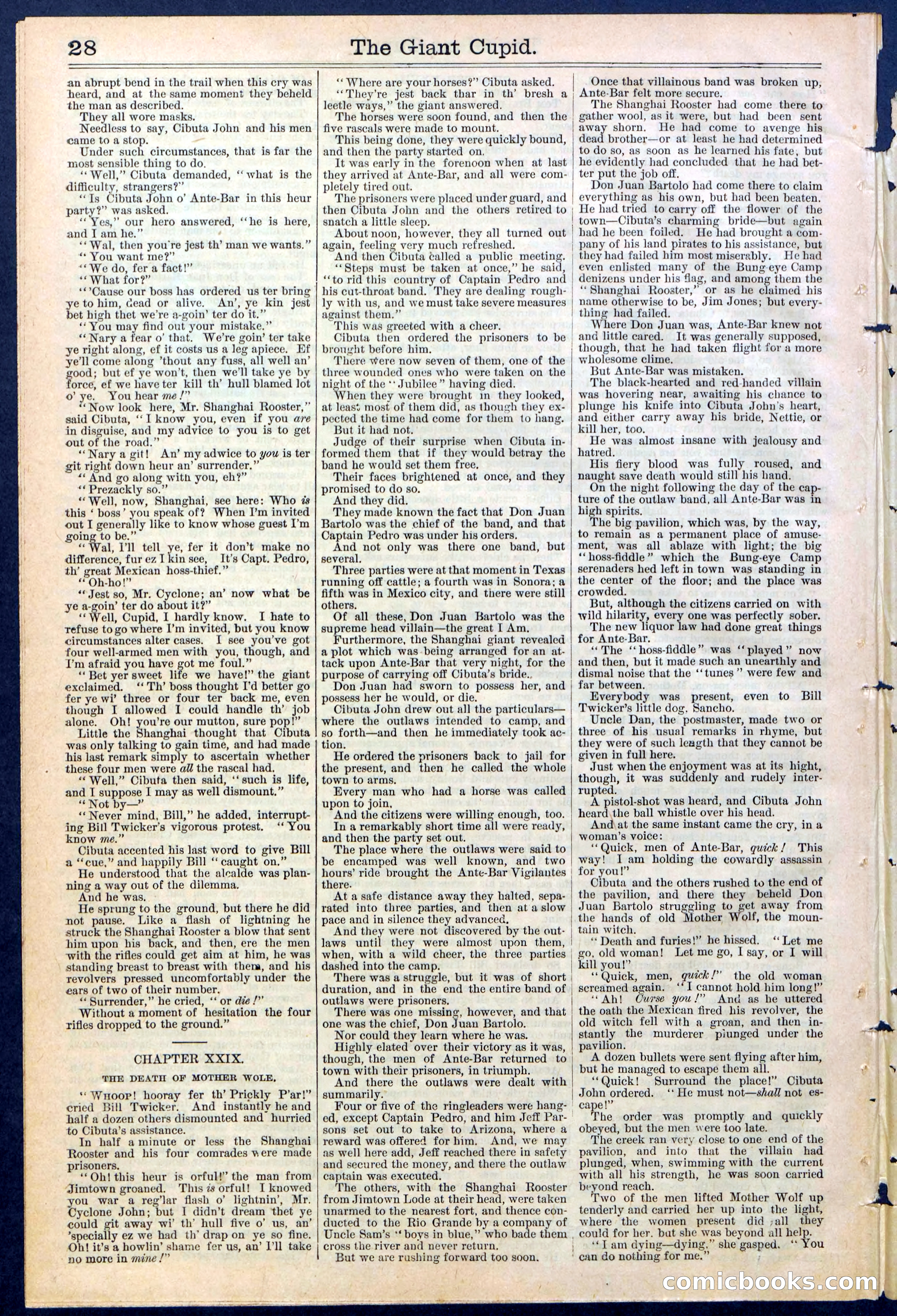
A restored page from Pulp Fiction, 1886. Page through the whole issue in the reader above.
📄 Transcribed text from this page (OCR, searchable)
Machine-transcribed from the original scan — historical spelling and the odd misread are preserved.
ee es OR — a a et —_ —a—e = -no more in mine /” 28 The Giant Cupid. an abrupt bend in the trail when this cry was heard, and at the same moment they beheld the man as described. They all wore masks. Needless to say, Cibuta John and his men came to a stop. Under such circumstances, that is far the most sensible thing to do, ‘‘Well,” Cibuta demanded, ‘‘ what is the difficulty, strangers?” ‘Is Cibuta John o’ Ante-Bar in this heur party?” was asked. ‘‘Yes,’’ our hero answered, ‘‘he is here, and I am he.” ‘Wal, then you're jest th’ man we wants.” * You want me?” ‘*We do, fer a fact!” ‘What for?” ‘**°Cause our boss has ordered us ter bring ye to him, cead or alive. An’, ye kin jest bet high thet we’re a-goin’ ter do it.” ‘You may find out your mistake.” **Nary a fear o’ that. We're goin’ ter take ye right along, ef it costs us a leg apiece. Ef ye'll come along ’thout any fuss, all well an’ rood; but ef ye won’t, then we'll take ye by force, ef we have ter kill th’ hull blamed lot ©’ ye. You hear me /” **Now look here, Mr. Shanghai Rooster,” said Cibuta, ‘‘I know you, even if you are in disguise, and my advice to you is to get out of the road.” ‘“Nary a git! An’ my adwice to you is ter git right down heur an’ surrender,” ** And go along with you, eh?” ‘* Prezackly so.”’ ‘* Well, now, Shanghai, see here: Who ¢ this ‘ boss’ you speak of? When I’m invited out I generally like to know whose guest I’m going to be.” «Wal, I'll tell ye, fer it don’t make no difference, fur ez I kin see, It’s Capt. Pedro, th’ great Mexican hoss-thief.” ** Oh-ho!” ** Jest so, Mr. Cyclone; an’ now what be ye a-goin’ ter do about it?” ‘* Well, Cupid, I hardly know. [I hate to refuse to go where I’m invited, but you know circumstances alter cases. I see you've got four well-armed men with you, though, and I’m afraid you have got me foul.” ‘Bet yer sweet life we have!” the giant exclaimed. ‘Th’ boss thought I'd better go fer ye wi’ three or four ter back me, even though I allowed I could handle th’ job alone. Oh! you’re our mutton, sure pop!” Little the Shanghai thought that Cibuta was only talking to gain time, and had made his last remark simply to ascertain whether these four men were all the rascal had. “Well,” Cibuta then said, ‘‘such is life, and I suppose I may as well dismount,” ‘* Not by—” ‘Never mind, Bill,” he added, interrupt- ing Bill Twicker’s vigorous protest. ‘‘ You know me.” Cibuta accented his last word to give Bill a ‘‘cue,” and happily Bill ‘‘ caught on.” He understood that the alealde was plan- ning a way out of the dilemma. And he was. He sprung to the ground, but there he did not pause. Like a flash of lightning he struck the Shanghai Rooster a blow that sent him upon his back, and then, ere the men with the rifles could get aim at him, he was standing breast to breast with thena, and his revolvers pressed uncomfortably under the ears of two of their number. “ Surrender,” he cried, ‘‘ or die /” Without a moment of hesitation the four rifles dropped to the ground.” CHAPTER XXIX. THE DEATH OF MOTHER WOLE, ‘Whoop! hooray fer th’ Prickly P’ar!” cried Bill Twicker. And instantly he and half a dozen others dismounted and hurried to Cibuta’s assistance. In half a minute or less the Shanghai Rooster and his four comrades were made risoners. ‘‘Oh! this heur is orful!” the man from Jimtown groaned. This és orful! I knowed you war a reg’lar flash o’ lightnin’, Mr. Cyclone John; but I didn’t dream thet ye could git away wi’ th’ hull five o’ us, an’ ’specially ez we had th’ drap on ye so fine. Oh! it’s a howlin’ shame fer us, an’ Vl take ee LLL en ‘* Where are your horses?” Cibuta asked. ‘““They’re jest back thar in th’ bresh a leetle ways,” the giant answered. The horses were soon found, and then the five rascals were made to mount. This being done, they were quickly bound, and then the party started on, It was early in the forenoon when at last they arrived at Ante-Bar, and all were com- pletely tired out. The prisoners were placed under guard, and then Cibuta John and the others retired to | snatch a little sleep. About noon, however, they all turned out again, feeling very much refreshed. And then Cibuta Galled a public meeting. ‘‘Steps must be taken at once,” he said, ‘to rid this country of Captain Pedro and his cut-throat band. They are dealing rough- ly with us, and we must take severe measures against them,”’ This was greeted with a cheer. Cibuta then ordered the prisoners to be brought before him. There were now seven of them, one of the three wounded ones who were taken on the night of the ** Jubilee” having died. When they were brought in they looked, at least most of them did, as though they ex- pected the time had come for them to hang. But it had not. Judge of their surprise when Cibuta in- formed them that if they would betray the band he would set them free, Their faces brightened at once, and they promised to do so. And they did. They made known the fact that Don Juan Bartolo was the chief of the band, and that Captain Pedro was under his orders. And not only was there one band, but several. Three parties were at that moment in Texas running off cattle; a fourth was in Sonora; a fifth was in Mexico city, and there were still others. Of all these, Don Juan Bartolo was the supreme head villain—the great I Am, Furthermore, the Shanghai giant revealed a plot which was being arranged for an at- tack upon Ante-Bar that very night, for the purpose of carrying off Cibuta’s bride.. Don Juan had sworn to possess her, and possess her be would, or die. Cibuta John drew out all the particulars— where the outlaws intended to camp, and so forth—and then he immediately took ac- tion. He ordered the prisoners back to jail for the present, and then he called the whole town to arms, Every man who had a horse was called upon to join, And the citizens were willing enough, too. In a remarkably short time all were ready, and then the party set out. The place where the outlaws were said to be encamped was well known, and two hours’ ride brought the Ante-Bar Vigilantes there. At a safe distance away they halted, sepa- rated into three parties, and then at a slow pace and in silence they advanced, And they were not discovered by the out- laws until they were almost upon them, when, with a wild cheer, the three parties dashed into the camp. There was a struggle, but it was of short duration, and in the end the entire band of outlaws were prisoners. There was one missing, however, and that one was the chief, Don Juan Bartolo. Nor could they learn where he was. Highly elated over their victory as it was, though, the men of Ante-Bar returned to town with their prisoners, in triumph. And there the outlaws were dealt with summarily. | they had failed him most miserably. Four or five of the ringleaders were hang- | ed, except Captain Pedro, and him Jeff Par-— sons set out to take to Arizona, where a reward was offered for him, And, we may as well here add, Jeff reached there in safety and secured the money, and there the outlaw captain was executed. The others, with the Shanghai Rooster from Jimtown Lode at their head, were taken unarmed to the nearest fort, and thence con- ducted to the Rio Grande by a company of Uncle Sam’s ‘f boys in blue,” who bade them , cross the river and never return, But we are rushing forward too soon. ; Once that villainous band was broken up, Ante-Bar felt more secure. The Shanghai Rooster had come there to gather wool, as it were, but had been sent away shorn. He had come to avenge his | dead brother—or at least he had determined to do so, as soon as he learned his fate, but he evidently had concluded that he had bet- ter put the job off. Don Juan Bartolo had come there to claim everything as his own, but had been beaten. He had tried to carry off the flower of the town—Cibuta’s charming bride—but again had he been foiled. He had brought a com. pany of his land pirates to his assistance, but He had even enlisted many of the Bung eye Camp denizens under his flag, and among them the ‘Shanghai Rooster,” or as he elaimed his name otherwise to be, Jim Jones; but every- thing had failed. Where Don Juan was, Ante-Bar knew not and little cared. It was generally supposed, though, that he had taken flight for a more wholesome clime. But Ante-Bar was mistaken. The black-hearted and red-handed villain was hovering near, awaiting his chance to plunge his knife into Cibuta John’s heart, and either carry away his bride, Nettie, or kill her, too. He was almost insane with jealousy and hatred. His fiery blood was fully roused, and naught save death would still his hand. On the night following the day of the cap- ture of the outlaw band, all Ante-Bar was in high spirits. The big pavilion, which was, by the way, to remain as a permanent place of amuse- ment, was all ablaze with light; the big ‘‘hoss-fiddle” which the Bung-eye Camp serenaders hed left in town was standing in the center of the floor; and the place was crowded. But, although the citizens carried on with wild hilarity, every one was perfectly sober. The new liquor law had done great things for Ante-Bar. “The ‘‘hoss-fiddle” was ‘‘ played” now and then, but it made such an unearthly and dismal noise that the ‘‘tunes’’ were few and far between. Everybody was present, even to Bill Twicker’s little dog, Sancho. Uncle Dan, the postmaster, made two or three of his usual remarks in rhyme, but they were of such leagth that they cannot be given in full here. Just when the enjoyment was at its hight, though, it was suddenly and rudely inter- rupted. A pistol-shot was heard, and Cibuta John heard.the ball whistle over his head. And at the same instant came the cry, ina woman’s voice: ‘‘Quick, men of Ante-Bar, quick! This way! for you!” Cibuta and the others rushed to the end of the pavilion, and there they beheld Don Juan Bartolo struggling to get away from the hands of old Mother Wolf, the moun- tain witch. ‘‘ Death and furies!” he hissed. ‘Let me | go, old woman! Let me go, I say, or I will kill you!” “Quick, men, quick!’ the old woman screamed again. ‘‘I cannot hold him long!” “Ah! Ourse you!” And as he uttered the oath the Mexican fired his revolver, the old witch fell with a groan, and then in- stantly the murderer piunged under the pavilion. A dozen bullets were sent flying after him, but he managed to escape them all. ‘Quick! Surround the place!” Cibuta John ordered. ‘' He must not—shall not es- he order was promptly and quickly obeyed, but the men were too late. The creek ran very close to one end of the pavilion, and into that the villain had plunged, when, swimming with the current with all his strength, he was soon carried beyond reach. Two of the men lifted Mother Wolf up tenderly and carried her up into the light, where the women present did ;all they could for her. bat she was beyond all help. “Tam dying—dying,” she gasped. ‘* You ‘can do nothing for me.’ is ; ‘ I am holding the cowardly assassin , Eomicboo Cc S: f a