
Pulp Fiction, 1886 · page 2 of 32
Beadle's New York Dime Library, No. 390 — page 2: what you’re looking at
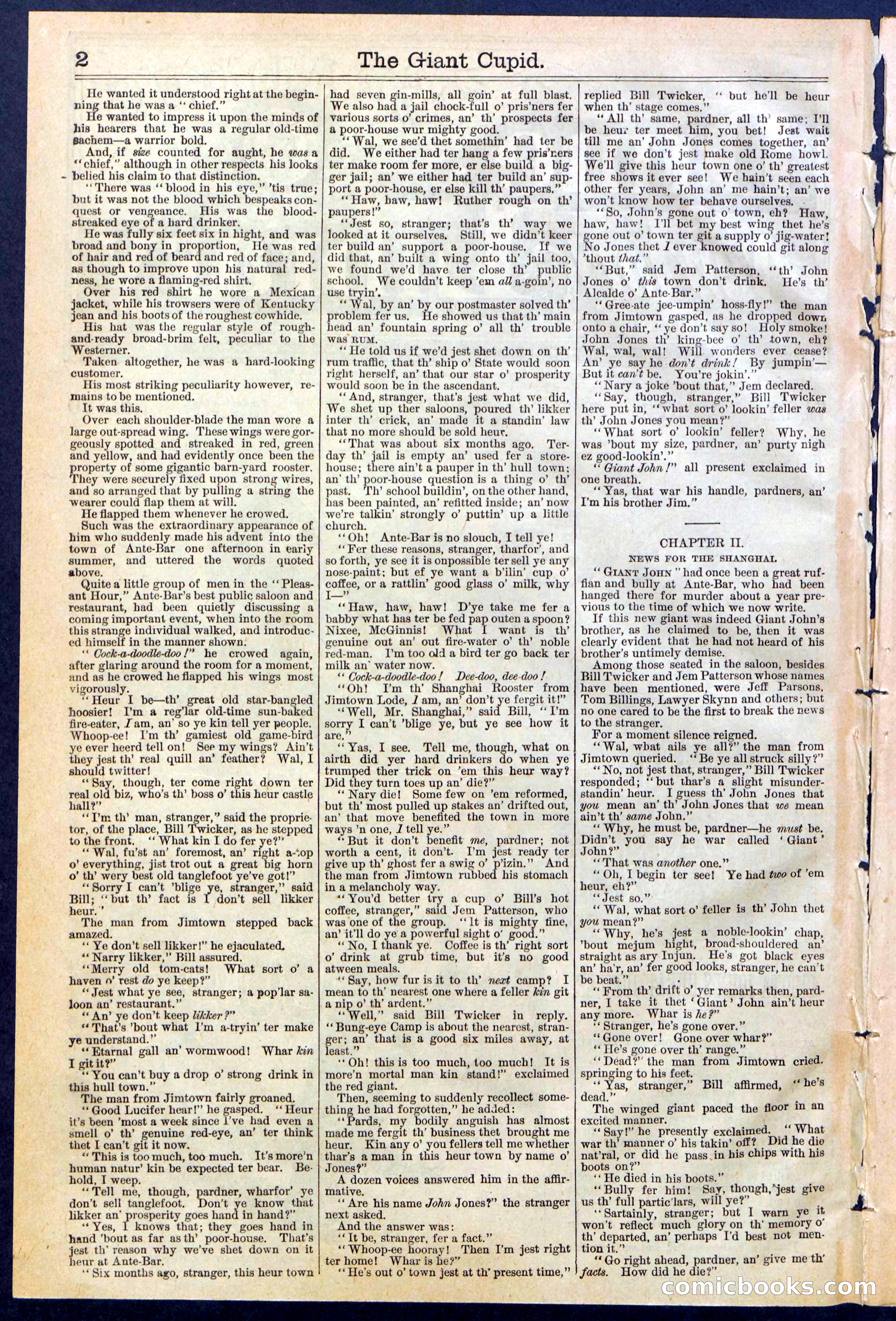
A restored page from Pulp Fiction, 1886. Page through the whole issue in the reader above.
📄 Transcribed text from this page (OCR, searchable)
Machine-transcribed from the original scan — historical spelling and the odd misread are preserved.
2 He wanted it understood right at the begin- ming that he was a ‘‘ chief.” He wanted to impress it upon the minds of his hearers that he was a regular old-time gsachem—a warrior bold. And, if size counted for aught, he was a *‘chief,” although in other respects his looks belied his claim to that distinction. ‘“There was ‘‘ blood in his eye,” ’tis true; but it was not the blood which bespeaks con- quest or vengeance. His was the blood- streaked eye of a hard drinker. He was fully six feet six in hight, and was broad and bony in proportion, He was red of hair and red of beard and red of face; and, as though to improve upon his natural red- ness, he wore a flaming-red shirt. Over his red shirt he wore a Mexican jacket, while his trowsers were of Kentucky jean and his boots of the roughest cowhide. His hat was the regular style of rough- and-ready broad-brim felt, peculiar to the Westerner. Taken altogether, he was a hard-looking customer. His most striking peculiarity however, re- mains to be mentioned. It was this. Over each shoulder-blade the man wore a large out-spread wing. These wings were gor- geously spotted and streaked in red, green and yellow, and had evidently once been the property of some gigantic barn-yard rooster, ‘They were securely fixed upon strong wires, and so arranged that by pulling a string the wearer could flap them at will. He flapped them whenever he crowed. Such was the extraordinary appearance of him who suddenly made his advent into the town of Ante-Bar one afternoon in early summer, and uttered the words quoted above. Quite a little group of men in the ‘‘ Pleas- ant Hour,” Ante-Bar’s best public saloon and restaurant, had been quietly discussing a coming important event, when into the room this strange individual walked, and introduc- ed himself in the manner shown. ‘* Cock-a-doodle-doo !” he crowed again, after glaring around the room for a moment, and as he crowed he flapped his wings most vigorously. ‘*Heur I be—th’ great old star-bangled hoosier! I’m a reg’lar old-time sun-baked fire-eater, Jam, an’ so ye kin tell yer people. Whoop-ee! I’m th’ gamiest old game-bird ye ever heerd tell on! See my wings? Ain’t they jest th’ real quill an’ feather? Wal, I should twitter! “Say, though, ter come right down ter real old biz, who’s th’ boss o’ this heur castle hall?” ‘‘T’m th’ man, stranger,” said the proprie- tor, of the place, Bill Twicker, as he stepped to the front. ‘‘ What kin I do fer ye?” “Wal, fu’st an’ foremost, an’ right a-‘op o’ everything, jist trot out a great big horn o’ th’ wery best old tanglefoot ye’ve got!” “Sorry I can’t "blige ye, stranger,” said Bill; ‘‘ but th’ fact is r don’t sell likker heur.’ | The man from Jimtown stepped back amazed, ‘** Ye don’t sell likker!” he ejaculated. ‘* Narry likker,” Bill assured. ‘‘Merry old tom-cats! What sort o’ a haven ’ rest do ye keep?” ‘* Jest what ye see, stranger; a pop’lar sa- loon an’ restaurant.” ** An’ ye don’t keep likker ?” ‘*That’s bout what I’m a-tryin’ ter make ye understand.”’ . **Etarnal gall an’ wormwood! Whar kin I git it?” ‘**You can’t buy a drop o’ strong drink in this hull town.” The man from Jimtown fairly groaned. **Good Lucifer hear!” he gasped. ‘‘ Heur it’s been ’most a week since |’ve had even a smell o’ th’ genuine red-eye, an’ ter think thet I can’t git it now. “‘This is toomuch, too much. It’s more’n human natur’ kin be expected ter bear. Be. hold, I weep. ‘*Tell me, though, pardner, wharfor’ ye don’t sell tanglefoot. Don't e know that likker an’ pe goes hand in hand?” ** Yes, 1 knows that; they goes hand in hand bout as far as th’ poor-house. That's jest th’ reason why we’ve shet down on it eur at Ante-Bar. ‘* Six months ago, stranger, this heur town ter home! The Giant Cupid. had seven gin-mills, all goin’ at full blast. We also had a jail chock-full o’ pris’ners fer various sorts 0’ crimes, an’ th’ prospects fer a poor-house wur mighty good. ‘Wal, we see’d thet somethin’ had ter be did. We either had ter hang a few pris’ners ter make room fer more, er else build a big- ger jail; an’ we either had ter build an’ sup- port a poor-house, er else kill th’ paupers,” ‘‘Haw, baw, haw! Ruther rough on th’ paupers!” *‘Jest so, stranger; that’s th’ way we looked at it ourselves, Still, we didn’t keer ter build an’ support a poor-house, If we did that, an’ built a wing onto th’ jail too, we found we'd have ter close th’ public school. We couldn’t keep ’em ail a-goin’, no use tryin’. ** Wal, by an’ by our postmaster solved th’ problem fer us. He showed us that th’ main head an’ fountain spring o’ all th’ trouble was RUM, ** He told us if we’d jest shet down on th’ rum traffic, that th’ ship o’ State would soon right herself, an’ that our star o’ prosperity would soon be in the ascendant. ‘*‘ And, stranger, that’s jest what we did, We shet up ther saloons, poured th’ likker inter th’ crick, an’ made it a standin’ law that no more should be sold heur, ““That was about six months ago, Ter- day th’ jail is empty an’ used fer a store- house; there ain’t a pauper in th’ hull town; an’ th’ poor-house question is a thing o’ th’ past. Th’ school buildin’, on the other hand, has been painted, an’ refitted inside; an’ now we're talkin’ strongly o’ puttin’ up a little church, ‘*Oh! Ante-Bar is no slouch, I tell ye! **Fer these reasons, stranger, tharfor’, and so forth, ye see it is onpossible ter sell ye any nose-paint; but ef ye want a Db’ilin’ cup o’ cone: or a rattlin’ good glass o’ milk, why ‘‘Haw, haw, haw! D’ye take me fer a babby what has ter be fed pap outen a spoon? Nixee, McGinnis! What [I want is_ th’ genuine out an’ out fire-water o’ th’ noble red-man. I’m too old a bird ter go back ter milk an’ water now. ‘* Oock-a-doodle-doo! Dee-doo, dee-doo ! “Oh! I’m th’ Shanghai Rooster from Jimtown Lode, J am, an’ don’t ye fergit it!” ‘‘Well, Mr. Shanghai,” said Bill, “I’m sorry I can’t ’blige ye, but ye see how it are,”’ ‘Yas, I see. Tell me, though, what on airth did yer hard drinkers do when ye trumped ther trick on ’em this heur way? Did they turn toes up an’ die?” ‘** Nary die! Some few on ’em reformed, but th’ most pulled up stakes an’ drifted out, an’ that move benefited the town in more ways ’n one, J tell ye.” “But it don’t benefit me, pardner; not worth a cent, it don’t. I’m jest ready ter give up th’ ghost fer a swig o’ p’izin.” And the man from Jimtown rubbed his stomach in a melancholy way. **You'd better try a cup o’ Bill’s hot coffee, stranger,” said Jem Patterson, who was one of the group. ‘‘lt is mighty fine, an’ it'll do ye a powerful sight 0’ good.” ‘*No, I thank ye. Coffee is th’ right sort o’ drink at grub time, but it’s no good atween meals, ‘‘Say, how fur isit to th’ nevt camp? I mean to th’ nearest one where a feller kin git a nip o’ th’ ardent.” “Well,” said Bill Twicker in reply. ‘*Bung-eye Camp is about the nearest, stran- ger; an’ that is a good six miles away, at least.” ‘*Oh! this is too much, too much! It is more’n mortal man kin stand!” exclaimed the red giant. Then, seeming to suddenly recollect some- thing he had forgotten,” he added: ‘‘Pards, my bodily anguish has almost made me fergit th’ business thet brought me heur. Kin any o’ you fellers tell me whether thar’s aman in this heur town by name o’ Jones?” A dozen voices answered him in the affir- mative. ‘* Are his name Jodn Jones?” the stranger next asked. And the answer was: ‘It be, stranger, fer a fact.” ‘ ‘“Whoop-ee hooray! Then I’m jest right Whar is be?” 3 ‘‘He’s out 0’ town jest at th’ present time,” - replied Bill Twicker, ‘‘ but he'll be heur when th’ stage comes.” ‘** All th’ same, pardner, all th’ same; Ill be heur ter meet him, you bet! Jest wait till me an’ John Jones comes together, an’ see if we don’t jest make old Rome howl. We'll give this heur town one o’ th’ greatest free shows it ever see! We hain’t seen each other fer years, John an’ me hain’t; an’ we won't know how ter behave ourselves. ‘So, John’s gone out o' town, eh? Haw, haw, haw! I'll bet my best wing thet he’s gone out o’ town ter git a supply o’ jig-water! No Jones thet J ever knowed could git along *thout that.” ‘*But,” said Jem Patterson, ‘‘th’ John Jones o’ this town don’t drink, He's th’ Alcalde o’ Ante-Bar.” ‘‘Gree-ate jee-umpin’ hoss-fly!” the man from Jimtown gasped, as he dropped down onto a chair, ‘‘ ye don’t say so! Holy smoke! John Jones th’ king-bee o’ th’ town, eh? Wal, wal, wal! Will wonders ever cease? An’ ye say he don’t drink! By jumpin’— But it can’t be. You're jokin’.” ““'Nary a joke ’bout that,” Jem declared. ‘Say, though, stranger,” Bill Twicker here put in, ‘‘what sort o’ lookin’ feller was th’ John Jones you mean?” ‘What sort o’ lookin’ feller? Why, he was *bout my size, pardner, an’ purty nigh ez good-lookin’.”’ ** Giant John!” all present exclaimed in one breath. ‘* Yas, that war his handle, pardners, an’ I’m his brother Jim.” —_ --- CHAPTER II. NEWS FOR THE SHANGHAI, “Grant Jon ” had once been a great ruf- fian and bully at Ante-Bar, who had been hanged there for murder about a year pre- vious to the time of which we now write. If this new giant was indeed Giant John’s brother, as he claimed to be, then it was clearly evident that he had not heard of his brother’s untimely demise. Among those seated in the saloon, besides Bill Twicker and Jem Patterson whose names have been mentioned, were Jeff Parsons, Tom Billings, Lawyer Skynn and others; but no one cared to be the first to break the news to the stranger. For a moment silence reigned. ‘Wal, what ails ye all?” the man from Jimtown queried. ‘‘ Be ye all struck silly?” ‘* No, not jest that, stranger,” Bill T wicker responded; ‘‘but thar’s a slight misunder- standin’ heur. I guess th’ John Jones that you mean an’ th’ John Jones that we mean ain’t th’ same John.” ‘‘'Why, he must be, pardner—he must be. Didn’t you say he war called ‘ Giant’ John?” | “That was another one.” “Oh, I begin ter see! Ye had tao of ’em heur, eh?” / “Jest so.” ‘Wal, what sort o’ feller is th’ John thet you mean?” ‘“Why, he’s jest a noble-lookin’ chap, ‘bout mejum hight, broad-shouldered an’ straight as ary Injun, He's got black eyes an’ ha'r, an’ fer good looks, stranger, he can’t be beat.” at. “From th’ drift o’ yer remarks then, pard- ner, I take it thet ‘Giant’ John ain’t heur any more. Whar is he?” ‘* Stranger, he’s gone over.” **Gone over! Gone over whar?” ** Tle’s gone over th’ range.” ‘‘Dead?” the man from Jimtown cried. springing to his feet. ‘‘Yas, stranger,” Bill affirmed, dead.”’ : The winged giant paced the floor in an excited manner. a ‘Say!’ he presently exclaimed. ‘‘ What war th’ manner ©’ his takin’ off? Did he die nat’ral, or did he pass. in his chips with his boots on?” ‘* He died in his boots.” : “ ere fer him! Say, though, jest give us th’ full partic’lars, will ye?” “a ‘‘Sartainly, stranger; but I warn ye 1t won't reflect much glory on th’ memory 0 th’ departed, an’ perhaps I’d best not men- tion it.” : ‘Qo right ahead, pardner, an’ give me th’ sé he’s facts. How did he die?” : ECOMmIEbOOkKs