
Pulp Fiction, 1886 · page 5 of 32
Beadle's Dime Library No. 388: The Giant Buccaneer — page 5: what you’re looking at
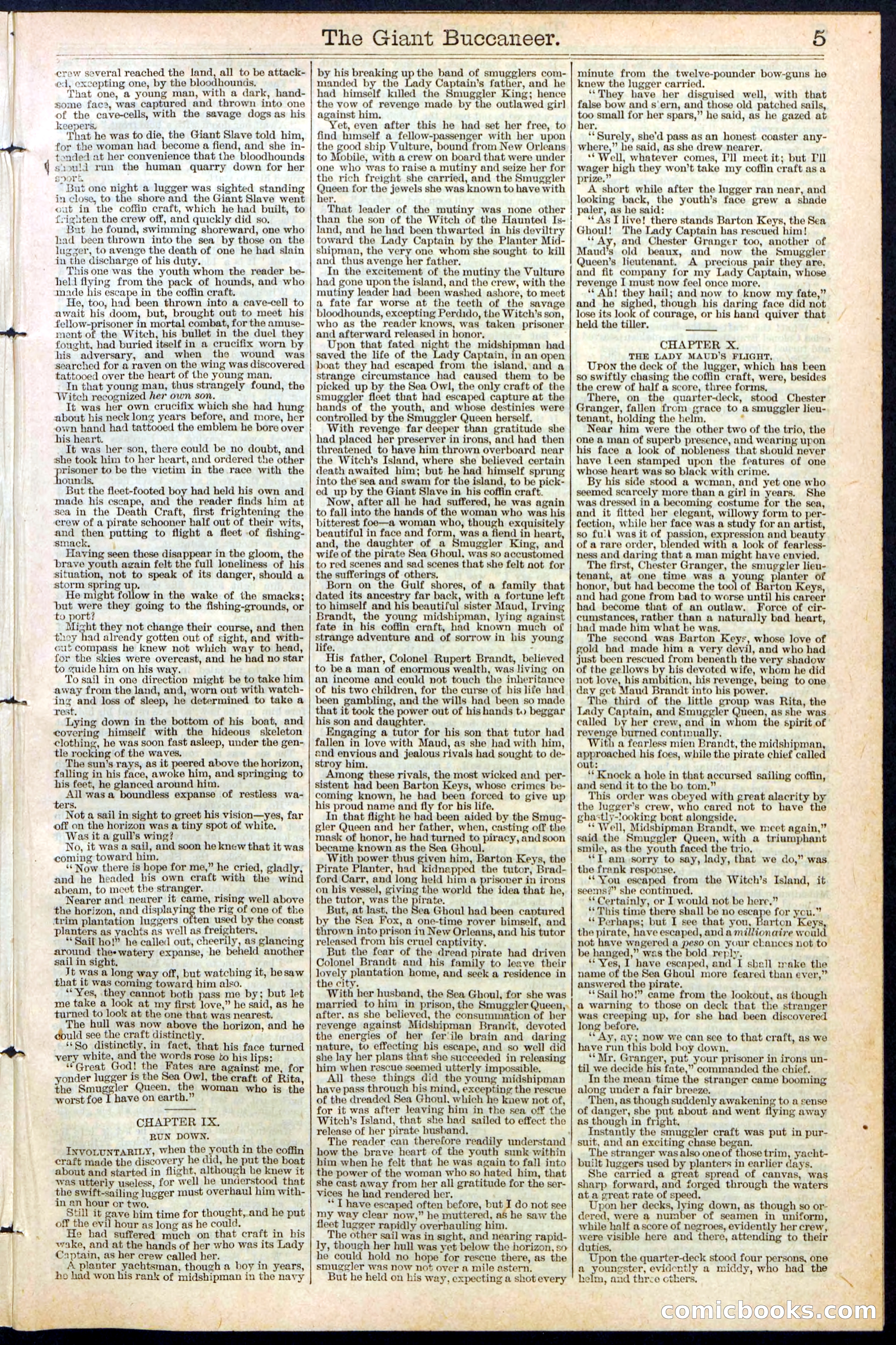
A restored page from Pulp Fiction, 1886. Page through the whole issue in the reader above.
📄 Transcribed text from this page (OCR, searchable)
Machine-transcribed from the original scan — historical spelling and the odd misread are preserved.
crew several reached the land, all to be attack- ed, excepting one, by the bloodhounds. That one, a young man, with a dark, hand- some facs, was captured and thrown into one of the cave-cells, with the savage dogs as his keeper's. That he was to die, the Giant Slave told him, for the woman had become a fiend, and she in- tonded at her convenience that the bloodhounds sjould run the human quarry down for her SoOTSL But one night a lugger was sighted standing in close, to the shore and the Giant Slave went out in the coffin craft, which he had built, to (vighten the crew off, and quickly did so, But he found, swimming shoreward, one who had been thrown into the sea by those on the lugzer, to avenge the death of one he had slain in the discharge of his duty. This one was the youth whom the reader be- held flying from the pack of hounds, and who made his escape in the coffin craft. He, too, had been thrown into a cave-cell to await his doom, but, brought out to meet his fellow-prisoner in mo combat, for the amuse- ment of the Witch, his bullet in the duel they fought, had buried itself in a crucifix worn by his adversary, and when the wound was searched for a raven on the wing was discovered tattooed over the heart of the young man, In that young man, thus strangely found, the Witch recognized her own son. It was her own crucifix which she had hung about his neck long years before, and more, her own hand had tattooed the emblem he bore over his heart. It was her son, there could be no doubt, and she took him to her heart, and ordered the other wrisoner to be the victim in the race with the 10unds. But the fleet-footed boy had held his own and made his escape, and the reader finds him at sea in the Death Craft, first frightening the crew of a pirate schooner half out of their wits, and a putting to flight a fleet of fishing- smack, Having seen these disappear in the gloom, the brave youth again felt the full loneliness of his situation, not to speak of its danger, should a storm spring ns He might follow in the wake of the smacks; but were they going to the fishing-grounds, or to port? Might they not change their course, and then they had already gotten out of sight, and with- cut compass he knew not which way to head, for the skies were overcast, and he had no star to euide him on his way. : To sail in one direction might be to take him away from the land, and, worn out with watch- ing and loss of sleep, he determined to take a rest. Lying down in the bottom of his boat, and covering himself with the hideous skeleton clothing, he was soon fast asleep, under the gen- tle rocking of the waves. The sun’s rays, as it peered above the horizon, falling in his face, awoke him, and springing to his feet, he glanced around him. All was a boundless expanse of restless wa- ters. Not a sail in sight to greet his vision—yes, far off on the horizon was a tiny spot of white, Was it a gull’s wing? No, it was a sail, and soon he knew that it was coming toward him. ‘‘ Now there is hope for me,” he cried, gladly, and he headed his own craft with the wind abeam, to meet the stranger, Nearer and nearer it came, rising well above the horizon, and displaying the rig of one of the trim plantation luggers often used by the coast planters as yachts as well as freighters, ** Sail ho!” he called out, cheerily, as glancin around theewatery expanse, he beheld another sail in sight. ; Jt was a long way off, but watching it, he saw that it was coming toward him also. “Yes, they cannot both pass me by; but let me take a look at my first love,” he said, as he turned to look at the one that was nearest. The hull was now above the horizon, and he dould see the craft distinctly, ‘So distinctly, in fact, that his face turned very white, and the words rose to his lips: ‘“Great God! the Fates are against me, for yonder lugger is the Sea Owl, the craft of Rita, the Smuggler Queen, the woman who is the worst foe I have on earth.” CHAPTER IX, RUN DOWN. INVOLUNTARILY, when the youth in the coffin craft made the discovery he did, he put the boat about and started in flight, although he knew it was utterly useless, for well he understood that the swift-sailing lugger must overhaul him with- in an hour cr two. Still it gave him time for thought, and he put off the evil hour as long as he could. He had suffered much on that craft in his wake, and at the hands of her who was its Lady Captain, as her crew called her. A planter yachtsman. though a boy in years, he had won his rank of midshipman in the navy LS LL eee eee an The Giant Buccaneer. by his breaking up the band of smugglers com- manded by the Lady Captain’s father, and he had himself killed the Smuggler King; hence the vow of revenge made by the outlawed gir] against him, Yet, even after this he had set her free, to find himself a fellow-passenger with her upon the good ship Vulture, bound from New Orleans to Mobile, with a crew on board that were under one who was to raise a mutiny and seize her for the rich freight she carried, and the Smuggler ape for the jewels she was known to have with er. That leader of the mutiny was none other than the son of the Witch of the Haunted Is- land, and he had been thwarted in his deviltr toward the Lady Captain by the Planter Mid- pen the very one whom she sought to kill and thus avenge her father. In the excitement of the mutiny the Vulture had gone upon the island, and the crew, with the mutiny leader had been washed ashore, to meet a fate far worse at the teeth of the savage bloodhounds, excepting Perdido, the Witch’s son, who as the reader knows, was taken prisoner and afterward released in honor, Upon that fated night the midshipman had saved the life of the Lady Captain, in an open boat they had escaped from the island, and a strange circumstance had caused them to be picked up by the Sea Owl, the only craft of the smuggler fleet that had escaped capture at the hands of the youth, and whose destinies were controlled by the Smuggler Queen herself. With revenge far deeper than gratitude she had placed her preserver in irons, and had then threatened to have him thrown overboard near the Witch’s Island, where she believed certain death awaited him; but he had himself sprung into the sea and swam for the island, to be pick- ed up by the Giant Slave in his coffin craft. Now, after all he had suffered, he was again to fall into the hands of the woman who was his bitterest foe—a woman who, though exquisitely beautiful in face and form, was a fiend in heart, and, the daughter of a Smuggler King, and wife of the pirate Sea Ghoul, was so accustomed to red scenes and sad scenes that she felt not for the sufferings of others. Born on the Gulf shores, of a family that dated its ancestry far back, with a fortune left to himself and his beautiful sister Maud, Irving Brandt, the young midshipman, lying against fate in his coffin craft, had known much of strange adventure and of sorrow in his young ife. : His father, Colonel Rupert Brandt, believed to be a man of enormous wealth, was living on an income and could not touch the inheritance of his two children, for the curse of his life had been gambling, and the wills had been so made that it took the power out of his hands to beggar his son and daughter. Engaging a tutor for his son that tutor had fallen in love with Maud, as she had with him, end envious and jealous rivals had sought to de- stroy him. Among these rivals, the most wicked and per- sistent had been Barton Keys, whose crimes be- coming known, he had been forced to give up his proud name and fly for his life. In that flight he had been aided by the Smug- gler Queen and her father, when, casting off the mask of honor, he had turned to piracy, and soon became known as the Sea Ghoul. With power thus given him, Barton Keys, the Pirate Planter, had kidnapped the tutor, Brad- ford Carr, and long held him a prisoner in irons on his vessel, giving the world the idea that he, the tutor, was the ae But, at last, the Sea Ghoul had been captured by the Sea Fox, a one-time rover himself, and thrown into prison in New Orleans, and his tutor released from his cruel captivity. But the fear of the dread pirate had driven Colonel Brandt and his family to leave their lovely plantation home, and seek a residence in the city. With her husband, the Sea Ghoul, for she was married to him in prison, the Smuggler Queen, after, as she believed, the consummation of ber revenge against Midshipman Brandt, devoted the energies of her fer'ile brain and daring nature, to effecting his escape, and so well did she lay her plans that she succeeded in releasing him when rescue seemed utterly impossible. All these things did the young midshipman have pass through bis mind, excepting the rescue of the dreaded Sea Ghoul, which he knew not of, for it was after leaving him in the sea off the Witch's Island, that she had sailed to effect the release of her pirate husband, ' The reader can therefore readily understand how the brave heart of the youth sunk within him when he felt that he was again to fall into the power of the woman who so hated him, that she cast away from her all gratitude for the ser- vices he had rendered her. ** T have escaped often before, but my way clear now,” he muttered, fleet lugger rapidly overbauling him. The other sail was in sight, and nearing rapid- ly, though her hull was yet below the horizon, so he could hold no hope for rescue there, as the smuggler was now not over a mile astern. But he held on his way, expecting a shot every do not see he saw the 5 minute from the twelve-pounder bow-guns he knew the lugger carried. ‘*They have her disguised well, with that false bow and s'ern, and those old patched sails, ed small for her spars,” he said, as he gazed at er. ‘* Surely, she'd pass as an honest coaster any- where,” he said, as she drew nearer. 6 Vell, whatever comes, Pll meet it; but Tl wager high they won’t take my coffin craft asa prize, A short while after the lugger ran near, and looking back, the youth’s face grew a shade paler, as he said: ‘* As I live! there stands Barton Keys, the Sea Ghoul! The Lady Captain has rescued him! tf yy and Chester Granger too, another of Maud’s old beaux, and now the Smuggler Queen’s lieutenant. A precious pair they are, and fit company for my Lady Captain, whose revenge I must now feel once more. ‘Ah! they hail; and now to know my fate,” and he mghed, though his daring face did not lose its loo held the tiller. CHAPTER X. THE LADY MAUD’S FLIGHT, Upon the deck of the lugger, which has been so swiftly chasing the coffin craft, were, besides the crew of half a score, three forms, There, on the quarter-deck, stood Chester Granger, fallen from grace to a smuggler lieu- tenant, holding the helm. . Near him were the other two of the trio, the one a man of superb presence, and wearing upon his face a look of nobleness that should never have Leen stamped upon the features of one whose heart was so black with crime. By his side stood a woman, and yet one who seemed scarcely more than a girl in years. She was dressed in a becoming costume for the sea, and it fitted her elegant, willowy form to per- fection, while her face was a study for an artist, so full was it of pardon, expression and beauty of a rare order, blended with a look of fearless- ness and daring that a man might have envied. The first, Chester Granger, the smuggler lieu- tenant, at one time was a young planter of honor, but had become the tool of Barton Keys, and had gone from bad to worse until his career had become that of an outlaw. Force of cir- cumstances, rather than a naturally bad heart, had made him what he was. The second was Barton Keys, whose love of gold had made him a very devil, and who had just been rescued from beneath the very shadow of the gellows by his devoted wife, whom he did not love, his ambition, his revenge, being to one day get Maud Brandt into his power. The third of the little group was Rita, the Lady Captain, and Smuggler Queen, as she was called by her crew, and in whom the spirit of | revenge burned continually. With a fearless mien Brandt, the midshipman, approached his foes, while the pirate chief called 0 ut: ** Knock a hole in that accursed sailing coffin, and send it to the bo tom.” This order was obeyed with great alacrity by the lugger’s crew, who cared not to have the ghastly-looking boat alongside. ** Well, Midshipman Brandt, we meet again,” said the Smuggler Queen, with a triumphant smile, as the youth faced the trio. ‘*T am sorry to say, lady, that we do,” was the frank response. ‘**'You escaped from the Witch’s Island, it seems?” she continued. ‘* Certainly, or I would not be here,” ‘* This time there shall be no mig 3 for you.” ‘* Perhaps; but I see that you, Barton Keys the pirate, have escaped, and a millionaire would not have wagered a peso on your chances not to be hanged,” was the bold reply. ** Yes, I have escaped, and I shell make the name of the Sea Ghoul more feared than ever,” answered the pirate. ‘* Sail ho!” came from the lookout, as though a warning to those on deck that the stranger was creeping up, for she had been discovered long before, ‘* Ay, ay; now we can see to that craft, as we have run this bold hoy down, ‘*Mr,. Granger, put your prisoner in irons un- til we decide his fate,” commanded the chief. In the mean time the stranger came booming along under a fair breeze. Then, as though suddenly awakening to a sense of danger, she put about and went flying away as though in fright. Instantly the smuggler craft was put in pur- suit, and an exciting chase began. The stranger was also one of those trim, yacht- built luggers used by planters in earlier days. She carried a great spread of canvas, was sharp forward, and forged through the waters at a great rate of speed, Upon her decks, ying down, as though so or- dered, were a number of seamen in uniform, while half ascore of negroes, evidently her crew, were visible here and there, attending to their duties, Upon the quarter-deck stood four persons, one a youngster, evidently a middy, who had the helm, and three others. of courage, or his hand quiver that (ECOL ebooks ‘GO