
Pulp Fiction, 1886 · page 11 of 32
Beadle's Dime Library No. 388: The Giant Buccaneer — page 11: what you’re looking at
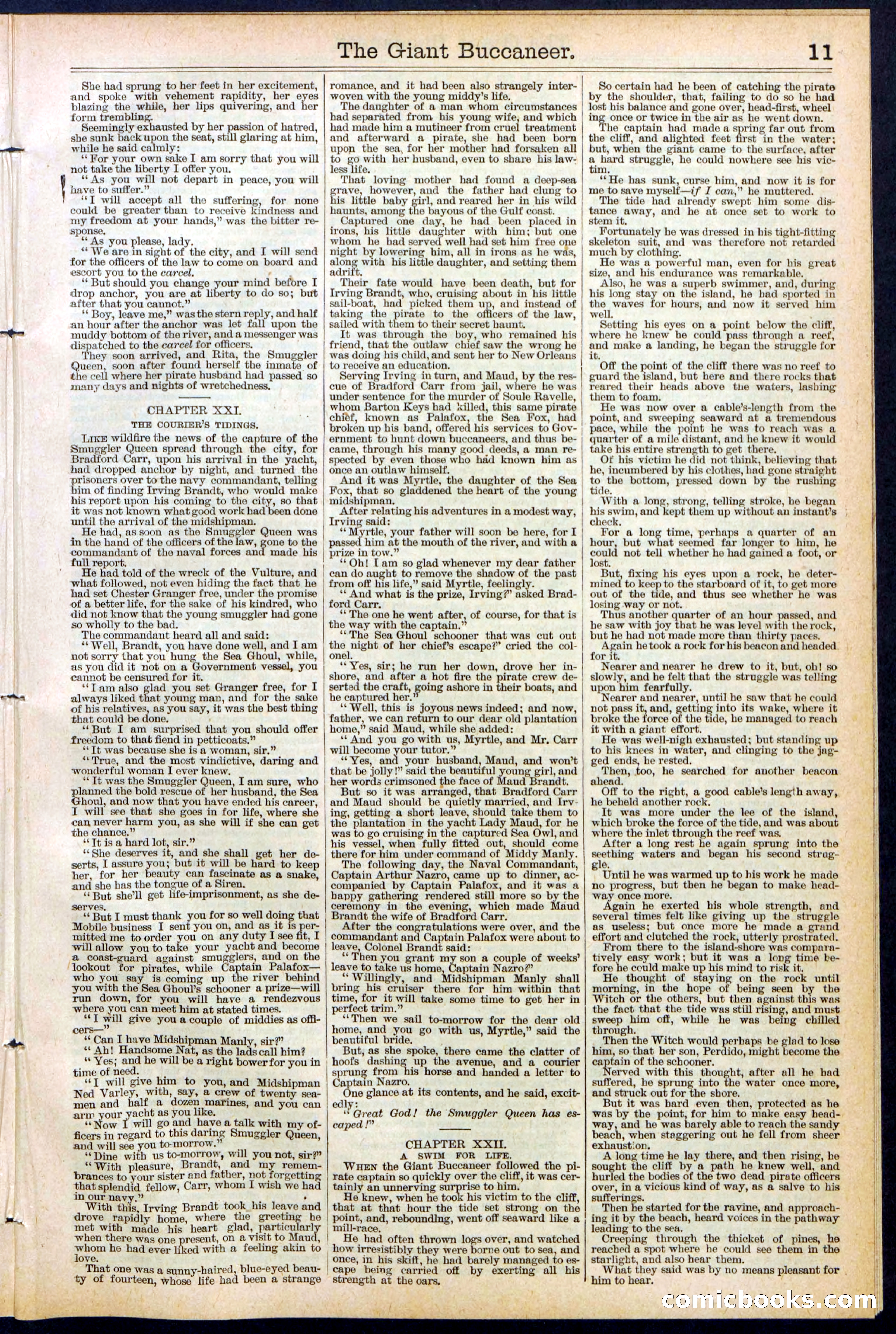
A restored page from Pulp Fiction, 1886. Page through the whole issue in the reader above.
📄 Transcribed text from this page (OCR, searchable)
Machine-transcribed from the original scan — historical spelling and the odd misread are preserved.
= -_——- ——<— - o [EE re eR te ea >? Saree + The Giant Buccaneer. om 4 ’ { * P , 11 She had sprung to her feet in her excitement, and spoke with vehement rapidity, her eyes blazing the while, her lips quivering, and her form trembling. Seemingly exhausted by her passion of hatred, sbe sunk back upon the seat, still glaring at him, while he said calmly: ‘Wor your own sake I am sorry that you will not take the liberty I offer you. ‘*As you will not depart in peace, you will have to suffer.” ‘*T will accept all the suffering, for none could be greater than to receive kindness and my freedom at your hands,” was the bitter re- | sponse, ‘* As you please, lady. ** We are in sight of the city, and I will send for the officers of the law to come on board and escort you to the carcel. ‘** But should you change drop anchor, you are at liberty to do so; but after that you cannot.” ‘* Boy, leave me,” was the stern reply, and half an hour after the anchor was let fall upon the muddy bottom of the river, and a messenger was dispatched to the carcel for officers. They soon arrived, and Rita, the Smuggler Queen, soon after found herself the inmate of the cell where her pirate husband had passed so many days and nights of wretchedness, CHAPTER XXI. THE COURIER’S TIDINGS. Like wildfire the news of the capture of the Smuggler Queen spread through the city, for Bradford Carr, upon his arrival in the yacht, had dropped anchor by night, and turned the prisoners over to the navy commandant, telling him of finding Irving Brandt, who would make his report upon his coming to the city, so that it was not known what good work had been done | until the arrival of the midshipman, He had, as soon as the Smuggler Queen was in the hand of the officers of the law, gone to the commandant of the naval forces and made his full report. He had told of the wreck of the Vulture, and what followed, not even hiding the fact that he had set Chester Granger free, under the promise of a better life, for the sake of his kindred, who did not know that the young smuggler had gone so wholly to the bad. The commandant heard all and said: “Well, Brandt, you have done well, and I am not sorry that you hung the Sea Ghoul, while, as you did it not on a Government vessel, you cannot be censured for it. ‘‘Tam also glad you set Granger free, for I always liked that young man, and for the sake of his relatives, as you say, it was the best thing that could be done, ; **But I am surprised that you should offer freedom to that fiend in petticoats.” ‘*Tt was because she is a woman, sir.” “True, and the most vindictive, daring and | wonderful woman I ever knew. ‘It was the Smuggler Queen, I am sure, who ecg the bold rescue of her husband, the Sea houl, and now that you have ended his career, I will see that she goes in for life, where she | can never harm you, as she will if she can get the chance.” ‘*Tt is a hard lot, sir.” ‘*She deserves it, and she shall get her de- serts, I assure a but it will be hard to keep her, for her beauty can fascinate as a snake, and she has the tongue of a Siren. ‘“But shell get life-imprisonment, as she de- serves, P ‘¢ But I must thank you for so well doing that Mobile business I sent you on, and as it is per- mitted me to order you on any duty I see fit, I will allow you to take your yacht and become a coast- ‘d against smugglers, and on the ‘lookout for pirates, while Captain Palafox— who you say is coming up the river behind you with the Sea Ghoul’s schooner a prize—will run down, for you will have a rendezvous where you can meet him at stated times. “T will give youacouple of middies as offi- cers—” ‘Can I have Midshipman Manly, sir?” ‘** Ah! Handsome Nat, as the lads call him? ** Yes; and he will be a right bower for you in time of need, “T will give him to you, and Midshipman Ned Varley, with, say, a crew of twenty sea- men and half a dozen marines, and you can arm your yacht as you like, ‘Now I will go and have a talk with my of- ficers in regard to this daring Smuggler Queen, and will see you to-morrow. “Dine with us to-morrow, will you not, sir?” “With pleasure, Brandt, and my remem- rances to your sister and father, not forgetting that splendid fellow, Carr, whom I wish we had in our navy.” ; , With this, Irving Brandt took his leave and drove rapidly home, where the grecting he met with made his heart glad, particular] when there was one present, on a visit to Maud, ee he had ever liked with a feeling akin to ove. That one was a sunny-haired, blue-eyed beau- ty of fourteen, whose life had been a strange } : | our mind before I | romance, and it had been also strangely inter- woven with the young middy’s life. The daughter of a man whom circumstances had separated from his young wife, and which had made him a mutineer from cruel treatment and afterward a pirate, she had been born upon the sea, for her mother had forsaken all to go with her husband, even to share his law- less life. | That loving mother had found a deep-sea | grave, however, and the father had clung to his little baby girl, and reared her in his wild | haunts, among the bayous of the Gulf coast. Captured one day, he had been placed in irons, his little daughter with him; but one whom he had served well had set him free one night by lowering him, all in irons as he was, elong with his little daughter, and setting them adrift, Their fate would have been death, but for Irving Brandt, who, cruising about in his little sail-boat, had picked them up, and instead of taking the pirate to the officers of the law, sailed with them to their secret haunt. It was through the boy, who remained his ' friend, that the outlaw chief saw the wrong he _ was doing his child, and sent her to New Orleans | to receive an education. Serving Irving in turn, and Maud, by the res- cue of Bradford Carr from jail, where he was under sentence for the murder of Soule Ravelle, whom Barton Keys had killed, this same pirate chiéf, known as Palafox, the Sea Fox, had broken up his band, offered his services to Gov- ernment to hunt down buccaneers, and thus be- came, through his many good deeds, a man re- spected by even those who had known him as once an outlaw himself. |_ And it was Myrtle, the daughter of the Sea Fox, that so gladdened the heart of the young | midshipman. After relating his adventures in a modest way, Irving said: ‘*Myrtle, your father will soon be here, for I passed him at the mouth of the river, and with a | prize in tow.” ; ‘*Oh! Lam so glad whenever my dear father can do aught to remove the shadow of the past _ from off his life,” said Myrtle, feelingly. ‘** And what is the prize, Irving?” asked Brad- ford Carr, ** The one he went after, of course, for that is the way with the captain.” ‘*The Sea Ghoul schooner that was cut out py of her chief's escape?” cried the col- onel. | ‘** Yes, sir; he run her down, drove her in- shore, and after a hot fire the pirate crew de- _ serted the craft, going ashore in their boats, and he captured her.’ ‘* Well, this is joyous news indeed; and now, father, we can return to our dear old plantation home,” said Maud, while she added: ‘* And you go with us, Myrtle, and Mr, Carr will become your tutor.” “Yes, and your husband, Maud, and won’t that be jolly!” said the beautiful ees girl, and her words crimsoned the face of Maud Brandt. But so it was arranged, that Bradford Carr -and Maud should be quietly married, and Irv- ing, getting a short leave, should take them to the plantation in the yacht Lady Maud, for he was to go cruising in the captured Sea Owl, and his vessel, when fully fitted out, should come there for him under command of Middy Manly. The following day, the Naval Commandant, Captain Arthur Nazro, came up to dinner, ac- companied by Captain Palafox, and it was a bappy gathering rendered still more so by the ceremony in the evening, which made ud Brandt the wife of Bradford Carr. After the congratulations were over, and the commandant and Captain Palafox were about to leave, Colonel Brandt said: ‘**Then you grant my son a couple of weeks’ leave to take us home, Captain Nazro?” ‘* Willingly, and Midshipman Manly shall bring his cruiser there for him within that time, for it will take some time to get her in perfect trim.” ‘Then we sail to-morrow for the dear old home, and you go with us, Myrtle,” said the beautiful bride. But, as she spoke, there came the clatter of hoofs iat 2 the avenue, and a_ courier _sprung from his horse and handed a letter to Captain Nazro. | ne glance at its contents, and he said, excit- edly: ® Great God! the Smuggler Queen has es- caped |” CHAPTER XXII. A SWIM FOR LIFE. WueEn the Giant Buccaneer followed the pi- rate captain so quickly over the cliff, it was cer- tainly an unnerving surprise to him. He knew, when he took his victim to the cliff, that at that hour the tide set strong on the point, and, reboundIng, went off seaward like a _mill-race. | He had often thrown logs over, and watched _how irresistibly they were borne out to sea, and once, in his skiff, he had barely managed to es- cape being carried off by exerting all his strength at the oars, ee SS —— 000.0 Se So certain had he been of catching the pirate by the shoulder, that, failing to do so he had lost his balance and gone over, head-first, wheel ing once or twice in the air as he went down. ‘he captain had made a spring far out from the cliff, and alighted feet first in the water; but, when the giant came to the surface, after . hard struggle, he could nowhere see his vic- im. ‘**He has sunk, curse him, and now it is for me to save myself—if J can,” he muttered. The tide had already swept him some dis- tance away, and he at once set to work to stem it. Fortunately he was dressed in his tight-fitting skeleton suit, and was therefore not retarded much by clothing. He was a powerful man, even for his great size, and his endurance was remarkable, Also, he was a superb swimmer, and, during his long stay on the island, he bad sported in deri for hours, and now it served him well. Setting his eyes on a point below the cliff, where he knew he could pass through a reef, and make a landing, he began the struggle for 1b. Off the point of the cliff there was no reef to guard the island, but here and there rocks that reared their heads above the waters, lashing them to foam. He was now over a cable’s-length from the point, and sweeping seaward at a tremendous pace, while the point he was to reach was a quarter of a mile distant, and he knew it would take his entire strength to get there, Of his victim he did not think, believing that he, incumbered by his clothes, had gone straight > the bottom, pressed down by the rushing | tide. With a long, strong, telling stroke, he began — his swim, and kept them up without an instant’s | check. For a long time, perhaps a quarter of an hour, but what seemed far longer to him, he ne not tell whether he had gained a foot, or ost. But, fixing his eyes upon a rock, he deter- mined to keep to the starboard of it, to get more out of the tide, and thus see whether he was losing way or not. Thus another quarter of an hour passed, and he saw with joy that he was level with the rock, but he had not made more than thirty paces, 3 Again he took a rock for his beacon and headed. | or it. | Nearer and nearer he drew to it, but, oh! so slowly, and he felt that the struggle was telling q upon him fearfully. I Nearer and nearer, until he saw that he could not pass it, and, getting into its wake, where it . broke the force of the tide, he managed toreach it with a giant effort. a | He was well-nigh exhausted; but standing up to his knees in water, and clinging to the jag- ged ends, he rested. ose, too, he searched for another beacon ead. Off to the right, a good cable’s length away, he beheld another rock. ‘|| It was more under the lee of the island, which broke the force of the tide, and was about where the inlet through the reef was, | i! After a long rest he again sprung into the a waters and began his second strag- e, : Until he was warmed up to his work he made no progress, but then he began to make head- way once more. gain he exerted his whole strength, and — several times felt like giving up the struggle as useless; but once more he made a grand effort and clutched the rock, utterly prostrated. From there to the island-shore was compara- tively easy work; but it was a long time be- fore he could make up his mind to risk it. He thought of staying on the rock until morning, in the hope of being seen by the Witch or the others, but then against this was the fact that the tide was still rising, and m sweep off, while he was being ch through. Then the Witch would rhaps be glad to lose him, so that her son, Perdic night b do captain of the schooner. erved with this thought, after all he had suffered, he sprung into the water once more, and struck out for the shore. But it was bard even then, protected as he was by the point, for him to make easy head- way, and he was barely able toreachthesandy || ch, when staggering out he fell from sheer exhaustion, A long time he lay there, and then rising, be sought the cliff by a path he knew well, and Ry naried the bodies of the two dead pirate officers __ over, in a vicious kind of way, as a salve to his sagt \ ; Then he started for the ravine, and approach- . ing it by the beach, heard voices in the pathway - leading to the sea, might become the Creeping through the thicket of pines, he | i reached a spot where he could see them in the ~— |. starlight, and also hear them. RAS |" What they said was by no means pleasant for . We; him to hear. \ ag cComicbooks..c . * a S |