
Pulp Fiction, 1886 · page 20 of 32
Beadle's New York Dime Library No. 385 — page 20: what you’re looking at
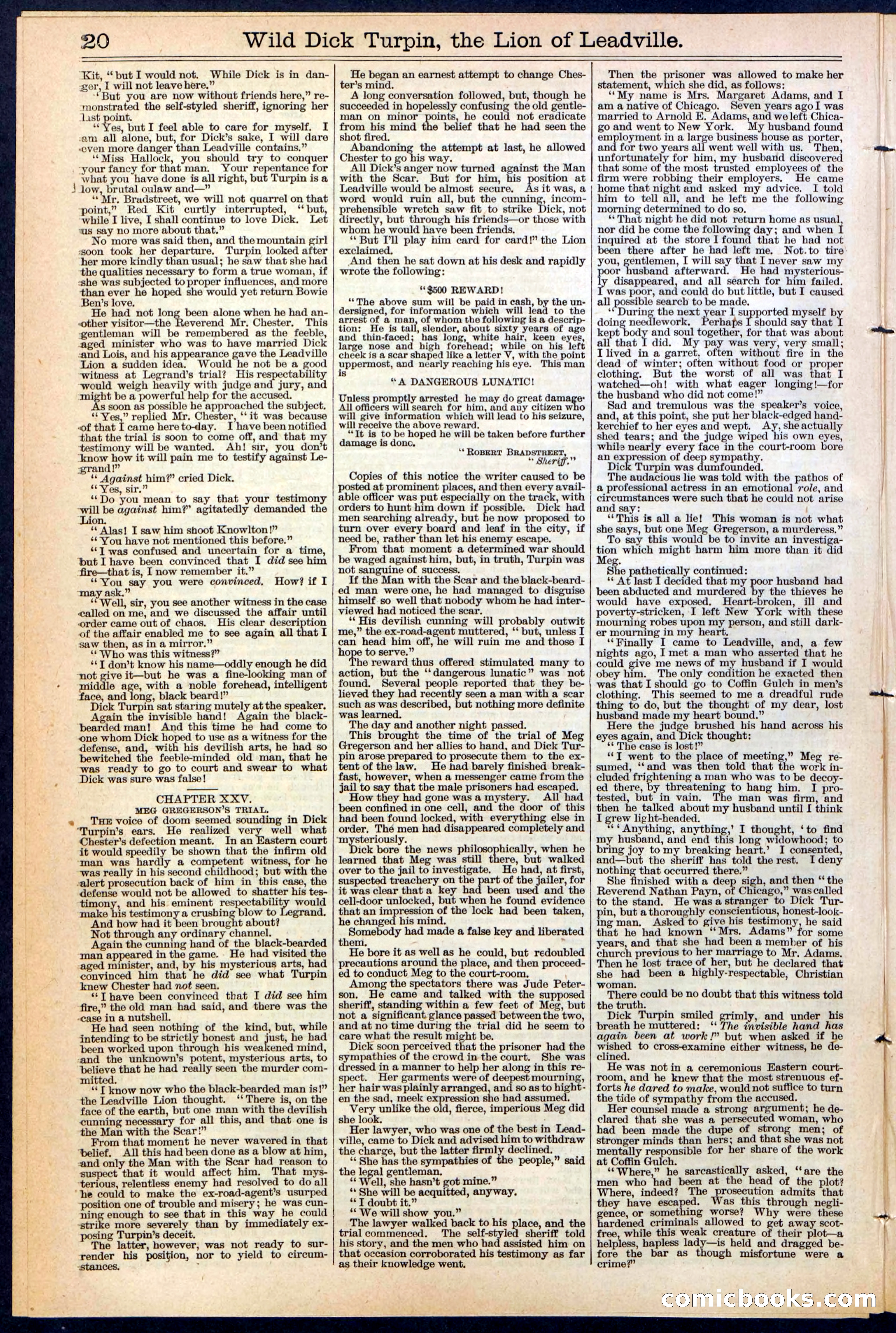
A restored page from Pulp Fiction, 1886. Page through the whole issue in the reader above.
📄 Transcribed text from this page (OCR, searchable)
Machine-transcribed from the original scan — historical spelling and the odd misread are preserved.
not ‘bearded man! . A + ee ee 20 ee = ~ —— Wild Dick Turpin, the Lion of Leadville. ‘Kit, “but I would not. While Dick is in dan- gor, I will not leave here.” ‘* But you are now without friends here,” re- monstrated the self-styled sheriff, ignoring her last point. ‘“ Yes, but I feel able to care for myself, I ‘am all alone, but, for Dick’s sake, I will dare even more danger than Leadville contains.” ‘*Miss Hallock, you should try to conquer ‘your fancy for that man. Your repentance for what you have done is all right, but Turpin is a low, brutal oulaw and—” ‘Mr. Bradstreet, we will not quarrel on that point,” Red Kit curtly interrupted, “but, while I live, I shall continue to love Dick. Let “us say no more about that.” No more was said then, and the mountain girl soon took her departure. Turpin looked after her more kindly than usual; he saw that she had the qualities necessary to form a true woman, if she was subjected to proper influences, and more than ever he hoped she would yet return Bowie Ben’s love. He had not long been alone when he had an- other visitor—the Reverend Mr. Chester. This gentleman will be remembered as the feeble, aged minister who was to have married Dick and Lois, and his appearance gave the Leadville Lion a sudden idea. Would he not be a good witness at Legrand’s trial? His respectability would weigh heavily with judge and jury, and might be a powerful help for the accused. is soon as possible he approached the subject. ‘‘ Yes,” replied Mr. Chester, ‘‘it was because «of that I came here to-day. I have been notified that the trial is soon to come off, and that my testimony will be wanted. Ah! sir, you don’t ‘know how it will pain me to testify against Le- grand!” ‘* Against him?” cried Dick. weer.” ‘Do you mean to say that your testimony 2 be against him?” agitatedly demanded the on. ** Alas! I saw him shoot Knowlton!” ‘¢-You have not mentioned this before.” ‘7 was confused and uncertain for a time, ‘but I have been convinced that I did see him fire—that is, I now remember it.” ‘You say you were convinced, How? if I “may ask.” ‘* Well, sir, you see another witness in the case called on me, and we discussed the affair until order came out of chaos. His clear description of the affair enabled me to see again all that I saw then, as in a mirror.” ‘* Who was this witness?” ‘*T don’t know his name—oddly enough he did ive it—but he was a fine-looking man of middle age, with a noble forehead, intelligent face, and long, black beard!” Dick Turpin sat staring mutely at the speaker. Again the invisible hand! Again the black- And this time he had come to one whom Dick hoped to use as a witness for the defense, and, with his devilish arts, he had so bewitched the feeble-minded old man, that he ‘was ready to go to court and swear to what Dick was sure was false! CHAPTER XXV. MEG GREGERSON’S TRIAL. THE voice of doom seemed sounding in Dick in’s ears. He realized ve well what Chester’s defection meant. In an Eastern court it would speedily be shown that the infirm old ‘man was hardly a competent witness, for he was really in his second childhood; but with the -alert prosecution back of him in this case, the defense would not be allowed to shatter his tes- timony, and his eminent respectability would make his testimony a crusbing blow to d, And how had it been brought about? Not through any ordinary channel. Again the cunning hand of the black-bearded man ap ed in the game. He had visited the aged minister, and, by his mysterious arts, had convinced him that he did see what Turpin knew Chester had not seen. ; ‘‘T have been convinced that I did see him fire,” the old man had said, and there was the -case in a nutshell. He had seen nothing of the kind, but, while intending to be strictly honest and just, he had been worked upon through his weakened mind, and the unknown’s potent, mysterious arts, to ‘believe that he had really seen the murder com- mitted. ‘‘ f know now who the black-bearded man is!” the Leadville Lion thought. ‘‘ There is, on the face of the earth, but one man with the devilish cunning necessary for all this, and that one is the Man with the Scar?” From that moment he never wavered in that ‘belief. All this had been done as a blow at him, and only the Man with the Scar had t that it would affect him. That mys- ‘terious, relentless enemy had resolved to do all he could to make the ex-road-agent’s usurped ition one of trouble and misery; he was cun- ning enough to see that in this way he could ‘rike more severely than by immediately ex- posing Turpin’s deceit. The latter, however, was not ready to sur- render his position, nor to yield to circum- stances. : EE a He began an earnest attempt to change Ches- ter’s mind. A long conversation followed, but, though he succeeded in hopelessly confusing the old gentle- man on minor points, he could not eradicate from his mind the belief that he had seen the shot fired. Abandoning the attempt at last, he allowed Chester to go his way. All Dick’s anger now turned against the Man with the Scar. But for him, his position at Leadville would be almost secure, s it was, a word would ruin all, but the et incom- prehensible wretch saw fit to strike Dick, not a but through his friends—or those with whom he would have been friends. **But PU play him card for card!” the Lion exclaimed. And then he sat down at his desk and rapidly wrote the following: **$500 REWARD! “The above sum will be paid in cash, by the un- dersigned, for information which will le to the arrest of a man, of whom the following is a descrip- tion: He is tall, slender, about sixty years of age and thin-faced; has long, white hair, keen eyes, large nose and high forehead; while on his left cheek is a scar shaped like a letter V, with the point uppermost, and nearly reaching his eye. This man is *A DANGEROUS LUNATIC! Unless promptly arrested he may do great damage: All officers will search for him, and any citizen who will give information which will lead to his seizure, will receive the above reward, “It is to be hoped he will be taken before further damage is dono, ‘* ROBERT BRADSTREET, * Sherif.” Copies of this notice the writer caused to be posted at prominent places, and then every avail- able officer was put especially on the track, with orders to hunt him down if possible. Dick had men searching already, but he now proposed to turn over every board and leaf in the city, if need be, rather than let his enemy escape. From that moment a determined war should be waged against him, but, in truth, Turpin was not sanguine of success. If the Man with the Scar and the black-beard- ed man were one, he had managed to disguise himself so well that nobody whom he had inter- viewed had noticed the scar. ** His devilish cunning will probably outwit me,” the ex-road-agent muttered, ‘* but, unless I can head him off, he will ruin me and those I ae to serve.” he reward thus offered stimulated many to action, but the ‘‘dangerous lunatic” was not found. Several people reported that they be- lieved they had eres seen a man with a scar such as was described, but nothing more definite was learned. The day and another night passed. This brought the time of the trial of Meg Gregerson and her allies to hand, and Dick Tur- pin arose prepared to prosecute them to the ex- tent of thelaw. He had barely finished break- fast, however, when a messenger came from the jail to say that the male prisoners had escaped. How they had gone wasa mystery. All had been confined in one cell, and the door of this had been found locked, with everything else in order, Thé men had disappeared completely and mysteriously. ick bore the news philosophically, when he learned that Meg was still there, but walked capectaliseatie ¥ on the part of the jailer, for sus ery on the of the jailer, for it as clear that a key had been cet and the cell-door unlocked, but when he found evidence that an eo ic of the lock had been taken, he changed his mind. “= ii had made a false key and liberated them, ‘ He bore it as well as he could, but redoubled precautions around the place, and then proceed- ed to conduct Meg to the court-room. Among the spectators there was Jude Peter- son. He came and talked with the supposed sheriff, standing within a few feet of Meg, but not a significant glance passed between the two, and at no time during the trial did he seem to care what the result might be. Dick soon perceived that the prisoner had the sympathies of the crowd in the court. She was dressed in a manner to help her along in this re- spect. Her garments were of dee Bt her hair was plainly arranged, and so as to hight- en the sad, meek ps > eg oe she had assumed. ; Very unlike the old, fierce, imperious Meg did she look. : Her lawyer, who was one of the best in Lead- ville, came to Dick and advised him to withdraw the charge, but the latter firmly declined. ‘‘ She has the sympathies of the people,” said the legal gentleman. , “Well, she hasn’t got mine.” ** She will be acquitted, anyway. **T doubt it.” ** We will show you.” The lawyer walked back to his place, and the trialcommenced. The self-styled sheriff told his story, and the men who had assisted him on that occasion corroborated his testimony as far as their knowledge went. Then the prisoner was allowed to make her statement, which she did, as follows: ‘‘My name is Mrs. Margaret Adams, and I am a native of Chicago. Seven years agol was married to Arnold E. Adams, and we left Chica- go and went to New York. My husband found pele aia in a large business house as porter, and for two years all went well with us. Then, unfortunately for him, my husband discovered that some of the most trusted employees of the firm were robbing their employers. He came home that night and asked my advice. I told him to tell all, and he left me the following morning determined to do so, * That night he did not return home as usual nor did he come the following day; and when I inquired at the store I found that he had not been there after he had left me. Not.to tire you, gentlemen, I will say that I never saw my r husband afterward. He had mysterious- >. disappeared, and all search for him failed. was poor, and could do but little, but I caused all possible search to be made. ‘* During the next year I supported myself b doing needlework. Perhaps I should say that 1 kept body and soul together, for that was about all that I did. My pay was very, very small; I lived in a garret, often without fire in the dead of winter; often without food or proper clothing. But the worst of all was that I watched—oh! with what eager longing!—for the husband who did not come!” Sad and tremulous was the speaker’s voice, and, at this point, she put her black-edged hand- kerchief to her eyes and wept. AY, she actually shed tears; and the judge wiped his own eyes, while nearly every face in the court-room bore an ie acer of deep sympathy. Dick Turpin was dumfounded. The audacious lie was told with the pathos of a professional actress in an emotional role, and circumstances were such that he could not arise and say: “This is all a lie! This woman is not what she says, but one Meg Gregerson, a murderess.” To say this would be to invite an investiga- tion which might harm him more than it did Meg. She pathetically continued: ** At last I decided that my — husband had been abducted and murdered by the thieves he would have exposed. Heart-broken, ill and pido Spi? ge I left New York with these mourning robes upon my person, and still dark- er mourning in my heart. ‘*Finally I came to Leadville, and, a few nights ago, I met a man who asserted that he could give me news of my husband if I would obey him. The only condition he exacted then was that I should go to Coffin Gulch in men’s clothing. This seemed to me a dreadful rude thing to do, but the thought of my dear, lost husband made my heart bound.” Here the judge brushed bis hand across his eyes again, and Dick thought: ‘** The case is lost!” ‘‘T went to the place of meeting,” Meg re- sumed, ‘‘and was then told that the work in- cluded fri ume a man who was to be decoy- ed there, by threatening to hang him. I pro- tested, but in vain. The man was firm, and then he talked about my husband until I think I grew light-headed. ‘** Anything, anything,’ I thought, ‘to find my husband, and end this long widowhood; to bring joy tomy breaking heart.’ I consented, and—but the sheriff has told the rest. I deny nothing that occurred there.” She finished with a deep sigh, and then “ the Reverend Nathan Payn, of Chicago,” was called to the stand. He wasastranger to Dick Tur- pin, but a thoroughly conscientious, honest-look- ing man, Asked to give his testimony, he said that he had known ‘‘ Mrs. Adams” for some years, and that she had been a member of his church previous to her marriage to Mr, Adams. Then he lost trace of her, but he declared that she had been a highly-respectable, Christian woman. There could be no doubt that this witness told the truth, | ‘ Dick Turpin smiled grimly, and under his breath he muttered: ‘‘ The invisible hand has again been at work!” but when asked if Mo Seb to cross-examine either witness, he de- clined. He was notin a ceremonious Eastern court- room, and he knew that the most strenuous ef- forts he dared to make, would not suftice to turn the tide of sympathy from the accused. Her counsel made a strong argument; he de- clared that she was a persecuted woman, who had been made the dupe of ng men; of stronger minds than hers; and that she was not mentally responsible for her share of the work at Coffin Gulch. : ‘“Where,” he sarcastically asked, “tare the men who had been at the head of the plot? Where, indeed? The Seg ln pe admits that they have ere: as this through negli- ence, or something worse? Why were these hardened criminals allowed to get away scot- free, while this weak creature of their plot—a helpless, hapless lady—is held and dragged be- fore on bar as though misfortune were a crime Eomicboo col