
Pulp Fiction, 1886 · page 16 of 32
Beadle's New York Dime Library No. 385 — page 16: what you’re looking at
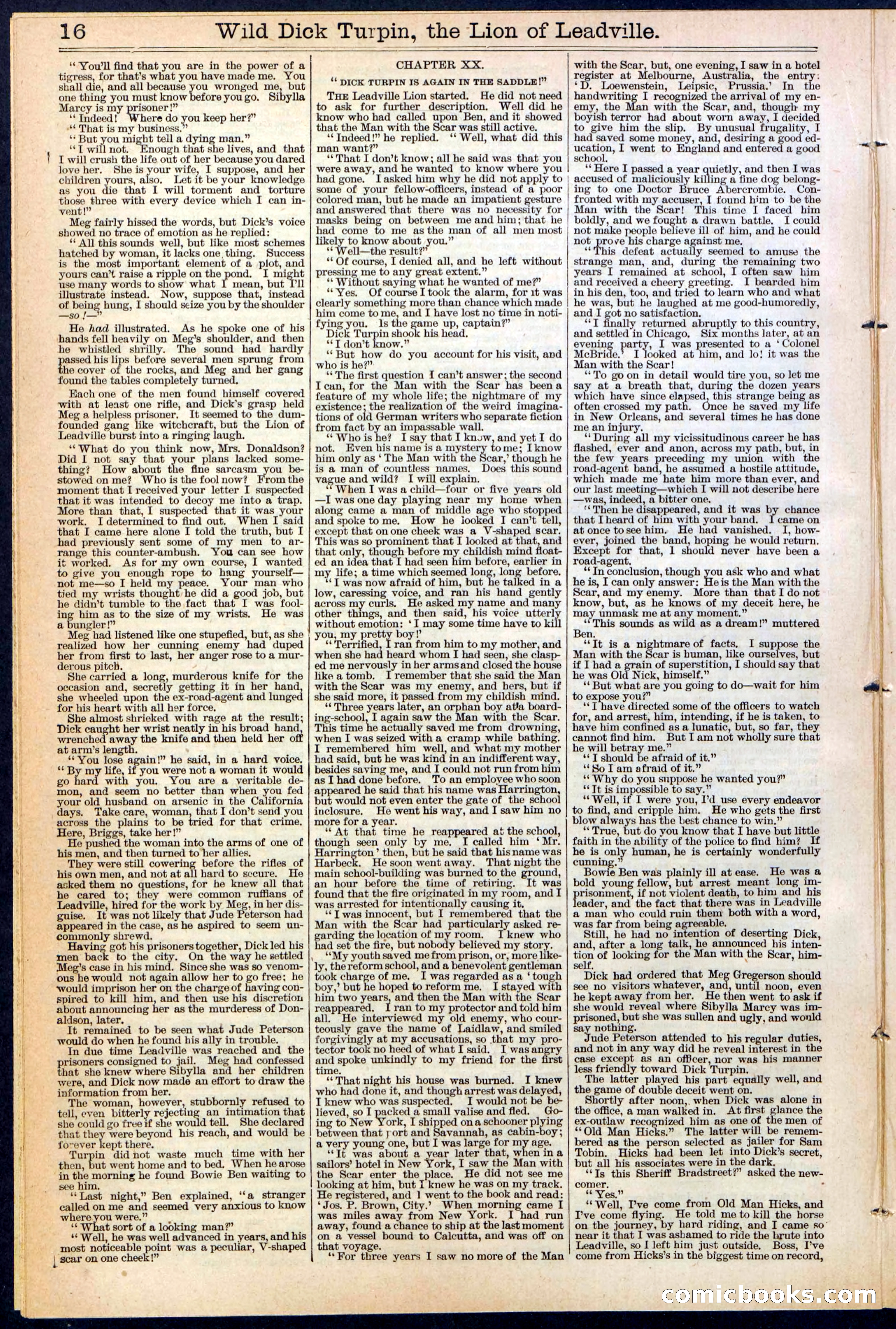
A restored page from Pulp Fiction, 1886. Page through the whole issue in the reader above.
📄 Transcribed text from this page (OCR, searchable)
Machine-transcribed from the original scan — historical spelling and the odd misread are preserved.
Df em eel days. M . rs nee ERR, ** You'll find that you are in the power of a tigress, for that’s what you have made me. You shall die, and all because you wronged me, but one thing you must know before yougo. Sibylla Marcy is my prisoner!” ‘* Indeed! here do you keep her?” “* That is my business,” ‘** But you might tell a dying man.” **T will not. Enough that she lives, and that I will crush the life out of her because you dared love her. She is your wife, I suppose, and her children yours, also. Let it be your knowledge as you die that I will torment and torture those three with every device which I can in- vent!” Meg fairly hissed the words, but Dick’s voice showed no trace of emotion as he replied: ** All this sounds well, but like most schemes hatched by woman, it lacks one thing. Success is the most important element of a plot, and yours can’t raise a ripple on the pond. I might use many words to show what | mean, but Pll illustrate instead. Now, suppose that, instead of being hung, I should seize you by the shoulder He had illustrated. As he spoke one of his hands fell heavily on Meg’s shoulder, and then he whistled shrilly. The sound had hardly penned his lips before several men sprung from he cover of the rocks, and Meg and her gang found the tables completely turned, Each one of the men found himself covered with at least one rifle, and Dick's grasp held Meg a helpless prisoner, It seemed to the dum- founded gang like witchcraft, but the Lion of Leadville burst into a ringing laugh. ‘““ What do you think now, Mrs. Donaldson? Did I not say that your plans lacked some- thing? How about the fine sarcasm you be- stowed on me? Who is the foolnow? From the moment that I received your letter I suspected that it was intended to decoy me into a trap. More than that, I suspected that it was your work. I determined to find out. When I said that I came here alone I told the truth, but I had previously sent some of my men to ar- range this counter-ambush. You can see how it worked. As for my own course, I wanted to give you enough rope to hang yourself— not me—so I held my peace. Your man who tied my wrists thought he did a good job, but he didn’t tumble to the fact that I was fool- ing him as to the size of my wrists. He was a bungler!” Meg had listened like one stupefied, but, as she realized how her cunning enemy had duped her from first to last, her anger rose to a mur- derous pitch. She carried a long, murderous knife for the occasion and, secretly getting it in her hand she wheeled upon the ex-road-agent and lunged for his heart with all her force, She almost shrieked with rage at the result; Dick caught her wrist neatly in his broad hand wrenched away the knife and then held her off at arm’s length. ‘You lose again!” he said, in a hard voice. ‘* By my life, if you were not a woman it would go hard with you. You are a veritable de- mon, and seem no better than when you fed your old husband on arsenic in the California Take care, woman, that I don’t send you across the plains to be tried for that crime. Here, Briggs, take her!” He pushed the woman into the arms of one of his men, and then turned to her allies. They were still cowering before the rifles of his own men, and not at all hard to secure. He asked them no questions, for he knew all that he cared to; they were common ruffians of Leadville, hired for the work by Meg, in her dis- guise. It was not likely that Jude Peterson had appeared in the case, as he aspired to seem un- commonly shrewd. Having got his prisoners together, Dick led his men bac Meg’s case in his mind. Since she was so venom- ous he would not again allow her to go free; he ‘would imprison her on the charge of having con- spired to kill him, and then use his discretion about announcing her as the murderess of Don- aldson, later. It remained to be seen what Jude Peterson would do when he found his ally in trouble. In due time Leadville was reached and the risoners consigned to jail. Meg had confessed hat she knew where Sibylla and her children were, and Dick now made an effort to draw the information from her. The woman, however, stubbornly refused to tell, even bitterly rejecting an intimation that she could go free if she would tell. She declared that they were beyond his reach, and would be forever kept there. in did not waste much time with her ut went home and to bed. When he arose Tu then, in the morning he found Bowie Ben waiting to see him. ‘Last night,” Ben explained, ‘‘a stranger called on me and seemed very anxious to know where you were.” ee t sort of a looking man?” - ‘¢ Well, he was well advanced in years, and his most noticeable oo was a peculiar, V-shaped Ye | scar on one cheek!” J to the OF ale the way he settled |, ee CHAPTER XX. ‘“ DICK TURPIN IS AGAIN IN THE SADDLE!” THE Leadville Lion started. He did not need to ask for further description. Well did he know who had called upon Ben, and it showed that the Man with the Scar was still active. ‘* Indeed!” he replied. ‘‘ Well, what did this man want?” ‘* That I don’t know; all he said was that you were away, and he wanted to know where you had gone. Iasked him why he did not apply to some of your fellow-officers, instead of a poor colored man, but he made an impatient gesture and answered that there was no necessity for masks being on between me and him; that he had come to me asthe man of all men most likely to know about you.” **'W ell—the result?” ** Of course, I denied all, and he left without pressing me to any great extent.” ‘* Without saying what he wanted of me?” “Yes, Of course I took the alarm, for 1t was clearly something more than chance which made him come to me, and I have lost no time in noti- fying you. Is the game up, captain?” Dick Turpin shook his head, ‘**T don’t know.” ‘‘But how do you account for his visit, and who is he?” ‘The first question [ can’t answer; the second I can, for the Man with the Scar has been a feature of my whole life; the nightmare of my existence; the realization of the weird imagina- tions of old German writers who separate fiction from fact by an impassable wall. ** Who is he? I say that I know, and yet I do not. Even his name is a mystery tome; I know him only as ‘ The Man with the Scar,’ though he is a man of countless names. Does this sound vague and wild? I will explain. ** When I was a child—four or five years old —I was one day playing near my home when along came a man of middle age who stopped and spoke tome. How he iooked I can’t tell, except that on one cheek was a V-shaped scar. This was so prominent that I looked at that, and that only, though before my childish mind float- ed an idea that I had seen him before, earlier in my life; a time which seemed long, long before, ‘‘T was now afraid of him, but he talked in a low, caressing voice, and ran his hand gently across my curls. He asked my name and many other things, and then said, his voice utter] without emotion: ‘I may some time have to kill you, my preety boy!’ ‘Terrified, I ran from him to my mother, and when she had heard whom I had seen, she clasp- ed me nervously in her armsand closed the house like atomb. I remember that she said the Man with the Scar was my enemy, and hers, but if she said more, it passed from my childish mind, ‘* Three years later, an orphan boy atla board- ing-school, I again saw the Man with the Scar. This time he actually saved me from drowning, when I was seized with a cramp while bathing. I remembered him well, and what my mother had said, but he was kind in an indifferent way, besides saving me, and I could not run from him as I had done before. To an employee who soon appeared he said that his name was Harrington, but would not even enter the gate of the school inclosure, He went his way, and I saw him no more for a year. ‘At that time he reappeared at the school, though seen only by me. I called him ‘Mr. Harrington’ then, but he said that his name was Harbeck. He soon went away. That night the main school-building was burned to the ground, an hour before the time of retiring. It was found that the fire originated in my room, and I was arrested for intentionally causing it, ‘*T was innocent, but I remembered that the Man with the Scar had particularly asked re- arding the location of my room. I knew who had set the fire, but nobody believed my story. ‘*My youth saved me from prison, or, more like- ly, the reform school, and a benevolent gentleman took charge of me. I was regarded as a ‘tough boy,’ but he hoped to reform me. I stayed with him two years, and then the Man with the Scar reappeared, I ran to my protector and told him all. He interviewed my old enemy, who cour- teously gave the name of Laidlaw, and smiled forgivingly at my accusations, so that my pro- tector took no heed of what I said. I wasangry and spoke unkindly to my friend for the time. ‘‘That night his house was burned. I knew who had done it, and though arrest was delayed, I knew who was suspected. I would not be be- lieved, so I packed a small valise and fled. _Go- ing to New York, I i ona schooner plying between that yort and Savannah, as cabin-boy; a very young one, but I was large for my age. ‘Tf was about a year later that, when ina sailors’ hotel in New York, I saw the Man with the Scar enter the place. He did not see me looking at him, but I knew he was on my track. He registered, and 1 went to the book and read: ‘Jos. P. Brown, City.’ When morning came I was miles away from New York. I had run away, found a chance to ship at the last moment on a vessel bound to Calcutta, and was off on that voyage. ‘*For three years I saw no more of the Man wa —— ET Wild Dick Turpin, the Lion of Leadville. with the Scar, but, one evening, I saw in a hotel register at Melbourne, Australia, the entry: ‘D. Loewenstein, Leipsic, Prussia.’ In the handwriting I recognized the arrival of my en- emy, the with the Scar, and, though my boyish terror had about worn away, I decided to give him the slip. By unusual frugality, I had saved some money, and, desiring a good ed- ucation, I went to England and entered a good school, ‘‘ Here I passed a year quietly, and then I was accused of maliciously killing a fine dog belong- ing to one Doctor Bruce Abercrombie. Con- fronted with my accuser, I found him to be the Man with the Scar! This time I faced him boldly, and we fought a drawn battle. I could not make people believe ill of him, and he could not prove his charge against me. “This defeat actually seemed to amuse the strange man, and, during the remaining two years I remained at school, I often saw him and received a cheery greeting. I bearded him in his den, too, and tried to learn who and what he was, but he laughed at me good-humoredly, and I got no satisfaction. ‘*I finally returned abruptly to this country, and settled in Chicago, Six months later, at an evenin party, I was presented to a ‘ Colonel McBride.’ I looked at him, and lo! it was the Man with the Scar! “To go on in detail would tire you, so let me say at a breath that, during the dozen years which have since elapsed, this strange being as often crossed my path. Once he saved my life in New Orleans, and several times he has done me an injury. ‘‘ During all my vicissitudinous career he has flashed, ever and anon, across my path, but, in the few years preceding my union with the road-agent band, he assumed a hostile attitude which made me hate him more than ever, and our last meeting—which I will not describe here —was, indeed, a bitter one. ‘* Then he disappeared, and it was by chance that Iheard of him with your band. I came on at once tosee him. He had vanished. I, how- ever, joined the band, hoping he would return. Except for that, 1 should never have been a road-agent, ** In conclusion, though you ask who and what he is, I can only answer: Heis the Man with the Scar,and my enemy. More than that I do not know, but, as he knows of my deceit here, he may unmask me at any moment.” ‘This sounds as wild as a dream!” muttered Ben. “Tt is a nightmare of facts. I sup the Man with the Scar is buman, like ourselves, but if I had a grain of superstition, I should say that he was Old Nick, himself.” ‘* But what are you going to do—wait for him to expose you?” ‘*T have directed some of the officers to watch for, and arrest, him, intending, if he is taken, to have him confined as a lunatic, but, so far, they cannot find him. But I am not wholly sure that he will betray me.” ‘*T should be afraid of it.” ** So I am afraid of it.” ‘* Why do you suppose he wanted you?” **Tt is impossible to say.” ‘Well, if I were you, I’d use every endeavor to find, and cripple him. He who gets the first blow always has the best chance to win.” ‘True, but do you know that I have but little faith in the ability of the police to find him? he is only human, he is certainly wonderfully cunning.’ Bowie Ben was plainly ill at ease. He was a bold young fellow, but arrest meant long im- risonment, if not violent death, to him and his eader, and the fact that there was in Leadville a man who could ruin them both with a word, was far from being agreeable. ; Still, he had no intention of deserting Dick, and, after a long talk, he announced his inten- tion of looking for the Man with the Scar, him- self. Dick had ordered that Meg Gregerson should see no visitors whatever, and, until noon, even he kept away from her. He then went to ask if she would reveal where Sibylla Marcy was im- prisoned, but she was sullen and ugly, and would may nothing. ude Peterson attended to his regular duties, and not in any way did he reveal interest in the case except as an officer, nor was his manner less friendly toward Dick Turpin. The latter played his part equally well, and the game of double deceit went on. Shortly after noon, when Dick was alone in the office, a man walked in. At first glance the ex-outlaw recognized him as one of the men of ‘‘Old Man Hicks.” The latter will be remem- bered as the person selected as jailer for Sam Tobin. Hicks had been let into Dick’s secret, but all his associates were in the dark, ‘‘ Well, I’ve come from Old Man Hicks, and I’ve come flying. He told me to kill the horse on the journey, by hard riding, and I came so’ near it that I was ashamed to ride the brute into Leadville, so I left him just outside. Boss, I’ve come from Hicks’s in the biggest time on record, \ ; so —@ (ECON ANIICEl eXexe) (E S) co