
Pulp Fiction, 1886 · page 11 of 32
Beadle's New York Dime Library No. 385 — page 11: what you’re looking at
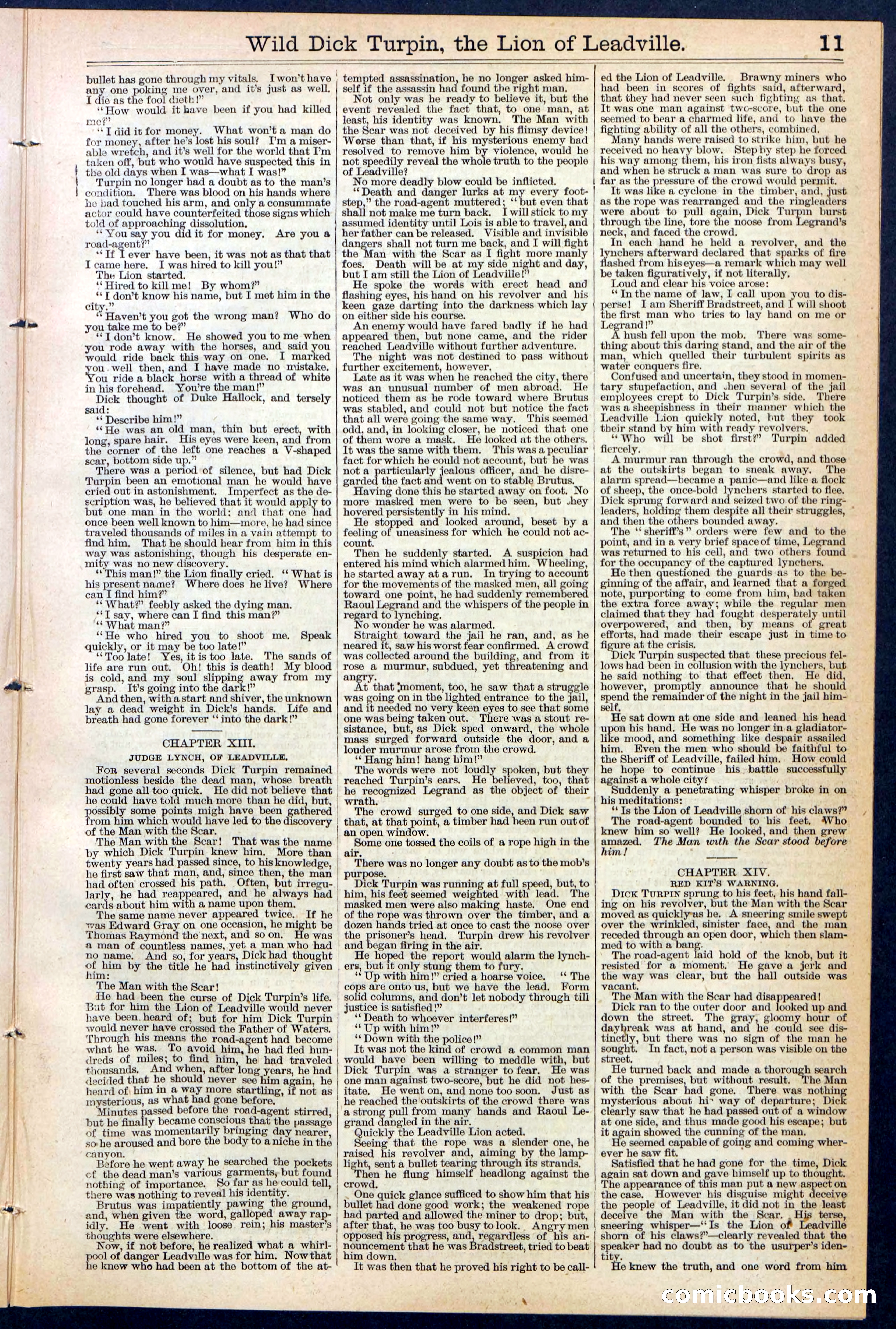
A restored page from Pulp Fiction, 1886. Page through the whole issue in the reader above.
📄 Transcribed text from this page (OCR, searchable)
Machine-transcribed from the original scan — historical spelling and the odd misread are preserved.
— any one poking me over, and it’s just as well. I die as the fool dieth!” ‘How would it have been if you had killed mo?” ‘‘T did it for money. What won’t a man do for money, after he’s lost his soul? I’m a miser- able wretch, and it’s well for the world that ’'m taken off, but who would have suspected this in the old days when I was—what I was!” Turpin no longer had a doubt as to the man’s condition. There was blood on his hands where he bad touched his arm, and only a consummate actor could have counterfeited those signs which told of approaching dissolution, ‘** You say you did it for money. Are you & road-agent?” ‘‘Tf Lever have been, it was not as that that I came here, I was hired to kill you!” The Lion started. ‘* Hired to kill me! By whom?” “*T don’t know his name, but I met him in the city.” @ Haven't you got the wrong man? Who do you take me to be?” ‘¢‘T don’t know. He showed you to me when you rode away with the horses, and said you would ride back this way on one. I marked rou. well then, and I have made no mistake, Tou ride a black horse with a thread of white in his forehead. “You're the man!” Dick thought of Duke Hallock, and tersely said: ‘‘ Describe him!” ‘‘He was an old man, thin but erect, with long, spare hair. His eyes were keen, and from the corner of the left one reaches a V-shaped scar, bottom side up.” There was a period of silence, but had Dick Turpin been an emotional man he would have cried out in astonishment. Imperfect as the de- scription was, he believed that it would apply to but one man in the world; and that one had once been well known to him—more, he had since traveled thousands of miles in a vain attempt to find him, That he should hear from him in this way was astonishing, though his desperate en- mity was no new discovery. ‘* This man!” the Lion finally cried. ‘‘ What is his present name? Where does he live? Where can I find him?” ‘What?’ feebly asked the dying man, ‘*T say, where can I find this man?” ‘* What man?” ‘‘He who hired you to shoot me, quickly, or it may be two late!” ‘*Too late! Yes, itis too late. The sands of life are run out. Oh! this is death! My blood is cold, and my soul slipping away from my grasp. It’s going into the dark!” And then, witha start and shiver, the unknown lay a dead weight in Dick’s hands. Life and breath had gone forever ‘‘ into the dark!” Speak CHAPTER XIII. JUDGE LYNCH, OF LEADVILLE, For several seconds Dick Turpin remained motionless beside the dead man, whose breath had gone all too quick. He did not believe that he could have told much more than he did, but, ossibly some pute migh have been gathered rom him which would have led to the discovery of the Man with the Scar. The Man with the Scar! That was the name by which Dick Turpin knew him, More than twenty years had passed since, to his knowledge, he first saw that man, and, since then, the man had often crossed his path, Often, but irregu- larly, he had reappeared, and he always had ecards about him with a name upon them, The same name never appeared twice, If he was Edward Gray on one occasion, he might be Thomas Raymond the next, and soon. He was a man of countless names, yeb a man who had no name. And so, for years, Dick had thought ys: him by the title he had instinctively given im: The Man with the Scar! Me had been the curse of Dick Turpin’s life. But for him the Lion of Leadville would never have been. heard of; but for him Dick Turpin would never have crossed the Father of Waters. ‘Through his means the road-agent had become what he was. To avoid him, he had fled hun- dreds of miles; to find him, he had traveled thousands. And when, after long years, he had decided that he should never see him again, he heard of him in a way more startling, if not as mysterious, as What had gone before, Minutes passed before the road-agent stirred, but he finally became conscious that the passage of time was momentarily bringing day nearer, so he aroused and bore the body to aniche in the canyon, Before he went away he searched the pockets cf the dead man’s various garments, but found nothing of importance. So far as he could tell, there was nothing to reveal his identity. Brutus was impatiently pawing the ground, and, when given the word, galloped away rap- idly. He went with loose rein; his master’s thoughts were elsewhere. : Now, if not before, he realized what _a whirl- set of danger Leadville was for him. Now that e knew who had been at the bottom of the at- a bullet has gone through my vitals, Iwon’t have : tempted vas spendlg ye he no longer asked him- self if the assassin had found the right man, Not only was he ready to believe it, but the event revealed the fact that, to one man, at least, his identity was known. The Man with the Scar was not deceived by his flimsy device! Worse than that, if his mysterious enemy had resolved to remove him by violence, would he not speedily reveal the whole truth to the people of Leadville? No more deadly blow could be inflicted. “Death and danger lurks at my every foot- step,” the road-agent muttered; ‘‘ but even that shall not make me turn back. I will stick to my assumed identity until Lois is able to travel, and her father can be released. Visible and invisible dangers shall not turn me back, and I will fight the Man with the Scar as I fight more manly foes. Death will be at my side night and day, but I am still the Lion of Leadville!” He spoke the words with erect head and flashing eyes, his hand on his revolver and his keen gaze darting into the darkness which lay on either side his course. An enemy would have fared badly if he had appeared then, but none came, and the rider reached Leadville without further adventure. The night was not destined to pass without further excitement, however, Late as it was when he reached the city, there was an unusual number of men abroad, He noticed them as he rode toward where Brutus was stabled, and could not but notice the fact that all were going the same way. This seemed odd, and, in looking closer, he noticed that one of them wore a mask. He looked at the others. It was the same with them. This was a peculiar fact for which he could not account, but he was not a particularly Moret officer, and he disre- garded the fact and went on to stable Brutus. Having done this he started away on foot. No more masked men were to be seen, but whey hovered persistently in his mind. He stopped and looked around, beset by a feeling of uneasiness for which he could not ac- count. Then he suddenly started. A suspicion had entered his mind which alarmed him. Wheeling he started away atarun. In trying to account for the movements of the masked men, all goin toward one point, he had suddenly remembere Raoul Legrand and the whispers of the people in regard to lynching. o wonder he was alarmed. Straight toward the jail he ran, and, as he neared it, saw his worst fear confirmed. A crowd was collected around the building, and from it rose a murmur, subdued, yet threatening and angry. ‘At that ‘moment, too, he saw that a struggle was going on in the lighted entrance to the jail, and it needed no very keen eyes to see that some one was being taken out. There was a stout re- sistance, but, as Dick sped onward, the whole mass surged forward outside the door, and a louder murmur arose from the crowd. “ Hang him! hang him!” The words were not loudly spoken, but they reached Turpin’s ears. He believed, too, that he recognized Legrand as the object of their wrath, : The crowd surged to one side, and Dick saw that, at that point, a timber had been run out of an open window. Some one tossed the coils of a rope high in the air. There was no longer any doubt as to the mob’s purpose. . Dick Turpin was running at full speed, but, to him, his feet seemed weighted with lead. The masked men were also making haste. One end of the rope was thrown over the timber, and a dozen hands tried at once to cast the noose over the prisoner’s head. Turpin drew his revolver and began firing in the air. He hoped the report would alarm the lynch- ers, but it only stung them to fury. ‘* Up with him!” cried a hoarse voice. ‘‘ The cops are onto us, but we have the lead. Form solid columns, and don’t let nobody through till justice is satisfied!” ‘Death to whoever interferes!” ‘Up with him!” ‘* Down with the police!” It was not the kind of crowd a common man would have been willing to meddle with, but Dick Turpin was a stranger to fear. He was one man against two-score, but he did not hes- itate. He went on, and none too soon. Just as he reached the outskirts of the crowd there was a strong pull from many hands and Raoul Le- grand dangled in the air. Quickly the Leadville Lion acted. Seeing that the rope was a slender one, he raised his revolver and, aiming by the lamp- light, sent a bullet tearing through its strands. hen he flung himself headlong against the crowd. . One quick glance sufficed to show him that his bullet had done good work; the weakened rope had parted and allowed the miner to drop; but, after that, he was too busy tolook.. Angry men opposed his progress, and, regardless of his an- nouncement that he was Bra treet, tried to beat him down. It was then that he proved his right to be call- Wild Dick Turpin, the Lion of Leadville. nn 8 ae ed the Lion of Leadville. Brawny miners who had been in scores of fights said, afterward, that they had never seen such fighting as that. It was one man against two-score, but the one seemed to bear a charmed life, and to have the fighting ability of all the others, combined, any hands were raised to strike him, but he received no heavy blow. Step by step he forced his way among them, his iron fists always busy, and when he struck a man was sure to drop as far as the pressure of the crowd would permit. It was like a cyclone in the timber, and, just as the rope was rearranged and the ringleaders were about to pull again, Dick Turpin burst through the line, tore the noose from Legrand’s neck, and faced the crowd. In each hand he held a revolver, and the lynchers afterward declared that sparks of fire ashed from his eyes—a remark which may well be taken figuratively, if not literally, Loud and clear his voice arose: ‘‘In the name of law, I call upon you to dis- perse! Iam Sheriff Bradstreet, and 1 will shoot the first man who tries to lay band on me or Legrand!” \ hush fell upon the mob, There was some- thing about this daring stand, and the air of the man, which quelled their turbulent spirits as water conquers fire. Confused and uncertain, they stood in momen- tary stupefaction, and vhen several of the jail employees crept to Dick Turpin’s side, There was a sheepishness in their manner which the Leadville Lion eens noted, but they took their stand by him with ready revolvers. ‘*Who will be Turpin added fiercely. A murmur ran through the crowd, and those at the outskirts began to sneak away. The alarm spread—became a panic—and like a flock of sheep, the once-bold lynchers started to flee, Dick sprung forward and seized two of the ring- shot first?” leaders, holding them despite all their struggles, ~ and then the others bounded away, The ‘‘ sheriff’s” orders were few and to the point, and in a very brief space of time, Legrand was returned to his cell, and two others found | for the occupancy of the captured lynchers. He then questioned the guards as to the be- ginning of the affair, and learned that a i note, purporting to come from him, bad taken the extra force away; while the regular men claimed that they had fought desperately until overpowered, and then, by means of great efforts, had made their escape just in time to figure at the crisis. ick Turpin suspected that these precious fel- lows had been in collusion with the lynchers, but he said nothing to that effect then. He did however, promptly announce that he should spend the remainder of the night in the jail him- self, He sat down at one side and leaned his head ~ upon his hand. He was no longer in.a gladiator- like mood, and something like despair as him. Even the men who should be faithful to the Sheriff of Leadville, failed him. How could he hope to continue his battle successfully against a whole city? Suddenly a penetrating whisper broke in on A assailed — his meditations: ry ‘* Ts the Lion of Leadville shorn of his claws?” The road-agent bounded to his feet, Who He looked, and then grew amazed, The Man with the Scar stood before knew him so well? him! ee | CHAPTER XIV. RED KIT’S WARNING. Dick TURPIN sprung to his feet, his hand fall- 7 ing on his revolver, but the Man with the Scar moved as quicklyas he. A sneering smile swept over the wrinkled, sinister face, and man receded through an open door, which then slam- med to with a bang. . The road-agent laid hold of the knob, but it resisted for a moment. He pers a jerk and the way was clear, but the hall outside was vacant. The Man with the Scar had disappeared! Dick ran to the outer door and load up and down the street. The gray, gloomy hour of daybreak was at hand, and he could see dis- tinctly, but there was no sign of the man he As he Tn fact, not a person was visible on the street. He turned back and made a thorough search of the premises, but without result. The Man with the Scar had gone. There was nothin mysterious about hiv way of departure; Di clearly saw that he had passed out of a window at one side, and thus made good his escape; but it agaln showed the cunning of the man, e seemed capable of going and coming wher- ever he saw fit. Satisfied that he had gone for the time, Dick The appearance of this man put a new. on the case. However his disguise might deceiy the people of Leadville, it did not in the least deceive the Man with the Scar. again sat down and gave himself up to thought. de sneering whisper—‘‘Is the Lion of Teadvills . shorn of his claws?’—clearly revealed that the speaker had no doubt as to the usurper’s iden- - t | tity. ~ oe He knew the truth, and one word from him Eomicbooks con —— ee