
Pulp Fiction, 1886 · page 4 of 32
Beadle's Dime Library No. 384 — page 4: what you’re looking at
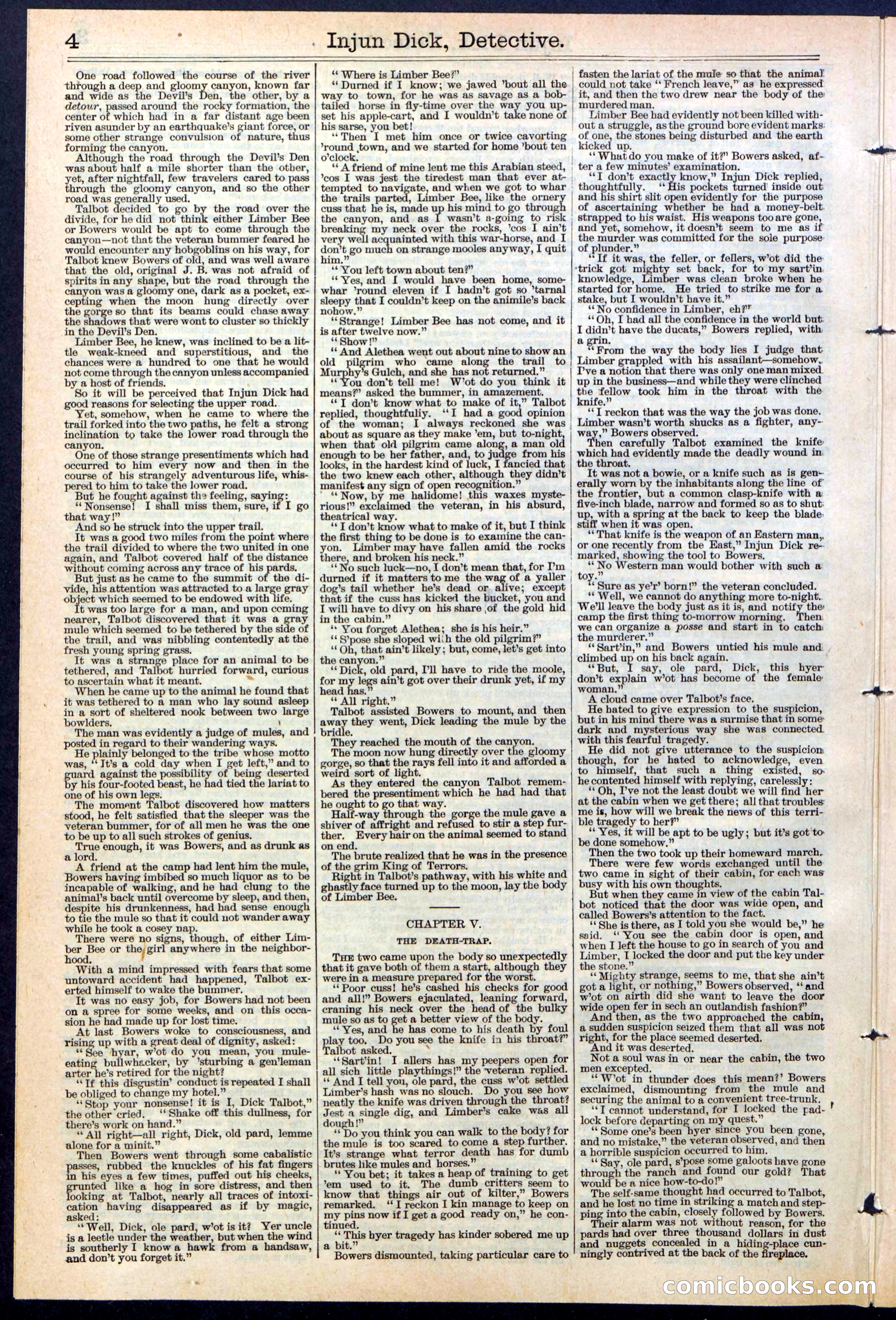
A restored page from Pulp Fiction, 1886. Page through the whole issue in the reader above.
📄 Transcribed text from this page (OCR, searchable)
Machine-transcribed from the original scan — historical spelling and the odd misread are preserved.
aa i 4 : One road followed the course of the river through a deep and gloomy canyon, known far and wide as the Devil’s Den, the other, by a detour, passed around the rocky formation, the center of which had in a far distant age been riven asunder by an earthquake’s giant force, or some other strange convulsion of nature, thus forming the canyon. Although the road through the Devil’s Den was about half a mile shorter than the other, yet, after nightfall, few travelers cared to pass through the gloomy canyon, and so the other road was generally used. Talbot decided to go by the road over the divide, for he did not think either Limber Bee or Bowers would be apt to come through the canyon—not that the veteran bummer feared he would encounter any hobgoblins on his way, for Talbot knew Bowers of old, and was well aware that the old, original J. B. was not afraid of spirits in any shape, but the road through the canyon was a gloomy one, dark as a pocket, ex- cepting when the moon hung directly over the gorge so that its beams could chase away the shadows that were wont to cluster so thickly in the Devil’s Den. Limber Bee, he knew, was inclined to be a lit- tle weak-kneed and superstitious, and the chances were a hundred to one that he would not come through the canyon unless accompanied by a host of friends. So it will be perceived that Injun Dick had good reasons for selecting the upper road. Yet, somehow, when he came to where the trail forked into the two paths, he felt a strong inclination to take the lower road through the canyon. One of those strange presentiments which had occurred to him every now and then in the course of his strangely adventurous life, whis- pered to him to take the lower road. But he fought against the feeling, mater “Nonsense! Is miss them, sure, if I go that way!” And so he struck into the upper trail. It was a good two miles from the point where the trail divided to where the two united in one again, and Talbot covered half of the distance without coming across any trace of his pards, But just as he came to the summit of the di- vide, his attention was attracted to a large gray i de which seemed to be endowed with life. t was too large for a man, and upon ceming nearer, Talbot discovered that it was a gray mule which seemed to be tethered by the side of the trail, and was nibbling contentedly at the fresh young spring grass. It was a strange place for an animal to be tethered, and Talbot hurried forward, curious to ascertain what it meant. an When he came up to the animal he found that it was tethered to a man who lay sound asleep in a sort of sheltered nook between two large bowlders, \ The man was evidently a judge of mules, and posted in regard to their wandering ways. He plainly belonged to the tribe whose motto was, ‘It’s a cold day when I get left,” and to ard against the possibility of being deserted y his four-footed beast, he had tied the lariat to one of his own legs. The moment Talbot discovered how matters stood, he felt satisfied that the sleeper was the veteran bummer, for of all men he was the one to be up to all such strokes of genius. ar enough, it was Bowers, and as drunk as a lord. A friend at the camp had lent him the mule, Bowers having imbibed so much liquor as to be incapable of walking, and he had clung to the animal’s back until overcome by sleep, and then, despite his drunkenness, had had sense enough to tie the mule so that it could not wander away while he took a cosey pap. There were no signs, though, of either Lim- ee Bee or thes girl anywhere in the neighbor- With a mind impressed with fears that some untoward accident had happened, Talbot ex- erted himself to wake the bummer. It was no easy job, for Bowers had not been on a spree for some weeks, and on this occa- sion he had made up for lost time. At last Bowers woke to consciousness, and rising up with a great deal of dignity, asked: “See hyar, wot do you mean, you mule- eating builwhacker, by ‘sturbing a gen’leman arter he’s retired for the night? “Tf this disgustin’ conduct is repeated I shall be obliged to change my hotel.” “Stop your nonsense! it is I, Dick Talbot,” the other cried. ‘‘ Shake off this dullness, for there’s work on hand.” “ All right—all right, Dick, old pard, lemme alone for a minit.” : Then Bowers went through some cabalistic passes, rubbed the knuckles of his fat fingers in his eyes a few times, puffed out his cheeks, bre hest like a hog in sore distress, and then ooking at Talbot, nearly all traces of intoxi- syria having disappeared as if by magic, asked: ‘Well, Dick, ole pard, w’ot is it? Yer uncle is a leetle under the weather, but when the wind is southerly I knowa hawk from a handsaw, and don’t you forget it.” re oI . Injun Dick, Detective. — ** Where is Limber Bee?” ‘‘ Durned if I know; we jawed "bout all the way to town, for he was as savage as a bob- set his apple-cart, and I wouldn’t take none of his sarse, you bet! ‘Then I met him once or twice cavorting round ,town, and we started for home ’bout ten o'clock. ‘* A friend of mine lent me this Arabian steed, tempted to navigate, and when we got to whar the trails sartnd, Limber Bee, like the whan d cuss that he is, made up his mind to go throug the canyon, and as I wasn’t a-going to risk breaking my neck over the rocks, very well acquainted with this war-horse, and I Fs much on strange mooles anyway, I quit im. ‘* You left town about ten?” ‘*'Yes, and I would have been home, some- | whar ’round eleven if I hadn’t got so ’tarnal | sleepy that I couldn’t keep on the animile’s back nohow.” ‘Strange! Limber Bee has not come, and it | is after twelve now.” | ** Show !” ‘‘ And Alethea went out about nine to show an old Lee a who came — the trail to Murphy’s Gulch, and she has not returned.” ‘“You don't tell me! W’ot do you think it means?’ asked the bummer, in amazement. ‘*T don’t know what to make of it,” Talbot | replied, thoughtfuliy. ‘‘I had a opinion | of the woman; I always reckoned she was | about as square as they make ’em, but to-night when that old pilgrim came along, a man ol enough to be her father, and, to ju from his looks, in the hardest kind of luck, I fancied that the two knew each other, although they didn’t manifest any sign of open recognition.” ‘* Now, by me halidome! this waxes myste- rious!” exclaimed the veteran, in his absurd, theatrical way. } ‘* T don’t know what to make of it, but I think | the first thing to be done is to examine the can- on. Limber may have fallen amid the rocks there, and broken his neck.” ‘No such luck—no, I don’t mean that, for ’m durned if it matters to me the wag of a yaller dog's tail whether he’s dead or, alive; except that if the cuss has kicked the bucket, you and I will have to divy on his share ,of the gold hid in the cabin.” ‘* You forget Alethea; she is his heir.” ‘« S*pose she sloped wiih the old pilgrim?” “Oh, that ain’t likely; but, come, let’s get into the canyon.” ‘Dick, old pard, I'll have to ride the moole, for ore, & ain’t got over their drunk yet, if my head has.” * All right.” Talbot assisted Bowers to mount, and then ai they went, Dick leading the mule by the ridle. Pus e They reached the mouth of the canyon. The moon now hung directly over the gloomy gorge, so that the rays fell into it and afforded a weird sort of light. As they entered the canyon Talbot remem- bered the presentiment which he had had that he ought to go that way. Half-way through the gorge the mule gave a shiver of affright and ref to stir a step fur- ther. Every hair on the animal seemed to stand on end. The brute realized that he was in the presence of the grim King of Terrors. Right in Talbot’s pathway, with his white and ghastly face turned up to the moon, lay the body of Limber Bee. eee ee ee CHAPTER V. THE DEATH-TRAP. THE two came upon the body so unexpectedly that it gave both of them a start, capes on they were in a measure prepared for the worst. ‘* Poor cuss! he’s cashed his checks for good and all!” Bowers ejaculated, leaning forward, eraning his neck over the head of the bulky mule so as to get a better view of the body. ‘Yes, and he has come to his death by foul lay too. Do you see the knife in his throat?” ctSartint. I all a f : in allers has my peepers open for all sich little playthings!” the veteran replied. ‘* And I tell yon, ole pard, the cuss w’ot settled Limber’s hash was no slouch. Do you see how neatly the knife was driven through the throat? Jest . single dig, and Limber’s cake was all dough!’ ‘Do you think you can walk to the body? for the mule is scared to come a step further. It’s strange what terror death has for dumb brutes like mules and horses.” ee! “You bet; it takes a heap of training to get ‘em used to it. The dumb critters seem to know that things air out of kilter,” Bowers remarked. ‘I reckon I kin manage to keep on ay cers now if I get a good ready on,” he con- nued. ‘ a hyer tragedy has kinder sobered me up a bit. Bowers dismounted, taking particular care to ‘ tailed horse in fly-time over the is you up- | e ’cos I was jest the tiredest man that ever at- | ‘eos I ain't | ‘trick got migh ee eee fasten the lariat of the mule so that the animal could not take ‘‘ French leave,” as he expressed it, and then the two drew near the body of the murdered man, Limber Bee had evidently not been killed with- out a struggle, as the ground bore evident marks: of one, the stones being disturbed and the earth kicked up. ‘*Whatdo you make of it?” Bowers asked, af- ter a few minutes’ examination. “T don’t al know,” Injun Dick replied, thoughtfully. ‘ His pockets turned inside out and his shirt slit open evidently for the purpose of ascertaining whether he had a money-belt strapped to his waist. His weapons too are gone, and yet, somehow, it doesn’t seem to me as if the murder was committed for the sole purpose of plunder.” ‘If it was, the feller, or fellers, w’ot did the set back, for to my sartin. knowledge, Limber was clean broke when he started for home. He tried to strike me for a stake, but I wouldn't have it.” ** No confidence in Limber, eh?” ‘*Oh, I had all the confidence in the world but. I didn’t have the ducats,” Bowers replied, with, a grin, Prom the way the body lies I judge that Limber grappled with his assailant—somehow,, I’ve a notion that there was only one man mixed. up in the business—and while they were clinched the fellow took him in the throat with the knife,” ‘‘T reckon that was the way the job was done, Limber wasn’t worth shucks as a fighter, any- way,” Bowers observed. hen carefully Talbot examined the knife which had evidently made the deadly wound in. the throat. It was not a bowie, or a knife such as is gen- erally worn a! the inhabitants along the line of the frontier, but a common clasp-knife with a five-inch blade, narrow and formed so as to shut: up, with a spring at the back to keep the blade: stiff when it was open. **That knife is the weapon of an Eastern man,, or one recently from tbe East,” Injun Dick re-- marked, showing the tool to Bowers, a No Western man would bother with such a f Sure as ye’r’ born!” the veteran concluded. ‘“* Well, we cannot do anything more to-night.. We'll leave the body just as it is, and notify the camp the first thing to-morrow morning. Then we can organize a posse and start in to catch the murderer.” ‘*Sart’in,” and Bowers untied his mule and , climbed up on his back again. ** But, say, ole pard, Dick, this hyer don’t explain w’ot has become of the female woman.’ A cloud came over Talbot’s face, He hated to give expression to the suspicion, but in his mind there was a surmise that in some dark and mysterious way she was connected. with this fearful tragedy. He did not give utterance to the suspicion though, for he hated to acknowledge, even to himself, that such a thing existed, so he contented himself with replying, carelessly: ‘* Oh, I’ve not the least doubt we will find her at the cabin when we get there; all that troubles me is, how will we break the news of this terri- ble tragedy to her?” ‘* Yes, it will be apt to be ugly; but it’s got to be done somehow.” Then the two took up their homeward march, There were few words exchanged until the two came in sight of their cabin, for each was busy with his own thoughts. : But when they came in view of the cabin Tal- bot noticed that the door was wide open, and called Bowers’s attention to the fact. ‘‘ She is there, as I told you she would be,” he ssid. ‘ You see the cabin door is open, and when I left the house to go in search of you and Limber, I locked the door and put the key under the stone.” ** Mighty Berg seems to me, that she ain’t got a light, or nothing,” Bowers observed, ‘‘ and w’ot on airth did she want to leave the door wide open fer in sech an outlandish fashion?” And then, as the two pi Lah ips the cabin, a sudden suspicion seized them that all was not right, for the pee seemed deserted. And it was deserted. Not a soul was in or near the cabin, the two men excepted. ‘Wot in thunder does this mean?’ Bowers exclaimed, dismounting from the mule and securing the animal to a convenient tree-trunk, ‘*T cannot understand, for I locked the pad- lock before departing on my quest.” ‘* Some one’s been hyer since you been gone, and no mistake,” the veteran observed, and then a horrible suspicion occurred to him. ‘Say, ole pard, s’pose some galoots have gone through the ranch and found our gold? That would be a nice how-to-do!” The self-same thought had occurred to Talbot, and he lost no time in macro an a match and step- ping into the cabin, closely followed by Bowers. Their alarm was not without reason, for the pards had over three thousand dollars in dust and nuggets concealed in a hiding-p cun- ningly contrived at the back of the — - m Ic (c(6) 200k