
Pulp Fiction, 1886 · page 16 of 32
Beadle's Dime Library No. 384 — page 16: what you’re looking at
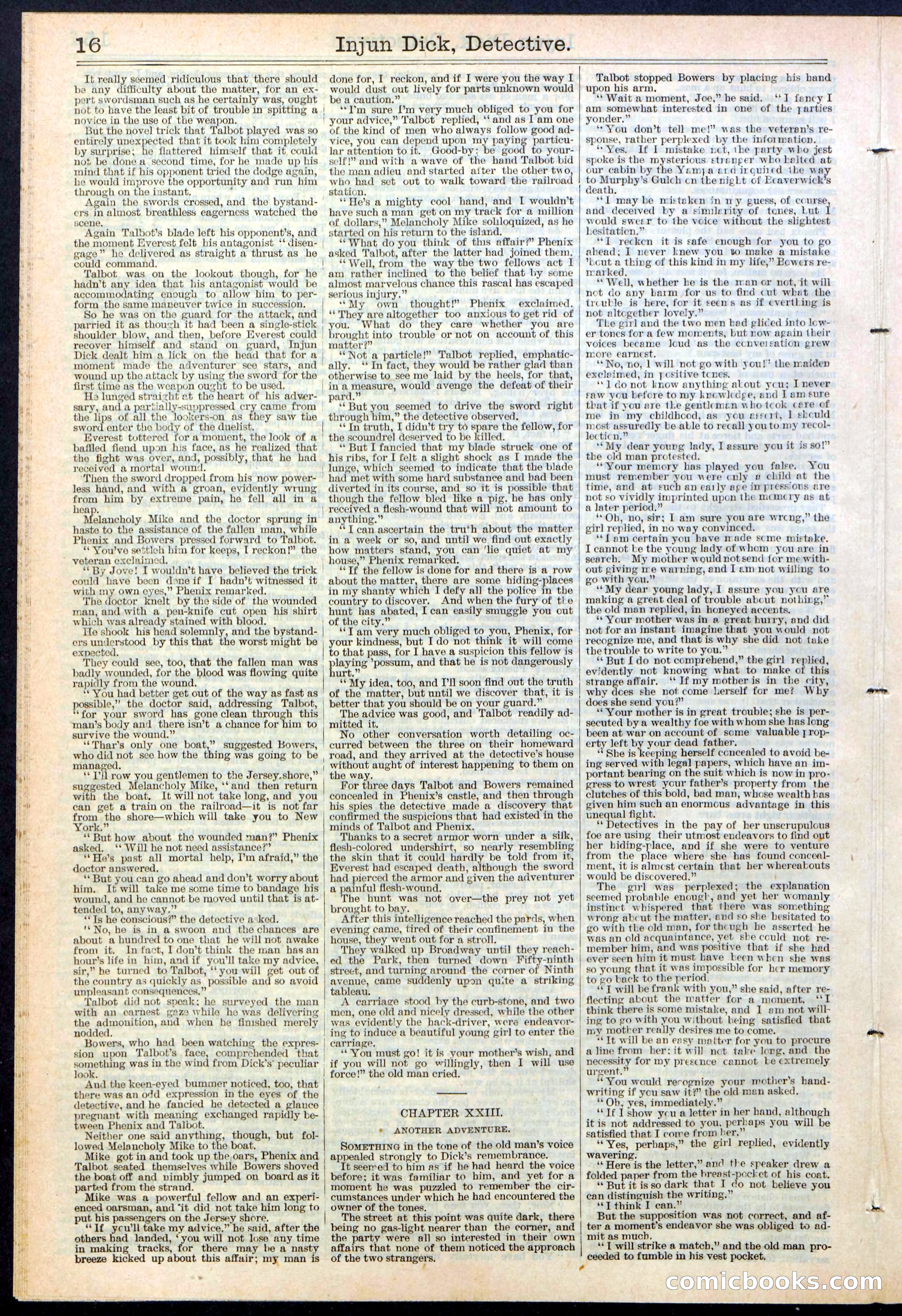
A restored page from Pulp Fiction, 1886. Page through the whole issue in the reader above.
📄 Transcribed text from this page (OCR, searchable)
Machine-transcribed from the original scan — historical spelling and the odd misread are preserved.
16 Injun Dick, Detective. It really seemed ridiculous that there should be any difficulty about the matter, for an ex- pert swordsman such as he certainly was, ought not to have the least bit of trouble in spitting a novice in the use of the weapon. But the novel trick that Talbot played was so entirely unexpected that it took him completely by surprise, he flattered himself that it, could not be done a second time, for he made up his mind that if his opponent tried the dodge again, he would improve the opportunity and run him through on the instant, : Again the swords crossed, and the bystand- ers in almost breathless eagerness watched the scene, Again Talbot’s blade left his opponent’s, and the moment Everest felt, his antagonist ‘‘ disen- | gage” he delivered as straight a thrust as he could command. Talbot was on the lookout though, for he hadn’t any idea that his antagonist would be accommodating enough to allow him to per- form the same maneuver twice in succession. So he was on the guard for the attack, and parried it as thouzh it had been a single-stick shoulder blow, and then, before Everest could | recover himself and stand on guard, Injun Dick dealt him a lick on the head that for a | moment made the adventurer see stars, and wound up the attack by using the sword for the first time as the weapon ought to be used. Ha lunged straizht et the heart of his adver- sary, and a partially-suppressed cry came from the lips of all the lookers-on as they saw the sword enter the body of the duelist. Everest tottered for a moment, the look of a ' baffled fiend upon his face, as he realized that the fight was over, and, possibly, that he had received a mortal wound. ‘Then the sword dropped from his now power- less hand, and with a groan, evidently wrung ees him by extreme pain, he fell all in a leap. elancholy Mike and the doctor sprung in haste to the assistance of the fallen man, while Phenix and Bowers pressed forward to Talbot. ** You've settich him for keeps, [ reckon!” the veteran exclaimed. ‘* By Jove! I wouldn’t have believed the trick could have beon deneif I hadn’t witnessed it with my own oyes,” Phenix remarked. The doctor knelt by the side of the wounded man, and with a pen-knife cuf open his shirt which was already stained with blood. Ife shook his head solemnly, and the bystand- ers understood by this that the worst might be expected. They could see, too, that the fallen man was badly wounded, for the blood was flowing quite rapidly from the wound. ‘* You had better get out of the way as fast as A saorey the doctor said, addressing Talbot, or man’s body and there isn’t a chance for him to survive the wound.” ‘‘Thar’s only one boat,” suggested Bowers, who did not see how the thing was going to be managed, ‘* Til row you gentlemen to the Jersey.shore,” suggested Melancholy Mike, ‘‘and then return with the boat, It will not take long, and you can get a train on the railroad—it is not far from the shore—which will take you to New York.” ‘But how about the wounded man?” Phenix asked. ‘* Will he not need assistance?” ‘He's past all mortal help, I’m afraid,” the doctor answered, ** But you can go ahead and don’t worry about him. It will take me some time to bandage his wound, and he cannot be moved until that is at- tended to, anyway.” ‘*Ts he conscious?” the detective asked. '*No, be is in a swoon and the chances are about a hundred to one that he will not awake from it. In fact, I don’t think the man has an hour’s life in him, and if you'll take my advice, sir,” he turned to Talbot, ‘‘ you will get out of the country as quickly as possible and so avoid unpleasant consequences,” Talbot did not speak; he surveyed the man | with an earnest gaze while he was delivering the admonition, and when he finished merely nodded, Bowers, who had been watching the expres- sion upon Talbot’s face, comprehended that something was in the wind from Dick’s’ peculiar look. And the keen-eyed bummer noticed, too, that there was an odd expression in the eyes of the detective, and he fancied he detected a glance pregnant with meaning exchanged rapidly be- tween Phenix and Talbot. Neither one said anything, though, but fol- lowed Melancholy Mike to the boat, Mike got in and took up the,oars, Phenix and Talbot seated themselves while Bowers shoved the boat off and nimbly jumped on board as it parted from the strand. Mike was a powerful fellow and an experi- enced oarsman, and “it did not take him long to ut his passengers on the Jersey shore. “If ycu’ll take my advice,” he said, after the others had landed, ‘ you will not lose any time in making tracks, for there may he a nasty breeze kicked up about this affair; my man is our sword has gone clean through this | done for, I reckon, and if I were you the way I would dust out lively for parts unknown would be a caution.” ‘*I’m sure ['m very much obliged to you for your advice,” Talbot replied, *‘ and as Iam one of the kind of men who always follow good ad- vice, you can depend upon my paying particu- lar attention to it. Good-by: be good to your- self!” and with a wave of the hand Talbot bid the man adieu and started aiter the other two, who had set out to walk toward the railroad station. ‘He's a mighty cool hand, and I wouldn't have such a man get on my track for a million of dollars,” Melancholy Mike solloquized, as he started on his return to the island. “What do you think of ths affair?’ Phenix asked Talbot, after the latter had joined them. _ Weill, from the way the two fellows act I am rather inclined to the belief that by some almost marvelous chance this rascal has escaped serious injury.” ‘My own thought!” Phenix exclaimed. “They are altogether too anxious to get rid of you. What do they care whether you are wrought into trouble or not on account of this matter?” ‘Not a particle!” Talbot replied, emphatic- ally. ‘In fact, they would be rather glad than otherwise to see me laid by the heels, for that, in a measure, would avenge the defeat of their ard.” : ‘‘But you seemed to drive the sword right through him,” the detective observed, ‘¢ In truth, I didn’t try to spare the fellow, for the scoundrel deserved to be killed. “ But I fancied that my blade struck one of his ribs, for I felt a slight shock as I made the lunge, which seemed to indicate that the blade had met with some hard substance and had been diverted in its course, and so it is possible that though the fellow bled like a pig. he has only ' received a flesh-wound that will not amount to anything.” ‘**T can ascertain the truth about the matter in a week or so, and until we find out exactly how matters stand, you can ‘lie quiet at my house,” Phenix remarked. “Tf the fellow is done for and there is a row about the matter, there are some hiding-places in my shanty which I defy all the police in the country to discover. And when the fury of tle hunt has abated, I can easily smuggle you out | of the city.” ‘‘T am very much obliged to you, Phenix, for your kindness, but I do not think it will come | to that pass, for I have a suspicion this fellow is laying possum, and that he is not dangerously urt, ‘My idea, too, and I’! soon find out the truth of the matter, but until we discover that, it is | better that you should be on your guard.” The advice was good, and Talbot readily ad- mitted it, No other conversation worth detailing oc- curred between the three on their homeward road, and they arrived at the detective’s house without aught of interest happening to them on the way. For three days Talbot and Bowers remained concealed in Phenix’s castle, and then through his spies the detective made a discovery that confirmed the suspicions that had existed in the minds of Talbot and Phenix. Thanks to a secret armor worn under a silk, flesh-colored undershirt, so nearly resembling the skin that it could hardly be told from 1, Everest had escaped death, although the sword had pierced the armor and given the adventurer a painful flesh-wound. he hunt was not over—the prey not yet brought to bay. After this intelligence reached the pards, when ' evening came, tired of their confinement in the house, they went out for a stroll. They walked up Broadway until they reach- ed the Park, then turned down Fifty-ninth _strect, and turning around the corner of Ninth avenue, came suddenly upon quite a striking tableau. A carriage stood by the curb-stone, and two men, one old and nicely dressed, while the other was evidently the hack-driver, were endeavor- ing to induce a beautiful young girl to enter the | carriage. ‘‘- You must go! it is your mother’s wish, and if you will not go willingly, then I will use force!” the old man cried. CHAPTER XXIII. * ANOTHER ADVENTURE, SoMETHING in the tone of the old man’s voice | appealed strongly to Dick’s remembrance, _ It seemed to him as if he had heard the voice before: it was familiar to him, and yet for a moment he was puzzled to remember the cir- cumstances under which he had encountered the owner of the tones. The street at this point was quite dark, there being no gas-light nearer than the corner, and the party were all so interested in their own affairs that none of them noticed the approach of the two mrengcre: 2 en ee ee ee eee Talbot stopped Bowers by placing his band upon his arm, ‘* Wait a moment, Joe,” he said. ‘I fancy I am somewhat interested in one of the yarties yonder.” ‘You don’t tell me!” was the veteran’s re- sponse, rather perplexed by the information. * Yes. If 1 mistake nct, ihe party who jest spoke is the mysterious strenger who halted at our cabin by the Yama ard irguiied the w ay to Murphy’s Gulch cn the night of Ecaverwick’s death, **t may be mistaken in my guess, of course, and deceived by a sinulerity of tones, Lut | would sweer to the voice without the slightest hesitatien.” ‘*T recken it is safe enough for you to go ahead: I never knew you to make a mistake *bout a thing of this kind in my life,” Bowers re- marked, ‘““ Well, whether he is the man or not, it will net do any harm for us to find cut what the ircubkle is here, for it seens as if everthing is not altogether lovely.” The girl and the two men bad gliced into lew- er tones for a few moments, but now again their voices became Joud as the cconvelsation grew more earnest. ** No, no, 1 will not go with you!’ the maiden excleimed, in positive tenes, ‘*] do not know anything altout ycu; I never saw you before to my knewlcdge, and I am sure that if you are the gentlemen who tcok cere of me in my childhood, as you esscrt, | sheuld most assuredly be able to recall youto my recol- lecticn.” ‘“My dear young lady, I assure you it is so!” the old man protested. ‘Your memory has played you false. You must remember you were cnly @ child at the time, and at such an ealy age in pressions are not so vividly imprinted upon the memcry as at a later period.” ‘*Oh, no, sir; I am sure you are wrcng,” the girl replied, in no way convinced. ‘*f am certain you have made scme mistake, I cannot ke the young lady of whom you are in search. My mother would notsend for me with- out giving me warning, end I em not willing to go with you.” ‘*My dear young lady, 1 assure you you are making a great deal of trouble about nothing,” the old man replied, in honeyed accents. ‘* Your mother was in a great hurry, and did not for an instant imagine that you would not recognize me, and that is why she did not take the trouble to write to you.” ‘‘ But [do not comprehend,” the girl replied, evidently not knowing what to make of this strange affair. ‘‘ If my mother is in the city, why dces she not come lerself for me? Why does she send you?” “Your iether is in great trouble; she is per- secuted by a wealthy foe with whom she has long been at war on account of some valuable } rop- erty left by your dead father. “She is keeviitic herself concealed to avoid be- ing served with legal papers, which have an im- portant bearing on the suit which is now in pro- gress to wrest your father’s property from the clutches of this bold, bad man, whose wealth bas given him such an enormous advantage in this unequal fight. ‘** Detectives in the pay of her unscrupulous foe are using their utmost endeavors to find out her hiding-place, and if she were to venture from the place where she has found conceal- ment, it is almcst certain that her whereabouts would be discovered.” The girl was perplexed; the explanation seemed probable enough, and yet her womanly instinct whispered that there was something wrong abcut the matter, and so she hesitated to go with the old man, for thcugh he asserted he was an old acquaintance, yet she could not re- member him, and was positive that if she had ever seen him it must have been when she was so young that it was impossible for hcr memory to go back to the period. ‘7 will be frank with you,” she said, after re- flecting about the matter for a moment, ‘‘I think there is some mistake, and 1 am not will- ing to go with you without being satisfied that my mother really desires me to come. “It will be an easy matter for you to procure a line from her: it wil) not take long, and the necessity for my presence cannot ke extremely urgent,” “You would recognize your mother’s hand- writing if you saw it?” the old man asked, ** Oh, yes, immediately.” ‘If 1 show yeu a letter in her hand, although it is not addressed to you, perhaps you will be satisfied that I come fromher.” ‘Yes, perhaps,” the girl replied, evidently wavering. ‘‘ Here is the letter,” and the speaker drew a folded paper from the breast-pecket of his coat. ‘‘ But it isso dark that I co not believe you can distinguish the writing.” “1 think I can.” But the supposition was not correct, and af- ter a moment's endeavor she was obliged to ad- mit as much. ‘* [ will strike a match,” and the old man pro- ceeded to fumble in his vest pocket. Gomichboo “SiG