
Pulp Fiction, 1886 · page 13 of 32
Beadle's New York Dime Library No. 383 — page 13: what you’re looking at
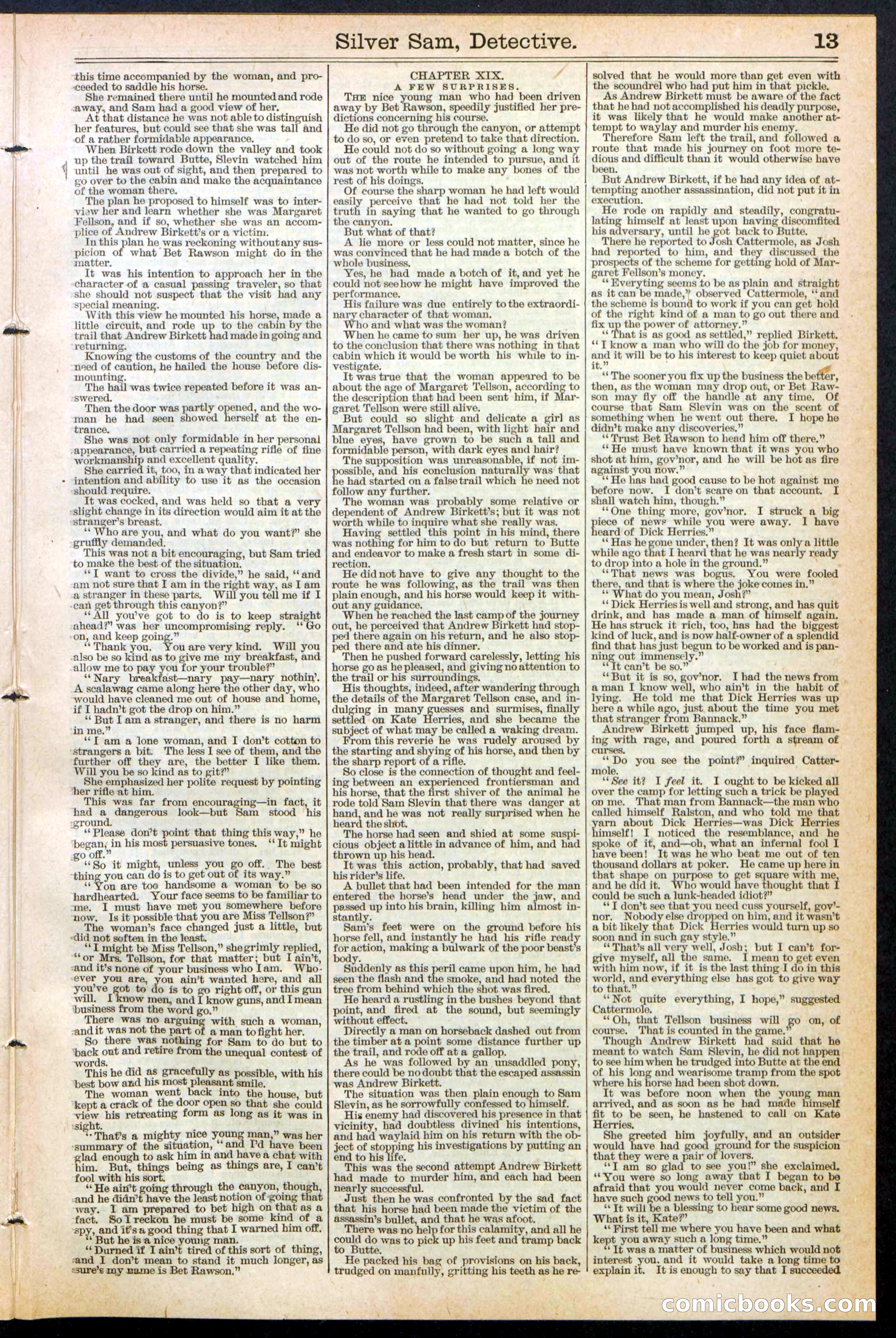
A restored page from Pulp Fiction, 1886. Page through the whole issue in the reader above.
📄 Transcribed text from this page (OCR, searchable)
Machine-transcribed from the original scan — historical spelling and the odd misread are preserved.
" Silver Sam, Detective. 13 this time accompanied by the woman, and pro- ‘coeded to saddle his horse. She remained there until he mounted and rode away, and Sam had a good view of her. At that distance he was not able to distinguish her features, but could see that she was tall and of a rather formidable appearance, When Birkett rode down the valley and took up the trail toward Butte, Slevin watched him until he was out of sight, and then prepared to eo over to the cabin and make the acquaintance of the woman there. The plan he proposed to himself was to inter- view her and learn whether she was Margaret Fellson, and if so, whether she was an accom- plice of Andrew Birkett’s or a victim. In this plan he was reckoning without any sus- ee m of what Bet Rawson might do in the matter. It was his intention to approach her in the character of a casual passing traveler, so that she should not suspect that the visit had any special meaning. With this view he mounted his horse, made a little circuit, and rode up to the cabin by the trail that Andrew Birkett had made in going and returning. Knowing the customs of the country and the need of caution, he hailed the house before dis- mounting. The hail was twice repeated before it was an- swered. Then the door was partly opened, and the wo- man he had seen showed herself at the en- trance. She was not only formidable in her personal appearance, but carried a repeating rifle of fine workmanship and excellent quality. She carried it, too, in a way that indicated her intention and ability to use it as the occasion should require. It was cocked, and was held so that a very slight change in its direction would aim it at the stranger’s breast. ‘** Who are you, and what do you want?” she gruffly demanded. This was not a bit encouraging, but Sam tried to make the best of the situation. ‘*T want to cross the divide,” he said, ‘‘and am not sure that I am in the right way, as I am a stranger in these parts. Will you tell me if I can get through this canyon?” ‘All youve got to do is to keep straight ahead?” was her uncompromising reply. ‘‘ Go on, and keep going.” ‘* Thank you. Fou are very kind. Will you also be so kind as to give me my breakfast, and allow me to pay you for your trouble?” ‘‘Nary breakfast—nary pay—nary nothin’. A scalawag came along here the other day, who would have cleaned me out of house and home, if I hadn’t got the drop on him.” ‘* But Iam a stranger, and there is no harm in me.” ‘*T am a lone woman, and I don’t cotton to strangers a bit. The less I see of them, and the further off they are, the better I like them, Will you be so kind as to git?” She emphasized her polite request by pointing ‘her rifle at him. This was far from encouraging—in fact, it had a dangerous look—but Sam _ stood his ‘round, “Please don’t point that thing this way,” he began, in his most persuasive tones. ‘It might o off.’ arr So it might, unless you go off. The best ‘thing you can do is to get out of its way.” ‘‘'You are too handsome a woman to be so hardhearted. Your face seems to be familiar to me. I must have met you somewhere before now. Is it possible that you are Miss Tellson?” The woman’s face changed just a little, but «did not seften in the least. “I might be Miss Tellson,” shegrimly replied, “or Mrs. Telison, for that matter; but I ain't, ‘and it’s none of your business who lam. Who- ever you are, you ain’t wanted here, and all you've got to do is to go right off, or this gun will. now men, and I know guns, and Imean ‘business from the word go.” There was no arguing with such a woman, and it was not the part of a man to fight her. So there was nothing for Sam to do but to beck out and retire from the unequal contest of words. This he did as gracefully as ‘best bow and his most pleasant f The woman went back into the house, but "kept a crack of the door open so that she could view his retreating form as long as it was in sight. . a. That’s a mighty nice young man,” was her ‘summary of the situation, “and I'd have been lad enough to ask him in and have a chat with iim. But, things being as things are, I can’t fool with his sort. “He ain’t going through the canyon, though and he didn’t have the least notion of going tha way. I am prepared to bet high on that as a fact. SoIreckon he must be some kind of a SPY; and it’s‘ good thing that I warned him off. ‘ But he is a nice young man. j “‘Durned if I ain’t tired of this sort of thing, sand I don’t mean to stand it much longer, as possible, with his smile ssure’s my name is Bet Rawson,” ~~ {?? gee” CHAPTER XIX, 4 A FEW SURPRISES. THE nice young man who had been driven away by Bet Rawson, speedily justified her pre- dictions concerning his course. He did not go through the canyon, or attempt to do so, or even pretend to take that direction. He could not do so without going a long way out of the route he intended to pursue, and it was not worth while to make any bones of the rest of his doings. Of course the sharp woman he had left would easily perceive that he had not told her the truth in saying that he wanted to go through the canyon. But what of that? A lie more or less could not matter, since he was convinced that he had made a botch of the whole business. Yes, he had made a botch of it, and yet he could not seehow he might have improved the performance. His failure was due entirely to the extraordi- nary character of that woman. Who and what was the woman? When he came to sum her up, he was driven to the conclusion that there was nothing in that cabin which it would be worth his while to in- vestigate. It was true that the woman appeared to be about the age of Margaret Tellson, according to the description that had been sent him, if Mar- garet Tellson were still alive. But could so slight and delicate a girl as Margaret Tellson had been, with light hair and blue eyes, have grown to be such a tall and formidable person, with dark eyes and hair? The supposition was unreasonable, if not im- ossible, and his conclusion naturally was that 1e had started on a false trail which he need not follow any further. The woman was probably some relative or dependent of Andrew Birkett’s; but it was not worth while to inquire what she really was. Having settled this point in his mind, there was nothing for him to do but return to Butte and endeavor to make a fresh start in some di- rection. He did not have to give any thought to the route he was following, as the trail was then plain enough, and his horse would keep it with- out any guidance, When he reached the last camp of the journey out, he perceived that Andrew Birkett had stop- ped there again on his return, and he also stop- ped there and ate his dinner. Then he pushed forward carelessly, letting his horse go as he pleased, and giving no attention to the trail or his surroundings. His thoughts, indeed, after wandering through the details of the Margaret Tellson case, and in- dulging in many guesses and surmises, finally settled on Kate Herries, and she became the subject of what may be called a waking dream. From this reverie he was rudely aroused by the starting and shying of his horse, and then by the sharp report of a rifle. So close is the connection of thought and feel- ing between an experienced frontiersman and his horse, that the first shiver of the animal he rode told Sam Slevin that there was danger at hand, and he was not really surprised when he heard the shot. The horse had seen and shied at some suspi- cious object alittle in advance of him, and had thrown up his head. It was this action, probably, that had saved his rider’s life. A bullet that had been intended for the man entered the horse’s head under the jaw, and passed up into his brain, killing him almost in- stantly. Sam’s feet were on the ground before his horse fell, and instantly he had his rifle ready for action, making a bulwark of the poor beast’s body. Siddenly as this peril came upon him, he had seen the flash and the smoke, and had noted the tree from behind which the shot was fired. He heard a rustling in the bushes beyond that point, and fired at the sound, but seemingly without effect. Directly a man on horseback dashed out from the timber at a point some distance further up the trail, and rode off at a gallop. As he was followed by an unsaddled pony, there could be no doubt that the escaped assassin was Andrew Birkett. The situation was then plain enough to Sam Slevin, as he sorrowfully confessed to himself. His enemy had discovered his presence in that vicinity, had doubtless divined his intentions, and had waylaid him on his return with the ob- ject of stopping his investigations by putting an end to his iffe. This was the second attempt Andrew Birkett had made to murder him, and each had been nearly successful. Just then he was confronted by the sad fact that his horse had been made the victim of the assassin’s bullet, and that he was afoot. There was no help for this calamity, and all he could do was to pick up his feet and tramp back to Butte. He packed his bag of provisions on his back, trudged on manfully, gritting his teeth as he re- ee solved that he would more than get even with the scoundrel who had put him in that pickle, As Andrew Birkett must be aware of the fact that he had not accomplished his deadly purpose, it was likely that he would make another at- tempt to waylay and murder his enemy, Therefore Sam left the trail, and followed a route that made his journey on foot more te- ‘abe and difficult than it would otherwise have een. But Andrew Birkett, if he had any idea of at- tempting another assassination, did not put it in execution. He rode on rapidly and steadily, congratu- lating himself at least wpon having discomfited his adversary, until he got back to Butte. There he reported to Soak Cattermole, as Josh had reported to him, and they discussed the prospects of the scheme for getting hold of Mar- garet Fellson’s money. ‘“*Everyting seems to be as plain and straight as it can be made,” observed Cattermole, ‘‘ and the scheme is bound to work if you can get hold of the right kind of a man to go out there and fix up the power of attorney.” “That is as good as settled,” replied Birkett. **T know a man who will do the job for money, and it will be to his interest to keep quiet about it. ‘**The sooner you fix up the business the better, then, as the woman may drop out, or Bet Raw- son may fly off the handle at any time. Of course that Sam Slevin was on the scent of something when he went out there. I hope he didn’t make any discoveries,” “Trust Bet Rawson to head him off there.” **He must have known that it was you who shot at him, gov’nor, and he will be hot as fire against you now.” ‘*He has had good cause to be hot against me before now. I don’t scare on that account, I shall watch him, though.” ‘One thing more, gov’nor. yiece of news while you were away. I have 1eard of Dick Herries.” ‘*Has he gone under, then? It was only a little while ago that I heard that he was nearly ready to drop into a hole in the ground.” oe “That news was bogus. You were fooled there, and that is where the joke comes in.” ‘* What do you mean, Josh?” ‘Dick Herries is well and strong, and has quit drink, and has made a man of Tinsolt again. He has struck it rich, too, has had the biggest kind of luck, and is now half-owner of a splendid find that has just begun to be worked and is pan- ning out immensely.” ‘Tt can’t be so.” ‘But it is so, gov’nor. I had the news from | aman I know well, who ain’t in the habit of lying. He told me that Dick Herries was up here a while ago, just. about the time you met that stranger from Bannack.” Andrew Birkett jumped up, his face flam- ing with rage, and poured forth a stream of curses. e Do you see the point?’ inquired Catter- mole. ‘* See it? I feel it. I ought to be kicked all over the camp for keting Fach a trick be played op me. That man from Bannack—the man who called himself Ralston, and who told me that yarn about Dick Herries—was Dick ies himself! I noticed the resemblance, and he spoke of it, and—oh, what an infernal fool I have been! It was he who beat me out of ten thousand dollars at poker. He came up here in that shape on purpose to get square with me and he did it. ho would have thought that 1 could be such a lunk-headed idiot?” “‘T don’t see that you need cuss yourself, gov’- nor. Nobody else Groped on him, and it wasn’t a bit likely that Dick Herries would turn up so soon and in such gay style.” **That’s all very well, Josh; but I can’t for- give myself, all the same. I mean to get even with him now, if it is the last thing I do in this world, and everything else has got to give way to that.” ‘“Not quite everything, I hope,” suggested Cattermole. “Oh, that Tellson business will course. That is counted in the game. Though Andrew Birkett had said that he meant to watch Sam Slevin, he did not happen to see him when he trudged into Butte at the end I struck a big Pj * « ' 2 la y go on, of Se a ‘x 7 «al | of his long and wearisome tramp from the spot where his horse had been shot down. It was before noon when the young man arrived, and as soon as he had made himself fit to be seen, he hastened to call on Kate Herries, She greeted him BE cena and an outsider would have had gooc that they were a pair of lovers. ‘“T am so glad to see you!” she exclaimed, ‘“You were so long away that I began to be afraid that you would never come back, and I have such good news to tell you.” ‘* Tt will be a blessing to hear some good news, — What is it, Kate?” ound for the suspicion _ \ ae * ee. * Pe * LaF Y pet y er” oa 4 L; ‘ hs 4 = ‘‘ First tell me where you have been and what - - kept you away such a long time.” wee ‘It was a matter of business which wouldnoG interest es and it would take alongtimeto explain i Gomicbooks (E . Itis enough to say that Isucceeded