
Pulp Fiction, 1886 · page 11 of 32
Beadle's New York Dime Library No. 383 — page 11: what you’re looking at
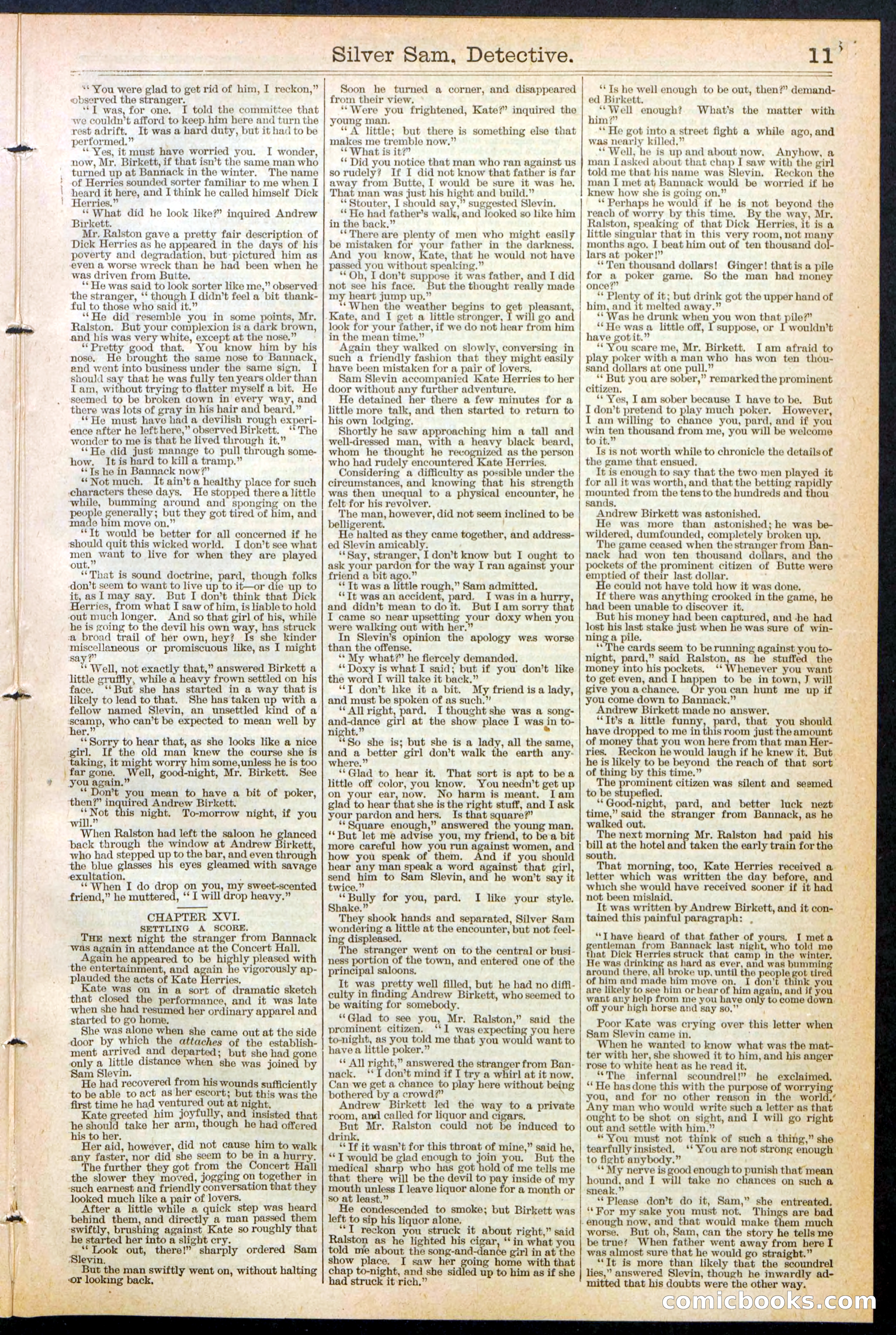
A restored page from Pulp Fiction, 1886. Page through the whole issue in the reader above.
📄 Transcribed text from this page (OCR, searchable)
Machine-transcribed from the original scan — historical spelling and the odd misread are preserved.
a broad trail of her own, hey? girl. taking, it might worry him some,unless he is too —— a me ew oe ee SS es _-_--_-_—_— ‘You were glad to get rid of him, I reckon,” observed the stranger. ‘*T was, for one. I told the committee that we couldn’t afford to keep. him here and turn the rest adrift. It was a hard duty, but it had to be performed.” ‘Yes, it must have worried you. I wonder, now, Mr, Birkett, if that isn’t the same man who turned up at Bannack in the winter. The name of Herries sounded sorter familiar to me when I heard it here, and I think he called himself Dick Herries.” ‘* What did he look like?” inquired Andrew Birkett. Mr, Ralston gave a pretty fair description of Dick Herries as he appeared in the days of his poverty and degradation, but: pictured him as even a worse wreck than he had been when he was driven from Butte. ** He was said to look sorter like me,” observed the stranger, ‘‘ though I didn’t feel a bit thank- ful to those who said it.” ‘He did resemble you in some points, Mr. Ralston. But your complexion is a dark brown, and his was very white, except at the nose.” “Pretty good that. You know him by his nose. He brought the same nose to Bannack, end went into business under the same sign. should say that he was fully ten years older than Tam, without trying to flatter myself a bit. He seemed to be broken down in every way, and there was lots of gray in his hair and beard.” ‘‘He must have had a devilish rough experi- ence after he left here,” observed Birkett. ‘The wonder to me is that he lived through it.” ‘‘He did just manage to pull through some- how. It is hard to kill a tramp.” “Ts he in Bannack now?” “Not much. It ain’t a healthy place for such characters these days. He stopped there a little while, bumming around and sponging on the per i eg generally; but they got tired of him, and made him move on,” “It would be better for all concerned if he should quit this wicked world. I don’t see what men want to live for when they are played out, **That is sound doctrine, pard, though folks don’t seem to want to live up to it—or die up to it, as | may say. But I don’t think that Dick erries, from what I saw of him, is liable to hold out much longer. And so that girl of his, while he is going to the devil his own way, has struck s she kinder miscellaneous or promiscuous like, as I might say?” * Well, not exactly that,” answered Birkett a little gruffly, while a heavy frown settled on his face. ‘‘But she has started in a way that is likely to lead to that. She has taken up with a fellow named Slevin, an unsettled kind of a scamp, who can’t be expected to mean well by her.” ‘Sorry to hear that, as she looks like a nice If the old man knew the course she is far gone. ell, good-night, Mr. Birkett. See you again.” ‘* Don’t you mean to have a bit of poker, then?” inquired Andrew Birkett. Reh this night. To-morrow night, if you Will. When Ralston had left the saloon he glanced back through the window at Andrew Birkett, who had stepped up to the bar, and even through the blue glasses his eyes gleamed with savage exultation. ‘When I do drop on you, my sweet-scented friend,” he muttered, ‘‘ [ will drop heavy.” CHAPTER XVI. SETTLING A SCORE. THE next night the stranger from Bannack was again in attendance at the Concert Hall. Again he appeared to be highly pleased with the entertainment, and again he vigorously ap- plauded the acts of Kate Herries. Kate was on in a sort of dramatic sketch that closed the performance, and it was late when she had resumed her ordinary apparel and started to go home. She was alone when she came out at the side door by which the attaches of the establish- ment arr ived and departed; but she had gone only a little distance when she was joined by Sam Slevin. : He had recovered from his wounds sufficiently +o be able to act as her escort; but this was the first time he had ventured out at night. Kate greeted him joyfully, and insisted that he should take her arm, though he had offered his to her. ‘ : Her aid, however, did not cause him to walk any faster, nor did she seem to be in a hurry. The further they got from the Concert Hall the slower they moved, jogging on together in ‘such earnest and friendly conversation that they looked much like a pair of lovers. After a little while a quick step was heard behind them, and directly a man passed them ‘swiftly, brushing against Kate so roughly that he started her into a slight cry. _“* Look out, there!” sharply ordered Sam evin. But the man swiftly or looking back, went on, without halting wcicabinaed ec maa Soon he turned a corner, and disappeared from their view. ‘Were you frightened, Kate?’ inquired the young man. ‘*A little; but there is something else that makes me tremble now,” ** What is it?” ** Did you notice that man who ran against us so rudely? If I did not know that father is far away from Butte, I would be sure it was he, That man was just his hight and build.” **Stouter, I should say,” suggested Slevin. ‘He had father’s walk, and looked so like him in the back.” “There are plenty of men who might easily be mistaken for your father in the darkness. And you know, Kate, that he would not have passed you without speaking.” **Oh, I don’t suppose it was father, and I did not see his face. But the thought really made my heart jump up.” ‘When the weather begins to get pleasant, Kate, and I get a little stronger, f will go and look for your father, if we do not hear from him in the mean time.” Again they walked on slowly, conversing in such a friendly fashion that they might easily have been mistaken for a pair of lovers, Sam Slevin accompanied Kate Herries to her door without any further adventure. He detained her there a few minutes for a little more talk, and then started to return to his own lodging. Shortly he saw approaching him a tall and well-dressed man, with a heavy black beard, whom he thought he recognized as the person who had rudely encountered Kate Herries. Considering a difficulty as possible under the circumstances, and knowing that his strength was then unequal to a physical encounter, he felt for his revolver. The man, however, did not seem inclined to be belligerent. He halted as they came together, and address- ed Slevin amicably. ‘Say, stranger, I don’t know but I ought to ask your pardon for the way I ran against your friend a bit ago.” ‘Tt was a little rough,” Sam admitted. ‘Tt was an accident, pard. I was ina hurry, and didn’t mean to doit. But I am sorry that I came so near upsetting your doxy when you were walking out with her.” In Slevin’s opinion the apology wes worse than the offense. ** My what?” he fiercely demanded. ‘*Doxy is what I said; but if you don’t like the word I will take it back.” ‘“T don’t hke it a bit. My friend is a lady, and must be spoken of as such.” ‘Allright, pard. I thought she was a song- and-dance girl at the show place I was in to- night.” ° ‘*So she is; but she is a lady, all the same, and a better girl don’t walk the earth any- where.” ‘*Glad to hear it. That sort is apt to bea little off color, you know, ‘You needn’t get up on your ear, now. No harm is meant. Iam glad to hear that she is the right stuff, and I ask your pardon and hers. Is that square?” ““Square enough,” answered the young man. **But let me advise you, my friend, to be a bit more careful how you run against women, and how you speak of them. And if you should hear any man speak a word against that girl, send him to Sam Slevin, and he won't say it twice.” ‘Bully for you, pard. Shake.” They shook hands and separated, Silver Sam wondering a little at the encounter, but not feel- ing displeased. The stranger went on to the central or busi- ness portion of the town, and entered one of the principal saloons. It was pretty well filled, but he had no diffi- culty in finding Andrew Birkett, who seemed to be waiting for somebody, **Glad to see you, Mr. Ralston,” said the prominent citizen. ‘1 was expecting you here to-night, as you told me that you would want to have a little poker.” ‘* All right,” answered the stranger from Ban- nack. ‘‘ I don’t mind if I try a whirl at it now. Can we get a chance to play here without being bothered by a crowd?” Andrew Birkett led the way to a private room, and called for liquor and cigars. But Mr. Ralston could not be induced to drink, ‘Tf it wasn’t for this throat of mine,” said he, “*T would be glad enough to join you. But the medical sharp who has got hold of me tells me that there will be the devil to pay inside of my mouth unless I leave liquor alone for a month or so at least.” : He condescended to smoke; but Birkett was left to sip his liquor alone. ‘I reckon you struck it about right,” said Ralston as he lighted his cigar, “in what you told me about the song-and-dance girl in at the show place. I saw her going home with that chap to-night, and she sidled up to him as if she had struck it rich,” \ I like your style. SE a a a a a a ee ee 11 — | ‘*Ts he well enough to be out, then?” demand- ed Birkett. “Well enough? What's the him?” ‘** He got into a street fight a while ago, and was nearly killed.” ‘* Well, he is up and about now. Anyhow, a man lasked about that chap I saw with the girl told me that his name was Slevin. Reckon the man I met at Bannack would be worried if he knew how she is going on.” ‘** Perhaps he would if he is not beyond the reach of worry by this time. By the way, Mr. Ralston, speaking of that Dick Herries, it is a little singular that in this very room, not man months ago. I beat him out of ten thousand dol- lars at poker!” **'Ten thousand dollars! for a poker game. & once?” ** Plenty of it; but drink got the upper hand of him, and it melted away.” ** Was he drunk when you won that pile?” ‘*He was a little off, I suppose, or I wouldn't have gotit.” **'You scare me, Mr. Birkett. Iam afraid to play poker with a man who has won ten thou- sand dollars at one pull.” ‘** But you are sober,” remarked the prominent citizen. ‘* Yes, Iam sober because I have to be. But I don’t pretend to play much poker. However, I am willing to chance you, pard, and if you win ten thousand from me, you will be welcome to it. Is is not worth while to chronicle the details of the game that ensued. It is enough to say that the two men played it for all if was worth, and that the betting rapidly os eran from the tens to the hundreds and thou sands. Andrew Birkett was astonished, He was more than astonished; he was be- wildered, dumfounded, completely broken up. The game ceased when the stranger from Ban- nack had won ten thousand dollars, and the pockets of the prominent citizen of Butte were emptied of their last dollar. e could not have told how it was done, If there was anything crooked in the game, he had been unable to discover it. But his money had been captured, and -he had lost his last stake just when he was sure of win- ning a pile. ‘The cards seem to be running against you to- night, pard,” said Ralston, as he stuffed the money into his Peg mate ‘Whenever you want to get even, and [ happen to be in town, J will give youachance. Or you can hunt me up if you come down to Bannack.” Andrew Birkett made no answer, ‘It’s a little funny, pard, that you should have mil se to me in this room just the amount of money that you won here from that man Her- matter with Ginger! thatis a pile So the man had money > > ries. Reckon he would laugh if he knew it. But — he is likely to be beyond the reach of that sort’ of thing by this time.” The prominent citizen was silent and seemed to be stupefied. ‘*Good-night, pard, and better luck nezt time,” said the stranger from Bannack, as he walked out. The next morning Mr. Ralston had paid his ay ae the hotel and taken the early train for the south. That morning, too, Kate Herries received a letter which was written the day before, and which she would have received sooner if it had not been mislaid. It was written by Andrew Birkett, and it con- tained this painful paragraph: . “T have heard of that father of yours. I meta zentleman from Bannack last night, who told me that Dick Herries struck that camp in the winter. - He was drinking as hard as ever, and was bummin around there, all broke up, until the people got tired of him and made him move on. I Goat t are likely to see him or bear of him again, and if you want any help from me you have only tocome down. — off your high horse and say so,” ' Poor Kate was crying over this letter when Sam Slevin came in. When he wanted to know what was the mat- ter with her, she showed it to him, and his anger rose to white heat as he read it, ““The infernal scoundrel!” he exclaimed, ‘He has done this with the purpose of worrying you, and for no other reason in the world.’ Any man who would write such a letter as that ought to be shot on sight, and I will go right out and settle with him.” , “You must not think of such a thing,” she tearfully insisted. to fight anybody.” nk you © f ‘ ‘*'You are not strong enough ° my ‘* My nerve is good enough to punish that mean hound, and I will take no chances on such a sneak.” ‘Please don’t do it, Sam,” she entreated. — ‘*For my sake you must not. Thin enough now, and that would make them much are bad © worse. But oh, Sam, can the story he tells me — be true? When father went away from here I was almost sure that he would go straight.” “‘It is more than likely that the scoundrel lies,” answered Slevin, though he inwardly ad- — mitted that his doubts were the other way. Gomichboo pe eel 2 hy, - os - af & La Pts a