
Pulp Fiction, 1886 · page 2 of 32
Beadle's New York Dime Library, No. 378 — page 2: what you’re looking at
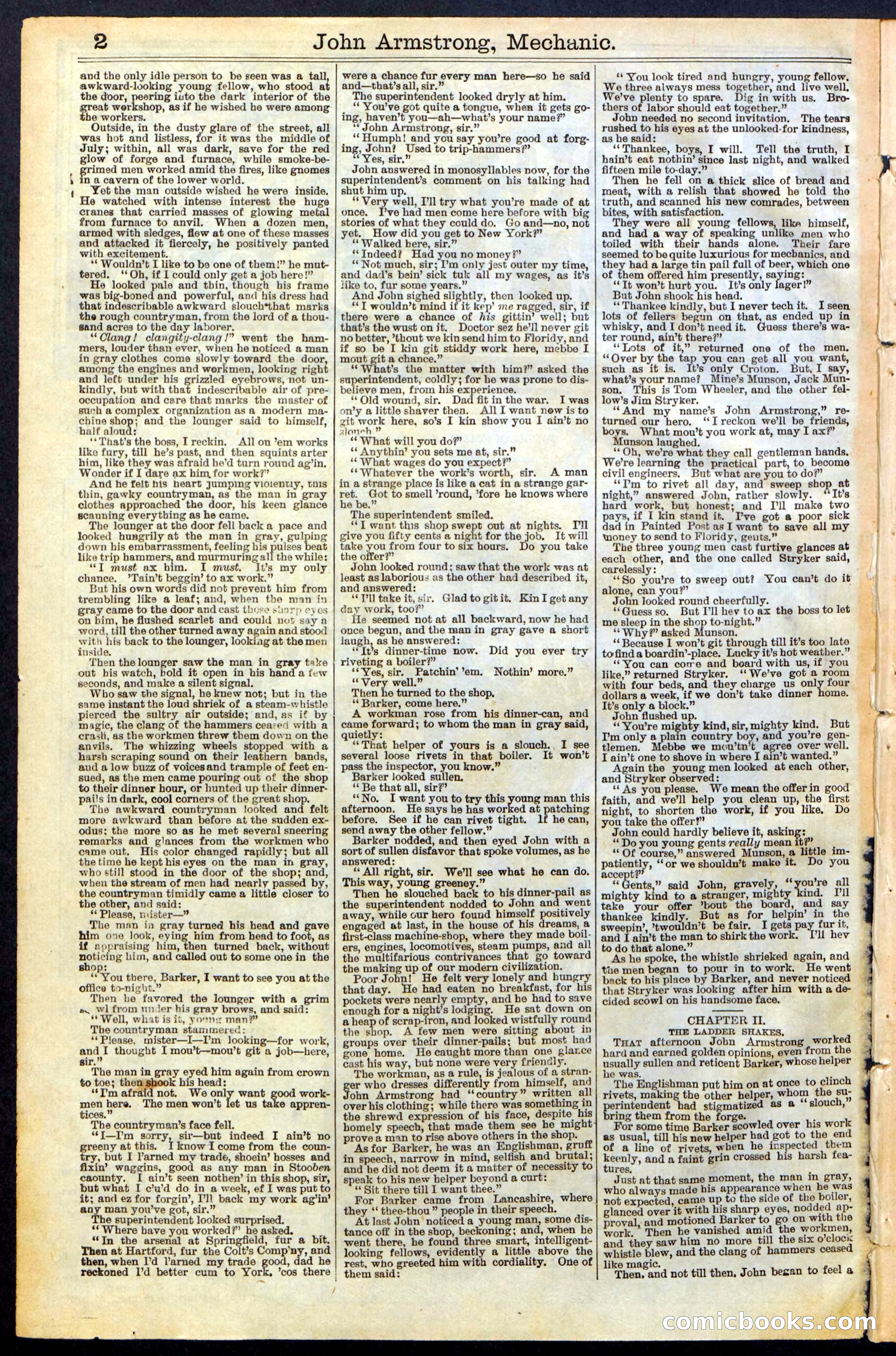
A restored page from Pulp Fiction, 1886. Page through the whole issue in the reader above.
📄 Transcribed text from this page (OCR, searchable)
Machine-transcribed from the original scan — historical spelling and the odd misread are preserved.
- 2 John Armstrong, Mechanic. ~—_— -- and the only idle person to be seen was a tall, awkward-looking young fellow, who stood at the door, peering iuto the dark interior of the eat workshop, as if he wished he were among he workers. Outside, in the dusty glare of the street, all was hot and listless, for it was the middle of July; within, all was dark, save for the red glow of forge and furnace, while smoke-be- rimed men worked amid the fires, like gnomes n a cavern of the lower world. Yet the man outside wished he were inside. He watched with intense interest the huge cranes that carried masses of glowing metal from furnace to anvil. When a dozen men, armed with sledges, flew at one of these masses and attacked it fiercely, he positively panted with excitement. ‘** Wouldn’t I like to be one of them!” he mut- fered. ‘Oh, if I could only get a job here!” He looked pale and thin, though his frame was big-boned and powerful, and his dress had that indescribable awkward slouch*that marks the rough countryman, from the lord of a thou- gand acres to the day laborer. “Olang! clangity-clang!” went the ham- mers, louder than ever, when he noticed a man in gray clothes come slowly toward the door, among the engines and workmen, looking right and left under his grizzled eyebrows, not un- kindly, but with that indescribable air of pre- occupation and care that marks the master of such a complex organization as a modern ma- chine cae and the lounger said to himself, half aloud: ‘** That’s the boss, Ireckin. All on ’em works like fury, till he’s past, and then squints arter him, like they was afraid he'd turn round ag’in. Wonder if I dare ax him, for work?” And he felt his heart Jumping violently, this thin, gawky countryman, as the man in gray clothes approached the door, his keen glance scanning everything as he came. The lounger at the door fell back a pace and looked hungrily at the man in gray, gulping down his embarrassment, feeling his pulses beat like trip hammers, and murmuring all the while: “T must ax him. I must. It’s my only chance. ’Tain’t beggin’ to ax work.” But his own words did not prevent him from trembling like a leaf; and, when the man in gray came to the door and cast thvuse suarp eyes on bim, he flushed scarlet and could not say a word, till the other turned away again and stood with his back to the lounger, lookiag at the men inside. Then the lounger saw the man in gray take out his watch, bold it open in his hand a few seconds, and make a silent signal. Who saw the signal, he knew not; but in the same instant the loud shriek of a steam-whistle pierced the sultry air outside; and, as if by magic, the clang of the hammers cearec| with a crasi, as the workmen threw them down on the anvils. The whizzing wheels stopped with a harsh scraping sound on their leathern bands, and a low buzz of voicesand trample of feet en- sued, as the men came pouring out of the shop to their dinner hour, or hunted up their dinner- pai!s in dark, cool corners of the great shop. The awkward countryman looked and felt more awkward than before at the sudden ex- odus; the more so as he met several sneering remarks and glances from the workmen who came out, His color changed rapidly; but all the time he kept his eyes on the man in gray, who still stood in the door of the shop; and, when the stream of men had nearly passed by, the countryman timidly came a little closer to the other, and said: ** Please, riister—” The man in gray turned his head and gave him one look, eying him from head to foot, as if appraising him, then turned back, without noticing him, and called out to some one in the shop: . ‘** You there, Barker, I want to see you at the office to-night.” Then he favored the lounger with a grim oe, wl from nnier his gray brows, and said: ‘* Well, what is it, youne man?” The countryman stammered: ‘*Please, mister—I—I’m looking—for work, and I thought I mou’t—mou’t git a job—here, sir. The man in gray eyed him again from crown to toe; then) k his head: ‘I’m afraid not. We only want good work- men here. The men won’t let us take appren- tices.” The countryman’s face fell. “T—[m sorry, sir—but indeed I ain’t no greeny at this. I know I come from the coun- try, but I l’arned my trade, shoein’ hosses and fixin’ waggins, good as any man in Stooben caounty. I ain’t seen nothen’ in this shop, sir, but what I c’u’d do in a week, ef I was put to it; and ez for forgin’, I'l back my work ag’in’ aoy man you've got, sir.” he superintendent looked surprised. ** ‘Where have you worked?” he asked. ; “In the arsenal at Springfield, fur a bit. Then at Hartford, fur the Colt’s Com ‘By, and then, when I’d l’arned my trade good, dad he reckoned I’d better cum to York, ’cos there >. = eS were a chance fur every man here—so he said and—that’s all, sir.” The superintendent looked dryly at him. _ “You've got quite a tongue, when it gets go- ing, haven’t you—ah—what’s your name?” ‘* John Armstrong, sir.” ‘*Humph! and you say you’re good at forg- ing, John? Used to trip-hammers?”’ ‘ Yos, str.” John answered in monosyllables now, for the superintendent’s comment on his talking had shut him up. “Very well, I'll try what you’re made of at once. l’ve had men come here before with big stories of what they could do. Go and—no, not yet. How did you get to New York?” ** Walked here, sir.” ‘Indeed? Had you no money?” ** Not much, sir; I’m only jest outer my time, and dad's bein’ sick tuk all my wages, as it’s like to, fur some years.” And John sighed slightly, then looked up. **T wouldn’t mind if it kep’ me ragged, sir, if there were a chance of his gittin’ well; but that’s the wust onit. Doctor sez he’ll never git no better, ’thout we kin send him to Floridy, and if so be I kin git stiddy work here, mebbe I mout git a chance.” es at’s the matter with him?’ asked the i, ert coldly; for he was prone to dis- believe men, from his experience. ‘*Old wound, sir. Dad fit in the war. I was on’y a little shaver then. All I want new is to git work here, so’s I kin show you I ain’t no sloneh ‘What will you do?” ** Anythin’ you sets me at, sir.” “What wages do you expect?” ‘* Whatever the work’s worth, sir. A man in a strange place is like a cat in a strange gar- ret. Got to smell ’round, ‘fore he knows where he be.” The superintendent smiled. ‘*] want this shop swept out at nights. Tl give you fifty cents a night for the job. It will take you from four to six hours, Do you take the offer?” John looked round; saw that the work was at least as laborious as the other had described it, and answered: ‘“* Tl take it, sir. Glad to gitit. Kin I get any day work, too?’ He seemed not at all backward, now he had once begun, and the manin gray gave a short laugh, as he answered: “Tvs dinner-time now. Did you eyer try riveting a boiler?” ‘¢'Yes, sir. Patchin’’em. Nothin’ more.” ‘Very well.” Then he turned to the shop, ‘* Barker, come here.” A workman rose from his dinner-can, and came forward; to whom the man in gray said, quietly: ‘That helper of yours is a slouch., I see several loose rivets in that boiler. It won’t pass the inspector, you know.” Barker looked sullen, ** Be that all, sir?” “No. I want you to try this gos man this afternoon. He says he has worked at poching before. See if he can rivet tight. 1f he can, send away the other fellow.” Barker nodded, and then eyed John with a sort of sullen disfavor that spoke volumes, as he answered: pees right, sir. We'll see what he can do. way, young greeney. : Then he slouched back to his dinner-pail as the superintendent nodded to John and went away, while our hero found himself positively engaged at last, in the house of his dreams, @ first-class machine-shop, where they made boil- ers, engines, locomotives, steam pumps, aid all the multifarious contrivances that go toward the making up of our modern civilization. Poor John! He felt very lonely and bungry that day. He had eaten no breakfast, for his pockets were nearly empty, and he had to save enough for a night’s lodging. He sat down on a heap of scrap-iron, and looked wistfully round the shop. A few men were vane about in groups over their dinner-pails; but most had gone home. He caught more than one glance cast his way, but none were very friendly. The workman, as a rule, is jealous of a stran- r who dresses differently from himself, and ohn Armstrong had ‘‘country” written all over his clothing; while there was something in the shrewd expression of his face, despite his homely speech, that made them see he might prove a man to rise above others in the shop. As for Barker, he was an Englishman, gruff in speech, narrow in mind, selfish and brutal; and he did not deem it a matter of necessity to speak to his new helper beyond a curt: ‘Sit there till I want thee.” : For Barker came from Lancashire, where they ‘‘ thee-thou ” people in their speech. : At last John noticed a young man, some dis- tance off in the shop, beckoning; and, when he went there, he found three smart, intelligent- looking fellows, evidently a little above the rest, who greeted him with cordiality. One of them said: “‘ You look tired and hungry, young fellow, We three always mess together, and live well, We’ve plenty to spare. Dig in with us. Bro- thers of labor should eat together.” Jobn needed no second invitation. The tears rushed to his eyes at the unlooked-for kindness, as he said: ; ‘*Thankee, boys, I will. Tell the truth, I hain’t eat nothin’ since last night, and walked fifteen mile to-day.” Then he fell on a thick slice of bread and meat, with a relish that showed he told tho truth, and scanned his new comrades, between bites, with satisfaction. They were all young fellows, like himself, and had a way of speaking unlike men who toiled with their hands alone. Their fare seemed to be quite luxurious for mechanics, and they had a large tin pail full of beer, which one of them offered him presently, saying: ‘Tt won’t hurt you. It’s only lager!” But John shook his head. ‘*'Thankee kindly, but I never tech it. I seen lots of fellers begun on that, as ended up in whisky, and I don’t need it. (juess there’s wa- ter round, ain’t there?’ ‘‘Lots of it,” returned one of the men, ‘““Over by the tap you can get all you want, such as it is. It’s only Croton. But, I say, what’s your name? Mine’s Munson, Jack Mun- son. This is Tom Wheeler, and the other fel- low’s Jim Stryker. “And my name’s John Armstrong,” re- turned our hero. ‘‘I reckon we'll be friends, boys. What mou’t you work at, may I ax?” Munson laughed. ‘*Oh, we're what they call gentleman hands, We're learning the practical part, to become civil engineers. But what are you to do?” “Tm to rivet all day, and sweep shop at night,” answered Jobn, rather slowly. “It’ hard work, but honest; and Tl make two pays, if I kin stand it. I’ve got a poor sick dad in Painted Post as I want to save all my woney to send to Floridy, gents.” The three young men cast furtive glances at each other, and the one called Stryker said, carelessly : . “So you’re to sweep out? You can’t do it alone, can you?” John looked round cheerfully. ** Guess so. me sleep in the shop to-night.” ‘Why?’ asked Munson, : ‘Because I won’t git through till it’s too late tofind a boardin’-place. Lucky it’s hot weather.” ‘You can core and board with us, if you like,” returned Stryker. ‘‘We’ve got a room with four beds, and they charge us only four dollars a week, if we don’t take dinner home. It’s only a block.” John flushed Ep. “You're mighty kind, sir, mighty kind. But I’m only a plain country boy, and you’re gen- tlemen. Mebbe we mou’tn’t agree over well. I ain’t one to shove in where I ain’t wanted.” Again the young men looked at each other, and Stryker observed: ; ‘© Ag you please. We mean the offerin good faith, and we'll help you clean up, the first night, to shorten the work, if you like, Do you take the offer?” John could hardly believe it, aoe “Do you young gents really mean it?” ‘Of course,” answered Munson, a little im- patiently, “or we shouldn't make it. Do you accept? ; “Gents,” said John, gravely, ‘you're all mighty kind to a stranger, mighty kind. I'll take ‘your offer ’bout the board, and say But as for helpin’ in the thankee kindly. ! sweepin’, ’twouldn’t be fair. I gots yeti it, and L ain’t the man to shirk the work. [ll hev to do that alone.” ; As he spoke, the whistle shrieked again, and the men began to pour in to work. He went back to his place by Barker, and never noticed that Stryker was looking after him with a de- cided scowl on his handsome face. CHAPTER II, THE LADDER SHAKES, Tat afternoon Jobn Armstrong worked hard and earned golden opinions, even from the usually sullen and reticent Barker, whose helper he was. The Englishman put him on at rivets, making the other helper, perenceys had stigmatized as a ring them from the forge. : For some time Barker scowled over his work ro ore till his new helper had got to the end of a line of rivets, when keenly, anda Ft ag Bt crossed his harsh fea- tures, : Just at that same moment, the man in gray, once to clinch whom the su- But I’ll hev to ax the boss to let é a he inspected them | aie ei ‘¢ slouch,” — who always made his appearance when he was * n ame up to the side of the boiler, el Gane with his sharp eyes, nodded ap- proval, and motioned Barker to go on with the work, Then he vanished amid the workmen, and they saw him no more till the six o’clock whistle blew, and the clang of hammers k ic. % Gaon and not till then, John began to feel a i] * ein en la JOO! com (E = ~~ = > J ; 2" = $ s .