
Pulp Fiction, 1886 · page 16 of 32
Beadle's New York Dime Library, No. 378 — page 16: what you’re looking at
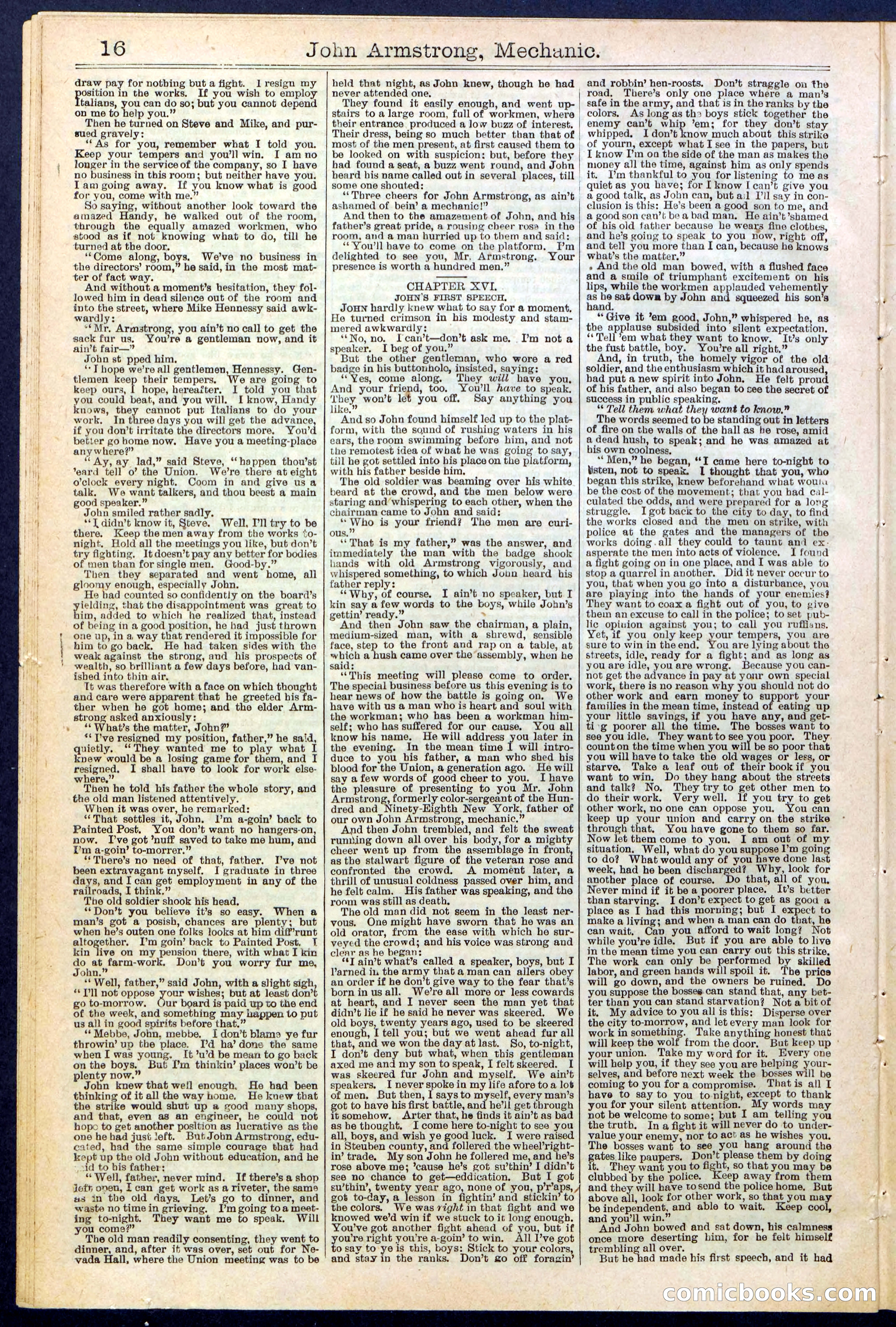
A restored page from Pulp Fiction, 1886. Page through the whole issue in the reader above.
📄 Transcribed text from this page (OCR, searchable)
Machine-transcribed from the original scan — historical spelling and the odd misread are preserved.
a eo Se an ag — - a ee ee %<e a? -_—~ a Se 72 <r, _— . = oe oe ‘ —_ a ais co ~ st ™& =: Se ae ee eee ~ “ Sr = = — = —_ ere Se oS ——— — - —————— draw pay for nothing but a fight. l resign my osition in the works. If you wish to employ talians, you can do so; but you cannot depend on me to help you.” Then he turned on Steve and Mike, and pur- sued gravely: **As for you, remember what I told you. Keep your tempers and you'll win. I am no longer in the service of the company, so I have no business in this room; but neither have you. Tam going away. If you know what is good for you, come with me,” So saying, without another look toward the amazed Handy, he walked out of the room, through the equally amazed workmen, who stood as if not knowing what to do, till he turned at the door. ‘Come along, boys. We've no business in the directors’ room,” he said, in the most mat- ter of fact way. And without a moment’s hesitation, they fol- lowed him in dead silence out of the room and into the street, where Mike Hennessy said awk- wardly: **Mr, Armstrong, you ain’t no call to get the sack fur us. You’re a gentleman now, and it ain’t fair—” John st pped him, ‘*T hope we’re all gentlemen tlemen keep their tempers. keep ours, | hope, hereafter. I told you that you could beat, and you will. I know, Handy knows, they cannot put Italians to do your work, In three days you will get the advance, if you don’t irritate the directors more. You’d better go home now. Have you a meeting-place any where?” ** Ay, ay lad,” said Steve, “happen thou’st ‘eard tell o’ the Union. We’re there at eight o’clock every night. Coom in and give us a talk. We want talkers, and thou beest a main good speaker.” John smiled rather sadly. ‘*] didn’t know it, Steve. Well, I'll try to be there. Keep the men away from the works to- night. Hold all the meetings you like, but don’t try fighting. Itdoesn’t pay any better for bodies of men than for single men. Good-by.” Then they separated and went home, all gloomy enough, especially John. He bad counted so confidently on the board’s ielding, that the disappointment was great to im, added to which he realized that, instead of being in a good position, he had just thrown one up, in a way that rendered it impossible for him to go back, He had taken sides with the weak against the strong, and his prospects of wealth, so brilliant a few days before, had van- ished into thin air, Tt was therefore with a face on which thought and care were apparent that he greeted his fa- ther when he got home; and the elder Arm- strong asked anxiously: ‘* What's the matter, John?’ **T’ve resigned my position, father,” he said, quietly. ‘They wanted me to play what I knew would be a losing game for them, and I resigned, I shall have to look for work else- where,” Then he told his father the whole story, and the old man listened attentively. When it was over, he remarked: ‘That settles it, John. I’m a-goin’ back to Painted Post. ‘You don’t want no hangers-on, now. I’ve got ’nuff saved to take me hum, and 0m a-goin’ to-morrer.” ‘*There’s no need of that, father. I’ve not been extravagant myself. I graduate in three days, and I can get employment in any of the railroads, I think,” The old soldier shook his head, **Don’t you believe it’s so easy. When a man’s got a posish, chances are plenty; but when he’s outen one folks looks at him diff’runt altogether. I’m goin’ back to Painted Post, T kin live on my pension there, with what I kin do at farm-work, Don’t you worry fur me, ‘* Well, father,” said John, with a slight sigh ** [ll not oppose your wishes; but at least don’t go to-morrow. Our board is paid up to the end of the week, and something may happen to put us all in good spirits before that.” ** Mebbe, John, mebbe. I don’t blame ye fur throwin’ up the place. Td ha’ dons the same when I was young. I[t’u’d be mean to go back on the boys. But I’m thinkin’ places won’t be plenty now.” John knew that well enough. He had been thinking of it all the way home, He knew that the strike would shut up a good many shops, and that, even as an engineer, he could not hopo to get another position as lucrative as the one he had just ‘eft. ButJobn Armstrong, edu- eated, had the same simple courage that had kept up the old John without education, and he rid to bis father: ** Well, father, never mind. If there’s a shop Jetr onen, I can get work as a riveter, the same «3 in the old days, Let’s go to dinner, and waste no timein grieving. I’m going toa meet- ing to-night. They want me to speak. Will you come?” The old man readily consenting, they went to dinner, and, after it was over, set out for Ne- vada Hall, where the Union meeting was to be Hennessy. Gen- ‘We are going to held that night, as John knew, though he had never attended one, They found it easily enough, and went up- stairs to a large room, full of workmen, where their entrance produced a low buzz of interest. Their dress, being so much better than that of most of the men present, at first caused them to_ be looked on with suspicion: but, before they had found a seat, a buzz went round, and John heard bis name called out in several places, till some one shouted: ‘‘Three cheers for John Armstrong, as ain’t ashamed of bein’ a mechanic!” And then to the amazement of John, and his father’s great pride, a rousing cheer rosa in the room, and a man hurried up to them and said: ‘You'll have to come on the platform, I’m delighted to see you, Mr, Armstrong, Your presence is worth a hundred men,” CHAPTER XVI. JOHN'S FIRST SPEECH, Joun hardly knew what to say for a moment, He turned crimson in his modesty and stam- moered awkwardly: ‘No, no. Ican’t—don’t ask me, speaker. I beg of you.” But the other gentleman, who wore a red badge in his buttonholo, insisted, saying: ‘*Yes, come along. They will have you, And your friend, too. You'll have to speak, They won’t let you off. Say anything you like,’ And so John found himself led up to the plat- form, with the sound of rushing waters in his ears, the room swimming before him, and not the remotest idea of what he was going to say, till he got settled into his place on the platform, with his father beside him, The old soldier was beaming over his white beard at the crowd, and the men below were staring and’ whispering to each other, when the chairman came to John and said: ** Who is your friend? ‘'he men are curi- ous.” ‘*That is my father,” was the answer, and immediately the man with the badge shook hands with old Armstrong vigorously, and whispered something, to which Join heard his father reply: | ‘‘ Why, of course. I ain’t no speaker, but I kin say a few words to the boys, while John’s gettin’ ready.” > And then John saw the chairman, a plain, medium-sized man, with a shrewd, sensible face, step to the front and rap on a table, at which a hush came over the assembly, when he said: ‘This meeting will please come to order, The special business before us this evening is to hear news of how the battle is going on, We have with us a man who is heart and soul with the workman; who has been a workman him- self; who has suffered for our cause. You all know his name. He will address you later in the evening. In the mean time 1 will intro- duce to you his father, a man who shed his blood for the Union, a generation ago. He will say afew words of good cheer to you. I have the pleasure of presenting to you Mr. John Armstrong, formerly color-sergeant of the Hun- dred and Ninety-Eighth New York, father of our own John Armstrong, mechanic.” And then John trembled, and felt the sweat runing down all over his body, for a mighty cheer went up from the assemblage in front as the stalwart figure of the veteran rose and confronted the crowd. A moment later, a thrill of unusual coldness passed over him, and he felt calm. His father was speaking, and the room was still as death, The old man did not seem in the least ner- vous. One might have sworn that he was an old orator, from the ease with which he sur- veyed the crowd; and his voice was strong and clear as he began: “‘T ain’t what’s called a speaker, boys, but I Varned in the army that aman can allers obey an order if he don’t give way to the fear that’s born in us all. We’re all more or less cowards at heart, and I never seen the man yet that didn’t lie if he said he never was skeered. We old boys, twenty years ago, used to be skeered enough, I tell you; but we went ahead fur all that, and we won the day at last. So, to-night, I don’t deny but what, when this gentleman axed me and my son to speak, I felt skeered. I was skeered fur John and myself. We ain’t speakers, I never spoke in my life afore to a lot of men, But then, I says to myself, every man’s got to have his first battle, and he’ll get through it somehow. Arter that, he finds it ain’t as bad as he thought. I come here to-night to see you all, boys, and wish ye good luck. I were raised in Steuben county, and follered the wheel’right- in’ trade. Myson John he follered me, and he’s rose above me; ’cause he’s got suw’thin’ I didn’t see no chance to get—eddication. But I got su’thin’, twenty year ago, none of you, p’r’aps, got to-day, a lesson in fightin’ and stickin’ to the colors. We was right in that fight and we knowed we’d win if we stuck to it long enough. You’ve got another fight ahead of iy but if ou’re right you're a-goin’ to win. All I’ve got osay to ye is this, boys: Stick to your colors, and stay in the ranks. Don’t go off foragin’ I’m nota John Armstrong, Mechanic. a a ae wlletguananed and robbin’ hen-roosts. Don’t straggle on the road. There’s only one place where a man’s safe in the army, and that is in the ranks by the colors. As long as th» boys stick together the enemy can’t whip ’em; for they don’t stay whipped, I don’t know much about this strike of yourn, except what I see in the papers, but I know I’m on the side of the man as makes the money all the time, against him as only spends it. I’m thankful to you for listening to meas quiet as you have; for I know I can’t give you a good talk, as John can, but ail Ill say in con- clusion is this: He’s been a good son to me, and a good son can’t bea bad man. He ain’t’shamed of his old father because he wears fine clothes, and he’s going to speak to you now, right off, and tell you more than I can, because he knows what’s the matter.” » And the old man bowed, with a flushed face and a smile of triumphant excitement on his lips, while the workmen applauded vehemently - - sat dowa by John and squeezed his son’s and, “Give it ’em good, John,” whispered he, as the applause subsided into silent expectation. ‘Tell ’em what they want toknow. It’s only the fust battle, boy. You're all right.” And, in truth, the homely vigor of the old soldier, and the enthusiasm which it had aroused, bad put a new spirit into John, He felt proud of his futher, and also began to see the secret of success in public speaking. ** Tell them what they want to know,” The words seemed to be standing out in letters of fire on the walls of the hall as be rose, amid a dead hush, to speak; and he was amazed at his own coolness, : “Men,” he began, “I came here to-night to listen, not to speak. 1 thought that you, who began this strike, knew beforehand what wouwlu be the cost of the movement; that you had ¢al- culated the odds, and were prepared for a long struggle. I got back to the city to day, to find the works closed and the meu on strike, with police at the gates and the managers of the works doing.all they could to taunt and ex- asperate the men into acts of violence. I found a fight going on in one place, and I was able to stop a quarrel in another, Did it never occur to you, that when you go into a disturbance, you are playing into the hands of your enemies? They want to coax a fight out of you, to give them an excuse to call in the police; to set pub- lic opiuion against you; to call you ruffisns. Yet, if you only keep your tempers, you are sure to win in theend, You are lying about the streets, idle, ready for a fight; and as long as you are idle, you are wrong. Because you can- not get the advance in pay at yonr own special work, there is no reason why you should not do other work and earn money to support your families in the mean time, instead of eating up your little savings, if you have any, and get- ti:g poorer all the time. The bosses want to see you idle, They want to see re poor, They count on the time when you will be so poor that you will have to take the old wages or less, or starve. Take a leaf out of their bookif you want to win. Do they hang about the streets and talk? No. They try to get other men to do their work. Very well. If you try to get other work, no one can Oppose you. You can keep up your union and carry on the strike through that, You have gone to them so far. Now let them come to you. I am out of my situation. Well, what do you suppose I’m going to do? What would any of you have done last week, had he been disc hs Why, look for another place of course. Do that, all of you, Never mind if it be a poorer place. It’s better than starving. I don’t expect to get as good a place as I had this morning; but I expect to make a living; and when a man can do that, he can wait, Can you afford to wait long? Not while you’re idle. But if you are able to live in the mean time you can carry out this strike, The work can only be performed by skilled labor, and green hands will spoil it. The prics will go down, and the owners be ruined. Do you suppose the bosseg.can stand that, any bet- ter than you can stand starvation? Nota bit of it, My advice to you all is this: Disperse over the city to-morrow, and let every man look for work in something. Take anything honest that will keep the wolf from the door. your union. Take my word for it. Every one will help you, if they see you are helping your- selves, and before next week the bosses will be coming to you for a compromise. Thatis all I have to say to you tonight, except to thank you for your silent attention.. My words may not be welcome to some; but I am telling you the truth. In a fight it will never do to under- value your enemy, nor to act as he wishes you. The bosses want to see you hang around the gates like paupers. Don’t please them by doing it. They want you to fight, so that you may be clubbed by the police. Keep away from them and they will have tosend the police home, But above all, look for other work, so that you ma be independent, and able to wait. Keep es and you’ll win.” ; And John bowed and sat down, his calmness once more deserting him, for he felt himself trembling all over. But he had made his first speech, and it had But keep up © Gomicboo (C (E (0) S) =