
Pulp Fiction, 1885 · page 6 of 32
Beadle's New York Dime Library, No. 375 — page 6: what you’re looking at
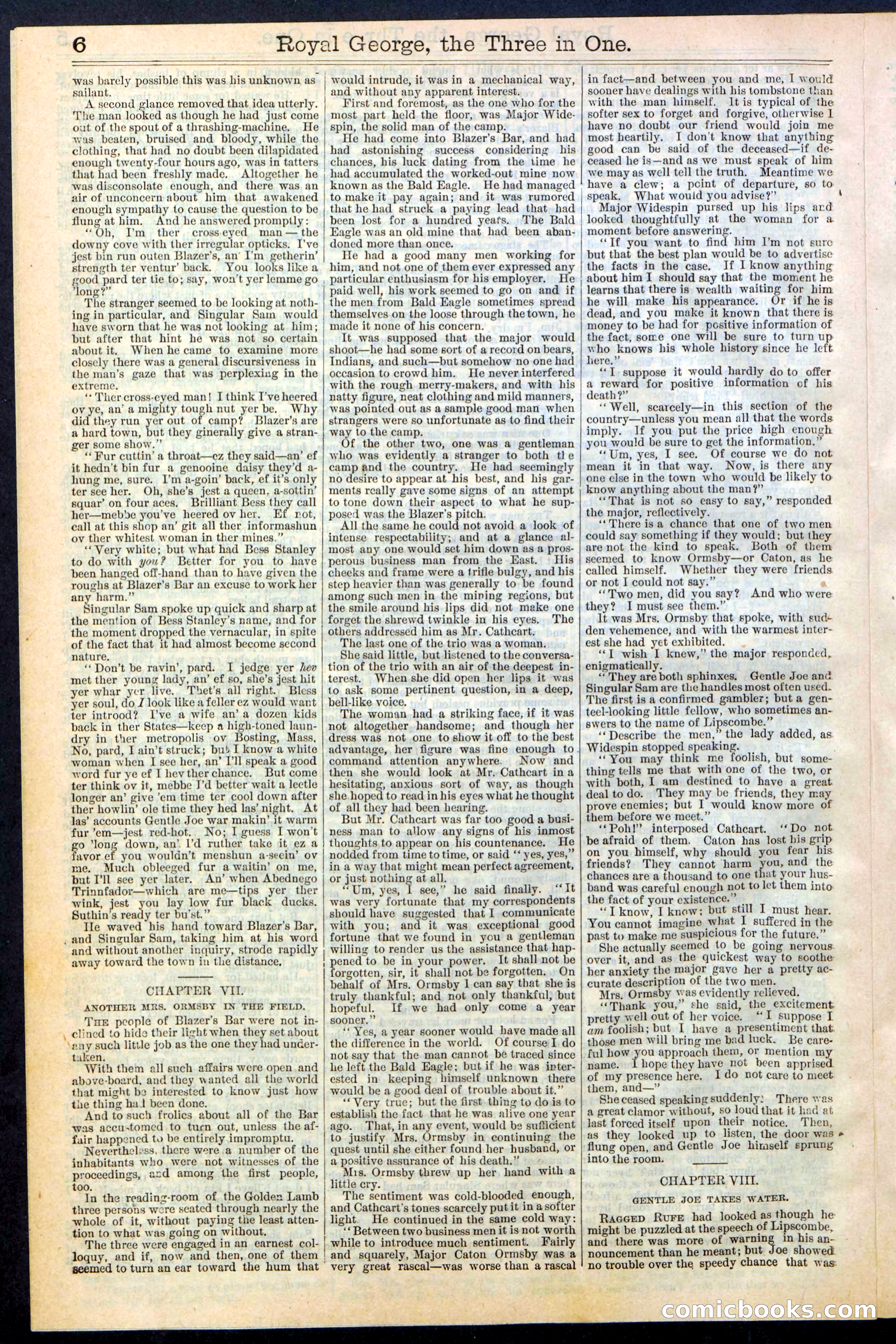
A restored page from Pulp Fiction, 1885. Page through the whole issue in the reader above.
📄 Transcribed text from this page (OCR, searchable)
Machine-transcribed from the original scan — historical spelling and the odd misread are preserved.
6 was barely possible this was his unknown as sailant. A second glance removed that idea utterly. The man looked as though he had just come out of the spout of a thrashing-machine. He was beaten, bruised and bloody, while the clothing, that had no doubt been dilapidated — + ae ete enough twenty-four hours ago, was in tatters | that had been freshly made. Altogether he was disconsolate enough, and there was an air of unconcern about him that awakened enough sympathy to cause the question to be flung at him. And he answered prompily: “Oh, I’m ther crosseyed man— the downy cove with ther irregular opticks. I've | jest bin run outen Blazer’s, an’ I’m getherin’ | strength ter ventur’ back. You looks like a rood pard ter tie to; say, won't yer lemme go , long?” The stranger seemed to be looking at noth- ing in particular, and Singular Sam would | have sworn that he was not looking at him; but after that hint he was not so certain | about it. When he came to examine more | closely there was a general discursiveness in the man’s gaze that was perplexixg in the extreme, ‘* Ther cross-eyed man! I think I’ve heered ov ye, an’ a mighty tough nut yer be. Why did they run yer out of camp? Blazer’s are a hard town, but they ginerally give a stran- ger some show.’ | ‘Fur cuttin’ a throat—ez they said—an’ ef it hedn’t bin fur a genooine daisy they’d a- hung me, sure. I’m a-goin’ back, ef it’s only Oh, she’s jest a queen, a-sottin’ squar’ on four aces. Brilliant Bess they call her—mebbe you've heered ov her. Ef rot, call at this shop an’ git all ther informashun ov ther whitest woman in ther mines.” ‘‘Very white; but what had Bess Stanley to do with you? Better for you to have been hanged off-hand than to have given the roughs at Blazer’s Bar an excuse to work her any harm.” Singular Sam spoke up quick and sharp at the mention of Bess Stanley’s name, and for the moment dropped the vernacular, in spite of the fact that it had almost become second nature, ‘‘Don’t be ravin’, pard. I jedge yer heo met ther young lady, an’ ef so, she’s jest hit yer whar yer live. Thet’s all right. Bless yer soul, do J look like a feller ez would want ter introod? I’ve a wife an’ a dozen kids back in ther States—keep a high-toned laun- dry in ther metropolis oy Bosting, Mass, No, pard, I ain’t struck; bu’ I know a white woman when I see her, an’ Ill speak a good word fur ye ef I hevtherchance. But come ter think ov it, mebbe J’d better wait a lectle longer an’ give ’em time ter cool down after ther howlin’ ole time they hed las’ night. At las’ accounts Gentle Joe war makin’ it warm fur ’em—jest red-hot.. No; I guess I won't o ‘long down, an’. I’d ruther take it ez a hecoe ef you wouldn’t menshun a-seein’ ov Much obleeged fur a waitin’ on me, An’ when Abednego ter see her. me. but I'll see yer later. Trinnfador—which are me—tips yer ther wink, jest you lay low fur black ducks. Suthin’s ready ter bu’st.” Ile waved his hand toward Blazer’s Bar, _and Singular Sam, taking him at his word and without another inquiry, strode rapidly away toward the town in the distance, CHAPTER VII. ANOTHER MRS. ORMSBY IN THE FIELD. Tre people of Blazer’s Bar were not in- . clined to hide their light when they set about ‘any such litile job as the one they had under- tuken, With them all such affairs were open and above-board, and they wanted all the world that might be interested to know just how the thing ha. been done. And to such frolics about all of the Bar was accustomed to turn out, unless the af- fair happened to be entirely impromptu. Nevertheless, there were a number of the inhabitants who were not witnesses of the proceedings, acd among the first people, too. In the reading-room of the Golden Lamb three persons were seated through nearly the whole of it, without paying the least atten- tion to what was going on without. The three were engaged in an earnest col- loquy, and if, now and then, one of them | seemed to turn an ear toward the hum that Royal George | PR hole forgotten, sir, it shall not be forgotten. | would intrude, it was in a mechanical way, ' and without any apparent interest. | First and foremost, as the one who for the |most part held the floor, was Major Wide- spin, the solid man of the camp. He had come into Blazer’s Bar, and had had astonishing success considering his | chances, his luck dating from the time he | had accumulated the worked-out mine now known as the Bald Eagle. He had managed to make it pay again; and it was rumored that he had struck a paying lead that had been lost for a hundred yeats. The Bald Eagle was an old mine that had been aban- doned more than once. | He had a good many men Waning for him, and not one of them ever expressed any particular enthusiasm for his employer. He paid well, his work seemed to go on and if the men from Bald Eagle sometimes spread themselves on the loose through the town, he made it none of his concern. It was supposed that the major would shoot—he had some sort of a record on bears, Indians, and such—but somehow no one had occasion to crowd him. He never interfered with the rough merry-makers, and with his natty figure, neat clothing and mild manners, was pointed out as a sample good man when strangers were so unfortunate as to find their way to the camp. Of the other two, one was a gentleman who was evidently a stranger to both tle camp and the country. He had seemingly no desire to appear at his best, and his gar- ments really gave some signs of an attempt to tone down their aspect to what he sup- posed was the Blazer's pitch. All the same he could not avoid a look of intense respectability; and at a glance al- most any one would set him down as a pros- perous business man from the East. His cheeks and frame were a trifle bulgy, and his step heavier than was generally to be found among such men in the mining regions, but the smile around his lips did, not make one forget the shrewd twinkle in his eyes. The others addressed him as Mr. Cathcart. The last one of the trio was a woman. She said little, but listened to the conversa- tion of the trio with an air of the deepest in- terest. When she did open her lips it was to ask some pertinent question, in a deep, bell-like voice. The woman had a striking face, if it was not altogether handsome; and though her dress was not one to show it off to the best advantage, her figure was fine enough to. command attention anywhere. Now and then she would look at Mr. Cathcart in a hesitating, anxious sort of way, as though she hoped to read in his eyes what he thought of all they had been hearing. But Mr. Cathcart was far too good a busi- ness man to allow any signs of his inmost thoughts to appear on his countenance. He nodded from time to time, or said ‘‘ yes, yes,” in a way that might mean perfect agreement, or just nothing at all. “Um, yes, | see,” he said finally. ‘‘It was very fortunate that my correspondents should have suggested that 1 communicate with you; and it was exceptional good fortune that we found in you a gentleman willing to render us the assistance that hap- pened to be in your power. It shall ie n behalf of Mrs. Ormsby 1 can say that she is truly thankful; and not only thankful, but hopeful. If we had only come a year sooner.”’ ‘‘ Yes, a year sooner would have made all the difference in the world. Of course I. do not say that the man cannot be traced since he left the Bald Eagle; but if he was inter- ested in keeping himself unknown there would be a good deal of trouble about it.” ‘“Very true; but the first. thing to dois to establish the fact that he was alive one year ago. That, in any event, would be sufficient to justify Mrs. Ormsby in continuing the quest until she either found her husband, or a positive assurance of his death.” — « Mis. Ormsby threw up her hand with a little cry. The sentiment was cold-blooded enough, and Cathcart’s tones scarcely put it in a softer light. He continued in the same cold way: ‘‘ Between two business men it isnot worth while to introduce much sentiment. Fairly and squarely, Major Caton Ormsby was a very great rascal—was worse than a rascal , the Three in One. | | a in fact—and between you and me, I would sooner have dealings with his tombstone than with the man himself. It is typical of the softer sex to forget and forgive, otherwise 1 have no doubt our friend would join me most heartily. I don’t know that anything good can be said of the deceased—if de- ceased he is—and as we must speak of him we may as well tell the truth. Meantime we have a clew; a pcint of departure, so to \ speak. What would you advise?” Major Widespin pursed up his lips ard looked thoughtfully at the woman for a moment before answering. “Tf you want to find him I’m not sure but that the best plan would be to advertise the facts in the case. If I know anything about him I should say that the moment he learns that there is wealth waiting for him he will make his appearance. Or if he is dead, and you make it known that there is money to be had for positive information of the fact, some one will be sure to turn up who knows his whole history since he left liere.”’ ‘I suppose it would hardly do to offer a rower for positive information of his death?” ‘‘Well, scarcely—in this section of the country—unless you mean all that the words imply. If you put the price high enough you would be sure to get the information,” “Um, yes, I see. Of course we do not mean it in that way. Now, is there any one else in the town who would be likely to know anything about the man?” “That is not so easy to say,” responded the major, reflectively. ‘‘There isa chance that one of two men could say something if they would; but they are not the kind to speak. Both of them seemed to know Ormsby—or Caton, as he called himself. Whether they were friends or not I could not say.” . ‘‘Two men, did vou say? And who were they? I must see them.” It was Mrs. Ormsby that spoke, with sud+ den vehemence, and with the warmest inter- est she had yet exhibited. ‘‘T wish I knew,” the major responded, enigmatically. “They are both sphinxes, Gentle Joe and Singular Sam are the handles most often used. The first is a confirmed gambler; but a gen- teel-looking little fellow, who sometimes an- swers to the name of Lipscombe.” ‘‘Describe the men,” the lady added, as Widespin stopped speaking. | ‘“You may think me foolish, but some- thing tells me that with one of the two, or with both, I am destined to have a great deal todo. They may be friends, they may prove enemies; but I would know more of them before we mcet.”’ ‘*Poh!’ interposed Cathcart. ‘‘Do not. be afraid of them. Caton hag lost his grip on you himself, why should you fear his friends?. They cannot harm you, and the chances are a thousand to one that your hus- band was careful enough not to let them into the fact of your existence.” | “T know, I know; but still I must hear. You cannot imagine what | suffered in the past to make me suspicious for the future,” She actually seemed to be going nervous: over it, and as the quickest way to soothe her anxiety the major gave her a pretty ac- curate description of the two men. Mrs. Ormsby was evidently relieved. “Thank you,” she said, the excitement pretty well out of her voice. “I suppose I am foolish; but I have a presentiment that. those men will bring me bad luck. Be care- ful how you approach them, Or mention my name. 1 hope they have not been apprised of my presence here. 1 do not care to meet. them, and—” She ceased speaking suddenly: There was a great clamor without, so loud that it had at last forced itself upon their notice. Then, as they looked up to listen, the door was flung open, and Gentle Joe himself sprung into the room. CHAPTER VIII. GENTLE JOE TAKES WATER. Raccep Rure had looked as though he might be puzzled at the speech of Lipscombe, and there was more of were in his an- nouncement than he meant; but Joe showed no trouble over the speedy chance that was: * ooo), mn Cc S) Ate