
Pulp Fiction, 1885 · page 2 of 32
Beadle's Dime Library No. 366 — page 2: what you’re looking at
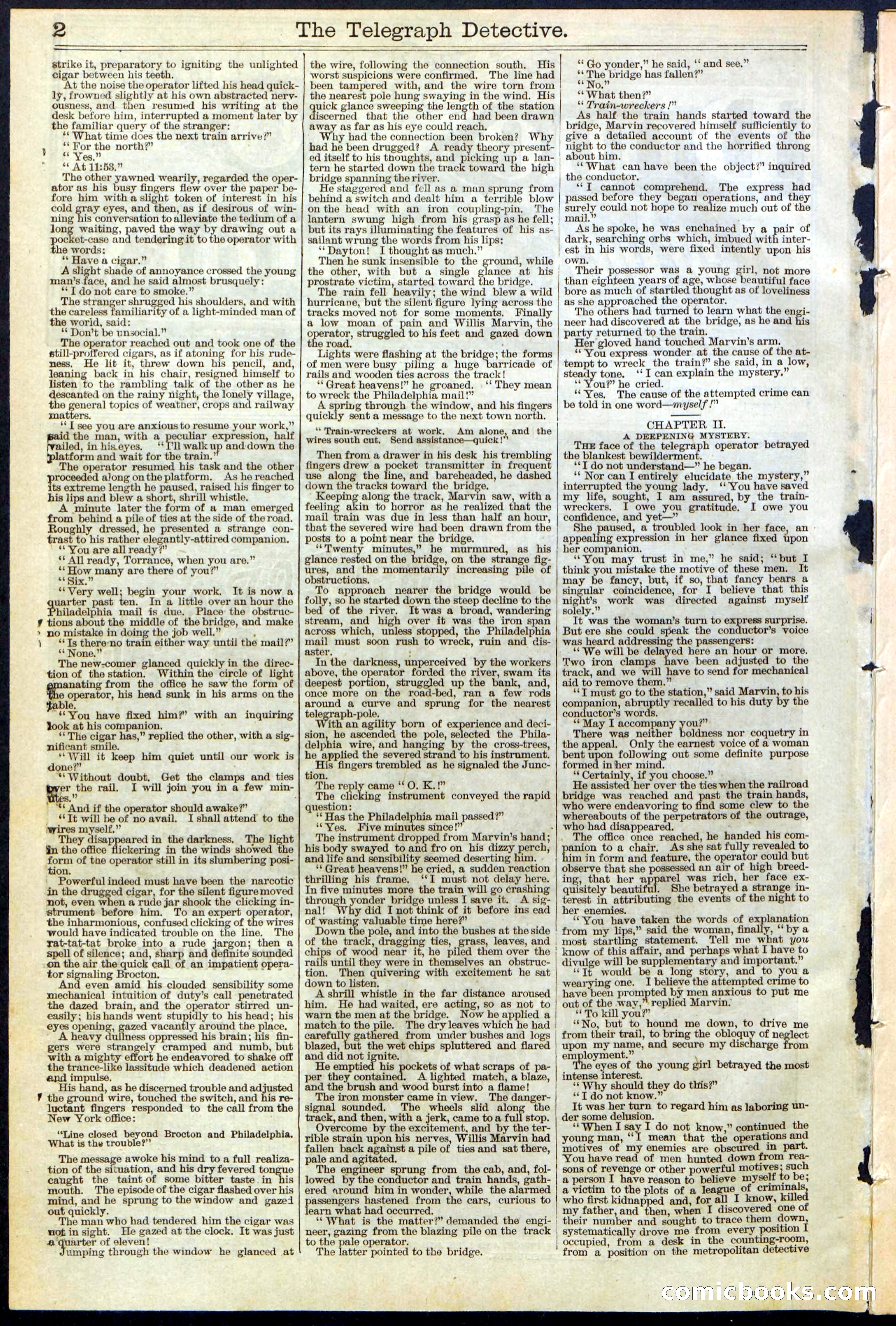
A restored page from Pulp Fiction, 1885. Page through the whole issue in the reader above.
📄 Transcribed text from this page (OCR, searchable)
Machine-transcribed from the original scan — historical spelling and the odd misread are preserved.
2 strike it, preparatory to igniting the unlighted cigar between his teeth. At the noise the operator lifted his head quick- ly, frowned slightly at his own abstracted nervy- ousness, and then resumed his writing at the desk before him, interrupted a moment later by the familiar query of the stranger: ** ‘What time does the next train arrive?” ** For the north?” “s Yes.” ** At 11:53,” The other yawned wearily, regarded the oper- ator as his busy fingers flew over the paper be- fore him witha slight token of interest in his cold gray eyes, and then, as if desirous of win- ning his conversation to alleviate the tedium of a long waiting, Dees the way by drawing out a ae et-case and tendering it to the operator with he words: ** Have a cigar.” A slight shade of annoyance crossed the young man’s face, and he said almost brusquely: **T do not care to smoke.” The stranger shrugged his shoulders, and with the careless familiarity of a light-minded man of the world, said: ** Don’t be unsocial.” The operator reached out and took one of the still-proffered cigars, as if atoning for his rude- ness, He lit it, threw down his pencil, and, leaning back in his chair, resigned himself to listen to the rambling talk of the other as he descanted on the rainy night, the lonely village, the general topics of weather, crops and railway matters. ‘| see you are anxious to resume your work,” paid the man, with a peculiar expression, half fwailed, inhiseyes. ‘Ill walk up and down the ‘platform and wait for the train.’ The operator resumed his task and the other roceeded along onthe platform. As he reached ts extreme length he paused, raised his finger to his lips and blew a short, shrill whistle, A minute later the form of a man emerged from behind a pile of ties at the side of the road. Roughly dressed, he presented a strange con- trast to his rather elegantly-attired companion, ** You are all ready?” ** All ready, Torrance, when you are.” ‘* How many are there of you?” ia) Six, ” ** Very well; begin your work, It is now a past ten. In a little over an hour the Philadelphia mail is due. Place the obstruc- ¥ tions about the middle of the bridge, and make » no mistake in feiny the job well.” ; ‘Tg there-no train either way until the mail?” ‘* None.” The new-comer glanced quickly in the direc- tion of the station, Within the circle of light | ting from the office he saw the form of the operator, his head sunk in his arms on the table, “You have fixed him?’ with an inquiring Jook at his companion. ‘The cigar has,” replied the other, with a sig- nificant smile. be Will it keep him quiet until our work is done?’ “Without doubt, Get the clamps and ties Ries” rail, I will join you in a few min- ‘ And if the operator should awake?” “Tt will be of no avail. I shall attend to the wires myself,” They ed pain in the darkness, The light in the office flickering in the winds showed the eo of the operator still in its slumbering posi- on. Powerful indeed are cesar = apt ae o drugs cigar, for the silent figure mov not, even when a rude jar shook the clicking in- strument before him. To an expert operator, the inharmonious, confused clicking of the wires would have indicated trouble on the line. The rat-tat-tat broke into a rude jargon; then a spell of silence; and, sharp and definite sounded on the air the quick call of an impatient opera- tor signaling Brocton. even amid his clouded sensibility some mechanical intuition of duty’s call penetrated the dazed brain, and the operator stirred un- easily; his hands went stupidly to his head; his eyes opening, ed vacantly around the place. ' A heavy dullness oppressed his brain; his fin- gers were strangely cramped and numb, but with a mighty effort he endeavored to shake off the trance-like lassitude which deadened action and impulse. His hand, as he discerned trouble and adjusted ¥ the ground wire, touched the switch, and his re- luctant fingers responded to the call from the New York office: “Line closed beyond Brocton and Philadelphia. What is the trouble?” The message awoke his mind to a full realiza- tion of the situation, and his dry fevered tongue caught the taint of some bitter taste in his mouth. The episode of the cigar flashed over his mind, and he sprung to the window and gazed out quickly. The man who had tendered him the cigar was notin sight. He gazed at the clock, It was just a quarter of eleven! umping through the window he glanced at the wire, following the connection south. His worst suspicions were confirmed. The line had been tampered with, and the wire torn from the nearest pole hung swaying in the wind. His uick glance sweeping the length of the station iscerned that the other end had been drawn ener as far as his eye could reach, hy had the connection been broken? Why had he been drugged? A ready theory present- ed itself to his thoughts, and picking up a lan- tern he started down the track toward the high bridge spanning the river. : He staggered and fell as a man sprung from behind a switch and dealt him a terrible blow on the head with an iron coupling-pin. The lantern swung high from his grasp as he fell; but its rays illuminating the features of his as- sailant wrung the words from his lips: ‘Dayton! I thought as much.” Then he sunk insensible to the ground, while the other, with but a single glance at his prostrate victim, started toward the bridge. The rain fell heavily; the wind blew a wild hurricane, but the silent figure lying across the tracks moved not for some moments. Finally a low moan of pain and Willis Marvin, the gts assp struggled to his feet and gazed down the road. Lights were flashing at the bridge; the forms of men were busy piling a huge barricade of rails and wooden ties across the track! **Great heavens!” he groaned. ‘‘ They mean to wreck the Philadelphia mail!” A spring through the window, and his fingers quickly sent a message to the next town north. ‘* Train-wreckers at work. Am alone, and the wires south cut, Send assistance—quick!" Then from a drawer in his desk his tremblin fingers drew a ket transmitter in frequen use along the line, and bareheaded, he dashed down the tracks toward the bridge. Keeping along the track, Marvin saw, with a feeling akin to horror as he realized that the mail train was due in less than half an hour, that the severed wire had been drawn from the posts to a point near the bridge. nse Pgeae ” he murmured, as his glance rested on the bridge, on the strange fig- ures, and the momentarily increasing pile of obstructions, To approach nearer the bridge would be folly, so he started down the steep decline to the bed of the river. It was a broad, wandering stream, and high over it was the iron span across which, unless stopped, the Philadelphia mail must soon rush to wreck, ruin and Gdis- aster, : In the darkness, unperceived by the workers above, the operator forded the river, swam its deepest portion, struggled up the bank, and, once more on the road-bed, ran a few rods around a curve and sprung for the nearest ign eg ith an agility born of sie and deci- sion, he ascended the pole, selected the Phila- delphia wire, and hanging by the cross-trees, he applied the severed strand to his instrument. one fingers trembled as he signaled the Junc- tion. The reply came “ O. K.!” The clicking instrument conveyed the rapid question: ; ** Has the Philadelphia mail passed?” ‘Yes. Five minutes since!” : The instrument dropped from Marvin’s hand; his body swayed to and fro on his dizzy perch, and life and sensibility seemed deserting him. . ‘** Great heavens!” he cried, a sudden reaction thrilling his frame. ‘‘I must not delay here. In five minutes more the train will go crashing Eanes yon bridge unless I save it. A sig- nal! y did I not think of it before ins ead of wasting valuable time here?” Down the pole, and into the bushes at the side of the track, dragging ties, grass, leaves, and ohn of wood near it, he piled them over the rails until they were in themselves an obstruc- tion. Then quivering with excitement he sat down to listen. A shrill whistle in the far distance aroused him. He had waited, ere acting, so as not to warn the men at the bridge. Now hea ae a match to the pile. The dry leaves which he had carefully gathered from under bushes and logs blazed, but the wet chips spluttered and flared and did not ignite. He emptied his Lb gap of what scraps of pa- per they contain A lighted match, a blaze, and the brush and wood burst into a flame! The iron monster came in view. The danger- signal sounded. The wheels slid along the track, and then, with a jerk, came toa stop. Overcome by the excitement, and by the ter- rible strain upon his nerves, Willis Marvin had fallen back against a pile of ties and sat there, pale and agitated, The engineer nrg from the cab, and, fol- lowed by the conductor and train hands, gath- ered «round him in wonder, while the alarmed paseees hastened from the cars, curious to earn what had occurred ‘What is the matter?” demanded the engi- | neer, gazing from the blazing pile on the track to the pa operator. The latter pointed to the bridge. The Telegraph Detective. , tL e_——————————— EE. a j ee ee “Go yonder,” he said, ‘‘ and see.” ‘** The bridge has fallen?” ¢é No.” ** What then?” ‘* Train-wreckers |” As half the train hands started toward the bridge, Marvin recovered himself sufficiently to give a detailed account of the events of the night to the conductor and the horrified throng about him. ‘What can have been the object?” inquired the conductor. ‘*T cannot comprehend, The express had passed before they began operations, and they surely could not hope to realize much out of the mail,” As he spoke, he was enchained by a pair of dark, searching orbs which, imbued: with inter- est in his words, were fixed intently upon his own. Their possessor was a young girl, not more than eighteen years of age, whose beautiful face bore as much of startled thought as of loveliness as she approached the operator. The others had turned to learn what the engi- neer had discovered at the bridge, as he and his party returned to the train. Her gloved hand touched Marvin’s arm. “You express wonder at the cause of the at- tempt to wreck the train?” she said, in a low, steady tone, ‘I can explain the mystery.” ‘**'You?” he cried. ‘“Yes, The cause of the attempted crime can be told in one word—myself !” CHAPTER II, A DEEPENING MYSTERY. Tue face of the telegraph operator betrayed the blankest bewilderment. ‘**T do not understand—” he began. ‘* Nor can I entirely elucidate the mystery,” interrupted the young lady. ‘‘ You have saved my life, sought, I am assured, by the train- wreckers. I owe you gratitude. I owe you confidence, and yet—” She paused, a troubled look in her face, an - appealing expression in her glance fixed iwpon her companion. ‘““You may trust in me,” he said; “but I think you mistake the motive of these men. It may be fancy, but, if so, that fancy bears a singular coincidence, for I believe that this night’s work was directed against myself solely.” It was the woman’s turn to express surprise. But ere she could speak the conductor’s voice was heard addressing the passengers: ‘‘ We will be delayed here an hour or more. Two iron clamps have been adjusted to the track, and we will have to send for mechanical aid to remove them.” ‘‘T must go to the station,” said Marvin, to his companion, aby recalled to his duty by the conductor’s words. ‘* May I accom ou?” Ther was Aefthe’ Daldneea nor coquetry in the appeal. Only the earnest voice of a woman bent upon following out some definite purpose formed in her mind. ‘“* Certainly, if you choose.” He assisted her over the ties when the railroad bridge was reached and past the train hands, who were endeavoring to find some clew to the whereabouts of the perpetrators of the outrage, who had disappeared. re The office once reached, he handed his com- peaipn to a chair, As she sat fully revealed to im in form and feature, the operator could but observe that she : an op gion breed- ing, that her a was rich, her face ex- quiinitely beautiful, She betrayed a strange in- terest in attributing the events of the night to her enemies. é ‘“You have taken the words of explanation from my lips,” said the woman, finally, “by a most startling statement. Tell me what you know of this affair, and perhaps what I have to divulge will be supplementary and important.” ‘‘Tt would be a long story, and to you a wearying one. I believe the attempted crime to have been prompted by men anxious to put me out of the way,” replied Marvin. ‘*To kill you?” ‘‘No, but to hound me down, to drive me from their trail, to bring the ee of neglect upon my name, and secure my discharge from employment.” The eyes of the young girl betrayed the most intense interest. - ‘‘ Why should they do this?” ‘*T do not know.” It was her turn to regard him as laboring un- der some delusion. ‘When I say I do not know,” continued the young man, ‘I mean that the operations and motives of my enemies are obscured in part. You have read of men hunted down from rea~ sons of revenge or other powerful motives ss sae a person I have reason to believe myself to be; a victim to the plots of a 1 e of or ee pa who first kidnapped and, for all kill my father, and then, when I discovered one of their number and sought to trace them down systematically drove me from every tion occupied, from a desk in the counting-room, from a position on the metropolitan detective ECOmMG S => 290