
Pulp Fiction, 1885 · page 17 of 32
Beadle's Dime Library No. 366 — page 17: what you’re looking at
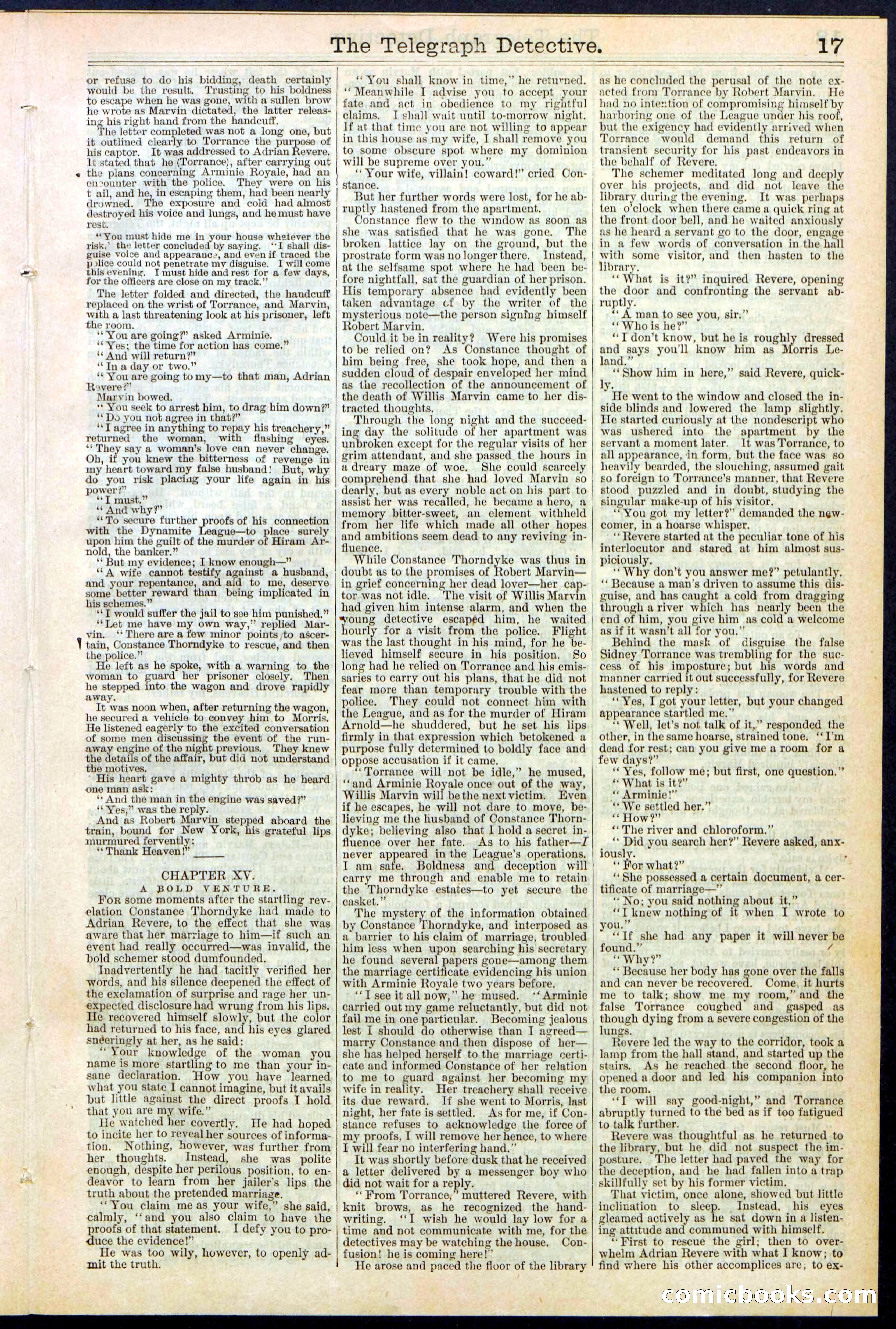
A restored page from Pulp Fiction, 1885. Page through the whole issue in the reader above.
📄 Transcribed text from this page (OCR, searchable)
Machine-transcribed from the original scan — historical spelling and the odd misread are preserved.
rn — The Telegraph Det or refuse to do his bidding, death certainly | would be the result. Trusting to his boldness to escape when he was gone, with a sullen brow he wrote as Marvin dictated, the latter releas- ing his right hand from the handcuff. The letter completed was not a long one, but it outlined clearly to Torrance the purpose of his captor. It was addressed to Adrian Revere. lt stated that he (Torrance), after carrying out the plans concerning Arminie Royale, had an encounter with the police. They were on his t ail, and he, in escaping them, had been nearly drowned. The exposure and cold had almost destroyed his voice and lungs, and he must have rest. *““You must hide me in your house whetever the risk,’ the letter concluded by saying. ‘'I shall dis- guise voice and appearance, and even if traced the p lice could not penetrate my disguise. I will come this evening. I must hide and rest for a few days, for the officers are close on my track.”’ The letter folded and directed, the handcuff replaced on the wrist of Torrance, and Marvin, with a last threatening look at his prisoner, left the room. ‘You are going?” asked Arminie. ‘*'Yes; the time for action has come.” ** And will return?” ‘Tn a day or two.” ‘* You are going tomy—to that man, Adrian Revere?” Marvin bowed. ‘** You seek to arrest him, to drag him down?” ** Do you not agree in that?” ‘*T agree in anything to repay his treachery,” returned the woman, with flashing eyes. ** They say a woman’s love can never change. Oh, if you knew the bitterness of revenge in my heart toward my false husband! But, why do you risk placiag your life again in his power?’ ‘*T must,” * And why?” *“To secure further proofs of his connection with the Dynamite gue—to place surely upon him the guilt of the murder of Hiram Ar- nold, the banker.” “But my evidence; I know enough—” “A wife cannot testify against a husband, and your repentance, and aid to me, deserve some better reward than being implicated in his schemes.” ‘**T would suffer the jail to see him punished.” **Let me have my own way,” replied Mar- vin. ‘‘ There are a few minor points to ascer- tain, Constance Thorndyke to rescue, and then the police.” He left as he spoke, with a warning to the woman to guard her prisoner closely. Then he stepped into the wagon and drove rapidly away. It was noon when, after returning the wagon, he secured a vehicle to convey him to Morris. He listened eagerly to the excited conversation of some men ee the event of the run- away engine of the night previous, They knew the tats of the affair, but did not understand the motives. His heart gave a mighty throb as he heard one man ask: ‘* And the man in the engine was saved?” ‘} Yes,” was the spud And as Robert Marvin stepped aboard the train, bound for New York, his grateful lips murmured fervently ‘* Thank Heaven!” . . —_-- CHAPTER XY. A BOLD VENTURE. For some moments after the startling rev- elation Constance Thorndyke had made to Adrian Revere, to the effect that she was aware that her marriage to him—if such an event had really occurred—was invalid, the bold schemer stood dumfounded. Inadvertently he had tacitly verified her words, and his silence deepened the effect of the exclamation of surprise and rage her un- expected disclosure had wrung from his lips. He recovered himself slowly, but the color had returned to his face, and his eyes glared snéeringly at her, as he said: “Your knowledge of the woman you name 1s more startling to me than your in- sane declaration. Tow you have learned what you state I cannot imagine, but it avails but little against the direct proofs I hold that you are my wife.” lie watched her covertly. He had hoped to incite her to reveal her sources of informa- tion. Nothing, however, was further from her thoughts. _ Instead, she was polite enough, despite her perilous position, to en- deavor to learn from her jailer’s lips the truth about the pretended marriage. ‘You claim meas your wife,” she said, calmly, ‘‘and you also claim to have the proofs of that statement. duce the evidence!” He was too wily, however, to openly ad- mit the truth. ‘“You shall know in time,” he returned. ‘* Meanwhile I advise you to accept your fate and act in obedience to my rightful Claims. I shall wait until to-morrow night. If at that time you are not willing to appear in this house as my wife, I shall remove you to some obscure spot where my dominion will be supreme over you.” ‘Your wife, villain! coward!” cried Con- | stance. But her further words were lost, for he ab- ruptly hastened from the apartment, Constance flew to the window as soon as she was satisfied that he was gone, broken lattice lay on the ground, but the prostrate form was no longer there, Instead, at the selfsame spot where he had been be- | fore nightfall, sat the guardian of her prison. His temporary absence had evidently been taken advantage cf by the writer of the mysterious note—the person signing himself Robert Marvin. Could it be in reality? Were his promises to be relied on? As Constance thought of him being free, she took hope, and then a sudden cloud of despair enveloped her mind as the recollection of the announcement of the death of Willis Marvin came to her dis- tracted thoughts, Through the long night and the succeed- ing day the solitude of her apartment was unbroken except for the regular visits of her grim attendant, and she passed the hours in a dreary maze of woe. She could scarcely comprehend that she had loved Marvin so dearly, but as every noble act on his part to assist her was recalled, he became a hero, a memory bitter-sweet, an element withheld from her life which made all other hopes and ambitions seem dead to any reviving in- fluence. While Constance Thorndyke was thus in doubt as to the promises of Robert Marvin— in grief concerning her dead lover—her cap- tor was not idle. The visit of Willis Marvin had given him intense alarm, and when the woung detective escapéd him, he waited ha for a visit from the police. Flight was the last thought in his mind, for he be- lieved himself secure in his position. So long had he velied on Torrance and his emis- saries to carry out his plans, that he did not fear more than temporary trouble with the police. They could not connect him with the League, and as for the murder of Hiram Arnold—he shuddered, but he set his lips firmly in that expression which betokened a purpose fully determined to boldly face and oppose accusation if it came. ‘Torrance will not be idle,” he mused, ‘‘and Arminie Royale once out of the way, Willis Marvin will bethe next victim. Even if he escapes, he will not dare to moye, be- lieving me the husband of Constance Thorn- dyke; believing also that | hold a secret in- fluence over her fate. As to his father—J never appeared in the League’s operations, I am safe. Boldness and deception will carry me through and enable me to retain the Thorndyke estates—to yet secure the casket.” The mystery of the information obtained by Constance Thorndyke, and interposed as a barrier to his claim of marriage, troubled him less when upon searching his secretary he found several papers gone—among them the marriage certificate evidencing his union with Arminie Royale two years before. ‘*T see it all now,” he mused. ‘‘ Arminie carried out my game reluctantly, but did not fail me in one particular. Becoming jealous lest I should do otherwise than I agreed— marry Constance and then dispose of her— she has helped herself to the marriage certi- cate and informed Constance of her relation to me to gpare against her becoming my wife in reality. Her treachery shall receive its due reward. If she went to Morris, last night, her fate is settled. As for me, if Con- stance refuses to acknowledge the force of my proofs, I will remove her hence, to where I will fear no interfering hand.”’ It was shortly before dusk that he received a letter delivered by a messenger boy who did not wait for a reply. ‘From Torrance,” muttered Revere, with knit brows, as he recognized the hand- writing. ‘‘I wish he would lay low for a I defy you to pro- | time and not communicate with me, for the detectives may be watching the house. Con- fusion! he is coming here!” He arose and paced the floor of the library The | ective. A te as he concluded the perusal of the note ex- acted from Torrance by Robert Marvin. He had no intention of compromising himself by harboring one of the League under his roof, but the exigency had evidently arrived when Torrance would demand this return of transient security for his past endeavors in the behalf of Revere, . The schemer meditated long and deeply over his projects, and did not leave the library during the evening. It was perhaps ten o'clock when there came a quick ring at the front door bell, and he waited anxiously as he heard a servant go to the door, engage in a few words of conversation in the hall with some visitor, and then hasten to the library. ‘“What is it?” inquired Revere, opening the door and confronting the servant ab- ruptly. ** A man to see you, sir,” ‘Who is he?” “1 don’t know, but he is roughly dressed and says you'll know him as nits Le- land.” ** Show him in here,’ y ’ said Revere, quick- He went to the window and closed the in- side blinds and lowered the lamp slightly. He started curiously at the nondescript who was ushered into the apartment by the servant a moment later. It was Torrance, to all appearance, in form, but the face was so heavily bearded, the slouching, assumed gait so foreign to Torrance’s manner, that Revere stood puzzled and in doubt, studying the singular make-up of his visitor. “You got my letter?’ demanded the new- comer, in a hoarse whisper. ‘* Revere started at the peculiar tone of his interlocutor and stared at him almost sus- piciously. ‘Why don’t you answer me?” petulantly. ‘‘ Because a man’s driyen to assume this dis- guise, and has caught a cold from dragging through a river which has nearly been the end of him, you give him as cold a welcome as if it wasn’t all for you.” Behind the mask of disguise the false Sidney Torrance was trembling for the suc- cess of his imposture; but his words and manner carried it out successfully, for Revere hastened to reply: ‘Yes, I got your letter, but your changed appearance startled me.” ‘* Well, let’s not talk of it,” responded the other, in the same hoarse, strained tone. ‘‘ I’m dead for rest; can you give me a room for a few days?” ‘* Yes, follow me; but first, one question.” ‘What is it?” “ Arminie!” ** We settled her.” ‘* How?” **The river and chloroform,” ‘* Did you search her?’ Revere asked, anx- iously. ‘ “ Wor what?” ‘‘She possessed a certain document, a cer- tificate of marriage—” ‘No; you said nothing about it,” ‘‘T knew nothing of it when I wrote to— bP ‘If she had any paper it will never be found.” 4 “Why?” ae ** Because her body has gone over the falls and can never be Rocreret Come, it hurts me to talk; show me my room,” and the false Torrance coughed and gasped as shovge dying from a severe congestion of the ungs. esis led the way to the corridor, took a lamp from the hall stand, and started up the stairs. As he reached the second floor, he opened a door and led his companion into the room. ‘‘T will say good-night,” and Torrance abruptly turned to the bed as if too fatigued to talk further. Revere was thoughtful as he returned to the library, but he did not suspect the im- posture. skillfully set by his former victim. That victim, once alone, showed but little inclination to sleep. Instead, his eyes gleamed actively as he sat down in a listen- ing attitude and communed with himself. “First to rescue the girl; then to over- whelm Adrian Revere with what I know; to find where his other accomplices are; to ex- The letter had paved the way for the deception, and he had fallen into a trap _ Ghbooks com €or